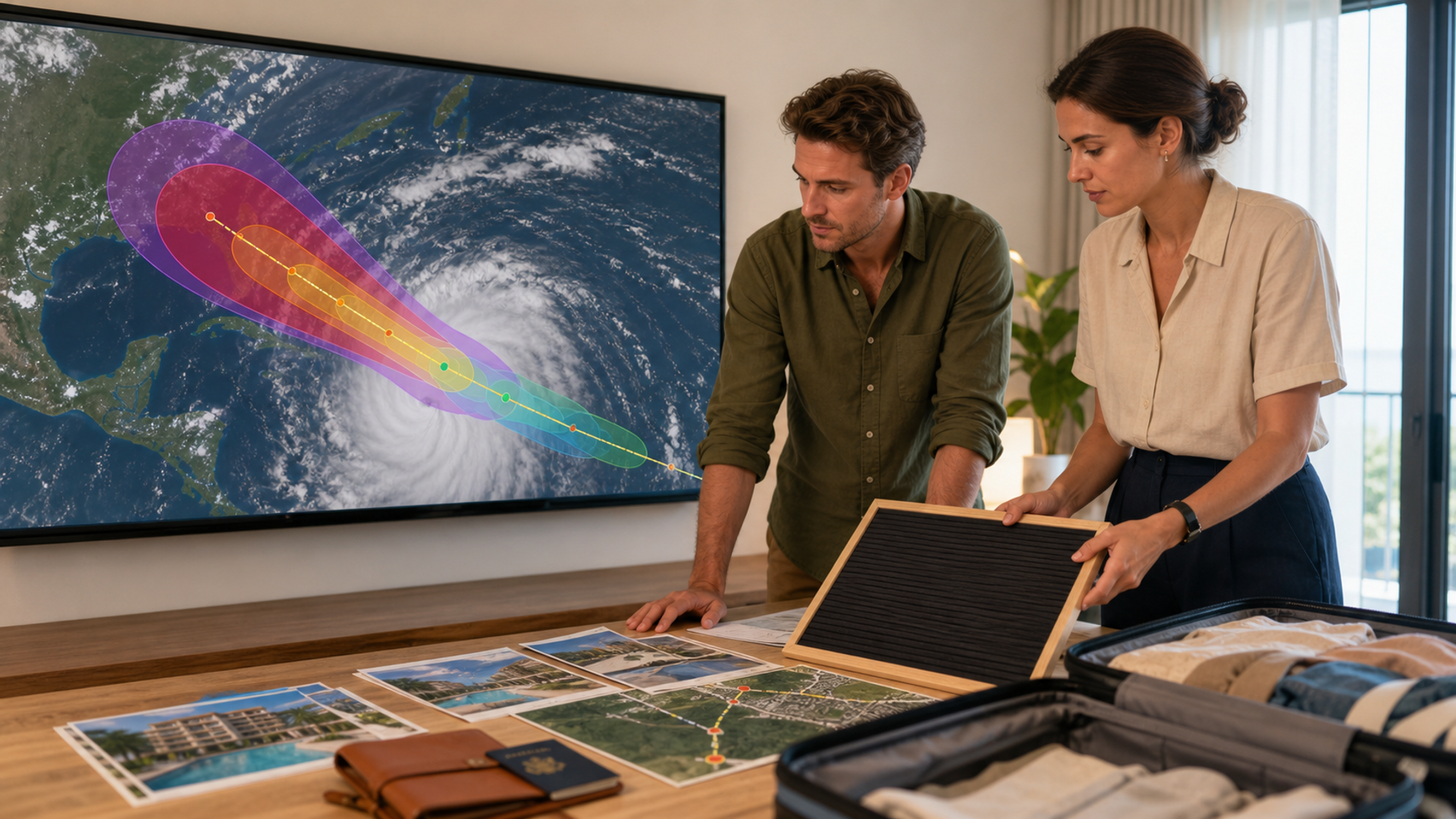
Google DeepMind reports that WeatherNext can improve cyclone track, intensity and wind-structure forecasting by roughly a day on average. For travellers, an extra day matters only when it changes a decision: rebooking before capacity disappears, leaving a coastal area, protecting medicine and documents, or avoiding an unsafe transfer. AI output remains one input to official warnings, not a private replacement for them.
Cyclone decision timeline
Use WeatherNext and other model guidance to understand uncertainty earlier, but act on official meteorological, emergency and carrier instructions. At low confidence, protect flexible bookings and monitor. As official risk and local instructions strengthen, move to concrete rebooking or evacuation. Never delay a safety action because one model track appears favourable.
| Decision factor | Monitor and preserve flexibility | Rebook or reroute | Follow evacuation or shelter orders |
|---|---|---|---|
| Evidence | Early probabilistic model spread | Official forecast plus material itinerary exposure | Official emergency instruction |
| Flight action | Keep alerts and flexible alternatives | Move before capacity and fare pressure rises | Do not travel into restricted area |
| Hotel action | Confirm cancellation and extension terms | Relocate inland or extend in safer location | Comply with closure and evacuation rules |
| Ground transport | Map alternatives and fuel constraints | Avoid bridges, ferries and flood-prone routes | Use authorised route and timing |
| Insurance | Preserve records and policy wording | Contact insurer before voluntary changes when safe | Safety first, then document as conditions allow |
| Decision owner | Traveller with official-source monitoring | Traveller and suppliers under changing conditions | Public authorities and emergency services |
This WeatherNext cyclone forecasting matrix is the article's working value object. Read the rows together: the decisive failure mode depends on this topic's evidence, operating context and reader objective.
What the forecasting claim means
Evidence 1. Google DeepMind says its current WeatherNext work improves state-of-the-art cyclone track, intensity and wind-structure accuracy by about 24 hours on average.
Evidence 2. Google's Weather Lab presents multiple possible storm scenarios rather than a single guaranteed path.
Evidence 3. Official warning agencies and local authorities remain responsible for watches, warnings and evacuation instructions.
Reader-visible sources checked for this article:
deepmind.google — current reader-visible source
blog.google — current reader-visible source
For WeatherNext cyclone forecasting, these sources establish only the claims inside their documented scope. Recheck every changeable specification, schedule, price, access condition or policy in the relevant market before acting.
Translate probability into travel action
The evidence row exposes a practical boundary. Route one assumes early probabilistic model spread, while route two is defensible only when official forecast plus material itinerary exposure. Route three depends on official emergency instruction. If that evidence is absent, keep the more reversible option.
Read flight action as a stop/go test: keep alerts and flexible alternatives supports the first option; move before capacity and fare pressure rises supports the second; and do not travel into restricted area supports the third. Record which source proves the condition and when it was checked.
A buyer can resolve hotel action without a brand preference. Ask whether confirm cancellation and extension terms; compare that with whether relocate inland or extend in safer location; then use comply with closure and evacuation rules as the third route's safeguard. An unknown condition stays unknown.
On ground transport, popularity is irrelevant. The evidence for option one is that map alternatives and fuel constraints. Option two means avoid bridges, ferries and flood-prone routes. Option three is rational where use authorised route and timing. Recheck any changeable term immediately before commitment.
The decision changes at insurance. Choose the first path only if preserve records and policy wording; move to the second when contact insurer before voluntary changes when safe; use the third when safety first, then document as conditions allow. Save the downside that would make this row fail.
For decision owner, the first route works when traveller with official-source monitoring; the second requires traveller and suppliers under changing conditions. The control for the third is public authorities and emergency services. Verify this row against the exact market, model, venue or itinerary before it can reverse the decision.
Facts that would reverse the current choice
Reversal control 1 — Evidence. Before choosing Monitor and preserve flexibility, write down how the decision changes if 'Early probabilistic model spread' proves false. Do the same for Rebook or reroute and 'Official forecast plus material itinerary exposure'. The Follow evacuation or shelter orders path should remain available until 'Official emergency instruction' is verified. This control belongs to WeatherNext cyclone forecasting; it should be updated from the cited source or the exact supplier, device, venue or operator rather than copied from a generic checklist.
Reversal control 2 — Flight action. Before choosing Monitor and preserve flexibility, write down how the decision changes if 'Keep alerts and flexible alternatives' proves false. Do the same for Rebook or reroute and 'Move before capacity and fare pressure rises'. The Follow evacuation or shelter orders path should remain available until 'Do not travel into restricted area' is verified. This control belongs to WeatherNext cyclone forecasting; it should be updated from the cited source or the exact supplier, device, venue or operator rather than copied from a generic checklist.
Reversal control 3 — Hotel action. Before choosing Monitor and preserve flexibility, write down how the decision changes if 'Confirm cancellation and extension terms' proves false. Do the same for Rebook or reroute and 'Relocate inland or extend in safer location'. The Follow evacuation or shelter orders path should remain available until 'Comply with closure and evacuation rules' is verified. This control belongs to WeatherNext cyclone forecasting; it should be updated from the cited source or the exact supplier, device, venue or operator rather than copied from a generic checklist.
Reversal control 4 — Ground transport. Before choosing Monitor and preserve flexibility, write down how the decision changes if 'Map alternatives and fuel constraints' proves false. Do the same for Rebook or reroute and 'Avoid bridges, ferries and flood-prone routes'. The Follow evacuation or shelter orders path should remain available until 'Use authorised route and timing' is verified. This control belongs to WeatherNext cyclone forecasting; it should be updated from the cited source or the exact supplier, device, venue or operator rather than copied from a generic checklist.
Reversal control 5 — Insurance. Before choosing Monitor and preserve flexibility, write down how the decision changes if 'Preserve records and policy wording' proves false. Do the same for Rebook or reroute and 'Contact insurer before voluntary changes when safe'. The Follow evacuation or shelter orders path should remain available until 'Safety first, then document as conditions allow' is verified. This control belongs to WeatherNext cyclone forecasting; it should be updated from the cited source or the exact supplier, device, venue or operator rather than copied from a generic checklist.
Reversal control 6 — Decision owner. Before choosing Monitor and preserve flexibility, write down how the decision changes if 'Traveller with official-source monitoring' proves false. Do the same for Rebook or reroute and 'Traveller and suppliers under changing conditions'. The Follow evacuation or shelter orders path should remain available until 'Public authorities and emergency services' is verified. This control belongs to WeatherNext cyclone forecasting; it should be updated from the cited source or the exact supplier, device, venue or operator rather than copied from a generic checklist.
Read the cone as uncertainty, not a road
A centre line is not the storm, and a cone is not a boundary of impact. Wind, surge, rain and transport disruption can extend far from a projected track. Compare several official updates and note whether the spread narrows. A model improvement can shift probability earlier without eliminating uncertainty.
Turn lead time into reversible actions first
Early actions should preserve options: refundable bookings, medicine, charged devices, copies of documents and a mapped inland route. These steps have limited downside if the storm turns. Waiting until certainty is high can remove seats, rooms and fuel. Escalate from monitoring to rebooking based on exposure and official guidance, not on a dramatic social-media map.
Separate supplier rules from safety decisions
Airlines, hotels and insurers use different disruption windows. Save notices, receipts and time-stamped advisories. Ask what happens if a service operates but the destination becomes unsafe. Insurance may distinguish cancellation, delay and government advice. Do not let reimbursement uncertainty override an evacuation order; document later when immediate safety requires action.
Plan communications for network failure
Share the itinerary, accommodation, meeting point and emergency contacts before conditions deteriorate. Keep offline maps and a written contact. Use battery conservatively and avoid repeated high-bandwidth checking. In a group, one person should track official warnings while another handles suppliers so contradictory updates do not paralyse the decision.
Three disruption cases
Island resort stay
Confirm evacuation transport and shelter limits before arrival; a beautiful remote location can have few last-minute alternatives. Define the fact that would reverse the choice before committing.
Connecting business trip
Protect the most fragile connection and move before network-wide aircraft displacement reduces options. Define the fact that would reverse the choice before committing.
Resident hosting visitors
Use local official guidance, explain the plan in advance and avoid taking guests on curiosity trips toward affected areas. Define the fact that would reverse the choice before committing.
Action checklist
Follow the official weather agency.
Track uncertainty across updates.
Check flexible booking terms.
Store documents offline.
Map an inland route.
Preserve medicines and power.
Save supplier notices.
Obey local emergency instructions.
Related VERTU reading
The linked VERTU reading expands adjacent parts of the WeatherNext cyclone forecasting decision. It does not substitute for the external evidence above, and brand relevance is kept out when it adds no reader value.
The traveller's WeatherNext rule
Use WeatherNext and other model guidance to understand uncertainty earlier, but act on official meteorological, emergency and carrier instructions. At low confidence, protect flexible bookings and monitor. As official risk and local instructions strengthen, move to concrete rebooking or evacuation. Never delay a safety action because one model track appears favourable.
Keep the WeatherNext cyclone forecasting decision reversible until its material cost, safety, access and compatibility facts are verified. Unknown evidence stays unknown; it is never silently scored as favourable.