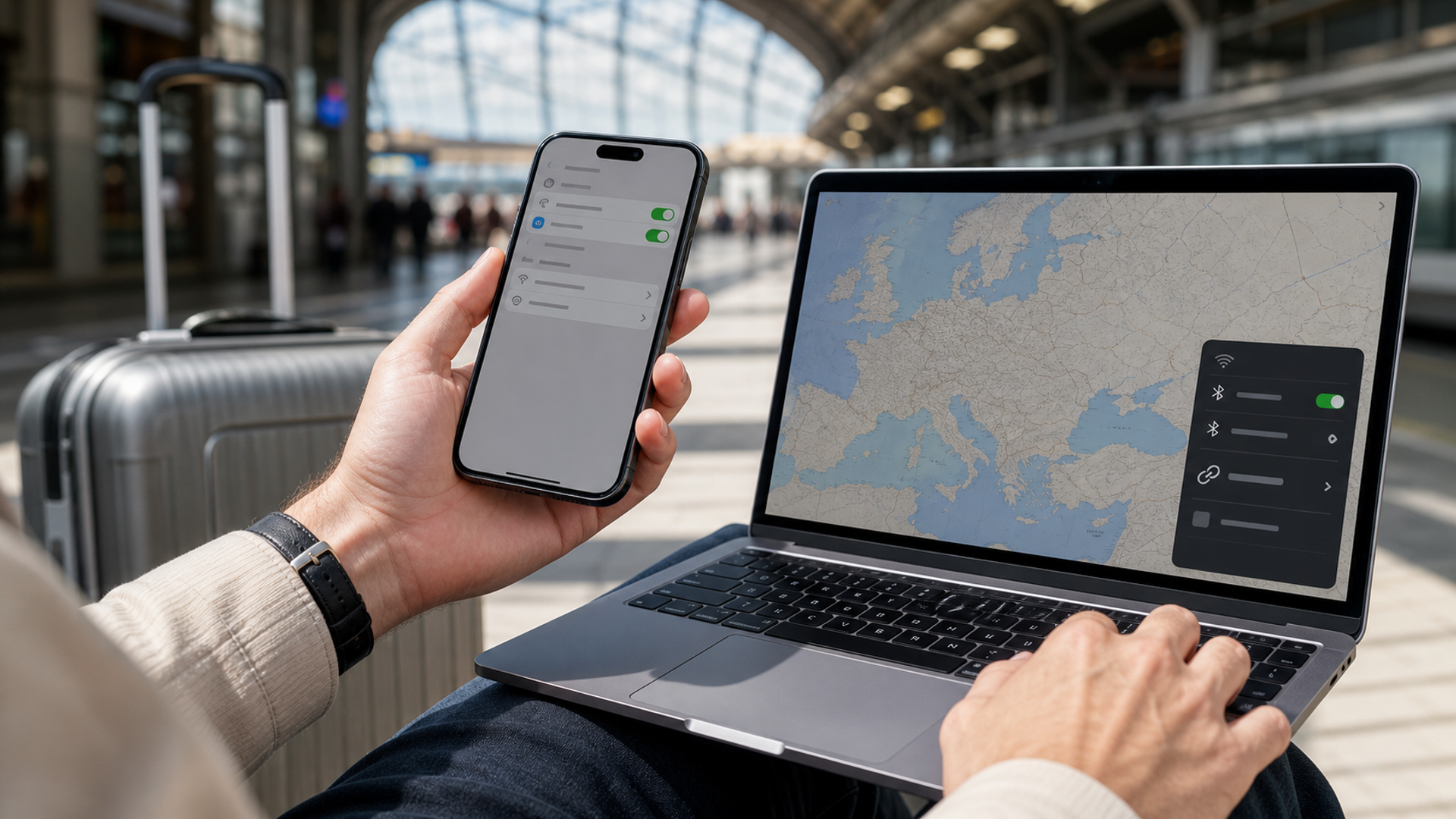
The best Europe eSIM is not the plan with the largest number beside “unlimited”. It is the plan that covers the countries on your actual route, permits the hotspot use you need, activates predictably, provides enough full-speed data and leaves a recovery path when a device or network fails. A weekend in Paris, a month moving between the EU and the UK, and a three-month executive assignment are different connectivity problems.
This guide compares plan types rather than declaring a permanent provider winner. Coverage, fair-use terms, prices and network partners change. Check the live offer immediately before purchase and save its terms. The goal is to choose with a repeatable matrix and avoid the common failure of discovering a restriction after landing.
The short answer
For a short multi-country trip with moderate data use, a fixed-data regional eSIM is often the clearest value because the allowance and validity are explicit. For heavy daily use, an “unlimited” plan may reduce monitoring anxiety, but only after confirming speed management and hotspot limits. For calls, a plan from a mobile-network operator that includes a number, minutes and texts may be more useful than a data-only travel eSIM. For a long stay in one country, a local carrier plan may offer the strongest local integration, though identity or residency requirements can apply.
Keep the home line active for banking and inbound calls only if you understand roaming charges. Disable data switching and roaming on the home line unless intentionally required.
Europe eSIM decision matrix
| Traveller profile | Best starting category | Must-check detail | Typical failure |
|---|---|---|---|
| 3–7 day city break | Small fixed-data regional plan | Activation starts on install or first network connection | Plan expires before the return journey |
| 10–21 day multi-country trip | Regional fixed-data or unlimited plan | Every country, including UK or Switzerland, is listed | “Europe” does not match the itinerary |
| Laptop-dependent executive | High allowance with generous hotspot | Tethering cap and speed policy | Phone data works but laptop use is limited |
| Voice-dependent traveller | Operator plan with calls and SMS | Number type, outgoing destinations and validity | Data-only plan cannot call a hotel or local service |
| Long stay in one country | Local carrier prepaid or postpaid | ID, local address, cancellation and top-up | Attractive monthly rate requires residency |
| Frequent repeat traveller | Rechargeable regional profile | Top-up, profile reuse and support account | New profile must be installed for every trip |
| Privacy-sensitive user | Provider with clear policy and minimal account data | App permissions, payment, logs and deletion route | Convenience app receives unnecessary access |
First map the itinerary, not the continent
Write every destination, transit country and side trip in date order. “Europe” is not a single commercial coverage zone. The European Union's roaming rules concern subscribers using eligible home plans within the EU/EEA under applicable fair-use conditions; they do not mean that every travel eSIM covers every European country. The UK, Switzerland, Türkiye, the Western Balkans, microstates and islands require explicit checking.
The European Commission's roaming policy and the practical Your Europe roaming guide explain the regulated “roam like at home” framework. That may make a separate eSIM unnecessary for an EU resident with a suitable plan. It does not automatically protect a visitor whose home subscription is outside the framework.
Check the provider's country list line by line. If your route includes a cruise, sea coverage is a separate issue; a phone can connect to costly maritime networks. Use flight mode at sea unless you have intentionally arranged coverage.
Fixed data versus unlimited data
Fixed-data plans are easier to compare. Ten or twenty gigabytes means a defined allowance, though speed and network availability still vary. They work well when most heavy activity occurs on trusted hotel or office Wi-Fi and mobile data is used for maps, messages, tickets and moderate video calls.
“Unlimited” needs interpretation. Read the fair-use policy for high-speed allocation, daily throttling, network management and prohibited uses. Some plans restrict hotspot sharing even when phone data is unlimited. Others provide a daily tethering allowance. A service can truthfully sell unlimited data while reducing speed after a threshold, so the word alone does not predict usability.
Holafly's current Europe eSIM page illustrates a duration-based unlimited model and publishes coverage and hotspot details. Orange Travel's current Europe offer illustrates fixed allowances and versions that include calls and texts. These are provider claims and live products, not permanent rankings. Record the offer viewed, date, country list and terms before paying.
Estimate use from behaviour. Navigation and messaging are light. Video meetings, cloud photo upload, social video, software updates and laptop tethering are heavy. Set app-store and photo backup to Wi-Fi unless the plan can absorb them.
Hotspot policy is a decisive business-travel feature
A plan can work perfectly on the phone and fail the workday if tethering is blocked or constrained. Before purchase, find the explicit hotspot allowance. “Data sharing supported” may not mean the full allowance can be shared. Ask whether tethered traffic is speed-limited and whether multiple devices are permitted.
Test hotspot immediately after activation, before leaving dependable Wi-Fi. Connect the laptop, load an ordinary secure site, join a short call and confirm the public IP does not trigger essential corporate blocks. Some company VPNs or security systems react to unfamiliar networks; this is not necessarily an eSIM fault.
Carry a charging strategy. Hotspot use drains the phone and creates heat. A power bank, short cable and separate backup connection can be more valuable than an extra theoretical 5G peak.
Data-only, local number and home-number continuity
Many travel eSIMs are data-only. Messaging apps continue to use an existing account, but conventional incoming and outgoing calls or SMS may not be included. That matters for restaurants, drivers, medical services and organisations that do not use app calling.
A plan with a local or regional number can solve this, provided you confirm which countries can be called, whether incoming calls are included and how long the number remains active. Keep the number in international format in your itinerary.
Dual-SIM operation allows a supported phone to keep a home number active while using the travel eSIM for data. Apple's current international eSIM guidance explains compatible iPhone behaviour, unlocked-device requirements and line selection. It also warns that keeping both lines on can still create charges on the home line. Similar principles apply across devices, but menus and supported combinations vary.
For banking codes, confirm whether the home operator charges for inbound SMS or requires roaming registration. Do not rely on SMS as the only authentication method for a mission-critical account; arrange secure alternatives where the service supports them.
Device compatibility and installation sequence
Verify that the exact device model supports eSIM and is not carrier-locked. Regional variants can differ. Record the device's EID or relevant settings only in secure storage and do not share activation QR codes. A QR code can be a credential.
Use this installation sequence:
Buy from the provider's official site or verified app on a trusted connection.
Save the receipt, plan terms, support details and activation instructions offline.
Install the profile while still on stable Wi-Fi, unless the plan starts its validity on installation.
Give the line a clear label such as “Europe 2026”.
Leave it off until the provider's instructed activation moment.
On arrival, enable the travel line, select it for mobile data and apply the required data-roaming setting.
Disable mobile-data switching if you do not want the home line to take over.
Test maps, messages, browser, hotspot and VPN.
If the plan begins when installed, delay installation until the validity window is safe. If it begins on first network registration, pre-installing can reduce airport friction. Provider wording decides.
5G, latency and network partner claims
5G availability is useful but not a sufficient quality measure. Coverage depends on country, local partner, spectrum, congestion, device bands and the commercial priority assigned to roaming traffic. A strong 4G connection can outperform weak 5G. The provider's country list should ideally name network partners, but those relationships can change.
For video calls and remote desktops, latency and stability may matter more than peak speed. Run a practical test after arrival rather than a single speed test. If the connection is unstable, manually selecting another permitted network can help, but use only provider instructions.
Coverage maps are models, not guarantees inside trains, basements, historic buildings or mountains. Plan an offline route, tickets and key addresses even when the eSIM is marketed as broad European coverage.
Top-up, validity and what happens when data ends
Ask whether a plan can be topped up without installing a new profile. Confirm whether the top-up extends validity, adds data to the same expiry date or starts a new package. Some accounts permit profile reuse; others issue a new eSIM.
Understand the end state. Does data stop, slow down or trigger pay-as-you-go charges? A prepaid travel eSIM should not normally surprise you with open-ended billing, but assumptions are unsafe. Remove stored payment methods if the account settings and your risk model justify it.
Set usage alerts at 50, 75 and 90 per cent. Monitor through both the provider app and the phone, recognising that measurement periods may differ.
Privacy and security checklist
An eSIM changes the delivery mechanism of mobile service, not the fundamental need to trust a carrier and provider. Review what identity data is collected, where support records are stored, whether marketing consent is optional and how the account can be deleted. Grant the app only permissions needed for purchase and management.
Use encrypted services and a trusted VPN where organisational policy requires it. Mobile data is not a substitute for endpoint security. Keep the operating system current, disable automatic connection to open Wi-Fi and use a strong device lock. The eSIM vs local SIM vs roaming guide supplies a useful control comparison.
For a supported premium device, the eSIM can serve as a secondary travel line while the primary line remains available for essential identity continuity. VERTU does not guarantee external carrier coverage, eSIM activation, roaming terms, reservation outcomes or third-party network performance. Connectivity decisions remain with the user and provider.
Recovery plan for arrival failures
Before the flight, keep the following offline: provider support route, order number, QR or activation code as permitted, APN instructions, hotel address, transfer contact and a screenshot of the purchased country list. Do not store sensitive activation material in a public photo album.
If activation fails:
Confirm the line is turned on and selected for data.
Confirm data roaming is set as the provider instructs.
Restart the device and wait for network registration.
Check APN settings without improvising values.
Try permitted automatic or manual network selection.
Contact official support over trusted Wi-Fi.
Use a pre-planned backup such as home-carrier pass or local operator.
Do not repeatedly delete and reinstall a profile unless the provider confirms it can be reissued. Many activation codes are single-use.
A simple scoring method
Score each shortlisted plan from zero to five for: exact route coverage, full-speed allowance, hotspot, voice/SMS, validity, top-up, support, privacy clarity and total live price. Multiply route coverage and hotspot by two if they are mission-critical. Eliminate any plan that fails a hard requirement regardless of total score.
Then purchase the smallest plan with sufficient margin and a credible recovery path. The best phones for international travel guide can help verify the broader dual-SIM and battery requirements.
Final verdict
There is no permanent best Europe eSIM for every frequent traveller. Fixed-data regional plans are often best for transparent value; unlimited plans can suit heavy phone use if their speed and hotspot policies pass; operator plans with calls and texts suit travellers who need a real number; and local plans are strongest for a long stay when eligibility allows.
The winning plan is the one whose country list, activation rule, hotspot allowance and recovery process match the itinerary on the day you buy it. Save the evidence, test before leaving Wi-Fi and keep a backup. Connectivity becomes luxurious when it is boring, predictable and recoverable.