

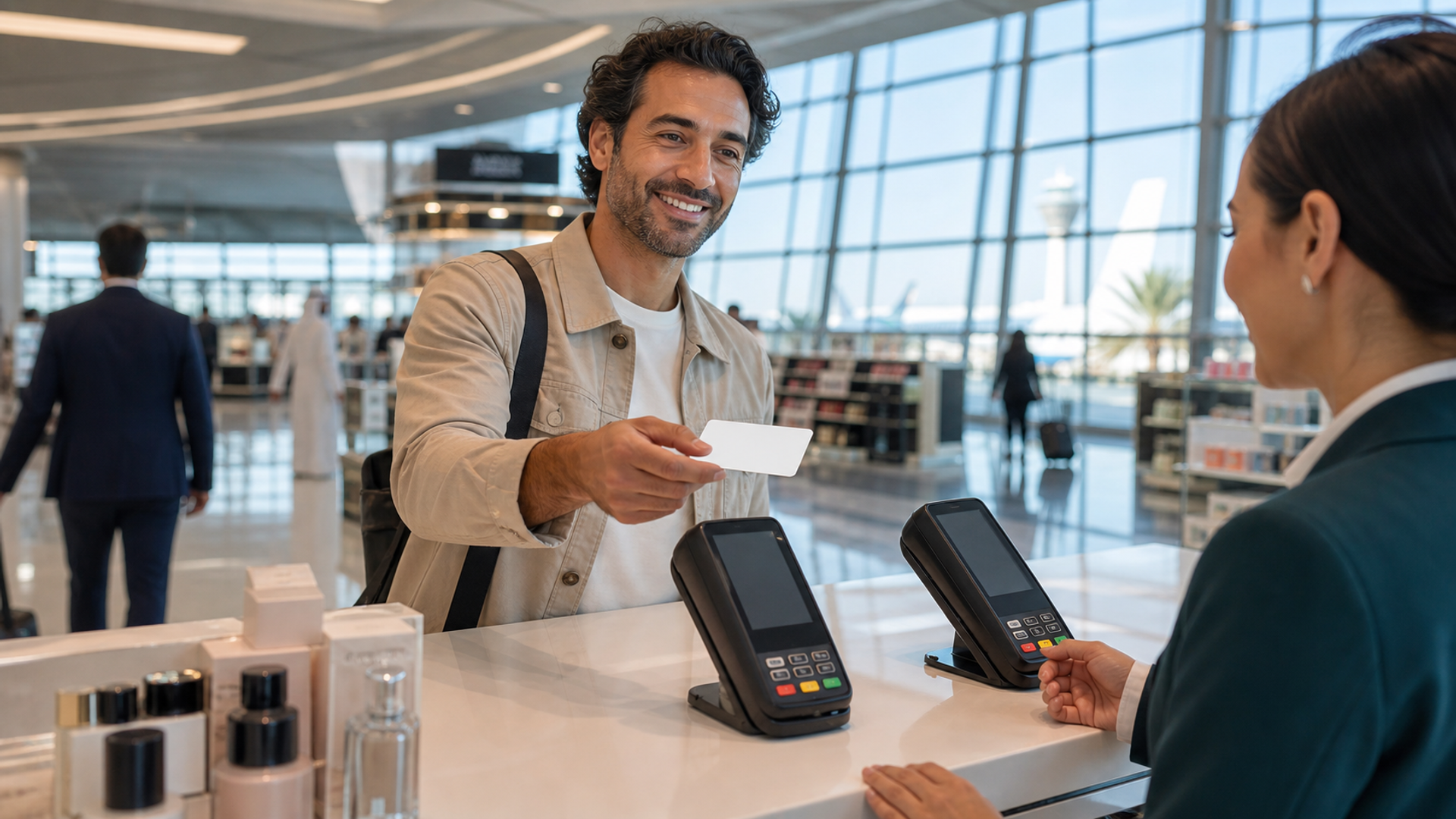
The Jaywan card is the United Arab Emirates’ national payment card scheme. Developed by Al Etihad Payments, a subsidiary of the Central Bank of the UAE, it is designed to route domestic card transactions through UAE payment infrastructure while allowing participating banks to issue cards suited to local customers. International use depends on the specific product and its co-badged global network.
That last distinction is the key to understanding Jaywan. The logo alone does not tell a traveller where a card will work. A domestic Jaywan card, a Jaywan–Mastercard co-badged card and a Jaywan card linked to another international scheme can have different acceptance, benefits, fees and application rules.
The Central Bank’s launch announcement explains the national scheme’s purpose. A July 2026 Mastercard and Al Etihad Payments announcement describes the first UAE co-badged credit-card arrangement. Current consumer reporting from Gulf News provides additional rollout context.
The four questions every applicant should answer
| Question | Why it matters | Evidence to request |
|---|---|---|
| Who issues the card? | The bank sets eligibility, fees, credit decisions and service | Product page and key facts statement |
| Which network routes UAE purchases? | Jaywan is designed for domestic UAE transactions | Jaywan mark and issuer confirmation |
| Which network handles overseas purchases? | International acceptance depends on co-badging or another arrangement | Named global network and acceptance terms |
| Which benefits and fees apply? | Rewards, lounge access, FX mark-up and insurance belong to the product, not the national scheme alone | Current tariff, benefits guide and insurance certificate |
If an issuer cannot answer all four clearly, do not assume that the product behaves like another card with a similar design.
What a national card scheme does
A card transaction involves more than the customer and merchant. The payment passes through an issuer, an acquiring bank, a network and settlement infrastructure. A national scheme gives a country greater control over how domestic transactions are routed and governed.
For the UAE, Jaywan supports several policy goals:
strengthening domestic payment resilience;
retaining more payment activity within national infrastructure;
encouraging competition and innovation;
expanding access to electronic payments;
supporting the transition toward a digital economy.
National routing does not mean every service is state-operated or that global networks disappear. Banks continue to issue and service cards. International networks can participate through co-badging and partnerships. The result is a layered system rather than a simple replacement.
Debit, credit and prepaid are separate decisions
Early public discussion of Jaywan often focused on debit and prepaid issuance. The 2026 Mastercard announcement is significant because it extends the co-badged model to credit cards.
Each form serves a different need:
Debit: purchases draw from an account balance. Eligibility and fees depend on the bank account.
Credit: the issuer provides a credit facility subject to assessment, limits, interest and repayment terms.
Prepaid: value is loaded before spending and may suit budgeting, payroll or inclusion use cases.
The scheme does not erase those distinctions. A Jaywan credit card remains a credit agreement. The bank, not Jaywan as a national brand, determines approval, limit, annual fee and repayment conditions.
How co-badging works
A co-badged card carries two payment identities. Within the UAE, an eligible transaction can route through Jaywan. Outside the domestic environment, the international partner network can provide acceptance where its rules and merchant coverage apply.
This design is common in markets that want domestic sovereignty and global usability. It can offer resilience and reduce dependence on one route, but the customer experience still depends on issuer implementation.
The network used for a particular transaction may vary by location, merchant setup, terminal routing, ecommerce configuration and issuer policy. The cardholder does not necessarily choose the route at the till.
Domestic and travel-use matrix
| Scenario | Likely route or dependency | What to verify before relying on the card |
|---|---|---|
| In-store purchase in the UAE | Jaywan domestic route where enabled | Merchant acceptance and issuer controls |
| UAE ecommerce purchase | Merchant gateway support for Jaywan | Online and recurring-payment eligibility |
| Cash withdrawal in the UAE | Participating ATM and issuer rules | Withdrawal fee and daily limit |
| In-store purchase abroad | Co-badged international network | Network mark, foreign-use setting and FX fees |
| Overseas ATM withdrawal | International network plus ATM operator | Issuer and operator fees, dynamic currency conversion |
| Foreign ecommerce subscription | International network and merchant acceptance | Recurring payment support and fraud controls |
| Hotel or car-hire deposit | Issuer authorisation and available credit/balance | Pre-authorisation policy and release timing |
| Mobile wallet payment | Issuer and wallet provisioning support | Whether the exact Jaywan product can be tokenised |
“Co-badged” should therefore be treated as a capability to verify, not a universal guarantee for every merchant or use case.
Which banks offer Jaywan?
Availability is changing as the scheme rolls out. Public announcements have named major UAE banks and financial institutions, but product status can differ between debit, prepaid and credit. Some cards may be available only to existing account holders, selected customer groups or particular salary arrangements.
Use the bank’s current product page or contact the bank directly. Ask for:
the exact product name;
whether it is debit, credit or prepaid;
the international co-badging network;
annual and replacement fees;
foreign transaction and cash-withdrawal charges;
mobile-wallet support;
rewards, travel cover and lounge terms;
eligibility for UAE citizens and residents.
Do not rely on a launch press release as proof that every branch or digital channel can issue the card immediately.
Benefits: scheme versus issuer
Jaywan’s national benefits are primarily infrastructural: domestic resilience, local routing and support for the UAE payments ecosystem. Consumer benefits such as cashback, points, airport lounges or purchase protection usually come from the issuing bank and product tier.
This separation prevents misleading comparisons. Two Jaywan cards may share domestic routing but offer very different customer value. One may be a no-fee debit card; another may be a premium co-badged credit card with travel benefits and a substantial annual fee.
Compare total value:
annual fee;
achievable rewards after exclusions and caps;
foreign-exchange mark-up;
lounge-guest policy;
travel-insurance eligibility and activation;
cash-withdrawal cost;
quality of fraud support;
digital-card and wallet availability.
A benefit has no practical value if the customer cannot meet its spending threshold or use its participating merchants.
What travellers need to check
Frequent travellers should carry payment redundancy. Even a widely accepted international network can fail because of issuer controls, terminal connectivity, merchant policy or an automated fraud block.
Before departure:
enable overseas use if the issuer requires it;
confirm the international network on the physical or digital card;
review FX and ATM charges;
verify that the PIN works and contact details are current;
save the issuer’s international support number;
carry a second card on a different account or network;
keep a limited emergency cash reserve appropriate to the destination.
Avoid dynamic currency conversion when the terminal offers to charge in your home currency without showing a genuinely competitive rate. Paying in the merchant’s local currency usually allows your issuer’s published conversion method to apply, although fees still need checking.
For a wider journey-planning framework, our 2026 passport-index guide explains mobility access, while the AI agent and concierge disruption matrix covers recovery when travel plans break.
Privacy, security and disputes
National routing can support data-sovereignty and resilience objectives, but consumers should evaluate the actual issuer’s security features. Look for instant transaction alerts, card freezing, merchant controls, tokenised mobile payments and a clear dispute process.
Phishing risk rises around new financial products because customers may be less familiar with normal application and verification procedures. Apply through the bank’s official app, website or branch. Do not share one-time passwords, PINs or full card details with callers claiming to “activate Jaywan”.
If a transaction is unfamiliar, freeze the card through the official app when possible and contact the issuer using a trusted number. Preserve timestamps and merchant information. The bank’s dispute terms and applicable UAE rules determine the formal process.
Jaywan versus a conventional international card
| Decision factor | Jaywan-only or domestically focused product | Jaywan co-badged product | Conventional international-network product |
|---|---|---|---|
| UAE domestic routing | Core purpose | Core purpose | Depends on local routing arrangements |
| International acceptance | May be limited | Provided through named partner network | Provided through network |
| Issuer choice | Growing rollout | Growing rollout | Broad established range |
| Rewards and fees | Issuer-specific | Issuer-specific | Issuer-specific |
| National infrastructure role | Direct | Direct | Indirect or partner-based |
| Best fit | Primarily domestic spending | UAE use plus international travel | Customer prioritising established global product range |
The categories are not value judgements. The right product depends on where the customer spends, whether credit is needed, and what the issuer charges.
A careful application decision
Choose Jaywan because the exact product fits—not merely because the scheme is new or nationally significant. For a UAE-focused debit customer, domestic integration and local service may be compelling. For a traveller, co-badging, FX costs and support matter more. For a premium credit customer, the comparison should include net rewards and protection after the annual fee.
Read the current key facts statement and tariff before applying. Credit products can create interest and late-payment costs, and eligibility is subject to the issuer. This guide describes the scheme and consumer decision points; it is not personal financial advice.
Jaywan is an important development in the UAE’s financial infrastructure because it combines domestic control with a route to international compatibility. Its success for an individual cardholder, however, will be determined at product level: the issuing bank, co-badged network, fees, controls and service that sit behind the logo.
![How to Scan Receipts and Documents with Your Phone [Full Guide]](https://cdn.sanity.io/images/e0gp1l2g/production/0db13feec1d5e72b8a8a5f976d1f3e86619c9228-3840x1860.webp?w=180&h=180&q=78&auto=format&fit=crop)
![How to Scan Receipts and Documents with Your Phone [Full Guide]](https://cdn.sanity.io/images/e0gp1l2g/production/0db13feec1d5e72b8a8a5f976d1f3e86619c9228-3840x1860.webp?w=800&h=450&q=82&auto=format&fit=crop)
![Top 10 Two-Tone Carbon-Fibre Watches for Men [2026 List]](https://cdn.sanity.io/images/e0gp1l2g/production/18870799ba33fab0e038968359cd5772d7d7db30-1024x576.webp?w=800&h=450&q=82&auto=format&fit=crop)
![Top 10 Luxury Watches with Digital Complication Displays for Men [Latest]](https://cdn.sanity.io/images/e0gp1l2g/production/c4f6bf8c080f291c39f7cc85c7344ecff2fd3799-1024x553.webp?w=800&h=450&q=82&auto=format&fit=crop)