

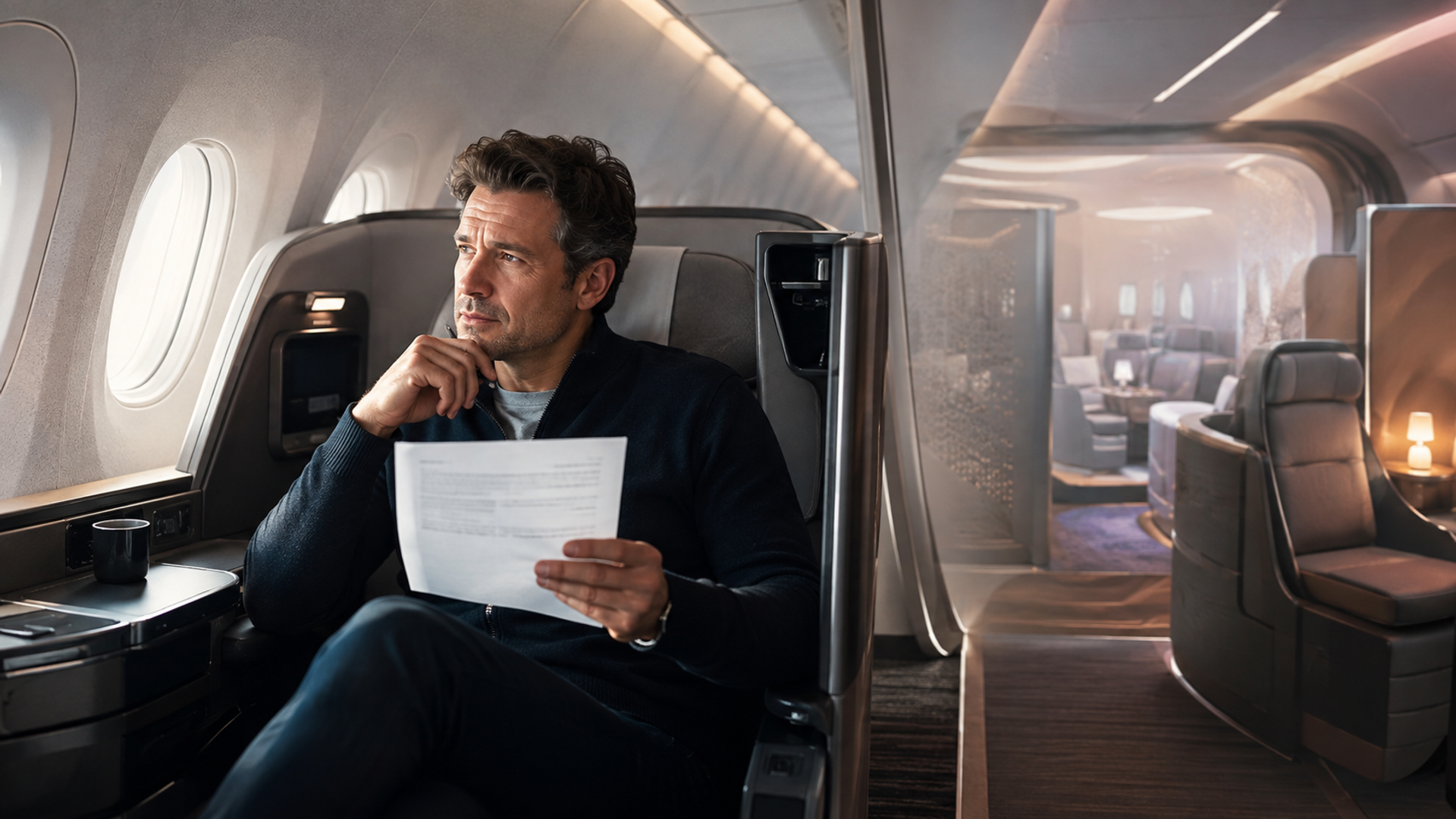
Singapore Airlines has created a rare premium-travel dilemma: a new long-haul Business Class product is now close enough to influence future bookings, but not yet available to buy with certainty. The airline's A350 retrofit programme covers 34 long-haul aircraft and seven ultra-long-range aircraft, yet the first refitted long-haul jet is expected only in the first quarter of 2027 and remains subject to approvals. A November 2026 reveal may answer design questions without immediately identifying every route or flight number.
Waiting therefore has an opportunity cost. A traveller can surrender a strong fare, a confirmed award seat or an important schedule while hoping for a cabin whose exact route is unknown. This guide treats the choice as a timing decision rather than a contest between an old seat and an imagined new one.
The direct decision
Wait only when the journey is discretionary, falls well into 2027, and the new cabin itself is worth accepting route and price uncertainty. Book the current product when dates, connections, award availability or business commitments matter more than being first. Until SIA publishes aircraft and route assignments, no booking can guarantee the retrofit.
| Decision factor | Evidence | Consequence | Control |
|---|---|---|---|
| Travel date | the first long-haul retrofit is expected in Q1 2027 | earlier journeys cannot rationally wait for the new seat | separate trips before and after the launch window |
| Route certainty | SIA has not published a complete launch-route schedule | an A350 booking is not automatically a refitted A350 | require a published aircraft or seat-map signal |
| Fare or award value | premium inventory can disappear while a traveller waits | the new seat may cost materially more or have no award space | hold a reversible fare where practical |
| Schedule value | nonstop timing and connections often dominate cabin novelty | a worse itinerary can erase the comfort gain | price hours and missed-connection risk |
| Current seat fit | today's long-haul A350 seat is wide but has a diagonal sleeping position | some travellers already know whether that geometry works | use prior experience rather than generic reviews |
| Change tolerance | aircraft swaps occur for operational reasons | even a marketed route may not be an absolute guarantee | retain a fallback acceptable on the current cabin |
This is the article-specific value object for Singapore Airlines business class. It distinguishes confirmed evidence from assumptions and makes the downside visible before the reader acts.
Evidence available on 2026-09-03
Evidence 1. Singapore Airlines announced a S$1.1 billion programme for new long-haul products across 41 A350-900 aircraft. Source.
Evidence 2. SIA's current published Business Class page describes the existing long-haul seat and bed experience. Source.
Evidence 3. Current reporting places the first refitted long-haul A350 in service in Q1 2027, subject to approvals. Source.
Evidence 4. The new First and Business Class seats are due to be shown to selected frequent flyers in November 2026. Source.
For Singapore Airlines business class, the sources support only the claims written above; timing, price, availability, certification, facilities and product configurations can change by market and date.
How each factor changes the answer
Travel date. The current evidence is that the first long-haul retrofit is expected in Q1 2027. This matters because earlier journeys cannot rationally wait for the new seat. The control is to separate trips before and after the launch window. For this exact Singapore Airlines business class decision, record the date, market, source and assumption that could reverse the conclusion. If the evidence is missing, leave the factor unknown; do not reward a confident guess.
Route certainty. The current evidence is that sIA has not published a complete launch-route schedule. This matters because an A350 booking is not automatically a refitted A350. The control is to require a published aircraft or seat-map signal. For this exact Singapore Airlines business class decision, record the date, market, source and assumption that could reverse the conclusion. If the evidence is missing, leave the factor unknown; do not reward a confident guess.
Fare or award value. The current evidence is that premium inventory can disappear while a traveller waits. This matters because the new seat may cost materially more or have no award space. The control is to hold a reversible fare where practical. For this exact Singapore Airlines business class decision, record the date, market, source and assumption that could reverse the conclusion. If the evidence is missing, leave the factor unknown; do not reward a confident guess.
Schedule value. The current evidence is that nonstop timing and connections often dominate cabin novelty. This matters because a worse itinerary can erase the comfort gain. The control is to price hours and missed-connection risk. For this exact Singapore Airlines business class decision, record the date, market, source and assumption that could reverse the conclusion. If the evidence is missing, leave the factor unknown; do not reward a confident guess.
Current seat fit. The current evidence is that today's long-haul A350 seat is wide but has a diagonal sleeping position. This matters because some travellers already know whether that geometry works. The control is to use prior experience rather than generic reviews. For this exact Singapore Airlines business class decision, record the date, market, source and assumption that could reverse the conclusion. If the evidence is missing, leave the factor unknown; do not reward a confident guess.
Change tolerance. The current evidence is that aircraft swaps occur for operational reasons. This matters because even a marketed route may not be an absolute guarantee. The control is to retain a fallback acceptable on the current cabin. For this exact Singapore Airlines business class decision, record the date, market, source and assumption that could reverse the conclusion. If the evidence is missing, leave the factor unknown; do not reward a confident guess.
Decision audit for Singapore Airlines business class
Start the audit with the exact decision: Singapore Airlines business class, for one named traveller, buyer or organisation in one market and on one date. For Singapore Airlines business class, write the preferred option and list three conditions that would reverse it. The first reversal comes from travel date; for Singapore Airlines business class, the second comes from route certainty and the third from fare or award value. Assign every Singapore Airlines business class verification to an owner and set its latest useful check time. Keep confirmed Singapore Airlines business class facts, dated reporting, estimates and unknowns in separate columns. A missing Singapore Airlines business class price, route, certification, facility status or access decision is not zero and cannot justify the most attractive outcome. For Singapore Airlines business class, run a downside case in which timing slips, availability disappears or the operating configuration changes. If the Singapore Airlines business class recommendation still works, it is robust; if it fails, choose a reversible booking, purchase, trial or fallback until stronger evidence arrives. Finally, save the source URL and observation date beside every material Singapore Airlines business class claim. That makes this Singapore Airlines business class decision updateable without rewriting its history and prevents a later announcement from making earlier uncertainty look falsely obvious.
Confidence and asymmetric risk
For Singapore Airlines business class, confidence should be reported factor by factor rather than as one theatrical percentage. The evidence for schedule value may be strong while current seat fit remains provisional. For Singapore Airlines business class, mark each line confirmed, current-but-changeable, inferred or unknown; give the consequence of being wrong and the cheapest reversible response. Do not average a hard Singapore Airlines business class blocker away with several attractive features. In this Singapore Airlines business class decision, a missed flight, unauthorised deployment, incompatible device, unavailable market or unsupported product claim has asymmetric cost. The final Singapore Airlines business class recommendation should name both the preferred action and its stop condition. That is more useful than a Singapore Airlines business class ranking because the reader can update the result when one decisive fact changes.
Worked scenario for wait-or-book-decision
A London-based executive sees a competitive Singapore return fare for February 2027. The meeting dates are fixed, the direct flight saves four hours over an alternative, and the current seat is acceptable. The correct move is to book a changeable itinerary now, not speculate. A leisure traveller considering a flexible May 2027 trip, by contrast, can wait until after the November reveal and route announcements. The value of waiting is highest when dates are loose and cabin novelty is the purpose of the trip.
What the programme actually guarantees
The investment and fleet count are official; the precise launch route, every seat feature and the rate at which aircraft return from retrofit are not. Certification and supply constraints have already changed the timetable. A reveal establishes design, not instant fleet coverage. Readers should keep these layers separate so a confirmed programme does not become a fictional guarantee for one flight.
Why the current A350 remains a rational booking
The present long-haul seat still provides direct aisle access and a flat-bed proposition. Its geometry divides opinion, especially the angled sleeping position and footwell, but a known compromise can be preferable to an unknown schedule. Service, catering, lounge access and nonstop convenience also survive a seat-generation change.
The signals that make waiting stronger
Waiting becomes rational after SIA names the first aircraft, routes and operating dates, and when seat maps show a clearly different layout. A fare that remains flexible and a trip with multiple acceptable dates further reduce the cost. Rumoured routes, anonymous seat renders and an A350 equipment code alone are not enough.
The signals that make booking now stronger
Book when an award seat is scarce, a client meeting is fixed, the nonstop is uniquely valuable or the current fare is unusually strong. Also book if the traveller sleeps well in the current seat. A new door or screen does not compensate for losing the right day, adding a stop or paying an unplanned premium.
A disciplined review calendar
Save the booking terms and review after the November presentation, after SIA publishes route assignments, and again before the free-change deadline. At each point ask whether the new evidence changes the exact flight—not whether the new seat looks attractive. This turns anticipation into a controlled option rather than an open-ended delay.
Action checklist
[ ] Confirm travel date and flexibility
[ ] Record exact aircraft and current seat
[ ] Save change and cancellation terms
[ ] Wait for official route assignment
[ ] Compare total journey time
[ ] Set a final decision date
[ ] Accept aircraft-swap residual risk
Unchecked Singapore Airlines business class items remain unresolved and cannot be treated as favourable assumptions.
Sources and method
These reader-visible Singapore Airlines business class sources were checked for this publication. Separate Singapore Airlines business class ranking-page research identified coverage gaps only; competitor wording, paragraph order and proprietary analysis were not copied.
Related VERTU editorial context
For Singapore Airlines business class, these links provide adjacent decision and premium-lifestyle context; they do not replace the official or specialist evidence required for this exact decision.
Final judgement
Wait only when the journey is discretionary, falls well into 2027, and the new cabin itself is worth accepting route and price uncertainty. Book the current product when dates, connections, award availability or business commitments matter more than being first. Until SIA publishes aircraft and route assignments, no booking can guarantee the retrofit.
The strongest Singapore Airlines business class decision is the one whose evidence, reversibility and next review point remain visible, not the one with the newest object or most confident forecast.
![How to Scan Receipts and Documents with Your Phone [Full Guide]](https://cdn.sanity.io/images/e0gp1l2g/production/0db13feec1d5e72b8a8a5f976d1f3e86619c9228-3840x1860.webp?w=180&h=180&q=78&auto=format&fit=crop)
![How to Scan Receipts and Documents with Your Phone [Full Guide]](https://cdn.sanity.io/images/e0gp1l2g/production/0db13feec1d5e72b8a8a5f976d1f3e86619c9228-3840x1860.webp?w=800&h=450&q=82&auto=format&fit=crop)
![Top 10 Two-Tone Carbon-Fibre Watches for Men [2026 List]](https://cdn.sanity.io/images/e0gp1l2g/production/18870799ba33fab0e038968359cd5772d7d7db30-1024x576.webp?w=800&h=450&q=82&auto=format&fit=crop)
![Top 10 Luxury Watches with Digital Complication Displays for Men [Latest]](https://cdn.sanity.io/images/e0gp1l2g/production/c4f6bf8c080f291c39f7cc85c7344ecff2fd3799-1024x553.webp?w=800&h=450&q=82&auto=format&fit=crop)