

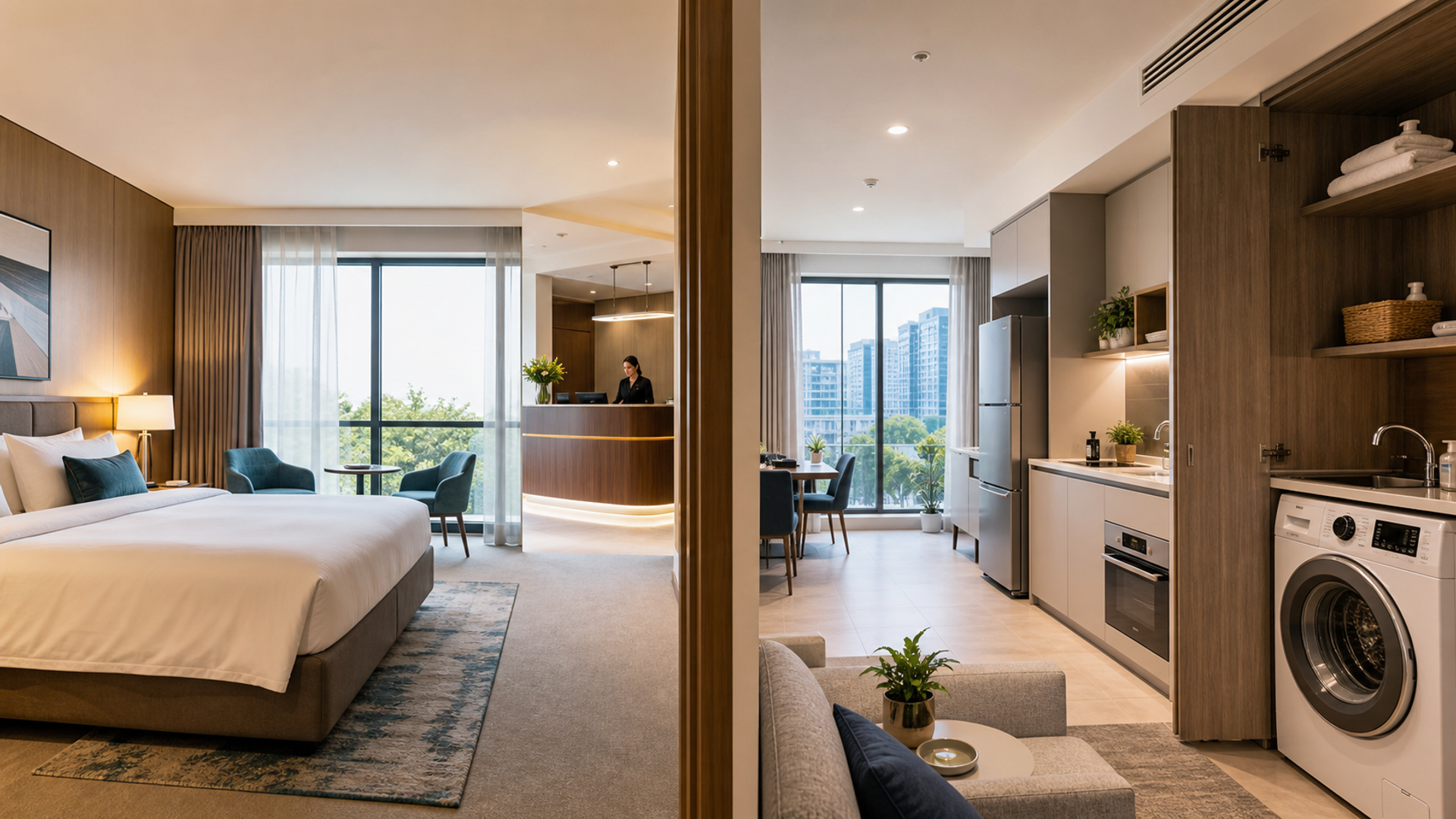
A serviced apartment combines residential functions such as a kitchen and living space with professional accommodation services, while a hotel generally concentrates rooms, reception and hospitality operations in one property. The categories overlap: some aparthotels look like hotels, and some extended-stay hotels include kitchens. The material differences are exact space, housekeeping, reception hours, security, maintenance response, final price and cancellation. For a long trip, those operating facts matter more than the label or a staged room photograph.
Length of stay changes the brief
Choose a serviced apartment when usable living space, kitchen, laundry and a residential rhythm justify the operating model. Choose a hotel when staffed reception, daily service, facilities and rapid recovery matter more. Choose by stay scenario when arrival time, duration, meetings, accessibility, local rules and service accountability can reverse the apparent value.
| Decision factor | Serviced apartment | Hotel | Choose by stay scenario |
|---|---|---|---|
| Space | Separate living and sleeping areas may be available | Room and suite layouts vary | Verify measured usable layout |
| Kitchen and laundry | Often central to the long-stay proposition | May be limited or outsourced | Check exact appliances and access |
| Housekeeping | Frequency can be scheduled rather than daily | Daily service may be available by property | Read the booked rate terms |
| Reception | Hours and staffing vary | Often continuous in full-service hotels | Map late arrival and emergencies |
| Price | Long-stay rates may improve with duration | Packages and loyalty can change value | Compare final total and inclusions |
| Recovery | Operator and building roles can split | Hotel duty management may be direct | Identify who fixes each failure |
This serviced apartment vs hotel matrix is the article's working value object. Read the serviced apartment vs hotel rows together: the decisive failure mode depends on this topic's evidence, operating context and reader objective.
Space is not the same as service
Evidence 1. Industry definitions describe serviced apartments as professionally managed accommodation combining residential facilities with hotel-like services for short or extended stays.
Evidence 2. A kitchen icon or the word apartment does not establish appliance inventory, housekeeping frequency, reception coverage or local legality.
Evidence 3. Mandatory-fee rules reinforce comparing the total price available before payment rather than a low headline rate.
Evidence 4. Fire safety, accessibility and registration obligations depend on jurisdiction and property type and must be verified locally.
Reader-visible sources checked for this article:
ura.gov.sg — reader-visible current or official evidence
ftc.gov — reader-visible current or official evidence
gov.uk — reader-visible current or official evidence
For serviced apartment vs hotel, these sources establish only the claims inside their documented scope. Recheck every changeable specification, availability condition, price, policy or service term in the relevant market before acting.
Verify the operating model
A buyer can resolve space without starting from a brand preference. Ask whether separate living and sleeping areas may be available; compare that with whether room and suite layouts vary; then use verify measured usable layout as the third route's safeguard. An unknown condition stays unknown.
On kitchen and laundry, popularity is not enough. The evidence for option one is that often central to the long-stay proposition. Option two means may be limited or outsourced. Option three is rational where check exact appliances and access. Recheck any changeable term immediately before commitment.
The decision changes at housekeeping. Choose the first path only if frequency can be scheduled rather than daily; move to the second when daily service may be available by property; use the third when read the booked rate terms. Save the downside that would make this row fail.
For reception, the first route works when hours and staffing vary; the second requires often continuous in full-service hotels. The control for the third is map late arrival and emergencies. Verify this row against the exact product, property, account or environment before it can reverse the decision.
The price row exposes a practical boundary. Route one assumes long-stay rates may improve with duration, while route two is defensible only when packages and loyalty can change value. Route three depends on compare final total and inclusions. If that evidence is absent, keep the more reversible option.
Read recovery as a stop/go test: operator and building roles can split supports the first option; hotel duty management may be direct supports the second; and identify who fixes each failure supports the third. Record which source proves the condition and when it was checked.
Facts that would reverse the current choice
Reversal control 1 — Space. Before choosing Serviced apartment, write down how the decision changes if “Separate living and sleeping areas may be available” proves false. Do the same for Hotel and “Room and suite layouts vary”. Keep the Choose by stay scenario route available until “Verify measured usable layout” is verified. This control belongs to serviced apartment vs hotel; update it from the cited source or exact supplier rather than copying a generic checklist.
Reversal control 2 — Kitchen and laundry. Before choosing Serviced apartment, write down how the decision changes if “Often central to the long-stay proposition” proves false. Do the same for Hotel and “May be limited or outsourced”. Keep the Choose by stay scenario route available until “Check exact appliances and access” is verified. This control belongs to serviced apartment vs hotel; update it from the cited source or exact supplier rather than copying a generic checklist.
Reversal control 3 — Housekeeping. Before choosing Serviced apartment, write down how the decision changes if “Frequency can be scheduled rather than daily” proves false. Do the same for Hotel and “Daily service may be available by property”. Keep the Choose by stay scenario route available until “Read the booked rate terms” is verified. This control belongs to serviced apartment vs hotel; update it from the cited source or exact supplier rather than copying a generic checklist.
Reversal control 4 — Reception. Before choosing Serviced apartment, write down how the decision changes if “Hours and staffing vary” proves false. Do the same for Hotel and “Often continuous in full-service hotels”. Keep the Choose by stay scenario route available until “Map late arrival and emergencies” is verified. This control belongs to serviced apartment vs hotel; update it from the cited source or exact supplier rather than copying a generic checklist.
Reversal control 5 — Price. Before choosing Serviced apartment, write down how the decision changes if “Long-stay rates may improve with duration” proves false. Do the same for Hotel and “Packages and loyalty can change value”. Keep the Choose by stay scenario route available until “Compare final total and inclusions” is verified. This control belongs to serviced apartment vs hotel; update it from the cited source or exact supplier rather than copying a generic checklist.
Reversal control 6 — Recovery. Before choosing Serviced apartment, write down how the decision changes if “Operator and building roles can split” proves false. Do the same for Hotel and “Hotel duty management may be direct”. Keep the Choose by stay scenario route available until “Identify who fixes each failure” is verified. This control belongs to serviced apartment vs hotel; update it from the cited source or exact supplier rather than copying a generic checklist.
Freeze the stay pattern
Record nights, guests, work calls, cooking, laundry, visitors, luggage and arrival time. Separate essential functions from appealing extras. For this serviced apartment versus hotel decision, record the exact item, place, date, measurement and source in the evidence log. Keep observations separate from category shorthand, repeat the check in the environment that matters, and price the downside of a wrong choice. If the stay is short and service-heavy, move toward the hotel route. When that condition appears, reopen the choice instead of defending the original preference.
Verify the unit
Request the exact floor plan, bed type, kitchen inventory, laundry, windows, desk, lift and accessibility details. Distinguish a representative photograph from the booked unit. For this serviced apartment versus hotel decision, record the exact item, place, date, measurement and source in the evidence log. Keep observations separate from category shorthand, repeat the check in the environment that matters, and price the downside of a wrong choice. If the operator will not confirm a critical feature, treat it as unavailable. When that condition appears, reopen the choice instead of defending the original preference.
Reconcile total price
Capture taxes, mandatory fees, deposits, cleaning, utilities, breakfast, parking and cancellation at checkout. Divide by nights only after inclusions are aligned. For this serviced apartment versus hotel decision, record the exact item, place, date, measurement and source in the evidence log. Keep observations separate from category shorthand, repeat the check in the environment that matters, and price the downside of a wrong choice. If the long-stay rate removes flexibility, price the disruption risk. When that condition appears, reopen the choice instead of defending the original preference.
Map service recovery
Write who handles lockout, noise, utilities, cleanliness, appliance failure and relocation after hours. Save the operator and platform contacts offline. For this serviced apartment versus hotel decision, record the exact item, place, date, measurement and source in the evidence log. Keep observations separate from category shorthand, repeat the check in the environment that matters, and price the downside of a wrong choice. If no accountable response exists for a critical failure, choose a staffed property. When that condition appears, reopen the choice instead of defending the original preference.
Check local and building rules
Verify registration, visitor policy, deliveries, security, fire information and quiet hours. Read recent reviews for repeated operational patterns. For this serviced apartment versus hotel decision, record the exact item, place, date, measurement and source in the evidence log. Keep observations separate from category shorthand, repeat the check in the environment that matters, and price the downside of a wrong choice. If legality or safety evidence is unclear, stop the booking. When that condition appears, reopen the choice instead of defending the original preference.
Four trips, four answers
Two-night late arrival
A staffed hotel can reduce access and recovery risk. Define the fact that would reverse this recommendation before committing.
Three-week project
A serviced apartment can make kitchen, laundry and separate work space valuable. Define the fact that would reverse this recommendation before committing.
Executive roadshow
Hotel operations and meeting facilities may outweigh extra living space. Define the fact that would reverse this recommendation before committing.
Family relocation
A verified apartment layout can support routines while permanent housing is arranged. Define the fact that would reverse this recommendation before committing.
Action checklist
Freeze dates and guests.
Verify exact unit.
Verify kitchen.
Verify laundry.
Read housekeeping schedule.
Map reception hours.
Capture final price.
Read cancellation.
Check accessibility.
Check safety information.
Save recovery contacts.
Write the relocation fallback.
Continue the decision
The linked VERTU articles expand adjacent parts of the serviced apartment vs hotel decision. They do not substitute for the external evidence above.
The serviced-apartment-versus-hotel verdict
Choose a serviced apartment when usable living space, kitchen, laundry and a residential rhythm justify the operating model. Choose a hotel when staffed reception, daily service, facilities and rapid recovery matter more. Choose by stay scenario when arrival time, duration, meetings, accessibility, local rules and service accountability can reverse the apparent value.
Keep the serviced apartment vs hotel decision reversible until its material cost, safety, access, privacy and compatibility facts are verified. Unknown evidence stays unknown; it is never silently scored as favourable.
![How to Scan Receipts and Documents with Your Phone [Full Guide]](https://cdn.sanity.io/images/e0gp1l2g/production/0db13feec1d5e72b8a8a5f976d1f3e86619c9228-3840x1860.webp?w=180&h=180&q=78&auto=format&fit=crop)
![How to Scan Receipts and Documents with Your Phone [Full Guide]](https://cdn.sanity.io/images/e0gp1l2g/production/0db13feec1d5e72b8a8a5f976d1f3e86619c9228-3840x1860.webp?w=800&h=450&q=82&auto=format&fit=crop)
![Top 10 Two-Tone Carbon-Fibre Watches for Men [2026 List]](https://cdn.sanity.io/images/e0gp1l2g/production/18870799ba33fab0e038968359cd5772d7d7db30-1024x576.webp?w=800&h=450&q=82&auto=format&fit=crop)
![Top 10 Luxury Watches with Digital Complication Displays for Men [Latest]](https://cdn.sanity.io/images/e0gp1l2g/production/c4f6bf8c080f291c39f7cc85c7344ecff2fd3799-1024x553.webp?w=800&h=450&q=82&auto=format&fit=crop)