
Introduction
Why AI business agents on smartphones matter now
The executive workday is increasingly mobile: approvals happen in airports, customer context is checked between meetings, and decisions are made in the five-minute gaps.
That’s exactly why AI business agents on smartphones are arriving now. Not because you needed another chat window—but because the phone is where you can compress decision time and trigger real actions across email, calendar, CRM, and service systems.
What productivity gains and risks executives must evaluate
Done well, mobile agents reduce cognitive load: less triage, fewer missed follow-ups, fewer status-chasing messages. Done carelessly, they create a new risk class: sensitive data flowing into prompts, over-permissioned connectors taking actions you didn’t intend, and thin audit evidence when something goes wrong.
The executive question isn’t “Is agentic AI useful?” It’s whether you can adopt it with provable controls and measurable outcomes.
How this guide helps you adopt securely and measurably
This guide is a practical adoption map:
what mobile AI agents are (and aren’t),
where they create immediate value,
the governance blueprint to mandate,
and a 2026-ready checklist you can use to pilot without improvising your security posture.
What AI agents on smartphones do
Definition and scope
A smartphone AI assistant answers questions. A smartphone AI agent goes further: it can plan steps and use tools (apps and connectors) to complete a task—often across multiple systems.
In this guide, the goal is a secure AI business agent smartphone adoption guide: adoption that’s controlled, auditable, and designed for executive reality.
Think of an agent as an orchestration layer: it reads context (with permission), proposes or executes actions (with constraints), and records what it did (with logs).
Scope boundaries you should define early:
- Read-only agentssummarize, draft, recommend.
- Read-write agentscreate calendar events, send emails, update CRM records.
- Action-with-approval agentsprepare changes, but require a human tap to commit.
Key TakeawayThe difference that matters to risk is simple: answers are low-impact; actions change systems.
High-impact mobile use cases
Mobile agents earn their place when they reduce “micro-friction” that adds up:
- Email and message triagesummarize threads, highlight decisions required, draft replies in your tone.
- Meeting outcomesturn notes into actions—follow-ups, owners, deadlines—while you walk to the next room.
- Calendar protectionpropose reschedules when travel changes, time zones shift, or conflicts appear.
- CRM hygieneturn call notes into structured updates without asking you to open a laptop.
- IT and operations requestscreate a ticket, attach context, and route it to the right queue.
How productivity is unlocked
Mobile productivity comes from three mechanisms:
- Context compressionthe agent surfaces the few facts that matter.
- Decision stagingit prepares an action you can approve in seconds.
- Cross-app continuityit carries intent across tools—so you don’t repeat yourself.
The trap is assuming this is “just UI.” Once an agent can touch multiple systems, it becomes an operational actor. Governance must be designed in—not bolted on.
Security and governance blueprint
A secure AI business agent smartphone adoption guide is only credible if the controls are measurable. That means defining what gets access, what gets logged, and what gets blocked—before the first executive installs an agent app.
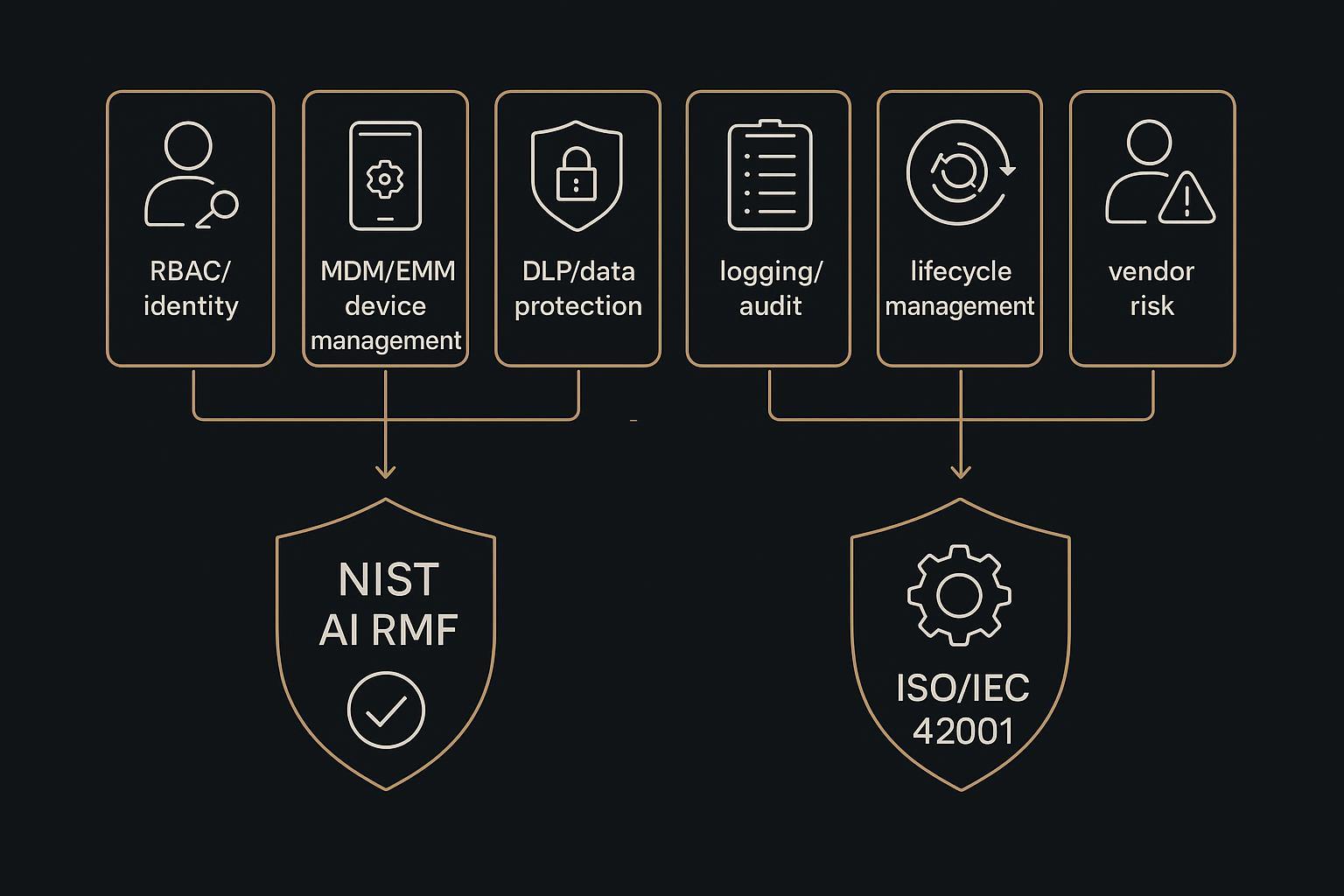
A strong blueprint aligns daily controls to recognized governance frames:
The NIST AI Risk Management Framework defines a loop of govern, map, measure, manage (see NIST’s AI RMF Core).
ISO/IEC 42001 defines what an organizational AI management system should look like: leadership accountability, risk management, operational controls, and continuous improvement (see ISO’s ISO/IEC 42001 overview (2023)).
Your job is to convert these into enforceable mobile requirements.
Identity and least-privilege access
Start with identity because it becomes the “master key” for every connector.
Mandates to set:
Role-based access control (RBAC) for agent capabilities, not just apps. Separate permissions for: reading sensitive data, drafting actions, and committing actions.
- Least-privilege connectorsan agent that updates CRM shouldn’t also have broad file-drive access by default.
Step-up authentication for high-risk actions (e.g., approving a payment workflow, exporting a customer list).
Human approval gates for irreversible or high-impact actions.
Failure mode to name explicitly: “The agent had access, so it used it.” Over-permissioning turns every small automation into an enterprise-wide blast radius.
How to verifyAsk for a matrix that lists agent capability → data sources → actions → required approval → audit evidence. If it can’t be written down, it can’t be governed.
Managed devices and mobile data protection
If the phone is the workplace, it must be treated as a governed endpoint—not a personal exception.
For executives, this is the practical definition of enterprise mobile AI governance: policies you can explain in one page, enforced automatically on every device.
Baseline controls (executive-readable, technically enforceable):
Managed enrollment (corporate or approved BYOD) with device posture checks.
Patch and OS compliance policies.
Strong authentication (device lock + MFA) and conditional access based on compliance.
Data separation using work profiles/containers where applicable.
- MDM for AI assistantsallowlist apps and degrade/deny agent access when posture fails.
DLP-style controls for sensitive flows (copy/paste, open-in, unmanaged cloud sync).
For mobile governance, NIST’s SP 800-124r2 guidance on securing mobile devices is a practical anchor: it treats mobile devices as enterprise endpoints with configuration, monitoring, and lifecycle controls.
AI-specific addition: treat prompts, attachments, and agent-generated drafts as potential data egress routes. “It was only a summary” is not a control.
Auditability, lifecycle, and vendor assurance
This is where most mobile AI pilots fail: they start with productivity demos and end with “we can’t prove what happened.”
Mandates to include:
Auditability
Log who invoked the agent, from which device posture state, what data sources were accessed, and what actions were proposed/executed.
Keep logs tamper-resistant and retention aligned to your risk tier.
Lifecycle controls
Onboarding: approved apps, approved connectors, approved data classes.
Offboarding: revoke tokens/keys, remove access immediately, wipe corporate container where appropriate.
Change control: connector scope changes should require review (new data source = new risk).
Vendor assurance
Demand evidence: security posture documentation, incident response commitments, and clarity on data handling.
Confirm what is retained, where it is processed, and how it is deleted.
The executive standard here is simple: if the agent can act, you must be able to reconstruct the action chain—with evidence.
Deployment model and evaluation checklist for a secure AI business agent smartphone adoption guide
Integration patterns that work
Most smartphone agent failures are integration failures—either too loose (“the agent can do anything”) or too brittle (“it can’t do anything reliably”).
Patterns that hold up in real operations:
- Connector + policy + approvalthe agent can propose actions, but sensitive actions require an explicit approval step.
- Read from systems of record; write through governed APIsreduce “shadow updates.”
Small number of high-trust workflows first (calendar protection, follow-up drafting) before expanding into higher-risk writes (CRM changes, ticket creation).
On-device vs. cloud processing
This is not a religious debate. It’s a risk trade-off.
On-device processing can reduce exposure of raw data outside the handset and can improve privacy posture—especially for highly sensitive notes or messages.
Cloud processing can offer stronger models, faster iteration, and centralized controls—but increases the importance of vendor assurance, data handling clarity, and network-level protections.
What to decide explicitly:
Which data classes may be processed where.
Whether prompts/outputs are retained.
What happens when the device is non-compliant (deny, degrade to read-only, or require step-up auth).
Executive checklist (2026-ready)
Use this as an adoption gate for any AI agent security checklist review. If you can’t answer “yes,” you’re not ready to scale.
- Defined scopeIs the agent’s role clear (read-only, read-write, or action-with-approval)?
- Least privilegeAre connectors scoped to the minimum data and actions required?
- Approval gatesAre high-impact actions gated by a human tap?
- Managed device postureAre phones enrolled in MDM/EMM with compliance enforcement?
- Data protectionIs corporate data separated and governed with DLP/container policies?
- Audit evidenceCan you reconstruct who did what, when, and from which device state?
- Lifecycle controlsAre onboarding, offboarding, and connector-scope changes governed?
- Vendor assuranceDo you have clear answers on retention, processing location, and deletion?
- Pilot metricsHave you defined measurable outcomes (time saved per exec/week, fewer missed follow-ups, reduced cycle time on approvals) and measurable risk signals (blocked actions, policy violations, anomalous access)?
- Human judgment remains explicitIs there a clear boundary between what automation can do and what must be escalated?
Where VERTU fits as a non-promotional illustration: executives often want a mobile experience that feels “concierge-like”—fast, private, and accountable. In that spirit, a well-designed mobile agent program should mirror the discipline of a human concierge: propose options, respect boundaries, and escalate when judgment is required. Some leaders choose devices and services built around that expectation—e.g., VERTU’s Concierge Service—as part of an executive mobile environment, alongside enterprise controls.
Conclusion
Key takeaways for secure, measurable adoption
Mobile AI agents create value by compressing decisions and orchestrating cross-app actions—but that action surface expands risk.
Treat identity, device posture, and data movement as the control plane.
Map your program to recognized governance frames (NIST AI RMF and ISO/IEC 42001), then demand auditable evidence.
Immediate next steps to pilot and govern at scale
Pick one high-value workflow (calendar protection or follow-up drafting), deploy it under managed-device and least-privilege constraints, and instrument it with logs and approval gates from day one. If the pilot can’t produce both productivity gains and clean audit evidence, it’s not a pilot—it’s a warning.
Disclosure: This article references VERTU pages. Editorial judgment remains the priority.