Qantas Premium Economy is the value choice for travellers who need a wider seat, more legroom and a smaller cabin but can accept sleeping upright. Business is worth the extra spend when an ultra-long itinerary includes a critical overnight sleep window, when the first day cannot be sacrificed, or when lounge access and a fully flat bed materially reduce journey fatigue. On flights approaching or exceeding fifteen hours, small comfort differences compound—but the exact aircraft, schedule and fare gap still decide the winner.
Quick verdict by traveller
| Traveller | Better starting choice | Reason |
|---|---|---|
| Daytime flyer with flexible arrival | Premium Economy | More usable space without paying for a bed you may not use |
| Overnight executive with meetings | Business | Flat bed and ground priority protect the arrival |
| Tall passenger who rarely sleeps on planes | Premium Economy | Seat width and pitch are useful for every hour |
| Side sleeper or back-pain-sensitive traveller | Business | A bed changes posture; test personal tolerance |
| Couple wanting to sit together | Premium Economy | Paired seating can be simpler and more social |
| Solo traveller needing frequent aisle access | Business | Direct aisle access on the relevant long-haul layout |
| Points upgrader | Business if confirmed | A confirmed bed can be strong value; speculative upgrades are not a plan |
The physical difference is larger on ultra-long-haul
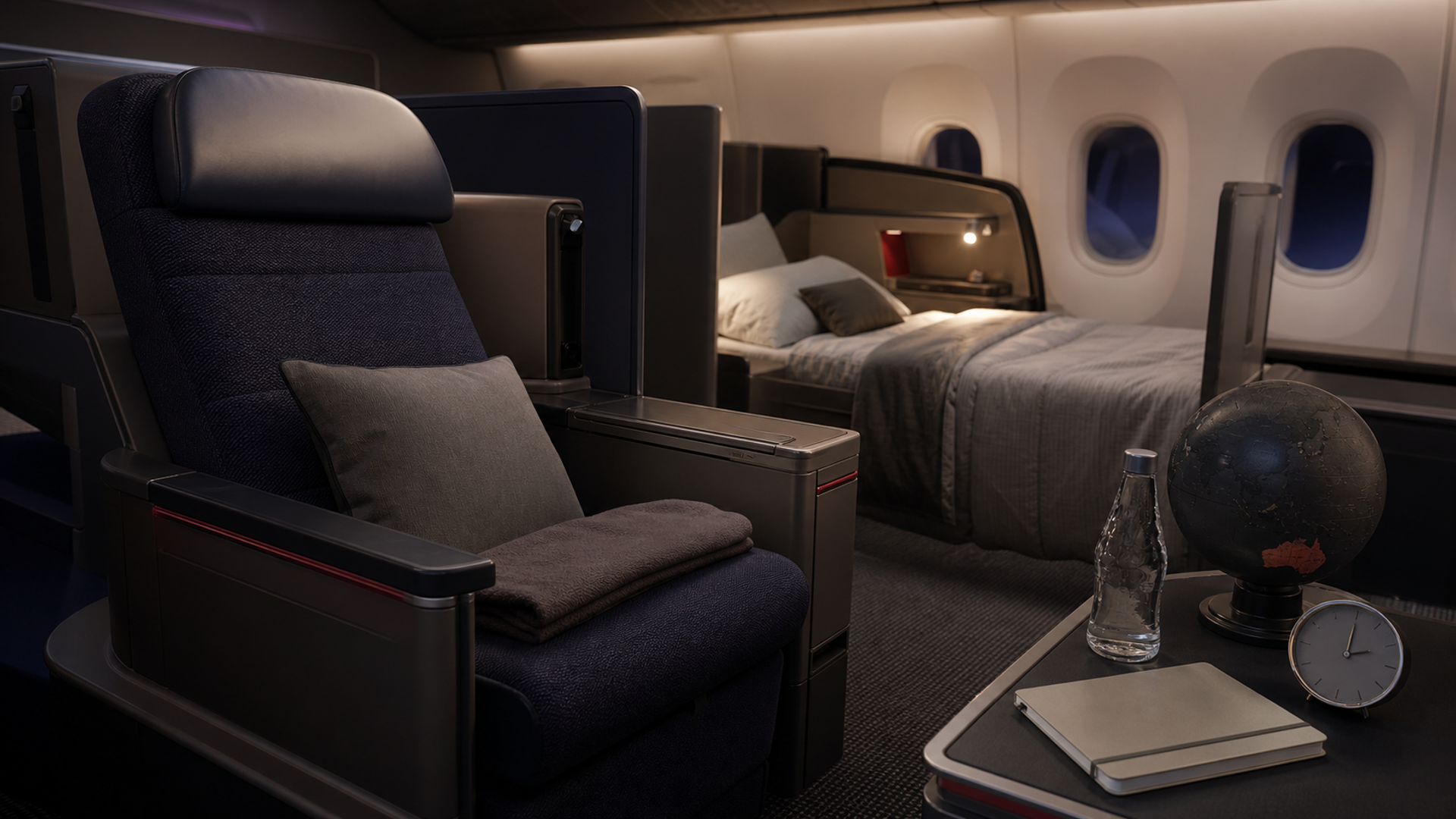
Qantas’s published Dreamliner guide lists Premium Economy at 38 inches of seat pitch, 20.5 inches of seat width and nine inches of recline. The same official guide describes its 787 Business seat as converting to an 80-inch-long bed with a width in the 23–24-inch range. Measurements can vary by aircraft and cabin generation, but the category difference is clear: Premium improves the seated position; Business changes the sleeping position.
The distinction matters more as duration increases. On an eight-hour flight, a traveller may tolerate an imperfect recliner and recover quickly. On a seventeen-hour journey, pressure points, interrupted sleep, cabin dryness and prolonged sitting accumulate. Business cannot remove jet lag or dehydration, but the bed allows more posture variation and a longer uninterrupted rest attempt.
Premium still has a strong argument. The seat is meaningfully wider than Economy, provides additional legroom and belongs to a smaller cabin. Those benefits continue even when turbulence, meal service or body-clock timing makes sleep impossible. If you are awake for most of the flight, a bed has less marginal value than its price implies.
Verify the aircraft before paying
Qantas operates different long-haul aircraft and configurations. Its UK Business page presents the broad service, while the airline’s 787 quick guide gives aircraft-specific measurements. A review of one Dreamliner layout should not be applied automatically to an A380 or A330.
Check:
the operating aircraft on every long sector;
the seat map for the date;
whether Business has direct aisle access from the selected seat;
Premium row position, bulkhead and bassinet locations;
whether a partner airline operates any segment;
how a later aircraft swap would change the value.
The seat map can change. Treat it as the best current evidence, not an absolute promise. If the fare premium only feels rational for one exact layout, prioritise a flexible ticket or a route with less configuration risk.
Build the decision around a sleep plan
Ultra-long-haul cabin decisions are often made with vague hopes: “I will sleep better in Business.” Replace that hope with a plan.
Identify the local bedtime at the destination. Mark the hours during the flight when sleep would help shift your body clock. Then ask how much of that window remains after take-off, the first meal and the pre-arrival service. A flat bed has greatest value when it overlaps a real six- or seven-hour sleep opportunity. It has less value when the schedule places you awake for most of the journey.
In Premium, plan for fragmented rest. A neck pillow that genuinely fits you, an eye mask, layers for temperature changes and a careful seat selection can improve the outcome. In Business, consider eating before boarding or requesting a faster service when rest is the priority. More elaborate dining is not a benefit if it consumes the only useful sleep window.
No cabin guarantees sleep. Noise, turbulence and physiology still matter. The honest comparison is the probability and quality of rest, not a promise of arriving untouched by the flight.
Qantas cabin-value matrix
Score each factor from zero to three, then multiply by how important it is to this trip.
| Factor | Premium Economy capability | Business capability | Importance questions |
|---|---|---|---|
| Sleep posture | Deep recline, leg support, upright sleep | Fully flat bed | Do you sleep seated? Is the sector overnight? |
| Personal space | Wider seat and greater pitch than Economy | Much larger work/rest zone | Are you tall, broad-shouldered or carrying work items? |
| Aisle independence | Depends on seat | Typically direct on current long-haul layouts | Do you move often or dislike disturbing others? |
| Ground time | Benefits vary by fare/status | Lounge and priority channels | Is the airport day long or connection tight? |
| Work privacy | Better than Economy but still exposed | More separation | Is the work suitable for a public cabin? |
| Recovery value | Moderate | Highest when sleep works | What happens in the first six hours after arrival? |
| Fare flexibility | Product-specific | Often better, not always | Are you comparing equivalent fare conditions? |
This matrix is deliberately trip-specific. A traveller can rationally choose Business on the outbound and Premium on the return because the sleep window and arrival consequences differ.
Ground experience and connections
The Business value begins before boarding. Lounge access can provide a quieter meal, shower or workspace; priority check-in and boarding reduce queue uncertainty; and priority baggage may help on arrival. Those benefits become more valuable during irregular operations or when a long flight connects to another sector.
Premium ground benefits depend on the airport, fare and status. If you already hold lounge access and priority status, subtract those duplicated benefits from the Business premium. Conversely, if a Business fare includes flexibility that you would otherwise buy, include it.
On a mixed-cabin itinerary, inspect each segment. A Business label on the booking summary may apply only to a short feeder while the longest flight sits in Premium, or vice versa. Price the journey according to the hours spent in each seat.
Food, hydration and movement
Qantas publishes international dining information by cabin on its inflight dining page. Business generally offers more choice, presentation and service flexibility, while Premium improves on Economy. The health and comfort fundamentals are less glamorous: drink water regularly, limit alcohol if sleep matters, and move when safe.
The additional Business space can make stretching and changing position easier, but it does not eliminate the risks associated with long immobility. Travellers with medical concerns should seek qualified advice before flying. A cabin comparison is not medical guidance.
How to value the fare difference
Use four numbers:
the true fare gap after matching change rules and baggage;
the number of useful sleep hours Business is likely to add;
the value of the first day after arrival;
the cost of alternatives, such as a stopover or extra hotel night.
If Business costs £2,400 more and you conservatively expect four additional useful rest hours plus two protected arrival hours, the working cost is £400 per protected hour. That may be sensible for a fixed commercial engagement and excessive for a relaxed holiday. The point is not to monetise every human experience; it is to stop treating the upgrade as a purely emotional purchase.
Points can improve the equation, but only a confirmed redemption should enter the plan. Waiting at the gate for an uncertain upgrade is not equivalent to booking the cabin needed for the journey.
When Premium Economy wins
The flight timing is mostly daytime.
You can sleep acceptably in a recliner.
The fare gap is large enough to fund a stopover or several hotel nights.
Your arrival day is deliberately light.
You already have lounge access and priority benefits.
The confirmed Premium seat suits your height and preferred row.
When Business wins
The useful sleep window covers a large part of the flight.
You have an immovable commitment shortly after landing.
A flat bed has repeatedly improved your travel recovery.
You need direct aisle access and a more private personal zone.
The itinerary contains a long connection where the lounge has practical value.
The fare or points gap is unusually favourable.
Coordinating the journey around the cabin
For eligible VERTU clients, VERTU Concierge may assist with premium transfers, hotel and dining coordination, difficult reservations and disruption support, subject to availability and service terms. It cannot guarantee a Qantas seat, upgrade, lounge entry or on-time operation. Its legitimate role is to coordinate the pieces around the flight so that a late arrival, changed connection or altered schedule does not leave the rest of the trip disconnected.
For another ultra-long-haul cabin comparison, see Singapore Airlines Premium Economy vs Business. To compare carriers by route rather than reputation, use our best business-class airlines decision matrix.
Final recommendation
Choose Qantas Premium Economy when the goal is sustained seated comfort at a defensible price. Choose Business when the journey’s central problem is sleep and the first day is valuable enough to protect. On ultra-long-haul, duration amplifies both the comfort gain and the cost of choosing badly. Verify the aircraft, map the sleep window and price the arrival consequence before you pay.