

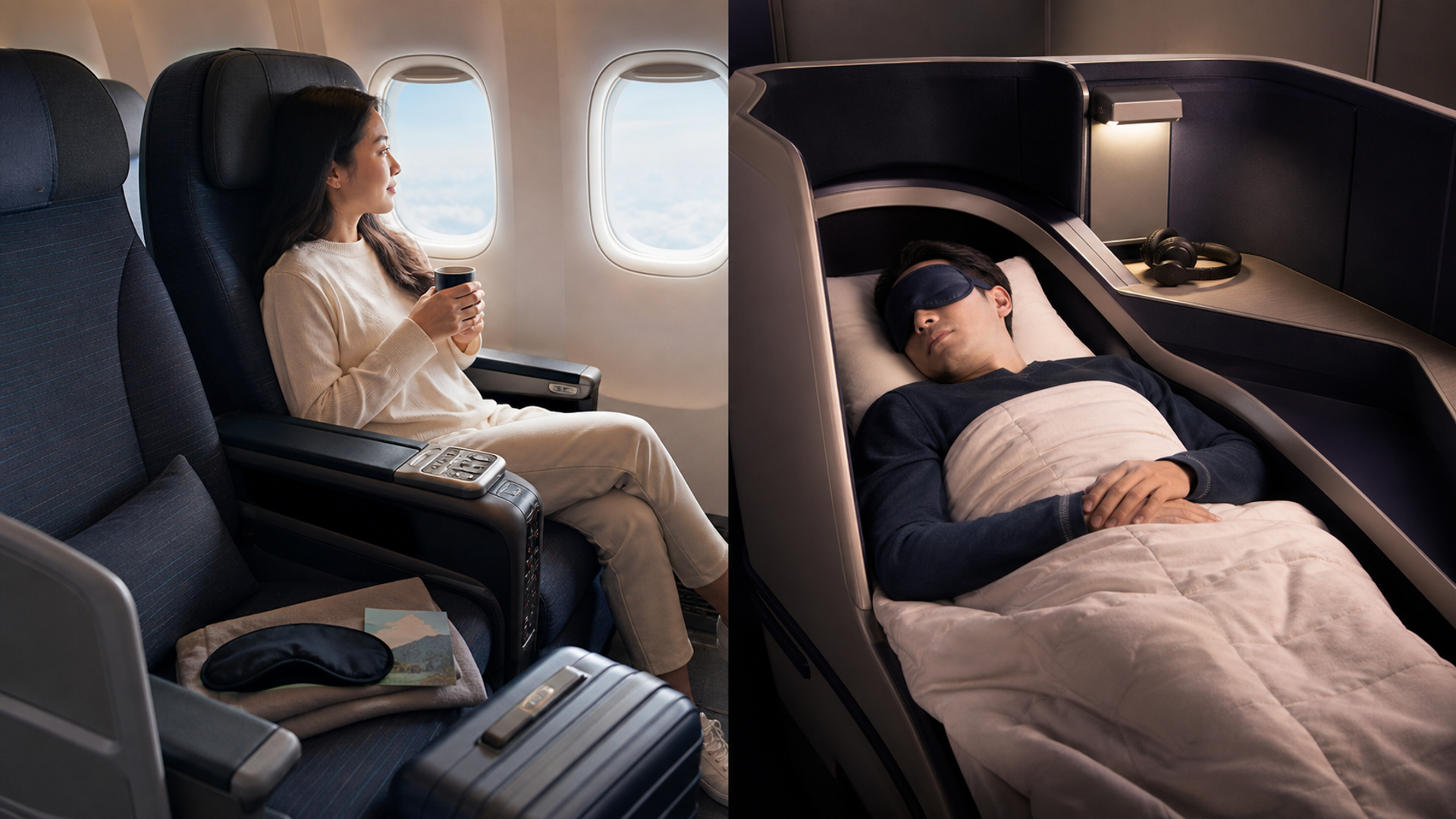
Japan Airlines Premium Economy is usually the better value when your priority is generous seated space, a calm cabin and a daytime journey. Business is the better tool when you need a flat bed, direct aisle access on the relevant aircraft, lounge time and a protected arrival after an overnight flight. JAL’s product varies substantially by aircraft, so the 2026 decision begins with the operating type—especially whether the long-haul sector uses the A350-1000 or an older configuration.
The decision in one table
| Question | Premium Economy | Business | Upgrade trigger |
|---|---|---|---|
| Can you lie flat? | No; it remains a recliner | Yes on long-haul Business products | Overnight sector plus important arrival |
| How much personal space? | JAL’s A350-1000 Premium seat lists about 107 cm pitch | Larger suite-like zone on A350-1000 | Work, privacy or sleep has real value |
| Is aisle access guaranteed? | No; layout depends on aircraft | Direct access on A350-1000 Business; verify older aircraft | Solo traveller or frequent movement |
| What changes on the ground? | Priority elements vary by itinerary and status | Lounge and priority path are central benefits | Busy airport, connection or work call |
| Best use case | Day flight, leisure, cost-sensitive comfort | Night flight, high-stakes arrival, complex journey | Buy the outcome, not the service theatre |
| Biggest risk | Expecting sleep from a recliner | Paying a large premium for an old or short experience | Confirm aircraft and fare conditions |
Why the A350-1000 matters
JAL’s A350-1000 is not merely a newer aircraft; it establishes a different decision baseline. The airline’s A350-1000 product page presents redesigned cabins across First, Business, Premium Economy and Economy. Its Premium Economy seat page lists approximately 107 cm of seat pitch on the A350-1000, with privacy dividers, leg support and enhanced storage. The precise experience on another aircraft can differ.
Business on the A350-1000 is built around personal space, privacy and a bed. That changes the value calculation on routes where the aircraft is scheduled. On an older 777 or 787, JAL may still offer an excellent long-haul Business product, but layout and aisle access need to be checked. Do not use a cabin review without confirming that it matches the aircraft shown in your booking.
Airlines can substitute equipment for operational reasons. Treat the seat map as evidence, not a contractual guarantee. If your purchase only makes sense with a specific suite, consider the fare’s change and refund terms and decide whether you would accept the fallback configuration.
Premium Economy: where the value is strongest
JAL Premium Economy is compelling because the space increase is useful for the entire flight. A tall passenger feels the pitch while awake; a traveller working on a laptop benefits from the larger zone; and a passenger who dislikes dense cabins gets a smaller, more separated environment. A fixed-shell or privacy-oriented seat design can also reduce disturbance from the passenger ahead, depending on aircraft.
The limitation is physical: it is not a bed. A deep recline, leg rest and better pillow can improve rest, but the body remains seated. Some travellers sleep surprisingly well in that position; others do not. Your own history is more predictive than a reviewer’s enthusiasm.
Premium Economy is therefore strongest on westbound or daytime flights, on trips where the first day is flexible, and when Business pricing is several times the Premium fare. It can also be the sensible choice for a couple that prefers sitting together and values conversation more than suite separation.
Business: what you are really buying
The Business fare buys three forms of control.
First is control over posture. A flat bed allows a normal sleeping position and a more deliberate sleep window. Second is control over movement. Direct aisle access—where the aircraft provides it—lets a traveller stand up without waking or crossing another passenger. Third is control over the journey outside the seat: lounge access, priority processing, a more flexible service rhythm and often more generous baggage.
JAL is known for attentive service, but service quality should not be the sole reason to upgrade. Premium Economy can also be warm and careful. The more defensible Business case is operational: the cabin allows you to rest, move and manage time in ways Premium cannot.
Calculate the 2026 fare gap properly
Compare like with like. A discounted Premium fare may have different change rules from a flexible Business fare. One ticket may include more checked baggage or easier changes. Before calling the price gap “£2,000,” break it into:
base fare and taxes;
change and cancellation flexibility;
seat selection;
lounge access you would otherwise buy;
baggage you genuinely need;
the value of sleep and arrival readiness;
points or status credit only if you will actually use them.
Then calculate a conservative cost per recovered hour. If Business is £1,800 more and you expect three additional hours of useful sleep plus one hour saved or protected on the ground, the working figure is £450 per recovered hour. The number does not tell you what to do; it makes the trade-off visible.
For leisure, compare that figure with an extra night in Tokyo and a better arrival schedule. For work, compare it with the cost of losing the first afternoon. In many cases, schedule wins: a well-timed Premium flight can beat an inconvenient Business itinerary.
Route scenarios
London or Europe to Tokyo, overnight
Business has the clearest case when the useful sleep window overlaps the long sector and the next day matters. Premium remains credible if the traveller can sleep seated, arrives with an empty calendar or can add a recovery night.
North America to Japan
Direction matters. A daytime-heavy westbound itinerary may favour Premium, while an eastbound or overnight pattern may increase the value of Business. Look at local departure and arrival times rather than simply counting flight duration.
Connecting beyond Tokyo
Business’s ground and sleep benefits can compound if the itinerary continues. But confirm through-checking of baggage, terminal changes and whether all sectors are on one ticket. A premium cabin cannot repair a risky self-transfer.
Travelling with a companion
Premium can feel more naturally social. In Business, central seats may support conversation, but suite dividers and staggered layouts vary. Couples should inspect the seat map and not assume that two central seats are equally good.
Work, connectivity and privacy
A larger screen and more space do not make an aircraft a secure office. Avoid exposing confidential material to neighbouring passengers, use an approved privacy screen where appropriate and assume onboard networks are untrusted. Download documents before departure and use company-approved security controls.
Premium provides enough space for light work but may make screen privacy harder in a paired layout. Business provides more physical separation on the latest aircraft, yet it is still a shared public environment. For executives, the right question is not “Can I open the laptop?” but “What information is safe to display here?”
Power availability should also be verified for the aircraft rather than assumed. Charge essential devices before boarding, carry permitted batteries in accordance with airline rules and keep a non-digital copy of critical arrival details. A premium cabin reduces friction; it does not make a traveller resilient to a flat device, missing network or changed gate.
If rest is the goal, technology can become the enemy of the upgrade. Set a hard stop for work, silence non-essential notifications and avoid using the larger screen or faster connection simply because it is available. The value of Business is often realised by doing less.
A practical pre-booking checklist
Confirm the operating carrier and aircraft for the long sector.
Inspect the seat map for aisle access, bassinet rows and proximity to toilets.
Check whether the flight timing offers a realistic sleep window.
Compare fare flexibility and baggage, not only the headline total.
Verify lounge eligibility at the actual departure airport.
Price an extra hotel night and an alternative schedule.
Decide what an equipment swap would do to your willingness to pay.
Recheck the booking during the final week.
Where journey coordination can help
For eligible VERTU clients, VERTU Concierge may assist with premium ground transport, hotel and dining coordination, difficult reservations and disruption handling, subject to availability and service terms. It cannot guarantee JAL inventory, prevent an aircraft swap or replace the airline’s customer-service obligations. The useful role is continuity around the flight: aligning arrival transport, accommodation and time-sensitive plans.
To compare the same cabin decision on another highly rated carrier, see our Singapore Airlines Premium Economy vs Business guide. For a broader shortlist, use the best business-class airlines route and seat matrix rather than choosing by brand reputation alone.
Verdict
JAL Premium Economy is not a compromised Business ticket. It is a strong seated-comfort product with a substantially lower price on many dates. Business is a different category: a bed, personal control and a smoother ground journey. Pay for it when the night and the arrival make those differences valuable. If the flight is daytime, the first day is flexible and the fare gap is large, Premium Economy is often the more intelligent luxury.
![How to Scan Receipts and Documents with Your Phone [Full Guide]](https://cdn.sanity.io/images/e0gp1l2g/production/0db13feec1d5e72b8a8a5f976d1f3e86619c9228-3840x1860.webp?w=180&h=180&q=78&auto=format&fit=crop)
![How to Scan Receipts and Documents with Your Phone [Full Guide]](https://cdn.sanity.io/images/e0gp1l2g/production/0db13feec1d5e72b8a8a5f976d1f3e86619c9228-3840x1860.webp?w=800&h=450&q=82&auto=format&fit=crop)
![Top 10 Two-Tone Carbon-Fibre Watches for Men [2026 List]](https://cdn.sanity.io/images/e0gp1l2g/production/18870799ba33fab0e038968359cd5772d7d7db30-1024x576.webp?w=800&h=450&q=82&auto=format&fit=crop)
![Top 10 Luxury Watches with Digital Complication Displays for Men [Latest]](https://cdn.sanity.io/images/e0gp1l2g/production/c4f6bf8c080f291c39f7cc85c7344ecff2fd3799-1024x553.webp?w=800&h=450&q=82&auto=format&fit=crop)