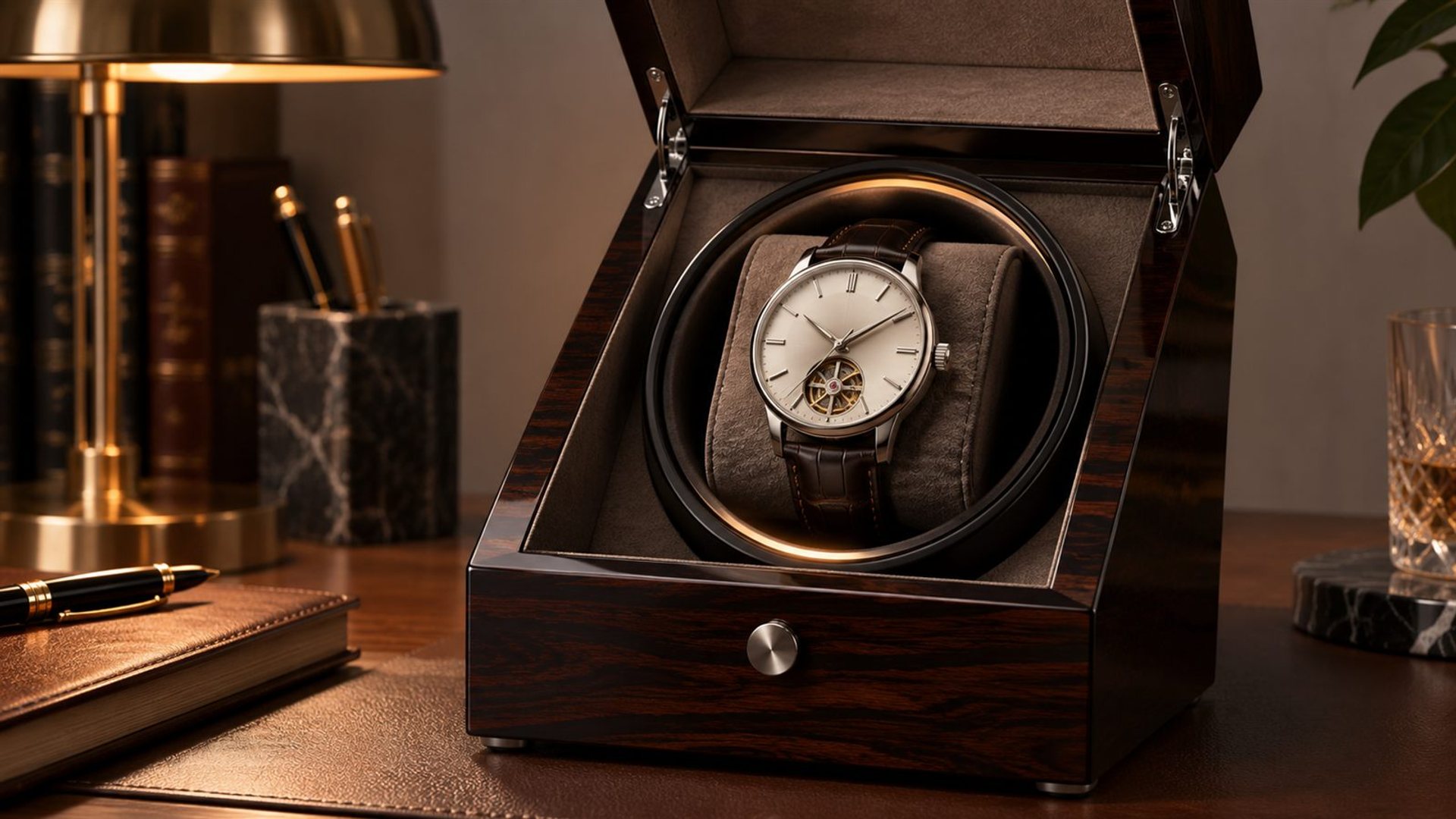
Watch winder use is a matter of convenience for an automatic mechanical watch, not a universal maintenance requirement. The rotating holder keeps the movement's winding rotor active while the watch is off the wrist. It can spare you from resetting time and complications after a pause, but an automatic watch may also be allowed to stop and be restarted according to its maker's instructions. A smartwatch cannot be charged by a winder.
The distinction starts with the movement inside the case. “Mechanical,” “automatic” and “smartwatch” describe different ways a watch operates. A winder is relevant only when a watch has an automatic mechanical winding system and the manufacturer permits its use.
What does a watch winder actually do?
An automatic watch stores energy in a mainspring. A rotor moves as the wearer moves, helping wind that spring. A winder holds the watch and rotates it to simulate some wrist motion while it is not being worn. The aim is to keep the movement running, often so the owner does not need to reset the time, date or more complicated indications later.
A winder is not a charger. It does not put electricity into a battery, and its motion will not revive a quartz or connected watch. Nor does it polish, clean or service a mechanical movement. It is an accessory for keeping an eligible automatic movement wound between wears.
Rolex's care guidance explains that its automatic watches wind while worn and that a stopped watch should be wound manually before use. The guidance gives an owner a normal restart route without claiming that a winder is indispensable. Follow the instructions for your exact calibre rather than applying Rolex's crown turns to another watch.
When does a winder add real convenience?
The strongest case is a watch with indications that take time to reset, such as a calendar or moon phase, and that you rotate into use frequently. Keeping it running can save a repetitive setup. The benefit is time and ease, not proof of better long-term movement health. If you wear one automatic watch every day, your normal wrist movement may make an additional box unnecessary.
Consider your actual rotation. If a watch rests for a week and you enjoy setting it before wearing it, you may prefer a protected storage case. If you alternate several watches every morning and dislike resetting each one, a carefully configured winder can be useful. The answer belongs to your routine and the movement's maker guidance, not to the price or status of the watch.
Some complications have particular setting restrictions. Avoid changing a date or calendar during a movement's prohibited interval if the manual warns against it. A winder may reduce how often that task arises, but the operator still needs to know the correct procedure when the watch eventually stops.
Does continuous winding improve accuracy or longevity?
Do not assume it does. A winder can keep the movement operating, but rate accuracy depends on the specific movement, regulation, position, power state and condition. It cannot compensate for a watch that needs professional service. If a watch consistently gains or loses time beyond its maker's guidance, discuss it with an authorised service provider.
Whether continuous running or occasional stopping is preferable for long-term wear is not answered by a blanket rule for every calibre. A running mechanism continues to operate and its lubricants and parts still age; a stored watch also needs proper care and eventual service. Ask the manufacturer or a qualified watchmaker about the exact model, especially for a vintage or unusual movement.
A winder can create a false sense of security if a watch remains on display but is never inspected. Check the case, strap, crown and water-resistance service interval according to the maker. A continuously moving watch is not necessarily a maintained watch.
How do you choose suitable winder settings?
First obtain the movement maker's or watch maker's recommendation for direction and turns per day. Some automatic calibres wind in one direction, others in both; a box with a dramatic rotation pattern is not automatically correct. If no reliable setting information is available, ask the manufacturer or an authorised watchmaker rather than guessing from an online table for a similar model.
Select a holder that supports the watch securely without compressing its strap or bracelet. The watch should not knock against the enclosure. Consider noise, power supply and where the box will sit. Keep it away from strong magnets, heat, moisture and direct sun in line with the watch and winder manuals. A glass display case is a furniture choice, not a performance specification.
Read the winder's actual cycle: turns per day may include pauses, and the effective winding depends on direction and movement. More turns are not necessarily better. If the watch stops in the winder, confirm the settings, power source and movement condition before assuming the watch is defective.
What if a mechanical watch has stopped?
Use the manufacturer's restart instructions. Rolex describes unscrewing and winding the crown of a stopped Rolex before wearing it again; its guidance states a minimum number of turns for adequate partial winding on its watches. Jaeger-LeCoultre advises against shaking an automatic watch to restart it and directs owners to use the crown. These are brand-specific examples, not permission to use the same sequence on every model.
Set the time and complications carefully. If you do not know whether the hands are in the morning or evening portion of the cycle, consult the manual before adjusting the date. Avoid forcing a crown. If winding feels rough, the watch does not start, or it stops unusually quickly, seek professional assessment rather than leaving it on a winder indefinitely.
Does VERTU Grand Watch need a winder?
No. The VERTU Grand Watch is a connected smartwatch with an electronic display and rechargeable battery. Its design may evoke mechanical watchmaking, but the digital dial does not turn it into an automatic mechanical movement. It needs its approved charging method and normal connected-device care, not rotation in a winder.
Before purchasing an accessory, identify the exact watch: a mechanical automatic, a manually wound mechanical, a quartz watch or a smartwatch. A manually wound watch lacks the automatic rotor that a winder is designed to move; a quartz or smartwatch requires a battery or electrical charge. The VERTU wearables collection helps distinguish current connected models from traditional mechanical pieces in a mixed watch cabinet.
Keeping separate storage and charging spaces for different watch types avoids the common mistake of treating every luxury watch as mechanically identical. Use a winder only where its action is relevant and supported by the maker.
Frequently asked questions
Will an automatic watch be damaged if I let it stop?
Stopping after its stored power runs down is normal for many automatic watches. Restart it using the exact maker's instructions and maintain the recommended service schedule. Ask a specialist about an unusual or vintage movement.
Can I put a manually wound watch in a winder?
A conventional winder is designed to move an automatic rotor, which a manually wound watch does not have. Store and wind a manual watch according to its maker's instructions instead.
Does a winder charge a smartwatch?
No. A smartwatch needs its approved electrical charging accessory. Moving it in a rotating box does not charge its battery.
How many turns per day should I set?
Use the direction and turns-per-day guidance for the exact movement. Do not copy a setting from a different calibre; ask the manufacturer or qualified watchmaker if the information is unavailable.