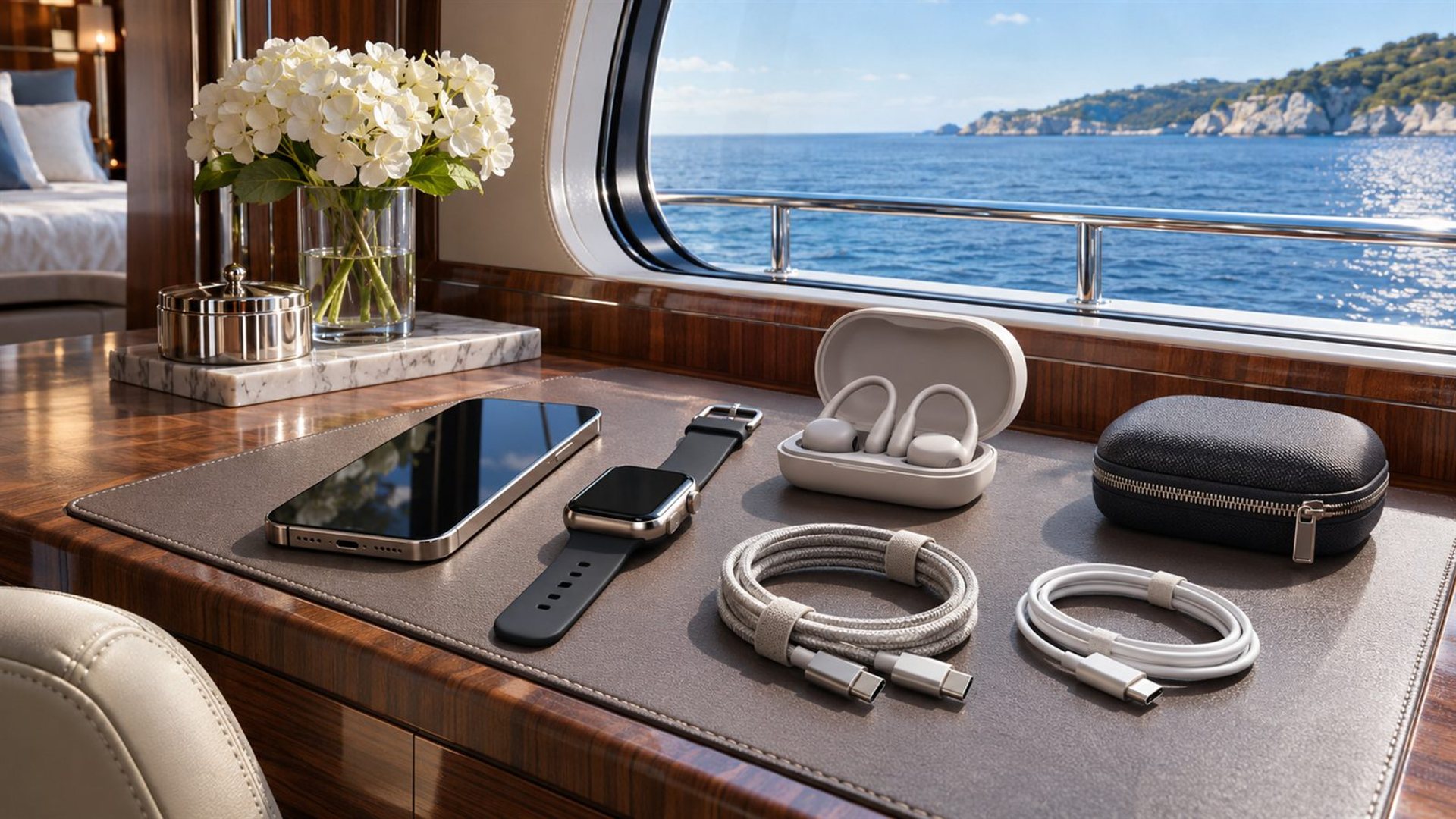
A superyacht charter packing list should start with three technology questions: how you will connect at sea, where you can charge, and how you will keep devices away from spray and heat. Ask the charter team about the actual yacht and route before packing. A marina Wi-Fi signal, a coastal mobile plan and an onboard satellite connection are different services with different limits.
A well-prepared phone is useful for photographs, documents and messages. It is not a substitute for the captain's navigation or emergency communications. The checklist below keeps guest convenience and vessel safety in their proper places.
What should you confirm about connectivity before departure?
Ask which internet system the vessel uses, whether guest Wi-Fi is included, whether there is a data allowance, and what coverage is expected on the planned route. Get the network name and access instructions from the crew rather than assuming the yacht's name identifies an open network. Clarify whether video calls or large uploads are practical while underway.
Satellite service can help beyond ordinary mobile coverage, but its availability depends on equipment, plan, territory and conditions. Starlink's own in-motion guidance says international-water use requires an eligible plan. That does not mean every yacht has Starlink, every charter includes unlimited data, or every stop permits the same service. Ask about the installed system on your vessel.
Before leaving port, download the files you genuinely need: charter contact details, travel documents, a route summary shared by the crew, tickets for shore visits and maps for destinations. Keep sensitive documents in a protected account or encrypted device storage. A printed copy of an essential contact number can be useful if a phone is flat or misplaced.
Will your mobile plan work offshore?
Do not assume it will. A phone may connect normally in a harbour and lose terrestrial signal further out. International roaming charges may also differ when the route crosses borders or uses a maritime network. Review your operator's terms and ask the charter team which connection guests typically use on that route.
Set expectations with colleagues or family before departure. If you need a daily check-in, agree on a time when the yacht expects a reliable connection. Queue large photo backups for a stable, approved network rather than letting them consume a shared guest link without warning. Offline copies make routine work possible when the network is intermittent.
A METAVERTU MAX can serve as the guest's phone in this routine, but no handset alone supplies guaranteed open-water internet. Its usefulness depends on the available mobile or onboard connection, the software you have installed and the services you can access in the region.
What is the correct role of the yacht's safety communications?
Leave navigation, distress calls and marine radio operation to the crew and the vessel's approved equipment. The International Telecommunication Union's maritime safety overview explains why ship radio systems and distress signalling are distinct from personal connectivity. A guest's phone or smartwatch is not a replacement for these systems.
Ask the captain how guests should report an urgent concern, especially when moving between decks or going ashore. Save that instruction in your phone, but listen to the crew's briefing in person. If the network fails, the chain of communication should still be clear.
Where can you charge safely on board?
Ask the crew which cabin outlets are intended for guests, what plug type and voltage they provide, and whether power stays available while the yacht is at anchor. A travel adapter changes plug shape; it does not automatically make an incompatible device suitable for a supply. Read the rating on your own charger and use a maker-approved cable.
Pack a modest charging kit: one reliable phone charger, the correct cable, the dedicated watch charger, and the earbuds' charging case if you use them. Label similar cables so you can collect them at the end of the charter. Avoid spreading accessories across several cabins and outdoor seating areas.
Charge on a stable dry surface away from washbasins, drinks, direct sun and soft furnishings that could trap heat. Do not run a cable across a passage or use an outlet the crew has reserved for vessel equipment. If a charger, plug or power bank becomes hot or damaged, disconnect it and ask the crew for guidance.
Should you pack a power bank?
A compact, correctly rated power bank can be useful for shore visits, but confirm airline and charter rules before travel. Spare lithium batteries and power banks generally belong in cabin baggage for flights, with applicable capacity limits. On board, keep the bank dry, protected from impacts and accessible for inspection. Do not leave it on a sunlit deck or in a closed hot bag.
Count expected charging opportunities rather than carrying the largest possible battery. If the yacht provides dependable cabin power, a small reserve for tender rides and shore excursions may be sufficient. If the itinerary involves long days away from the vessel, plan the reserve against the actual phone and camera workload.
How do you protect devices from spray and salt?
Assume that an exposed deck can become wet even when the weather looks calm. Use a protective pouch or dry compartment during tender transfers and keep devices off the rail. Salt residue is different from clean fresh water; after exposure, follow the specific maker's cleaning instructions rather than rinsing every device indiscriminately.
Do not infer a waterproof rating from a product's appearance. The VERTU wearables collection includes different watches, rings and bracelets, each with its own materials and care conditions. The Agent Watch, for example, has a documented phone-dependent Agent workflow; it should not be described as an independent marine communicator. CRUSH OWS earbuds likewise should be treated according to their exact product instructions, not a generic claim about open-ear designs.
A soft dry cloth, a small case and a consistent place to store each device are more useful than an improvised plastic bag left in the sun. Remove wet accessories before placing them in a charging case. If a device has become soaked, stop using or charging it and seek the manufacturer's care advice.
What should you prepare for photographs and files?
Free storage before departure. Save a local copy of essential travel information and set photo backup to run only when you approve a suitable connection. A single day of high-resolution video can consume substantial storage and shared bandwidth. Select the shots you want to transmit while aboard; leave bulk uploads for a dependable connection ashore.
Make a small shared album only if other guests agree. Respect the charter party's privacy preferences, particularly around crew, other vessels and location tags. If you use a work phone, confirm whether company policy permits connection to the yacht's network before you board.
How should you organise a day's shore excursion?
Leave with a charged phone, offline address, return time and the crew's agreed contact method. Carry only the accessories you expect to use. A watch may make notifications convenient, but its connected functions can depend on the paired phone and network. VERTU's Agent Watch launch explanation describes its Agent request path through a paired phone, which is a reason to test the full connection before relying on a watch prompt ashore.
Check the local weather and dress for the tender ride. Keep small electronics in a closed bag rather than a loose pocket. The crew's return procedure is more important than any map app: agree on the meeting place and time before leaving the vessel.
What should go on the final tech checklist?
Record the yacht's guest Wi-Fi terms, mobile and satellite expectations, and the crew's contact procedure. Download documents and maps. Pack tested chargers, cables and any needed adapters. Confirm the airline treatment of power banks. Prepare dry storage for devices, an offline backup for critical information and an agreed photo-sharing plan. Test the whole kit before sailing, not for the first time at anchor.
The best kit is not the largest. It is a small set of devices whose connectivity, power and protection you have actually checked against the vessel and route.
Frequently asked questions
Will a phone have signal throughout a superyacht charter?
No guarantee exists. Coastal mobile coverage, roaming and onboard service differ by route and plan. Ask the charter team and prepare offline copies of essentials.
Can I use the yacht's Wi-Fi for video calls?
Perhaps, depending on the installed system, current coverage and guest data rules. Ask before scheduling a time-sensitive call or large upload.
Can a smartwatch replace the crew's radio?
No. Marine safety communication belongs to the vessel's approved equipment and trained crew. A consumer watch is for personal convenience.
Should I charge devices on deck?
Prefer a dry, stable cabin location approved by the crew. Spray, heat and loose cables make exposed charging a poor routine.
What is the most useful item to download first?
Save the crew's contact details, departure and return instructions, travel documents and shore addresses offline before leaving a dependable network.