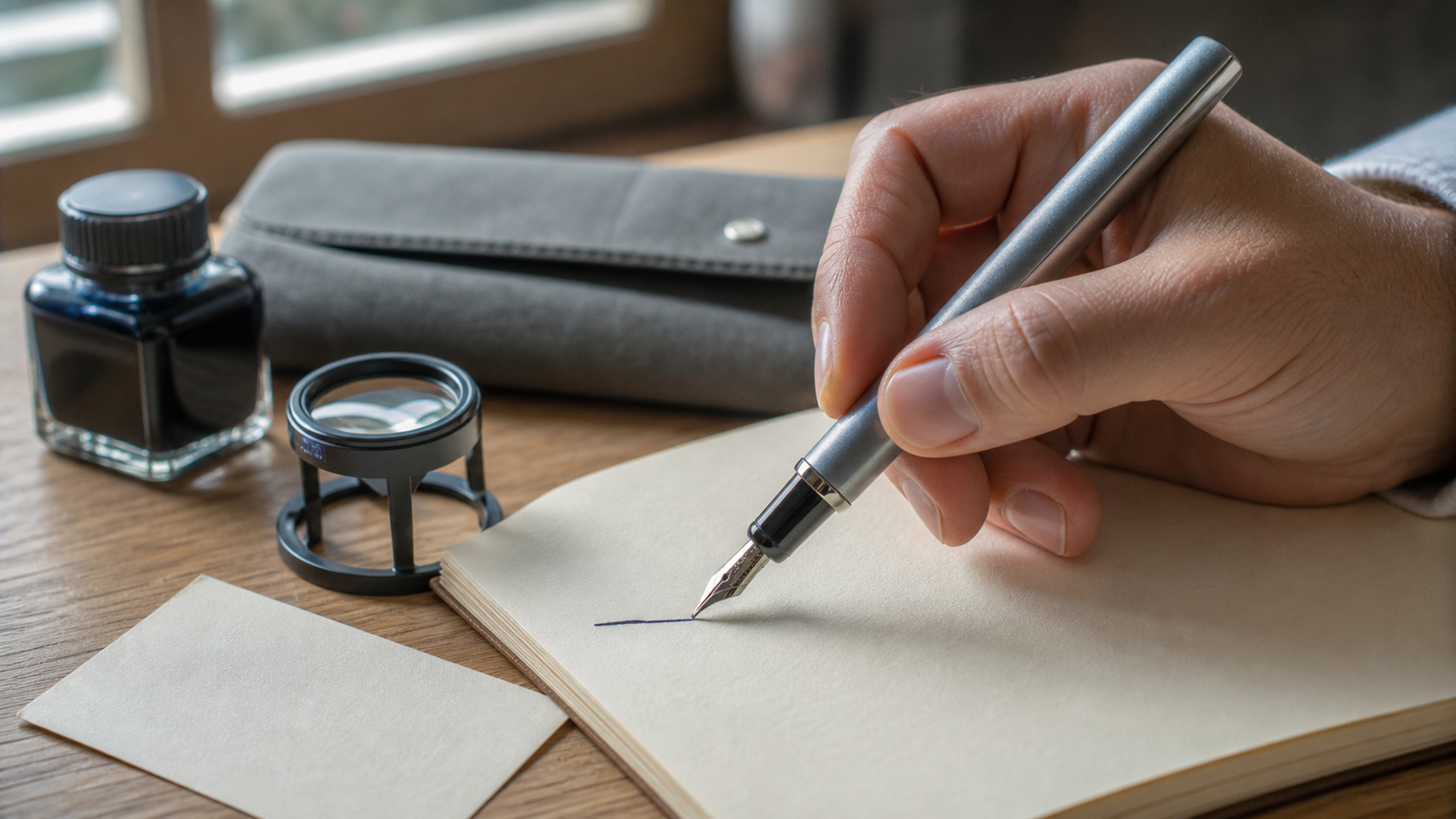
To store a fountain pen when not in use, decide first whether the pause is brief or extended. Keep a pen used regularly capped and protected from heat, while a pen being put away for a long period should generally be emptied and cleaned according to its maker's instructions. Allow cleaned components to dry before closing them in a case. The exact procedure depends on the filling system, ink and pen materials.
Key Takeaways
- A short break between writing sessions is different from extended storage.
- For a long absence, remove ink and flush the pen as its maker directs.
- Do not add household detergent or mix inks without checking compatibility.
- Keep the pen in a protective case at room temperature and inspect it before refilling.
How long can a fountain pen sit with ink?
There is no single safe number of days for every pen. Cap seal, feed design, ink formulation, ambient conditions and the amount of ink remaining all affect how quickly a pen dries. A pen used every few days may remain ready to write, while the same pen with a loose cap can dry sooner. If you know you will not use it for an extended period, the safer decision is to consult its maker's storage guidance rather than leave ink in it indefinitely.
Montblanc's writing-instrument care guidance recommends removing ink and cleaning with additive-free water when a pen will not be used for an extended time. The maker also recommends room temperature and normal humidity for storage. That is a brand-specific recommendation, but it illustrates the main concern: ink can dry in the feed and complicate the next use. A pen with permanent or pigment-heavy ink may demand particular attention under its own instructions.
Do not turn an arbitrary calendar interval into a rule. “I will use it next week” and “I am storing it until next season” call for different choices, but the boundary depends on the pen and ink. If you are unsure, clean it before storage. The inconvenience of a careful flush is usually lower than the inconvenience of a clogged feed or uncertain residue later.
Should you store a fountain pen inked or empty?
For a short, predictable pause, an inked pen can remain capped if its maker allows it and you can monitor it. For extended storage, empty and clean it. Remove a cartridge according to the pen's instructions, or expel ink from a converter or piston mechanism into an appropriate waste container. Do not return used ink to the bottle: contamination can compromise the remaining supply.
After emptying, flush the permitted parts with clean water until the water runs sufficiently clear under the maker's procedure. LAMY's fountain-pen FAQ explains that dried ink can encrust the nib and feed and that a converter can be filled with water to flush the system repeatedly. It says plain water can be used to soak an appropriate front section and warns not to add soap or detergent. Only disassemble a pen as far as its manufacturer permits; delicate finishes and piston mechanisms may need service rather than home teardown.
How do you clean the nib and feed before storage?
Begin with the pen's own filling and cleaning instructions. Remove or empty the ink supply, then cycle clean water through the feed using the converter or filling mechanism where appropriate. Use gentle movements; force can damage a nib or seal. If the water remains coloured, repeat rather than increasing pressure or adding an unapproved solvent. A stubborn blockage may require a model-specific soak or authorised service.
Pay attention to what is removable. A cartridge pen, converter pen and piston filler can have different cleaning paths. Some nib units unscrew; others should stay assembled. A decorative barrel may not tolerate immersion even when the feed can be rinsed. Keep water away from electronics, wood, leather, gemstone details and other sensitive trim unless the maker expressly allows contact. Dry the exterior with a soft cloth and let the cleaned internal parts air-dry as directed.
Ink choice can change maintenance. LAMY advises rinsing thoroughly before changing ink colours because mixing formulations with different pH values can create precipitation. If you are changing inks after storage, clean the old ink out first. Do not assume that every bottle labelled “fountain pen ink” behaves the same; follow both pen and ink maker guidance.
How dry should the pen be before you put it away?
Allow rinsed components to dry sufficiently so free water is not trapped in a closed case. A soft cloth can remove exterior moisture; the feed may need additional airflow. Follow the maker's instructions for orientation and reassembly. Do not use a hair dryer, radiator or direct intense heat to speed the process, particularly around adhesives, lacquer, resin or plated trim.
Check that the cap, grip section and converter are dry before closure. If you must store removable parts separately, label them so the correct components are reunited later. Avoid a sealed container while moisture remains. A protective pen case should prevent scratches and knocks, not become a damp chamber. If the pen has a material-specific case or sleeve, verify that it is clean and dry as well.
Should a fountain pen be stored nib-up or horizontal?
The answer depends on whether the pen is inked, its feed and cap, and the manufacturer's recommendation. Horizontal storage is often practical for a capped pen in regular use because it avoids a prolonged extreme orientation, while nib-up storage may reduce some leakage risks in particular situations. There is no universal orientation that fixes a poor cap seal or stale ink. For a cleaned, empty pen, physical protection and a dry environment matter more than a debate about gravity.
Do not keep a valuable pen loose in a drawer where the nib can be struck. A fitted case or tray can keep it from rolling and protect the finish. Avoid placing it against sharp metal objects, keys or ink-stained materials. If the pen is a collector's item, record the original box and service information, but do not assume a decorative presentation box is automatically the best long-term storage environment.
What temperature and environment are best?
Choose an ordinary, stable indoor environment away from direct sun, radiators, car interiors and damp storage spaces. Heat can affect ink and components; excess moisture can affect packaging and finishes. Montblanc recommends room temperature and normal atmospheric humidity for its writing instruments. Without a model-specific numerical range, avoid promising that one temperature or humidity percentage is safe for every pen material.
Inspect the case periodically for moisture, dust and pressure marks. Leather sleeves, lacquered barrels, metal fittings and wood details can age differently. If you store several pens together, give each one a sleeve or separate slot so clips and nib ends do not strike neighbouring barrels. Keep ink bottles upright, sealed and away from light according to their own labels; a pen-storage method does not automatically describe how to store ink.
How do you prepare a stored pen for use again?
- Inspect the barrel, nib, cap and filling mechanism for visible damage or residue.
- Check that all cleaned parts are assembled correctly and seals appear intact.
- If the pen was stored for a long period, follow the maker's recommended pre-use cleaning.
- Fill with a compatible fountain-pen ink, avoiding unverified mixtures.
- Test a few lines on ordinary paper without pressing the nib.
- If flow is poor, troubleshoot gently or seek service rather than forcing the feed.
Do not assume a first hard start means permanent damage. A feed may need time to saturate after filling, while dried residue may need another approved flush. If there is leakage, a crack, a stuck piston or a misaligned nib, stop and contact a qualified repair provider. The goal is to preserve the instrument, not to make it write at any cost.
How should VERTU Marengo Fountain Pen be stored?
The current VERTU Marengo Fountain Pen product page advises using quality fountain-pen ink, rinsing the feed with clean water every two to three ink fills, and allowing it to air-dry. That is a specific maintenance cue for the named pen, not a substitute for a full storage manual. Before an extended period without use, confirm the edition's filling system and the official method for emptying and cleaning it.
Marengo is also a writing object with a finished exterior. Protect the barrel and trim from hard contact and store it in a suitable case after it is clean and dry. If the pen has a bespoke or different edition, verify that its care instructions match the standard model. Do not infer that every VERTU fountain pen uses the same materials or can be soaked in water; the feed and exterior may need different treatment.
What if you use permanent or unusual ink?
Give the ink maker's instructions more weight. Permanent, pigment or specialty formulations can have different cleaning demands from ordinary dye ink. Montblanc recommends more frequent cleaning for its permanent inks and warns that pigment can settle in the feeder if maintenance is neglected. That advice applies to its specified products, but the general purchasing lesson is clear: a low-maintenance storage plan should be agreed with the ink you actually use.
If you discover old, dried ink, do not attack it with alcohol, acetone or a needle. These can damage feeds, seals or plating. Begin with the manufacturer's approved water-based procedure. If it does not restore flow, professional service is safer than aggressive disassembly. Write down which ink was last used; that information can help a technician choose an appropriate cleaning approach.
What storage mistakes should you avoid?
| Mistake | Possible consequence | Better choice |
|---|---|---|
| Leaving ink during a long absence | Dried feed or difficult restart | Empty and clean as the maker directs |
| Using household detergent or solvent | Damage to pen parts or seals | Use approved clean-water procedure |
| Closing a damp pen in a case | Trapped moisture and finish concerns | Allow permitted parts to air-dry |
| Storing loose with metal objects | Scratches or nib impact | Use a protective sleeve or tray |
Prevention is easier than recovery. A short cleaning routine before storage gives you a clearer starting point when the pen returns to rotation. If a model is unusually delicate or valuable, document the maker's advice and arrange authorised service rather than improvising.
Frequently asked questions
Can I leave a fountain pen unused with ink in it?
For a brief pause, possibly, if the maker permits it. For extended storage, empty and clean the pen according to its instructions.
Should I use soap to flush the feed?
Do not assume so. LAMY advises plain water for its described cleaning method and specifically warns against soap or detergent.
Can I store a fountain pen in its box?
Yes, if the pen is clean and dry and the box protects it without trapping moisture or pressing on the nib. Check the exact materials.
What should I do if the pen will not write after storage?
Follow the maker's gentle cleaning and filling instructions. If flow remains blocked, seek qualified service instead of forcing the nib or feed.
Conclusion
Store a fountain pen according to how long it will rest and what ink it contains. Keep a frequently used pen capped and protected; before extended storage, empty and clean it, allow permitted components to dry and place it in a stable indoor environment. For VERTU Marengo, use the official feed-rinsing guidance and confirm any edition-specific instructions before putting it away.