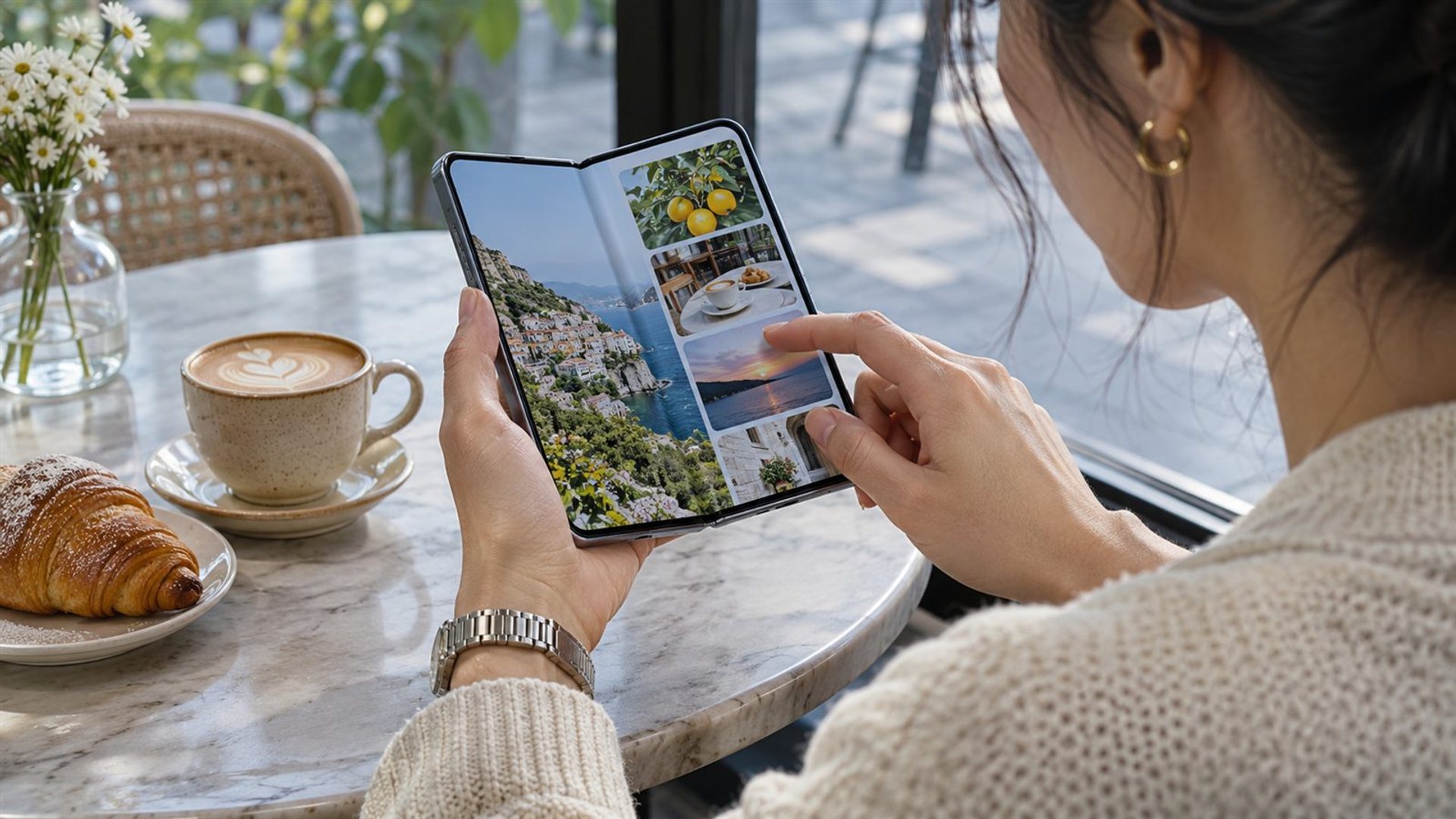
A lightweight foldable phone can feel easier to carry, but all-day handheld comfort depends on more than its mass in grams. Width, thickness, balance, case, grip and the length of each task all change the experience. A foldable that feels fine for messages while closed may tire one hand during a long unfolded reading session. Test the actual device in both positions before deciding.
There is no universal weight at which a foldable becomes “too heavy.” The useful question is whether its form fits your routine: pocket carry, standing calls, travel reading or desk-based work. This guide offers a repeatable way to judge that fit and explains how to compare official specifications without turning them into a comfort guarantee.
Why can the same weight feel different?
Mass is only one part of hand effort. A wide unfolded device places the far edge farther from your palm, so the wrist and fingers may work harder to stabilise it. A narrow folded device of similar mass can feel easier because the grip is compact. Centre of mass and surface texture also affect whether you can hold the phone securely without squeezing it.
Cases alter both mass and shape. A slim protective shell may add little weight but improve grip; a thick case or stand may change balance and pocket bulk. Compare the phone in the configuration you intend to carry. The manufacturer's listed weight often refers to the bare handset, not the complete set of case, strap and accessories you will actually use.
Hand size and task duration matter. A device that is comfortable for a thirty-second reply may feel different through a twenty-minute call. Do not treat a brief shop demonstration as proof of all-day comfort. Simulate the actual actions you perform repeatedly.
What does the gram figure tell you?
It gives a consistent starting point for comparing specified models. Samsung's Fold model comparison lists different weights across generations, illustrating that “foldable” is not one fixed mass. Compare the same units and current exact configurations. A few grams on paper may be difficult to notice, while a change in width or balance can be obvious.
Check whether a cited weight includes a case or special finish. A leather, metal or bespoke edition may differ from a standard model. If a product page omits weight, do not borrow a number from a related device. Ask the seller for the precise configuration or weigh a sample if one is available.
Do not confuse lower weight with higher durability or better battery life. Those are separate characteristics that require their own evidence. A lighter device can be well engineered, but the weight number alone does not establish resistance to impact, hinge life or runtime.
How should you test folded use?
Hold the phone in your usual hand and type a short message on the outer screen. Reach the far corners without shifting the grip excessively. Then try a call, a map check and taking a photograph. Notice whether the device feels secure when you turn it, and whether its thickness changes your pocket or bag routine.
Walk for a few minutes while carrying it, if the seller permits a realistic trial. A compact foldable may feel convenient in a jacket pocket but less comfortable in a shallow trouser pocket. Test retrieving it one-handed without putting pressure on the hinge. A case can improve grip but might catch on fabric; evaluate that combination, not only the bare phone.
Think about frequency. If most of your day is spent on the cover screen, the folded shape deserves more weight in your decision. If you unfold constantly, outer-screen comfort is only one part of the answer.
How should you test unfolded use?
Open the phone and read a page of text, scroll a document and hold a video call posture for several minutes. Alternate hands and try two-handed support. Notice where the device's weight sits relative to your palm. A larger screen may make reading easier visually while increasing the span your fingers must support. Both effects belong in the decision.
Place the phone on a desk or stand for longer sessions. A supported position changes the weight problem entirely. If you mainly use the inner screen at a table, a heavier foldable may be acceptable because you rarely hold its full mass for long. If you expect to read standing on a train, the same device may feel less convenient.
Check whether the case or stand supports the angles you need without blocking the hinge or controls. Samsung's foldable care guidance warns against excessive force when folding and describes model-specific case handling. Follow the instructions for the foldable you actually own; an accessory should not make the hinge harder to use.
When is a flip better than a book-style foldable?
A flip folds a phone-sized display into a shorter package. A book-style foldable opens to a wider canvas. Those designs solve different problems. A flip may be easier to carry in a small bag, while a book-style device may better support documents or side-by-side apps. Compare how each feels folded and open, not simply which one posts the lower weight.
For one-handed use, width and controls may matter more than the published mass. Try answering a call, checking a notification and navigating with the outer display. For content work, try the inner display with both hands or a stand. The best category is the one that reduces effort in your most common tasks.
Do not assume a smaller closed footprint means it is thin. A folded flip can be thicker than a flat handset in a pocket. Pocket comfort is a three-dimensional issue: height, width and thickness alongside weight.
How do VERTU foldables compare in scope?
The VERTU knowledge base identifies AlphaFold as a book-style foldable family and Quantum Flip as a flip-phone family. A current AlphaFold Stitched Calfskin product page lists 264 g for that specified edition. That figure is useful for setting expectations, but it does not establish how another edition, case or user's hand will feel.
Use the official page for the precise edition and market when checking current dimensions and weight. Then try the posture that matters: unfolded document review, folded messaging or video calls. AlphaFold's larger inner display can change the working position; Quantum Flip's compact folded form changes carry. Neither form factor guarantees a comfortable day without a personal trial.
If a chosen edition has a special finish, ask whether the display and hinge can be serviced locally and whether the case you want is compatible. Those ownership details can be more consequential than a small weight difference. Keep aesthetics, function and service in the same evaluation.
What if your hand becomes tired?
Change the setup before assuming the phone is unusable. Switch hands, use two-handed support, rest the device on a table or choose a stable stand for long video and reading sessions. Reduce continuous handheld time. If discomfort is persistent or unusual, do not force a posture simply to justify a purchase; choose a device or workflow that suits you.
A case with a better grip may help some users, but a strap or ring grip can change how the phone folds, rests and charges. Confirm compatibility and avoid attaching anything that presses on the flexible screen or hinge. The goal is a secure hold with ordinary effort, not a workaround that creates another mechanical problem.
Frequently asked questions
Is 264 g too heavy for a foldable?
It depends on the shape, case and how you use it. VERTU lists 264 g for one AlphaFold Stitched Calfskin edition, but a number alone cannot predict comfort. Hold the exact configuration through realistic folded and unfolded tasks.
Does a lighter foldable always feel better?
No. Width, balance, texture and task duration can outweigh a modest difference in grams. A lighter device with a slippery finish may require more grip effort than a slightly heavier one you can hold securely.
Should I judge it with a case attached?
Yes, if you intend to use that case daily. It changes mass, thickness and sometimes grip. Confirm the case fits the exact model and does not obstruct folding or controls.
Is a flip lighter than a book-style foldable?
Often the formats differ, but compare exact models rather than categories. A flip and a book-style device also provide different screen sizes and carrying shapes. Choose according to the tasks you do most often.