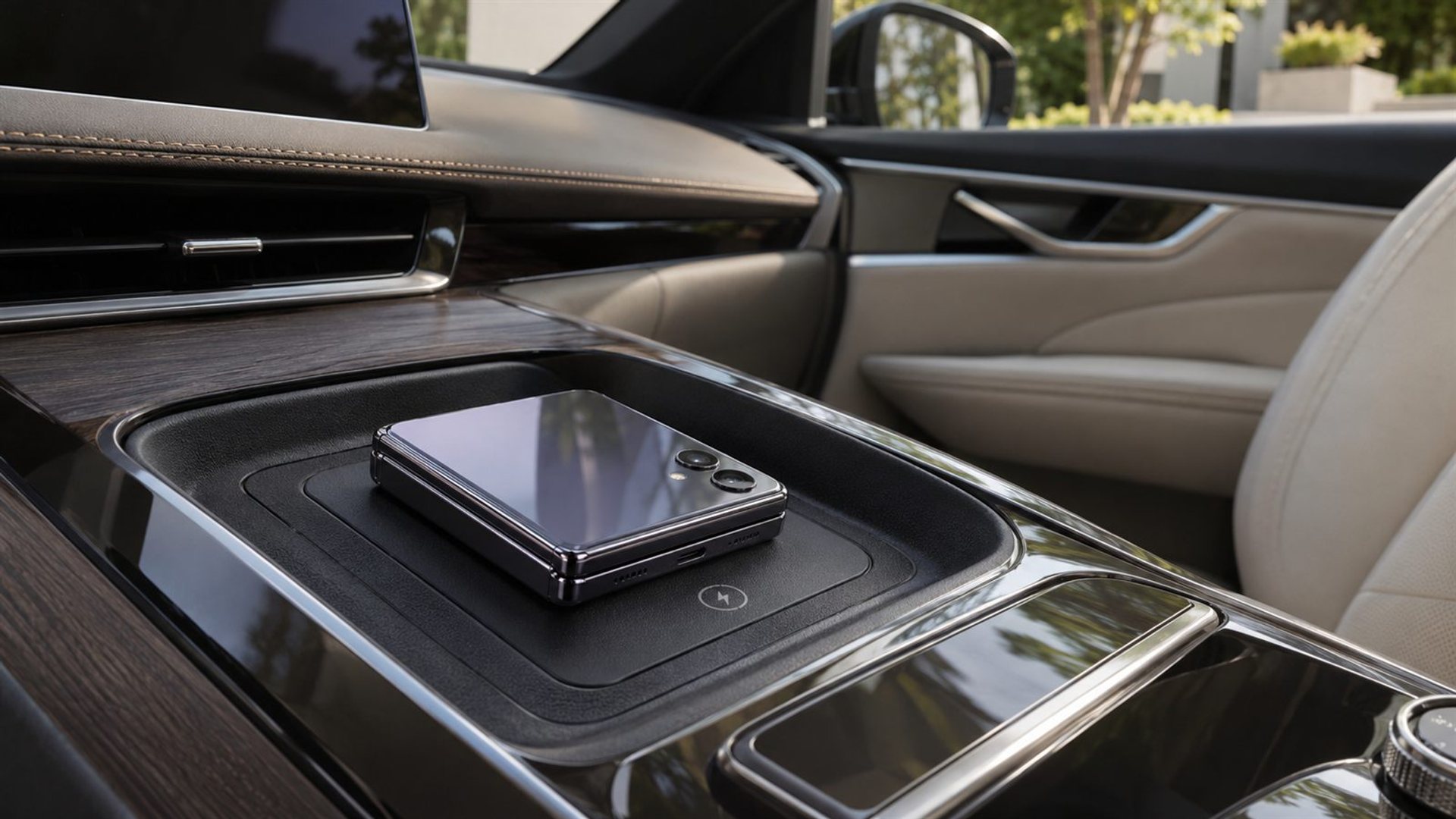
Flip phone wireless charging in a car is possible only if the exact phone model has a compatible wireless charging receiver and the car pad can align with it. Folding shape is not proof of support. Before moving the phone around the tray, check both product specifications; if the handset does not support wireless charging, no placement adjustment will make the pad work.
Even with compatible hardware, a car creates a harder charging environment than a bedside pad. The phone may slide as the vehicle moves, the charging pocket may be too short for the unfolded handset, and a case may increase the gap between coils. A good diagnosis starts with compatibility and then moves to position and power.
Does every flip phone support Qi charging?
No. Flip phones vary in internal design, charging receiver and supported standard. The Wireless Power Consortium's Qi guidance explains that certification is a way to check tested interoperability. Search the exact model and variant, then inspect the manufacturer's current specifications. Do not rely on a review of a similarly named phone or the fact that another foldable charges wirelessly.
Check the car as carefully as the phone. A dashboard storage tray, a ventilated phone holder and a charging pad can look similar. Find the charging symbol in the car manual, note any supported standard or accessory requirement, and confirm whether the feature is available on your vehicle's trim. If it is an aftermarket pad, use its own model number and instructions.
What is known about VERTU Quantum Flip?
The current VERTU Quantum Flip page describes the phone and its charging section but does not establish Qi wireless receiver support. Therefore, do not assume that a Quantum Flip will charge on a car pad. Ask VERTU to confirm wireless charging support for the exact configuration and market, preferably against the technical specification for your device, before buying a pad or planning a cable-free journey.
This is a useful example of why general statements about “flip phones” are insufficient. A product may support fast charging through a cable while lacking a compatible wireless receiver. The reverse is possible for other models. The charging method, not the folding mechanism, answers the compatibility question.
Why does a compatible phone fail to charge in a car?
Coil position is often the next variable. Qi power transfer depends on the transmitting and receiving coils being placed within the charger's working area. The Consortium's technical explanation of Qi components notes that housing, shielding and coil distance can affect transfer. A car tray designed around a conventional slab phone may place a short, closed foldable too low or too high.
Start with the phone centred in the pad's marked charging zone. Wait a moment for the charging indicator on the handset, rather than relying only on a light in the car. If nothing happens, move the phone in small increments while it remains safely secured. Do this while parked. Repositioning a device while driving is a distraction and can let it become a loose object.
When the phone is folded, its charging coil may sit in only one half of the body, depending on the design. Turning the handset through 180 degrees can change which half is over the pad. Do not assume the outer display marks the coil location. Use the manufacturer's placement guidance if available.
Could the case or accessory be the problem?
Yes. A thick case, metal plate, wallet attachment or grip can increase distance or obstruct the intended contact area. Remove the case for a short stationary test if the phone maker allows it, then retry in the same position. If the bare phone charges and the cased phone does not, the accessory is a likely cause. Choose a case whose maker expressly supports the specific phone and charging arrangement.
Do not place keys, coins or cards between the phone and the pad. Car pads and Qi equipment may have foreign-object detection, but that is not a reason to leave metal objects in the charging area. Inspect the pad for heat, warning lights or a stopped charging session and follow the car or charger manual if any warning appears.
Does the phone need to be open or closed?
There is no universal answer. A closed flip phone may fit the tray but align its receiver poorly; an open phone may place the coil better but exceed the charger's safe retaining area. Check the phone and charger manuals for an approved orientation. A placement that starts charging but lets the phone move on bends is not a useful solution.
Test the stable position with the car parked. Put the phone in the tray, confirm the charge icon on the handset, and gently check that it cannot slide out of the intended area. If the pad has a clamp, verify that the clamp does not press against the hinge, buttons or screen edge. An improvised wedge may trap heat or interfere with foreign-object detection.
Why is car-pad charging sometimes slow?
A charging pad's advertised maximum is not the power every phone receives. The car's supply, the phone's accepted profile, temperature, alignment, case thickness and background activity all influence the rate. Navigation and a bright screen can consume power while the phone is charging, making the battery percentage rise slowly or remain almost steady.
Compare the phone's battery level after a short parked test with navigation off, then repeat under your normal driving conditions. If the pad repeatedly pauses or the handset becomes unusually warm, stop the test and follow the device and vehicle guidance. Avoid claiming a fault solely from a slower rate than a wired charger.
What is the quickest way to isolate the cause?
Use a simple sequence. First, verify that the exact phone model supports the relevant wireless standard. Second, test the phone on a known compatible stationary pad. Third, test another confirmed compatible phone on the car pad. Fourth, remove accessories and check the car pad's power or settings. This sequence distinguishes a missing receiver from a faulty charger and a placement problem.
If neither device charges in the car, the pad or its supply deserves attention. If your flip phone charges on a desk pad but not in the car, tray geometry, alignment and vehicle power become more plausible causes. If it charges nowhere wirelessly, return to the handset specification before seeking repair.
Is a cable the better option for a long drive?
Often it is the more predictable choice when Qi support is unconfirmed or the car tray cannot hold a foldable in a stable charging position. Use a suitable cable and vehicle power source specified for the phone. Keep the cable routed away from steering and other controls. A wired connection also gives a clear fallback when navigation places extra demand on the battery.
For Quantum Flip owners, this decision should follow the exact device's current charging guidance. For a separate ownership question, our flip-phone hinge longevity guide explains daily handling around the fold. Charging compatibility is a separate specification and should not be inferred from hinge design.
Frequently asked questions
Will a car's wireless pad charge any flip phone?
No. The exact handset needs a compatible wireless receiver. Confirm the phone specification and the car charger's standard before trying to fix alignment.
Does Quantum Flip support car wireless charging?
The current VERTU product page does not establish Qi support. Confirm the exact Quantum Flip configuration with VERTU before relying on a car pad.
Why does charging start and stop when I drive?
Movement, coil misalignment, temperature or power delivery may interrupt a compatible charging session. Test while parked, remove obstructive accessories and follow vehicle warnings.
Can I charge a foldable while it is open?
Only if the manufacturer permits that orientation and the car tray retains the phone safely with its receiver over the pad. There is no universal rule for foldable models.
Should I buy a magnetic case to solve alignment?
Only after confirming both phone and charger compatibility. An accessory cannot add an internal wireless receiver, and its magnets or thickness may change charging behaviour.