The phrase ‘carrier-based combat drone’ sounds like a finished weapon entering service. A request for information is much earlier in the acquisition chain: a government buyer asks industry what may be feasible, available and supportable before deciding how to structure a programme. Search interest can therefore run ahead of evidence. The responsible way to read the Navy notice is to translate requested capabilities into engineering and operational questions while keeping award, cost and schedule claims explicitly unresolved.
Direct answer
The RFI is market research, not a programme award or deployment order. It signals that the Navy is testing industry options for carrier-suitable unmanned combat aircraft, but it does not establish a winning design, fleet size or operational date. The important questions are launch and recovery compatibility, deck handling, communications resilience, human command and integration with existing carrier air wings.
The status of unmanned combat aerial vehicle can change after publication. Use the update dates and source links below before making a time-sensitive, financial, safety or travel decision.
What is confirmed now
Evidence 1. The official SAM.gov notice is the controlling source for the Navy request for information and its stated market-research purpose. Read the source.
Evidence 2. The US Navy fact file describes the MQ-25A's carrier-based unmanned refuelling role and integration context. Read the source.
Evidence 3. The Congressional Research Service provides public context on Navy carrier-air-wing and unmanned-system issues. Read the source.
Evidence 4. The US Government Accountability Office explains recurring acquisition risks in major defence programmes. Read the source.
These sources support only the claims attached to them. They do not prove that every social post, reseller listing, weather headline, schedule or interpretation about unmanned combat aerial vehicle is current.
The decision matrix
| Decision factor | Evidence to collect | Why it changes the answer | Control |
|---|---|---|---|
| Acquisition stage | whether the document is an RFI, solicitation or award | each stage grants a different level of certainty | label the stage in every claim |
| Carrier compatibility | catapult, arrestment, deck footprint and sea-state limits | a flying prototype is not automatically carrier-operational | look for shipboard evidence |
| Command model | human authority, autonomy boundaries and lost-link behaviour | combat use requires accountable decisions under degraded communications | separate navigation autonomy from weapons authority |
| Network resilience | datalinks, emissions, cyber protection and fallback modes | carrier operations may occur under jamming | ask what happens disconnected |
| Payload trade-off | range, sensors, fuel, weapons and recovery reserve | every kilogram changes mission reach and survivability | compare mission profiles |
| Industrial readiness | prototype maturity, production capacity and support | a concept can be impressive but unavailable at fleet scale | distinguish demonstration from sustainment |
The matrix is the article-specific value object for unmanned combat aerial vehicle. It forces the reader to compare evidence, consequence and control instead of relying on one emotional cue. A useful result can be cautious: unknown is more accurate than a confident answer built from a missing field.
How each factor changes the result
Acquisition stage
For unmanned combat aerial vehicle, verify whether the document is an RFI, solicitation or award. This matters because each stage grants a different level of certainty. The practical control is to label the stage in every claim. The avoidable failure is that market research is reported as procurement. Write the observation beside its date, market and source; if the evidence is missing, mark the acquisition stage field unknown. Do not award a favourable conclusion merely because another factor looks strong. A reader can then see whether acquisition stage changed the answer or only changed the confidence around it.
Carrier compatibility
For unmanned combat aerial vehicle, verify catapult, arrestment, deck footprint and sea-state limits. This matters because a flying prototype is not automatically carrier-operational. The practical control is to look for shipboard evidence. The avoidable failure is that airframe performance eclipses deck reality. Write the observation beside its date, market and source; if the evidence is missing, mark the carrier compatibility field unknown. Do not award a favourable conclusion merely because another factor looks strong. A reader can then see whether carrier compatibility changed the answer or only changed the confidence around it.
Command model
For unmanned combat aerial vehicle, verify human authority, autonomy boundaries and lost-link behaviour. This matters because combat use requires accountable decisions under degraded communications. The practical control is to separate navigation autonomy from weapons authority. The avoidable failure is that the word autonomous hides several functions. Write the observation beside its date, market and source; if the evidence is missing, mark the command model field unknown. Do not award a favourable conclusion merely because another factor looks strong. A reader can then see whether command model changed the answer or only changed the confidence around it.
Network resilience
For unmanned combat aerial vehicle, verify datalinks, emissions, cyber protection and fallback modes. This matters because carrier operations may occur under jamming. The practical control is to ask what happens disconnected. The avoidable failure is that a perfect network defines the concept. Write the observation beside its date, market and source; if the evidence is missing, mark the network resilience field unknown. Do not award a favourable conclusion merely because another factor looks strong. A reader can then see whether network resilience changed the answer or only changed the confidence around it.
Payload trade-off
For unmanned combat aerial vehicle, verify range, sensors, fuel, weapons and recovery reserve. This matters because every kilogram changes mission reach and survivability. The practical control is to compare mission profiles. The avoidable failure is that one maximum specification becomes universal. Write the observation beside its date, market and source; if the evidence is missing, mark the payload trade-off field unknown. Do not award a favourable conclusion merely because another factor looks strong. A reader can then see whether payload trade-off changed the answer or only changed the confidence around it.
Industrial readiness
For unmanned combat aerial vehicle, verify prototype maturity, production capacity and support. This matters because a concept can be impressive but unavailable at fleet scale. The practical control is to distinguish demonstration from sustainment. The avoidable failure is that schedule ignores testing and training. Write the observation beside its date, market and source; if the evidence is missing, mark the industrial readiness field unknown. Do not award a favourable conclusion merely because another factor looks strong. A reader can then see whether industrial readiness changed the answer or only changed the confidence around it.
Worked scenario
Two hypothetical concepts answer the RFI. One advertises greater unrefuelled range; the other has a smaller deck footprint, mature landing controls and clearer lost-link behaviour. A headline comparison picks range. A carrier-operations matrix may favour the second concept for early experimentation because it creates less integration risk. No selection can be inferred without Navy evaluation, but the matrix shows why one dramatic specification is insufficient.
Now stress-test the unmanned combat aerial vehicle result. Remove the most optimistic assumption, add the largest plausible friction and ask whether the action still makes sense. If the recommendation changes, name the decisive assumption. That is more useful than hiding uncertainty behind a single score.
What an RFI can and cannot prove
An RFI can reveal the problem a service is exploring and the information it wants from industry. It cannot prove that funding is approved, requirements are fixed or a competition will proceed. Responses are commonly non-public. Claims about bidders, designs or quantities therefore need separate evidence rather than inference from the notice.
In this unmanned combat aerial vehicle decision, apply that principle to the exact date, location, product, account or route described above. Keep the source and the decision trigger together. If conditions change, update the conclusion rather than quietly preserving an attractive headline.
The carrier deck is the real integration test
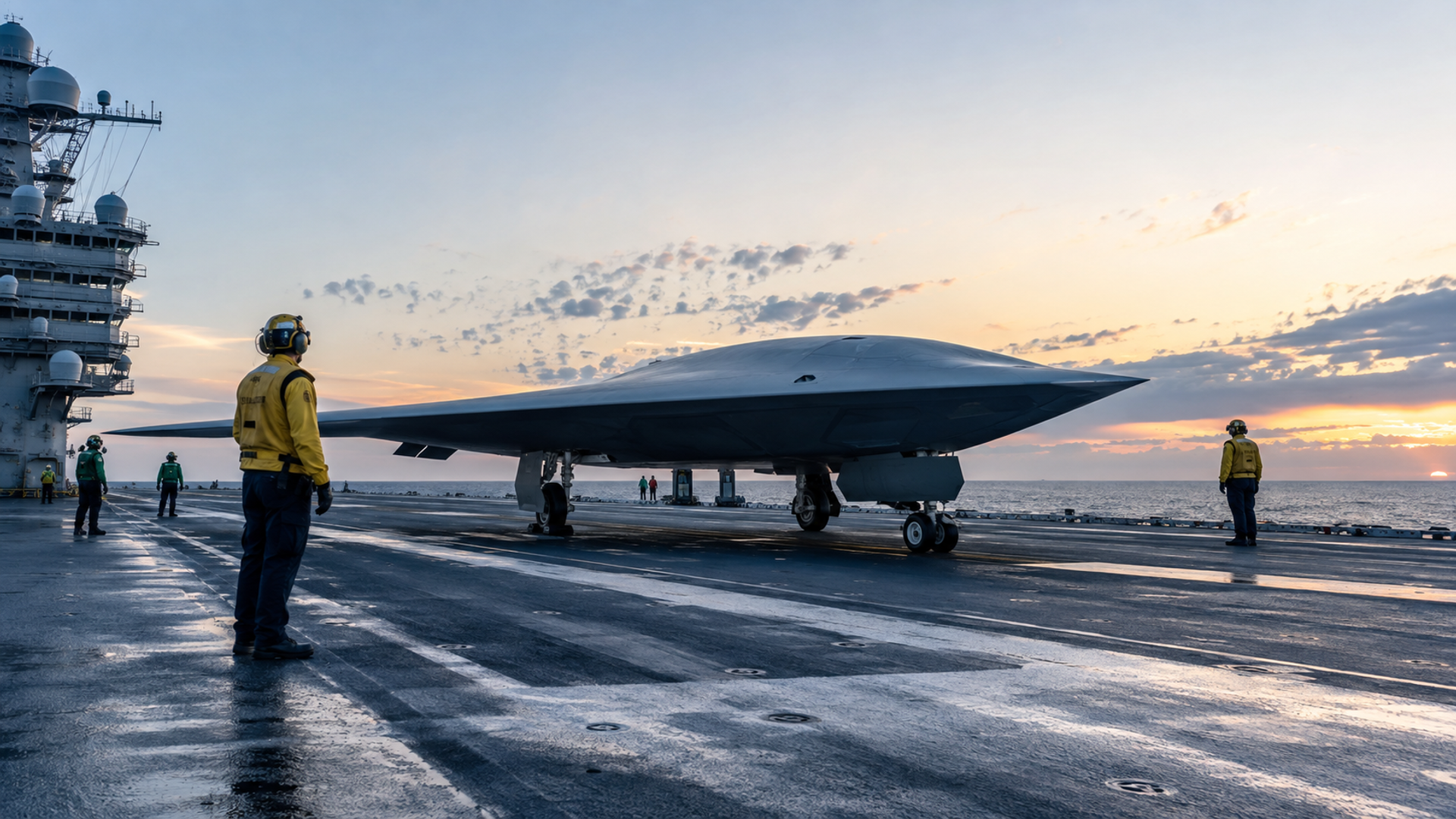
Aircraft must move, launch, recover, refuel and receive maintenance in constrained space around people and other aircraft. Salt, wind and deck motion matter. Folding geometry, tow points, engine safety and turnaround time can be as important as range. A rendering that ignores deck operations answers only part of the question.
In this unmanned combat aerial vehicle decision, apply that principle to the exact date, location, product, account or route described above. Keep the source and the decision trigger together. If conditions change, update the conclusion rather than quietly preserving an attractive headline.
Autonomy needs a verb
Ask whether autonomy refers to taxiing, route planning, sensor management, formation, threat response or weapons employment. Human command may be exercised at different stages. Lost-link rules and identification confidence are central. Broad labels create heat but conceal the governance design that decides operational acceptability.
In this unmanned combat aerial vehicle decision, apply that principle to the exact date, location, product, account or route described above. Keep the source and the decision trigger together. If conditions change, update the conclusion rather than quietly preserving an attractive headline.
MQ-25 is relevant but not a direct template
The Navy's MQ-25 programme demonstrates carrier integration for an unmanned refuelling aircraft. A combat role adds different payload, survivability and command requirements. Lessons may transfer in deck handling, control and maintenance, yet the mission and risk profile remain distinct. Analogy should be used to frame questions, not claim an inevitable design.
In this unmanned combat aerial vehicle decision, apply that principle to the exact date, location, product, account or route described above. Keep the source and the decision trigger together. If conditions change, update the conclusion rather than quietly preserving an attractive headline.
The timeline should remain a range
After market research may come requirements work, competitive steps, prototypes, testing, ship integration, training and production. Any of these can change scope. A credible article names the milestone that would increase confidence next: a formal solicitation, contract award, flight test or carrier demonstration. Until then, precise service-entry dates are speculation.
In this unmanned combat aerial vehicle decision, apply that principle to the exact date, location, product, account or route described above. Keep the source and the decision trigger together. If conditions change, update the conclusion rather than quietly preserving an attractive headline.
Reader checklist
[ ] Identify the acquisition stage
[ ] Read the official notice
[ ] Separate requested from proven capability
[ ] Ask how carrier recovery works
[ ] Define each autonomous function
[ ] Examine lost-link behaviour
[ ] Distinguish prototype from production
[ ] Wait for the next official milestone
Unchecked fields for unmanned combat aerial vehicle remain unresolved. They should trigger a recheck, a smaller commitment or a decision to wait; they should not be silently converted into approval.
Sources and method
sam.gov — The official SAM.gov notice is the controlling source for the Navy request for information and its stated market-research purpose.
navy.mil — The US Navy fact file describes the MQ-25A's carrier-based unmanned refuelling role and integration context.
crsreports.congress.gov — The Congressional Research Service provides public context on Navy carrier-air-wing and unmanned-system issues.
gao.gov — The US Government Accountability Office explains recurring acquisition risks in major defence programmes.
The external sources above were checked for this unmanned combat aerial vehicle treatment. Ranking pages were used only to identify repeated coverage and missing reader value. Their wording, paragraph order and distinctive structure were not copied. This article contributes its own matrix, scenario, failure modes and action checklist.
Continue with adjacent research
These contextual links provide adjacent planning or ownership information for unmanned combat aerial vehicle. They do not replace the official sources, professional help or current local conditions required for the decision in this article.
Final judgement
The RFI is market research, not a programme award or deployment order. It signals that the Navy is testing industry options for carrier-suitable unmanned combat aircraft, but it does not establish a winning design, fleet size or operational date. The important questions are launch and recovery compatibility, deck handling, communications resilience, human command and integration with existing carrier air wings.
The Discover opportunity for unmanned combat aerial vehicle comes from timely usefulness and a concrete visual subject, not from a guarantee of distribution. The durable standard is a decision readers can verify, act on and revise when new evidence arrives.