Leather handbag quality is easier to judge through construction than through a label alone. Inspect the leather disclosure, cutting and panel matching, stitch consistency, edge finishing, hardware, lining and how the loaded bag behaves. A smooth surface or high price is not enough. The most useful test is to handle the exact bag, put in your usual belongings and check the stress points before buying.
Start with the material description
Ask the seller what leather and surface finish the bag uses, and which parts use another material. “Genuine leather” identifies a broad material category; it does not tell you the leather's thickness, finishing process or expected appearance after wear. Examine the body, handle and strap separately. A contrasting lining or trim can be intentional, but the listing should not imply that every part is the same leather when it is not.
Look at the bag in both daylight and indoor light. Check for unexpected peeling, cracking or a colour difference at corresponding panels. Natural leather can vary, and a visible grain pattern is not proof of a particular leather grade. Ask how the specific finish should be cared for rather than relying on a universal leather-cleaning tip. The Leather Working Group recommends contacting the brand or retailer for product-specific instructions if none are supplied.
Inspect the seams and edge finish
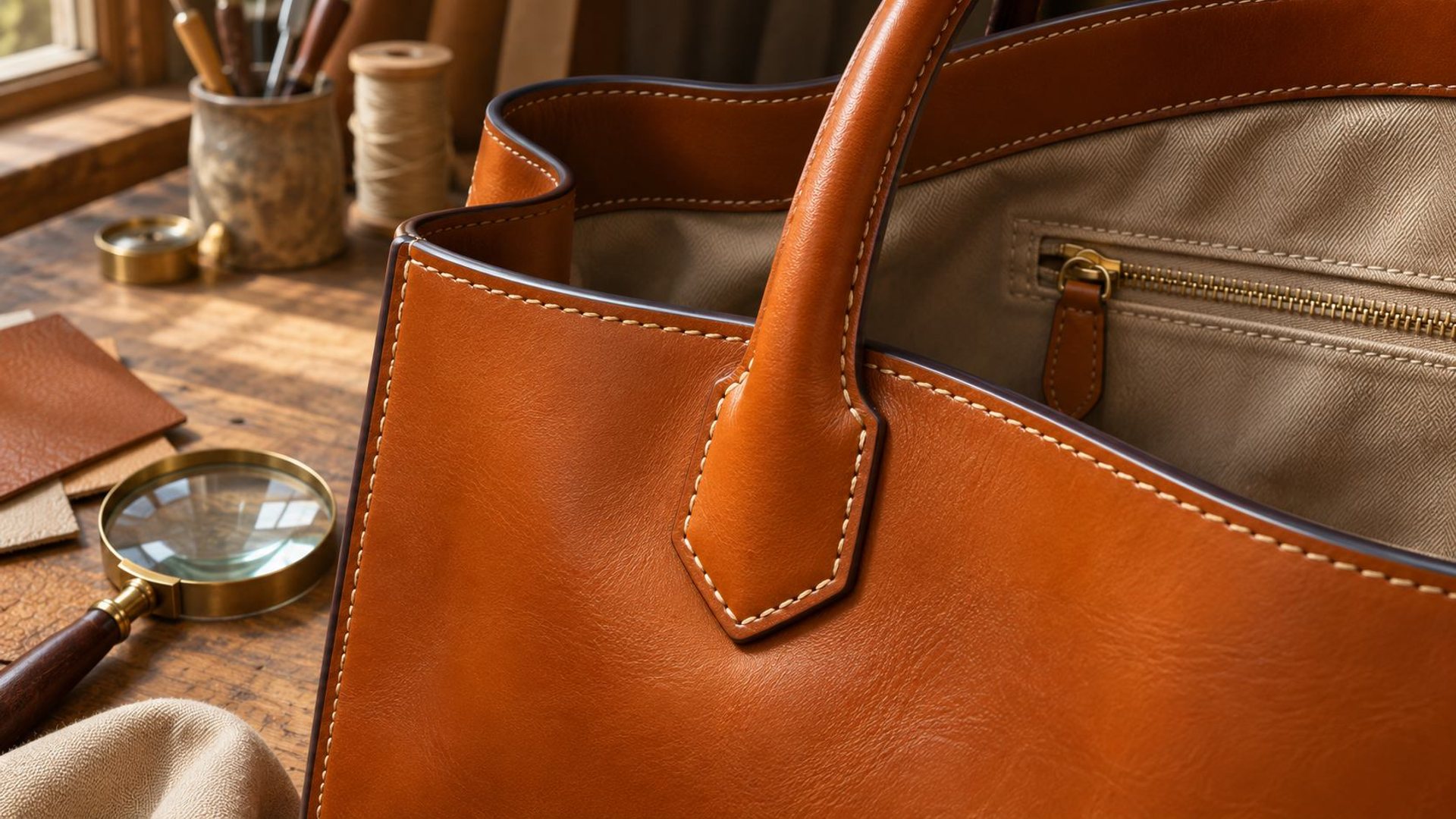
- Follow the stitching along the handles, side panels and base. Look for secure ends and no loose thread at load-bearing joints.
- Compare left and right sides. Small handwork variation can be normal, but distorted panels or a seam pulling open deserve attention.
- Examine painted or folded edges at corners and around the opening. They should feel smooth rather than sharp or already split.
- Look inside. Check whether the lining is attached cleanly and whether a pocket seam catches your hand or phone.
- Check the base after setting the bag down with a realistic load. A bag may be intentionally soft, but it should behave as its design promises.
Do not pull aggressively on a seam to “test” it in a shop. Normal handling, a loaded trial and close visual inspection are enough to reveal many concerns without damaging a sale item.
Test hardware and function
Open and close every clasp, zip and magnetic fastening several times. Check alignment with the bag both empty and normally filled. Examine the strap anchors, chain joints and handle attachments. Hardware should operate smoothly and not scrape or cut the leather. Metal colour alone does not establish its alloy or plating, so request the maker's specification if that matters. Carry the bag for a few minutes to check the centre of gravity and whether a strap twists or digs into your shoulder.
| Area | Pass condition to look for | Ask before buying if... |
|---|---|---|
| Leather | Consistent finish and clear material disclosure | Surface is already peeling or the listing is vague |
| Stitching | Secure seams at handles, sides and base | A load-bearing thread is loose |
| Edges | Smooth finishing at opening and corners | Paint is splitting on a new bag |
| Hardware | Reliable closure under normal load | Latch or zip only aligns while empty |
| Lining | Useful pockets and clean seams | Fabric catches contents or bunches |
| Shape | Behaves as expected with your items inside | Base or side collapses unexpectedly |
How does a quality check differ from choosing a style?
A quilted bag invites close inspection of stitching and padding. A top-handle bag makes handle drop and loaded access especially important. This checklist covers the construction that matters across both types. A beautiful silhouette can pass a quality check yet still be the wrong size, while a practical shape can fail because of poor seams or hardware. Separate “well made” from “right for my day” and test both.
How do the VERTU Catena bags illustrate the checklist?
VERTU lists the Folded V Catena Handbag as a geometric leather design with a V-fold closure and metallic accents. Its Catena Crossbody is described with quilted leather and a chain strap. Those official descriptions identify different construction points to inspect: the top-handle design's handle and closure, and the crossbody's quilting and chain attachments. They do not establish an independent durability test, stitch count or universal capacity. Check the exact variant, available measurements and current market terms.
If buying online, ask for close views of corners, underside, interior and strap anchors rather than relying on a single front-facing image. Keep the current product description and receipt so any question about the received piece can be compared with what was offered. Evaluate return and repair terms before removing packaging.
Frequently asked questions
Does a higher price prove better leather quality?
No. Price can reflect design and brand as well as material. Inspect the disclosed leather, finishing and construction of the actual bag.
Are small stitching variations always defects?
No. Judge whether the seam is secure and the variation affects appearance or function. A loose load-bearing seam deserves attention.
How can I check a bag online?
Request detailed images and measurements, review the material description and test the bag promptly on delivery while the return window is open.
Should I use leather conditioner immediately?
Only if the maker recommends it for the specific finish. An unsuitable product may alter colour or texture.
Use this leather handbag quality checklist to examine materials, seams, edges, hardware and loaded behaviour as one system. The bag that holds up under those ordinary checks is the one worth comparing on style and price.