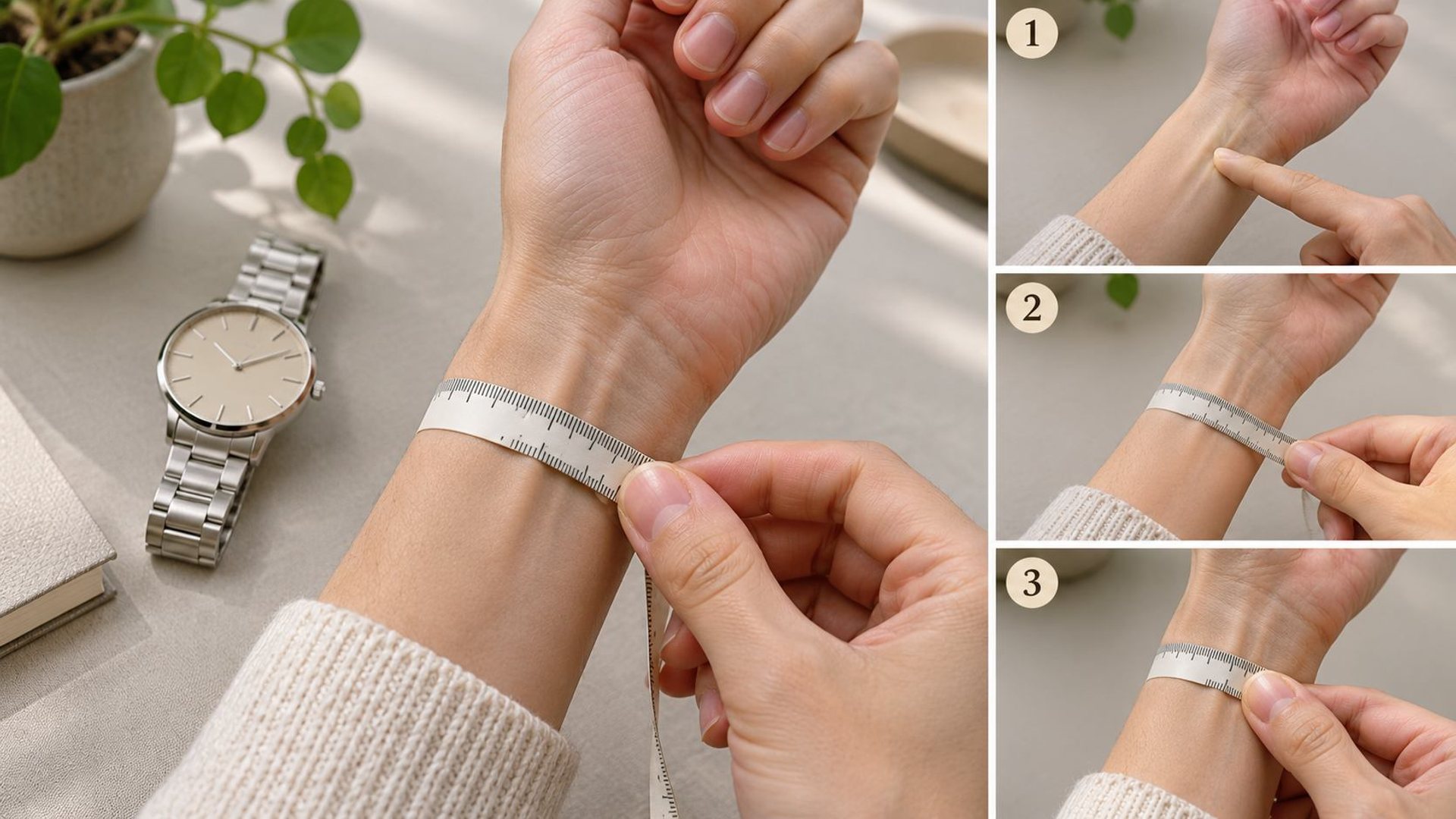
How to measure your wrist for a watch: wrap a flexible tape around the point where you normally wear the watch, keep it flat and comfortably snug, and record the circumference in millimetres. Repeat the measurement, then compare it with the exact strap or bracelet's adjustment range. Wrist circumference helps determine band length; case width, thickness and lug shape still need a separate fit check.
What do you need before measuring?
Use a soft measuring tape marked in millimetres. If you do not have one, wrap a narrow strip of paper around the wrist, mark where the ends meet, then measure the strip flat with a ruler. Avoid a stretchy string that changes length under tension. Measure the wrist on which you intend to wear the watch, since left and right may differ. Remove an existing watch and let any indentation settle before measuring.
Where should the tape sit?
- Find the position where the watch normally rests, often just above the wrist bone.
- Wrap the tape around that point without twisting it. Keep the tape level all the way around.
- Pull it close to the skin without compressing it or leaving a loose gap.
- Read and record the number in millimetres. Repeat once to catch a misread or a tilted tape.
- If you prefer a loose bracelet, note that preference separately; do not alter the raw wrist measurement without recording why.
Seiko's sizing guide describes measuring with a flexible tape around the wearing position without overtightening or leaving a gap. That produces a circumference, not a complete answer to the size of every case and strap. A printable ruler must be printed at actual size; browser scaling can make it inaccurate.
How do you turn circumference into band size?
Compare the measurement with the maker's stated fit range and adjustment method. A leather or rubber strap may use holes, while a metal bracelet may need links removed. Some bands allow small clasp adjustments; others move in larger steps. Ask whether the displayed range includes the watch case or only the strap. A vendor's sizing instruction should take precedence over a generic extra-centimetre rule because cases and links differ.
| Measurement | What it answers | What to check next |
|---|---|---|
| Wrist circumference | Starting point for band length | Exact maker's adjustment range |
| Wrist width | How much case spans the top of the wrist | Lug-to-lug or tonneau case shape |
| Wrist profile | Flat or rounded surface under the case | How the watch sits without rocking |
| Clothing and comfort | Desired snugness during wear | Try-on with sleeve or coat |
Does a larger case always need a larger wrist?
No single diameter cutoff works for every watch. A round 40 mm case, a rectangular tonneau case and a watch with long lugs occupy the wrist differently. Case thickness also changes how it fits under a cuff. Try the watch if possible, or compare its full dimensions with a watch you already wear comfortably. Look down at your wrist from a normal viewing angle and check whether the case or lugs extend beyond the wrist edges.
Do not confuse comfort with a visual rule. A wearer may prefer a prominent case, but the strap should still close securely and the watch should not rotate or press sharply into the wrist. Check comfort after several minutes of movement, not only in a static photograph.
How do VERTU Agent Watch and Grand Watch affect the fit check?
The official VERTU Agent Watch page lists a tonneau case measuring 53.9 × 46.9 × 15.8 mm. The case profile cannot be judged from a single round-diameter figure. Compare wrist width, thickness and strap feel before choosing it. VERTU's Grand Watch is a separate design with its own dimensions and band construction; check the specific edition rather than transferring Agent Watch sizing assumptions to it. Product availability and strap options should be verified on the current listing.
If ordering remotely, provide the retailer your raw wrist circumference and your preferred fit, and ask which adjustments are included. Keep the measurement for later band changes. If a metal bracelet needs links removed, use an authorised service or a qualified watchmaker instead of risking damage to pins or finish.
What case size can you try for a 16, 17 or 18 cm wrist?
The ranges below are practical first-fit starting points for round watches, not a manufacturer standard or a wrist-to-case conversion formula. Case diameter alone does not determine fit: lug-to-lug length, case thickness, lug shape, bracelet articulation and personal style can change how a watch wears. Try the exact model on your wrist where possible.
| Wrist circumference | Initial round-case range to try | Check next |
|---|---|---|
| 16 cm (160 mm) | 36–40 mm | Keep the lugs within the wrist profile; compare thickness and strap fit. |
| 17 cm (170 mm) | 38–42 mm | Check whether the case overhangs and whether the bracelet articulates comfortably. |
| 18 cm (180 mm) | 40–44 mm | Compare lug-to-lug length and how the watch sits during wrist movement. |
These overlapping ranges are a try-on shortlist, not a guarantee: a compact lug design may wear smaller, while a broad or thick case may feel larger. For rectangular or tonneau watches, compare the case’s height and width rather than applying a round-watch diameter rule.
Frequently asked questions
Should the tape be tight?
It should sit close to the skin without compressing it. Record the actual circumference and discuss preferred looseness separately.
Can I use a piece of paper?
Yes, if it does not stretch. Mark the overlap, measure it flat and repeat once.
Does wrist size tell me the right watch diameter?
It is a starting point, not a complete formula. Case shape, lug span and thickness change the result.
Should I measure over a sleeve?
Measure the bare wrist for the baseline. Try the watch with typical clothing separately if you expect to wear it over or against a sleeve.
To measure your wrist for a watch, record a snug, repeatable circumference at the wearing point, then verify the exact band's adjustment range and the case's real footprint. That two-part check is more useful than choosing by a single wrist-size chart.