

Introduction
In 2026, “value retention” in a men’s watch isn’t a promise of profit. It’s a practical measure of how much of your purchase price you can reasonably expect to preserve when you sell—and how quickly you can sell without taking a needless haircut.
That second piece matters more than most first-time buyers realize. A watch can “hold value” on paper, but if it’s hard to move, the market effectively owns you.
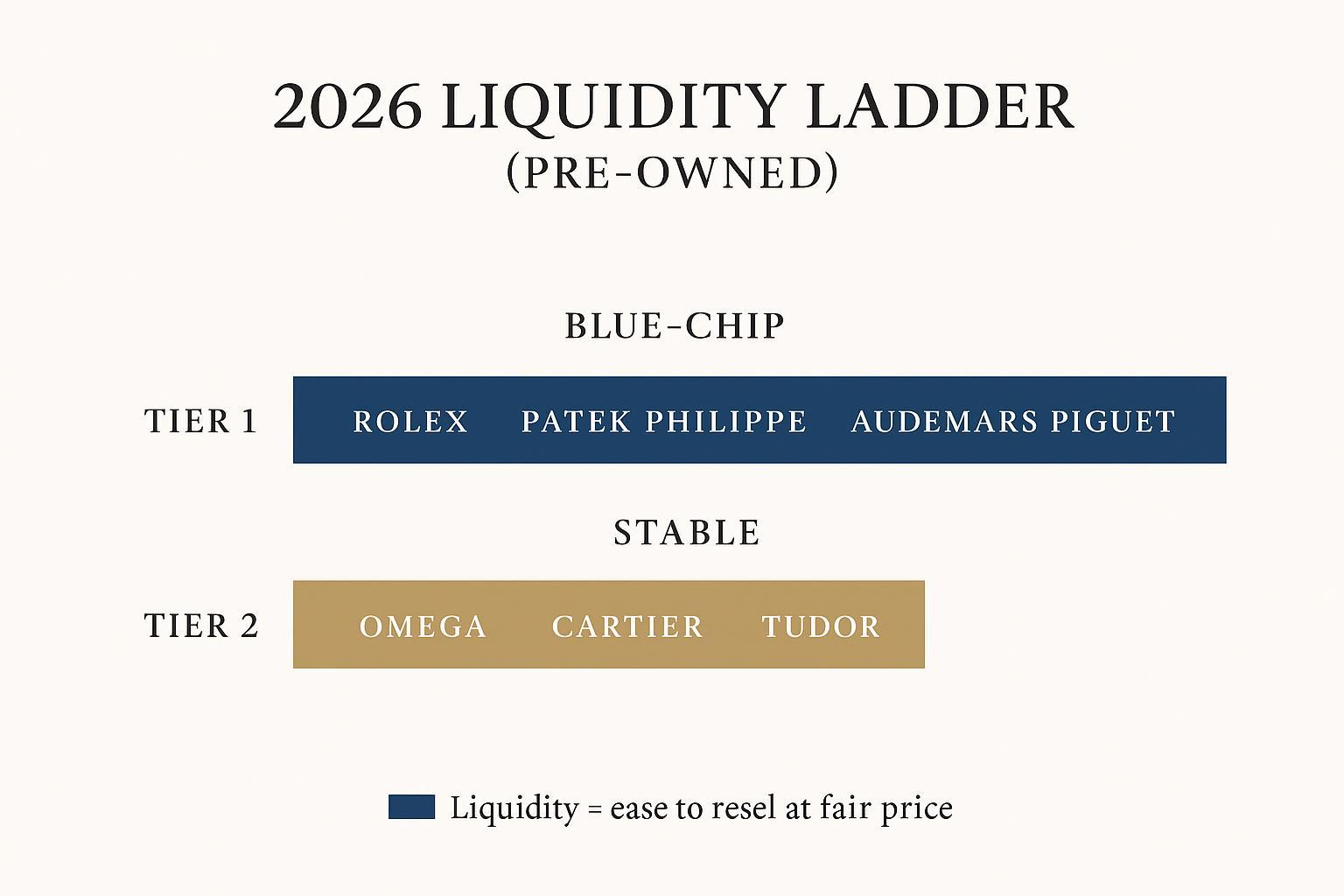
The leaders in resale and liquidity are familiar: Rolex, Patek Philippe, and Audemars Piguet sit at the top of the demand pyramid. Below them are brands that are often stable and easier to live with day-to-day—Omega, Cartier, and Tudor—where value retention tends to be more reference-dependent and less driven by frenzy.
In this guide, we’ll stay disciplined: price tiers, US buying paths, and the ownership factors (documentation, condition, serviceability, and security) that separate a low-regret purchase from an expensive lesson—whether you’re buying new or joining the world of pre-owned luxury watches.
Value retention 101
What drives resale value
Value retention tends to come from a predictable handful of forces:
Brand recognition and buyer confidence. In the secondary market, recognition is a form of reduced friction. When the buyer already trusts the name, you spend less time “proving” the watch is worth the ask.
Model depth, not just brand prestige. Even within top brands, certain references trade far more easily than others. The most liquid watches are the ones with an established, repeatable buyer base.
Condition and originality. Scratches are negotiable. Over-polishing, replaced parts, or mismatched components often aren’t. Collectors pay for integrity—especially if you want the option to sell quickly.
Completeness and documentation. Box, papers, warranty card, receipts, and service history reduce the two risks every buyer fears: authenticity problems and hidden damage. A clear explanation of “liquidity” and why completeness widens the buyer pool is laid out well in the TNS Diamonds explainer on what makes a luxury piece “liquid” in the secondary market.
Service ecosystem. A watch that’s difficult or expensive to service—especially without a clean paper trail—tends to discount more heavily. Buyers price in future friction.
The 2026 liquidity ladder
Think of the market as a ladder. The higher you are, the more the brand and the reference do the selling for you.
Top rung (blue-chip liquidity): Rolex, Patek Philippe, Audemars Piguet.
Stable rung (solid but more reference-dependent): Omega, Cartier, Tudor.
One useful way to keep yourself honest: if you’re buying primarily for value retention, prioritize the depth of the buyer pool over the romance of a niche pick.
Risks and caveats
Even in the best mens watch luxury brands, value retention has limits.
Collector’s note: The most expensive mistake isn’t “choosing the wrong brand.” It’s paying a price that assumes a perfect future—then discovering that real buyers negotiate around condition, missing sets, and provenance.
Key risks to keep in mind:
Market cycles are real. The post-pandemic surge normalized; 2026 buyers are typically more rational and documentation-focused.
Model-specific volatility. Some references swing sharply with trends, dial colors, or short-lived hype.
Counterfeit sophistication. Fake watches and swapped parts are more convincing than ever, and the risk premium shows up in resale prices.
Ownership behavior affects resale. Heavy polishing, aftermarket parts, and poor storage quietly tax your exit value.
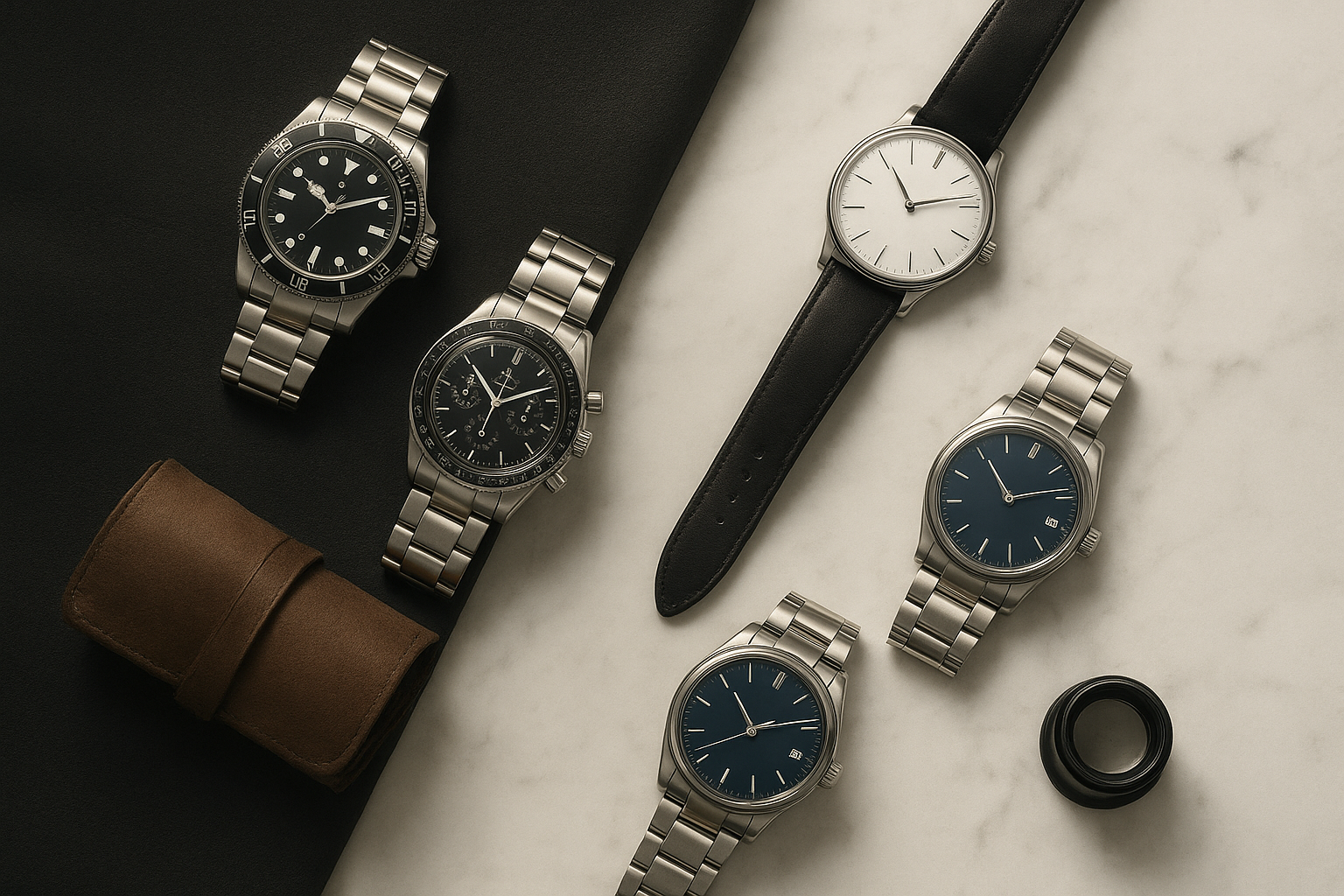
Blue‑chip mens watch luxury brands
Rolex
Rolex is blue-chip for a simple reason: demand is broad and persistent. You’re not relying on a small circle of collectors to care about the exact watch you’re selling.
Rolex also benefits from a strong “reference language” in the market: buyers know what they’re looking at, dealers know what they can move, and pricing ranges are widely understood. That ecosystem makes Rolex unusually liquid compared to almost anything else.
Where Rolex can still go wrong is the part buyers ignore: paying a premium for a configuration that isn’t the market’s favorite. If resale value is the priority, treat the “core” steel sports families and the most recognized classics as the baseline, then get more personal from there.
Patek Philippe
Patek sits on a different kind of demand: prestige and perceived permanence. It’s not just a watch purchase; it’s a cultural object in the way fine jewelry or certain cars can be.
That said, Patek liquidity is often more concentrated by model and by buyer type. When you buy into Patek for value retention, you’re effectively choosing a narrower—but often more committed—buyer pool.
The practical takeaway is to be conservative on variants. If your exit matters, prioritize the references and dial configurations that have long-standing market recognition.
Audemars Piguet
Audemars Piguet (AP) is the classic case of a brand with extraordinary “signal value.” When the watch is right, the market knows it immediately.
AP’s resale strength is also highly reference-driven. The Royal Oak family anchors the brand’s liquidity in a way few lines do for other houses. That concentration can be an advantage (clear demand) or a risk (higher volatility in certain segments).
If you’re buying AP with value retention in mind, think like a curator: condition, completeness, and originality matter—because the buyer you’ll eventually sell to is often more exacting.
Strong and rising brands
Omega
Omega’s value retention story is built on two pillars: a large global collector base and a service ecosystem that makes long-term ownership straightforward.
Liquidity is typically strongest when you choose references with enduring narratives and consistent demand. The brand also has many variations, which is good for personal taste but requires discipline if resale matters. A “great” Omega to wear isn’t always the easiest Omega to sell.
The upside is lower entry friction compared to the blue-chip tier. You can buy well, enjoy the watch, and still protect a meaningful share of your value—especially if you keep the set complete and stay gentle with polishing.
Cartier
Cartier is the quiet power move in value retention conversations because it doesn’t depend on the same sports-watch logic. It benefits from design permanence.
In fact, a Chrono24 press analysis based on the ChronoPulse Index noted substantial five-year value changes for several major brands in its Oct 2019–Oct 2024 window, including Cartier among the leaders in average gains (context matters, and past performance isn’t a guarantee). See Chrono24’s Oct 2019–Oct 2024 market analysis.
For buyers, the Cartier lesson is simple: iconic, recognizable shapes tend to stay desirable longer than trend-based designs. And because Cartier appeals to a broader style audience, the exit can be smoother than you’d expect—if you buy the right reference and keep it clean.
Tudor
Tudor is often the “stable rung” recommendation for buyers who want a serious watch with a credible lineage and manageable ownership.
But Tudor is also a reminder that brand-level narratives can hide model-level reality. Liquidity varies. Some pieces move quickly and hold up well; others soften more than buyers expect.
If value retention is a top criterion, the Tudor approach should be conservative: avoid novelty buys, keep the full set, and plan on wearing the watch rather than treating it as a short-term trade.
Price tiers and picks
$5k–$10k starting points
This tier is where mistakes happen because buyers treat it like a “safe” price band. It isn’t. Your outcome depends on discipline:
Choose widely recognized models within the stable brands.
Avoid rare variants unless you’re comfortable holding longer.
Keep every piece of documentation.
In this range, the best play is often a watch you can wear hard without destroying resale: steel, versatile, and easy to service.
$10k–$20k sweet spot
This is a genuine sweet spot for value retention when you buy intelligently. You’ll typically have access to more liquid references, better condition examples, and a seller base with stronger documentation habits.
A good rule: at this tier, you’re not just paying for the watch—you’re paying for the ease of exit. A complete set and a clean service story can be worth more than a slightly better cosmetic condition with missing papers.
$20k+ prestige and complications
Above $20k, the watch becomes more like a “position.” Your buyer pool narrows, and your sale timeline matters more.
Complications add two realities:
Service complexity increases. Even if the watch holds value, it may cost more to keep it in the condition that protects resale.
Documentation becomes non-negotiable. At this level, the buyer expects provenance, not vibes.
Below is a simple framework you can use to align expectations by tier:
Tier | Best strategy for value retention | Common regret |
|---|---|---|
$5k–$10k | Buy versatile, serviceable classics; keep full set | Trend-driven variant that’s hard to resell |
$10k–$20k | Prioritize liquidity + completeness over “perfect deal” | Paying up for condition but missing papers |
$20k+ | Buy for provenance, condition integrity, and long horizon | Underestimating service and resale friction |
How to buy in the US
AD vs. grey market
For US buyers, the decision isn’t moral. It’s mechanical.
Authorized dealer (AD)
Pros: clean provenance, manufacturer warranty path, straightforward paperwork.
Cons: availability constraints; you may wait, or you may be pushed into less liquid configurations.
Grey market / pre-owned dealers
Pros: selection, immediate availability, potential value if you buy at the right number.
Cons: higher diligence burden; more variance in documentation quality.
If your priority is value retention, AD buying often reduces risk, while grey buying can improve your entry price. The correct answer depends on whether your edge is patience (AD) or expertise (grey).
Authenticate and service
In 2026, authentication is part of the price. Treat it like one.
Start with a simple principle: you’re not just verifying a watch. You’re verifying the story of the watch—what it is, what’s been done to it, and what you’ll be able to prove when you sell.
A practical workflow:
Buy the seller before you buy the watch. Reputation and policies matter.
Insist on the full set where possible. Box, papers, warranty card, and service records aren’t accessories—they’re liquidity.
Cross-check reference details. Dial, hands, bezel, bracelet, serial ranges, and caseback markings.
Plan servicing with resale in mind. Avoid unnecessary polishing. Keep documentation of any work.
How to verify: If you want a modern analogy for low-regret ownership support, think of the way a concierge-style ecosystem reduces decision fatigue. With VERTU Concierge, the value isn’t loud marketing—it’s having a reliable human-and-digital support layer for complex, time-sensitive needs, paired with a security-forward ecosystem that emphasizes trust and control (see VERTU’s security ecosystem overview). The parallel in watches is straightforward: you’re buying not only the object, but the support system that helps you keep it authentic, documented, and ready to move.
Taxes, insurance, security
US ownership costs are easy to ignore—until they aren’t.
Taxes: Sales tax rules vary by state and by buying path. Factor this into your all-in cost because your exit price won’t refund it.
Insurance: If you can’t replace it without pain, insure it. If the watch is part of a broader collection, consider a policy designed for valuable articles rather than generic coverage.
Security: A watch is a small, portable asset. That’s a feature—until it becomes a risk. Think in layers: secure storage at home, discreet travel habits, and documentation stored separately from the watch.
Conclusion
Value retention in 2026 is best understood as resale price stability plus liquidity—the ability to sell at a fair number without a long, stressful process.
The blue-chip leaders remain Rolex, Patek Philippe, and Audemars Piguet, largely because demand is deep and recognition reduces buyer friction.
Omega, Cartier, and Tudor can be stable choices, but outcomes are more reference-dependent and more sensitive to how you buy.
In the US, your buying path matters: AD purchasing lowers provenance risk, while grey market buying can improve entry price—if you have a verification workflow.
Next steps: decide your tier, define your timeline (are you holding for years or keeping the option to exit quickly?), and choose your sourcing path accordingly. If you do nothing else, keep the full set and preserve the watch’s integrity—because in the secondary market, proof is value.
Disclosure: This article references VERTU pages. Editorial judgment remains the priority.

![Top 10 Luxury Smartwatches for Business Travel [2026]](https://cdn.sanity.io/images/e0gp1l2g/production/8b5e5b21db42a1c5f040e828bd041857353a8eb2-2560x1382.webp?w=800&h=450&q=82&auto=format&fit=crop)