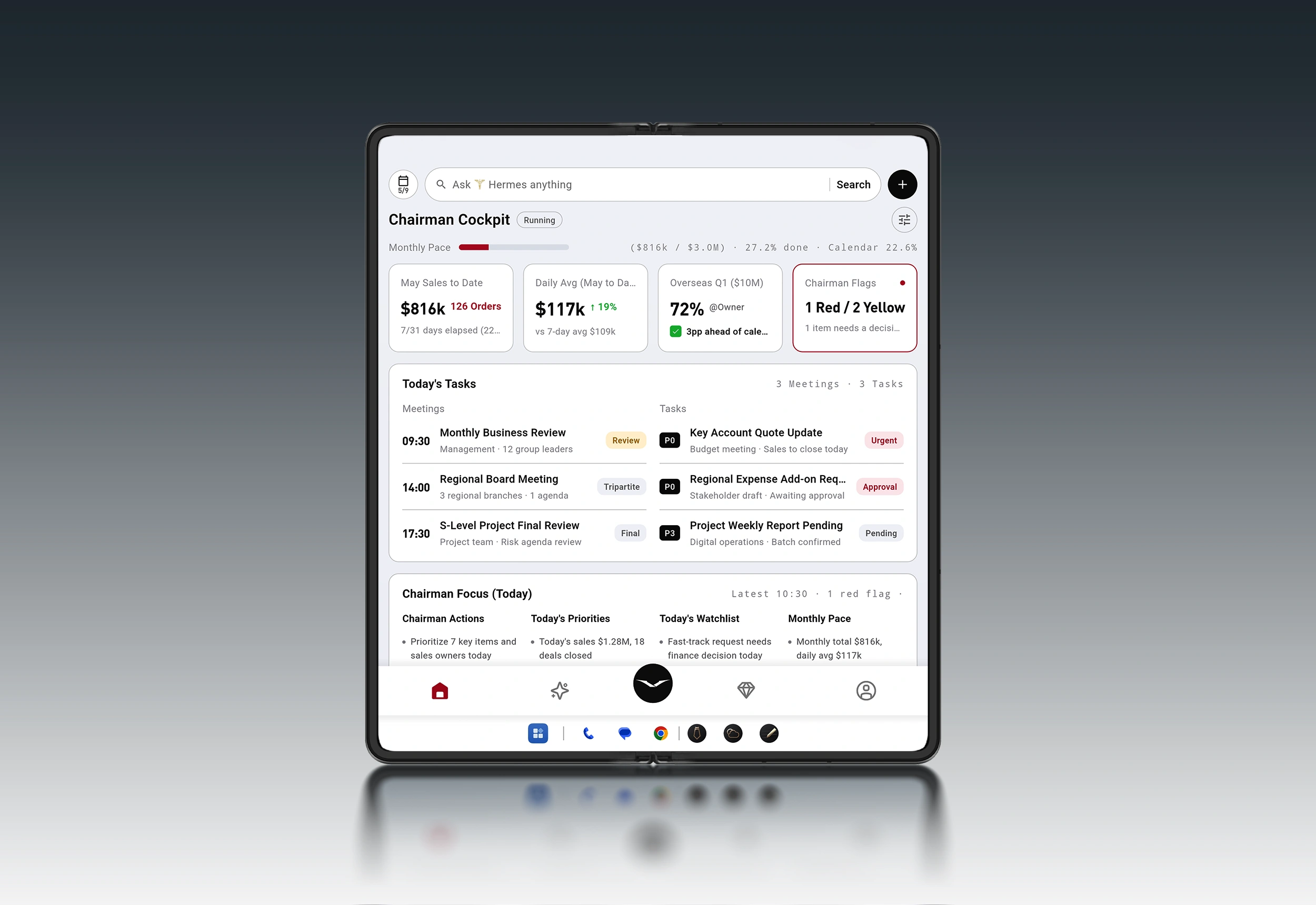
Autonomy on a phone is seductive for one reason: it collapses time. You don’t want “assistance.” You want outcomes—booked, scheduled, confirmed, routed—before you’ve even had to think about the steps.
But on a device that holds your relationships, locations, accounts, and private decisions, autonomy without control isn’t innovation. It’s liability.
The practical thesis is simple:
A mobile autonomous AI agent only becomes usable when it can’t act beyond your intent—and when you can prove what happened afterward.
VERTU’s framing captures the standard you should demand: “It learns. It prepares. It acts with your approval.” The missing piece is how that approval is enforced—consistently, across every risky step. That’s where Smart Block belongs: not as a feature you toggle once, but as a control layer that follows the agent through the entire loop.
The autonomy loop: learn, prepare, act—then confirm and audit
Most discussions of an autonomous AI agent stop at capability. On mobile, the real question is governance.
A serious agent should operate in five modes:
It learns (signals and preferences, with limits)
It prepares (plans and drafts)
It acts (executes with constrained permissions)
It confirms (asks at the risk boundary)
It audits (leaves evidence you can inspect)
Smart Block is the mechanism that makes each transition safe.
Key TakeawayAutonomy is not a single permission. It’s a chain of permissions—each link should tighten, not loosen, as stakes rise.
Key takeaways are summarized near the end for quick review.
Why an autonomous AI agent needs Smart Block approval controls
Mobile autonomy becomes trustworthy only when approval, boundaries, and evidence are built into execution—by design, not by optimism.
Smart Block, explained as a control plane (not a promise)
“Smart Block” should be understood as a control plane with three jobs:
- Permission ceilinga maximum scope the agent can never exceed, even if something else tries to grant more.
- Approval gatea deliberate pause before high-risk actions, where you see exactly what will happen.
- Evidence trailan audit log that answers “who did what, under what authority, and was it approved?”
That model mirrors established access-control thinking. For example, AWS describes a permissions boundary as a managed policy that sets the maximum permissions an identity can have—effective permissions become the intersection of granted rights and the boundary (the ceiling still applies) (AWS IAM permissions boundaries (maximum permissions)).
On a phone, Smart Block should function the same way: nothing happens outside the boundary—even if the agent is clever, even if the user is busy, even if an attacker is persuasive.
What an AI agent should never do automatically
(These are AI agent approval controls in plain language: if the action changes reality, the agent pauses.)
If you remember nothing else, remember this: the most dangerous actions are the ones that are fast, irreversible, or externally binding.
A mobile autonomous agent should never do the following without explicit approval (and a clear preview of the change):
Move money or create financial obligations
Purchases, transfers, refunds, changing billing details, generating payment tokens—anything that moves value.
Change authority or access
Password resets, MFA changes, role/permission changes, recovery email/phone updates, adding a new device/session, linking accounts.
Share private data outside your control
Sending files, forwarding messages, exporting contacts, syncing to third-party apps, uploading documents to external services.
Delete or overwrite information
Deleting messages, notes, recordings, files, backups, logs—especially anything that removes your ability to reconstruct events later.
Sign, submit, or accept terms
Contract acceptance, policy acceptance, legal attestations, form submissions, signature flows—anything that binds you.
Escalate its own permissions
If an agent can grant itself broader access, it’s not governed. It’s improvising.
⚠️ Warning“It can do it” is not the standard. The standard is “It can’t do it unless you approve—and it can prove you approved.”
Where autonomy goes wrong on mobile: AI agent memory boundaries and AI agent permission boundaries
Two failure modes show up repeatedly in real-world deployments:
1) Memory that outlives the user’s intent
A capable agent benefits from memory. An unsafe agent hoards memory.
You want boundaries that are explicit:
What can be remembered by default (preferences, non-sensitive routines)
What must not be remembered (credentials, one-time codes, sensitive legal/health details)
What requires time limits (travel itineraries, temporary guests, event security notes)
What requires re-approval to reuse (bank details, identity documents, sensitive contacts)
This is not abstract governance. It is personal risk management.
2) Permissions that are broad by default
The safest pattern is to avoid “all-at-once” access.
Instead, grant permissions:
- Least privilegeonly what is needed right now
- Just in timefor the moment of execution, not indefinitely
- Purpose-boundthe permission is tied to a specific task
Oso’s delegated-access model frames this cleanly: let the agent inherit the user’s current permissions (not a broad service account), and scope access so that if the user loses permissions, the agent loses them too (Oso on delegated access and least-privilege for AI agents).
Smart Block is the practical enforcement layer here: it keeps read tasks read-only, and forces a checkpoint before write actions.
“It learns. It prepares. It acts with your approval.” What that looks like in practice
Here’s the phone-native version of the promise—without the marketing.
It learns (with explicit memory rules)
Learns your preferences for formatting, tone, time zones, and typical decision patterns.
Smart Block constrains what is stored, for how long, and what requires re-authorization.
It prepares (drafts are safe; commitments are not)
Preparation is where autonomy should shine:
Draft replies.
Build itineraries.
Produce a short list of options.
Pre-fill forms without submitting.
Smart Block’s job is to keep preparation reversible.
It acts (only inside the boundary)
When execution is required, Smart Block enforces:
Which app/system can be touched
Which action types are allowed (read vs write vs delete)
Which objects are in-scope (this account, not every account)
It confirms (approval is a design, not a pop-up)
Approval is not “Are you sure?”
A proper approval step shows:
The exact action to be taken
The target (who/what will be changed)
The side effects (what else will be notified, shared, or stored)
The permission used (scope + expiry)
Auth0 describes human approval gates for sensitive actions as a secure pattern—particularly when the authorization can be handled asynchronously so the agent doesn’t have to stall the entire workflow (Auth0 on secure human-in-the-loop approval for agents).
On mobile, this matters: you approve in seconds, but only after you’ve seen what you’re approving.
<div data-type="node-video" data-provider="youtube" data-url="https://www.youtube.com/watch?v=4673nnLapS8" data-embed-url="https://www.youtube.com/embed/4673nnLapS8"></div>
It audits (so you can verify, not just trust)
If you can’t reconstruct what happened, you don’t have autonomy—you have a black box.
Agent audit logs should capture more than “an API call happened.” WorkOS highlights that agent audit logs should capture the human user identity, the agent identity, the approval context (including its validity window), and the delegation chain—because the question is “who did what, under what authority?” (WorkOS on agent audit logs and approval context).
Smart Block should make auditability default: approvals, denials, attempted escalations, and blocked actions all leave evidence.
The counterargument: approval slows everything down
It’s a fair criticism—when approval is implemented as a constant interruption.
But approval doesn’t need to block the entire experience. The difference is where the friction lives:
Let the agent move quickly through learning and preparation.
Insert approval at the risk boundary.
Keep approvals legible (preview + scope + expiry).
Keep them rare by using sensible defaults (read-only, then step up).
A well-designed approval loop doesn’t kill autonomy. It turns autonomy into something you can actually use.
A practical Smart Block policy for high-risk actions
If you’re evaluating any “autonomous AI agent” on mobile, ask for these controls explicitly:
Risk-tiered actions (read vs write vs delete vs share vs pay)
Permission ceilings (maximum scopes that can’t be exceeded)
Step-up approval for:
money movement
account recovery or MFA changes
data export/sharing
deletion
signing/submitting
permission escalation
Memory boundaries (what’s stored, what expires, what requires re-approval)
Audit logs that separate user vs agent identity, and record approvals/denials
Pro TipIf an agent can’t show you a preview screen of the exact change, it shouldn’t be allowed to execute the change.
Where Smart Block fits in the VERTU world
If you want autonomy without exposure, the device matters—not just the model.
VERTU approaches the mobile agent era as a relationship between capability and restraint: a phone as a private operating environment where sensitive actions are governed, not guessed.
For a broader view of agent phones and why autonomy is shifting from apps to agents, see VERTU Agent Q and the move from apps to agents.
For security and privacy framing, you can also review VERTU mobile security and privacy protection and VERTU information security protection services.
Key takeaways
A mobile autonomous AI agent is only useful when it’s constrained by approval, boundaries, and auditability.
Smart Block should behave like a control plane: a permission ceiling, an approval gate, and an evidence trail.
The “never automatic” list is the real standard for trust: money movement, account authority changes, data sharing, deletion, signing/submitting, permission escalation.
Memory is power—treat memory rules as seriously as permissions.
Next steps
If you’re considering a phone-native autonomous agent for real work, evaluate it like you’d evaluate a private banker: by controls, not charisma.
Ask for a walk-through of the approval loop.
Ask what Smart Block blocks.
Ask what gets logged—and how you can audit it.
If you’d like, VERTU can provide a private demonstration focused specifically on approval controls, permission boundaries, and auditability.
(For an overview of agent-phone capabilities, see AI agent phone capabilities.)
Disclosure: This article references VERTU pages. Editorial judgment remains the priority.