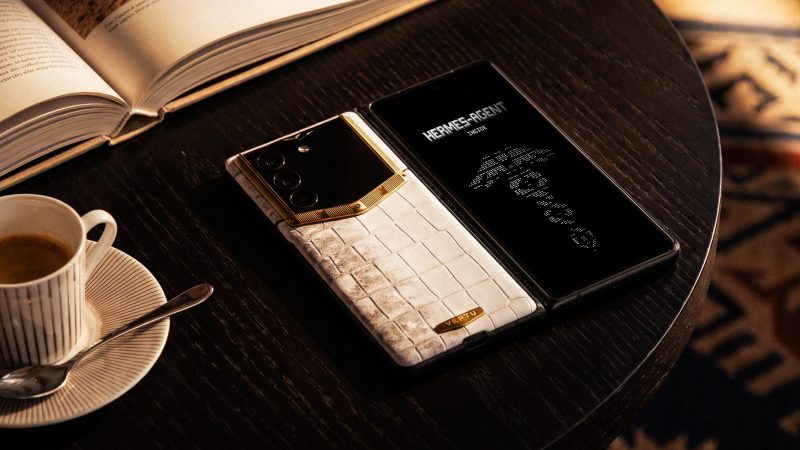
iPhone Duo is the more straightforward candidate for someone who wants a folding display while keeping an iOS-based routine. VERTU ALPHAFOLD belongs on the shortlist when the attraction is a different combination of folding hardware, AI workflows and VERTU service—and the buyer is prepared to verify the platform transition and the exact service package.
This comparison has been rewritten following Apple's Duo announcement. It is no longer a choice between an unnamed Apple rumour and an announced VERTU product. It compares the current official descriptions as of 11 September 2026, without claiming that we have tested either phone or confirmed an ALPHAFOLD delivery date.
Decision in brief
- Choose iPhone Duo: If your operational dependencies (MDM enterprise profiles, iCloud Keychain, Apple Pay, family location sharing) require staying inside iOS, and you treat the fold as a dual-app Split View expansion.
- Choose VERTU ALPHAFOLD: If you view the folding screen as a portable executive workstation requiring native mobile ERP tools, autonomous Hermes AI task execution, and 24/7 human butler support beyond standard operating system support.
Begin with the cost of leaving your current setup
The expensive part of changing phones can be the workflow surrounding them. A family may depend on shared purchases and device location; a business may require a particular management profile, authenticator or document container. Those dependencies will not appear in a display comparison.
Make an inventory before considering the hardware. Separate essential apps from convenient ones, then identify which require a new subscription, an account transfer or approval from an employer. Check access to backups and the process for moving authentication credentials. A platform decision is incomplete until the important accounts work on the destination device.
The official Duo page describes an iOS folding experience. The official ALPHAFOLD page presents VERTU's folding phone around parallel work and AI assistance. Those are product positions, not evidence that every existing application or workflow transfers without friction.
Compare what happens inside the open screen
Duo's announced Split View supports two apps together, including two windows of supported apps such as Safari. ALPHAFOLD's official description emphasises working on documents, calls and information in parallel. To compare the benefit, give each product the same job rather than comparing separate promotional demonstrations.
For example, use a sample quotation and a draft email. Open both, inspect a figure, add a question to the reply, then switch to a call and back again. Observe whether the document position survives, whether text remains legible with the keyboard visible and whether you can complete the task without moving to another device.
Do not load confidential customer files into a sales demonstration. A redacted sample with the same file format, page layout and permissions is more useful than a perfectly arranged demo document. It also lets you assess the workflow without granting unnecessary access to real accounts.
| Migration or ownership question | What to establish for Duo | What to establish for ALPHAFOLD | Evidence to obtain |
|---|---|---|---|
| Essential apps | Support for your account and Duo layout | Availability and behaviour of the same work functions | A demonstration with representative files |
| Two-app work | Whether the intended app pair stays useful | Whether the parallel workflow works as described | Completion of the same task |
| Account continuity | Transfer and recovery of your existing setup | Migration, authentication and backup arrangements | A written transfer checklist |
| AI assistance | Supported language, region and app access | Included agents, integrations and service conditions | A precise feature-and-entitlement list |
| Repair and downtime | Local service, coverage and return terms | Local service, coverage and return terms | Terms for your exact market and model |
| Delivery | Local ordering window and checkout estimate | Current stock or order status | Written fulfilment confirmation |
This matrix deliberately avoids declaring a performance winner. It gives the seller a set of questions that can be answered and the buyer a record that can be checked after delivery.
Treat VERTU service as a defined deliverable
ALPHAFOLD's appeal extends beyond opening a larger screen. VERTU describes AI-supported workflows alongside its broader product and service proposition. The right comparison is therefore not “which phone has more AI?” but “what assistance is included, how is it accessed, and who completes the task?”
Ask the seller to distinguish software output from a completed action and from a human-assisted request. For a proposed travel or business task, establish the supported countries, account connections, approval steps, response expectations and any additional charges. A successful example should end with a verifiable result, not only a persuasive conversational answer.
Availability of a service does not mean every request will be fulfilled. Nor does a premium purchase automatically remove the need to review a booking, approve a payment or check information. Those boundaries should be part of the buying discussion, not discovered after an urgent request.
For a wider view of the range, our current VERTU phone comparison helps distinguish the folding proposition from other VERTU formats. It should not replace confirmation of the exact model and current offer.
Do not compare availability labels at face value
Apple has announced an October launch window for Duo. Confirm your regional store, carrier and checkout estimate rather than treating a first-wave date as a delivery promise. The Duo announcement is the primary reference for Apple's announced schedule.
ALPHAFOLD's public product description alone does not confirm current stock or a guaranteed shipping date for your configuration and market. Obtain a dated written fulfilment estimate for the exact phone you intend to order, rather than interpreting a product presentation as a delivery commitment.
Compare like with like: an official announced date, a shop's estimated dispatch date and a courier delivery commitment are different facts. If you need the phone before an important trip, ask what happens if the estimate slips and whether cancellation or refund terms apply.
Price the transition and the period without a phone
Use the exact local configuration and service package for each quotation. Add any migration work, replacement accessories, coverage and subscriptions that the switch actually requires. Keep optional services separate so that a bundled offer does not make unrelated costs disappear inside the headline price.
Then consider downtime. Where would you send the device for repair? Could you recover essential accounts on a spare phone? Does the seller offer a loan device, or would you need to maintain your own backup? These are especially important questions when the phone serves as both your everyday connection and the key to work accounts.
Do not assume that a premium material or service description guarantees a particular repair speed. Ask for written local terms and keep them with the order. Likewise, a larger manufacturer network does not establish that a specific part or repair appointment will be available when you need it.
Frequently Asked Questions
Can the iPhone Duo run more than two apps side-by-side on its unfolded display?
No. Apple's announced iOS software for iPhone Duo officially supports two concurrent applications in Split View, or two instances of supported applications like Safari. It does not offer a freeform floating-window desktop environment.
What makes the VERTU ALPHAFOLD different from traditional Android foldables?
Beyond luxury material architecture, ALPHAFOLD integrates Hermes Agent mobile ERP software designed for parallel document processing and business workflows, backed by 24/7 dedicated human concierge services for real-world executive assistance.
Will switching from iPhone to VERTU ALPHAFOLD disrupt my corporate email and authenticators?
It can. If your organization mandates Apple-specific Mobile Device Management (MDM) profiles or proprietary iOS security containers, you must verify enterprise compatibility and secure migration routes before switching to an Android-based foldable platform.
Choose after completing one migration rehearsal
For an established iPhone user, Duo deserves consideration when continuity is valuable and the folding workflow solves a real problem. For a buyer seeking VERTU's hardware-and-service proposition, ALPHAFOLD deserves a demonstration that covers both the device and the included assistance.
Before committing, rehearse the first day of ownership: activate service, sign into essential accounts, open a work document, make a call, recover a password and obtain support. Any unanswered step belongs on the purchase checklist. The better foldable is the one that can complete that day under terms you understand—not the one with the more impressive list of possibilities.