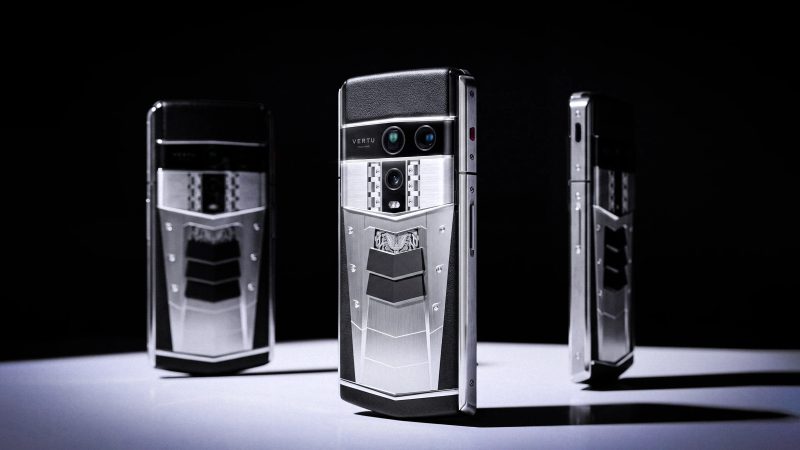
A regular smartphone is already fast. The difference is that an AI phone can become decisive.
If you’re shopping with work in mind, treat this as an AI phone for business decision, not a consumer feature upgrade.
Not “better search.” Not “smarter photos.” The change that matters for business users is whether the device can take a messy day of inputs (calls, calendars, documents, travel changes, approvals) and turn it into controlled, reversible action.
That’s also why most AI-phone searches stay vague. People want the time savings, but they don’t want the risk.
According to YouGov’s 2024 survey: 63% expect time savings, 60% worry about data collection, buyers are pulled in two directions at once. Your evaluation has to resolve that tension.
- AuthorVERTU Editorial Team (enterprise mobile productivity, information security, and executive efficiency workflows)
- Last updated2026-06-11
- DisclosureNo paid partnerships or commission links. References to VERTU pages are included as first‑party examples of how vendors describe capabilities; evaluate any vendor claims through verification steps.
- Feedback & correctionsIf you spot an error, please contact VERTU support via https://vertu.com (use the site’s contact options) and include the article title + the paragraph in question.
Key takeaways
If your phone can’t act across apps with clear approvals, it’s still a regular smartphone with AI features.
“Context” is a buying criterion only when you can define what context is allowed and what is off-limits.
Privacy isn’t a slogan. Ask where processing happens (on-device vs cloud), what gets stored, and how you can delete or audit it.
Efficiency gains show up when the phone reduces app switching and follow‑through, not when it generates nicer text.
Service matters more with AI phones than with regular smartphones, because when delegated actions go wrong, you need recovery, not apologies.
Quick comparison: AI phone vs regular smartphone (business lens)
What you’re buying | Regular smartphone | AI phone (business-grade) |
|---|---|---|
Automation | Shortcuts inside apps; you still do the handoffs | Cross‑app workflows; “draft then approve”; repeatable routines |
Context understanding | Limited, app-by-app, often forgetful | Persistent context with boundaries (thread, file, calendar window) |
Privacy posture | Mixed; many features assume cloud | Preferably on‑device for sensitive tasks, with explicit cloud controls |
Efficiency | Faster execution, but still high coordination load | Lower coordination load (briefings, follow‑ups, scheduling) |
Service | Support is separate from your workflow | Support is part of the workflow: setup, personalization, and recovery |
Key TakeawayIf it can’t move from “answer” to “approved action,” it’s not meaningfully different for business.
Automation: from “answers” to approved actions
A regular smartphone helps you communicate. An AI phone can help you close loops.
For business users, the real automation question isn’t “Can it write an email?” It’s whether it can take a sequence you do every week and make it routine without creating new risk.
A useful mental model is three levels:
- Readsummarize an email thread, extract dates, surface key risks.
- Draftprepare the reply, propose a schedule, assemble a brief.
- Execute (with approval)send, book, move time blocks, trigger a workflow.
This is where “agentic” behavior starts to matter. MIT Sloan describes agentic AI as autonomous systems that can “perceive, reason, and act” toward goals on a user’s behalf, and flags reliability and accountability as core risks as autonomy increases (MIT Sloan’s “Agentic AI, explained” (2026)).
A regular smartphone is built around apps. An AI phone is built around intent.
If you’re looking at VERTU’s ecosystem, this is the promise behind devices positioned as agent phones: an intent‑first workflow, with explicit approvals.
And if you’re evaluating an agentic AI smartphone, ask the uncomfortable question early: what exactly happens when the system is wrong?
The decision-stage question
When you shortlist an AI phone, ask:
Can it operate in draft-only mode for high-risk actions?
Can it show you exactly what it plans to do before it does it?
Can you revoke access quickly without breaking your entire workflow?
If the vendor can’t answer those clearly, the automation is either toothless or unsafe.
Context understanding: the quiet advantage (and the hidden trap)
“Context” is often sold as magic. For business users, it’s closer to a contract.
A regular smartphone usually needs you to restate the situation inside each app: the client name, the latest thread, the time window, the meeting purpose. A genuinely useful AI phone should reduce repeated explanations.
The trap is scope creep.
You don’t want a device that “knows everything.” You want a device that can pull the minimum necessary context, for a single job, and then forget.
What good context looks like
- Narrowthis thread, this document, this calendar window.
- Visibleyou can see what the system used.
- Revocableyou can remove a permission or clear a memory.
That’s how you get the upside (less rework, fewer misses) without turning your phone into an uncontrolled archive of sensitive business detail.
A practical example from the executive day:
You land, a meeting shifts by 90 minutes, and you need three things quickly: the latest thread, the decision history, and a short brief. A regular phone makes you hunt across mail, notes, attachments, and chat. A good AI phone assembles a brief, then asks for approval before it changes anything.
Privacy: on-device AI privacy vs cloud isn’t technical trivia
Privacy is the dealbreaker category because AI changes what the phone touches: email content, meeting notes, attachments, voice, and the “in‑between” context you normally keep in your head.
IDC’s definition of next‑gen AI smartphones ties the category to on‑device GenAI capability: a modern SoC/NPU that can run generative models locally, rather than pushing every request to the cloud (IDC’s definition of next‑gen AI smartphones (2024)).
That distinction matters for business because local processing can reduce what leaves the device and can keep workflows usable when connectivity is imperfect.
A carrier-level explainer puts it plainly: some platforms emphasize on-device processing for privacy, while others rely more on cloud processing for compute power (T‑Mobile’s explainer on on‑device vs cloud AI (2025)).
What to ask before you trust it
Instead of accepting “privacy” as a checkbox, ask for specifics:
Where is processing done for summaries, voice, and document analysis: on-device, cloud, or hybrid?
- What is retainedconversation history, embeddings, memory, logs?
Can you delete and verify deletion?
Can you isolate work and personal contexts?
Enterprise AI phone capability matrix (what to ask + what to test)
Use this as a vendor‑agnostic checklist. You’re not trying to “win” features—you’re trying to reduce risk while increasing follow‑through.
Capability | What to ask (procurement questions) | What to test (15–30 min) |
|---|---|---|
On‑device vs cloud execution | For each feature (summaries, voice, document Q&A), what runs on‑device vs cloud vs hybrid? What triggers cloud fallback? | Toggle cellular/Wi‑Fi off and repeat the same task. Compare output quality and whether the feature still runs. |
Approvals for actions | Which actions can the assistant execute (send, schedule, move files)? Can you force draft‑only mode globally? | Attempt a high‑risk action (send to external, move a meeting) and confirm it always shows a preview + explicit approval step. |
Permission granularity | Are permissions per app, per account, per folder, or “all‑or‑nothing”? Can you limit scope to one thread/folder/calendar window? | Grant minimal permissions, then run the workflow. Verify the assistant still functions without broad access. |
Revocation & recovery | If you revoke access, does it stop immediately? Is there a one‑tap “kill switch” for delegated actions? | Revoke permissions mid‑workflow; confirm pending actions stop and the UI reflects the revocation. |
Retention, logs, and auditability | What is stored (history, memory, embeddings, logs)? Where is it stored and for how long? | Find the activity log (if any). Verify you can see what the system used and what actions were proposed/executed. |
Deletion & verification | How do you delete history/memory? Is deletion device‑only or also cloud? Is there a way to confirm deletion completed? | Delete history/memory, then re‑ask for previously discussed sensitive details. It should not recall them. |
Work/personal separation | Can you isolate work and personal data (profiles/spaces/accounts)? Are AI memories separated across spaces? | Create two contexts (work + personal) and verify cross‑context leakage doesn’t occur in summaries or suggestions. |
Note on definitions: “On‑device” often means some steps run locally, while large‑model tasks may still route to cloud. Always ask what happens in offline mode and what is transmitted/stored.
In VERTU’s lineup, privacy language often shows up as architectural claims. For instance, ALPHAFOLD references features such as Private Space, end‑to‑end encryption, encrypted V‑Talk, and triple-system isolation on its product page. You should still treat these as reasons to ask better questions, not as guarantees.
Pro TipAsk the vendor to walk you through a “worst-case” scenario: a sensitive file appears in the wrong context. What can you do in 60 seconds to contain it?
Efficiency: AI phone productivity is real only when coordination load drops
Most productivity demos focus on outputs: a nicer email, a cleaner summary, a faster search.
Business users feel the value somewhere else: fewer repeated explanations, fewer missed follow‑ups, fewer micro-decisions.
If you want to convert generic AI curiosity into a shortlist decision, evaluate efficiency in three places:
1) Preparation (before the meeting)
Can it turn scattered inputs into a brief?
Can it pull only what’s relevant, and show sources?
2) Follow‑through (after the meeting)
Can it draft follow‑ups and tasks in the systems you already use?
Can it propose next actions without committing them?
3) Travel (when the schedule breaks)
Can it keep the day coherent when flights shift and meetings move?
Can it rebuild your schedule without turning your calendar into a mess?
If those three improve, the phone becomes a decision tool, not just a communication device.
For deeper evaluation criteria and everyday scenarios, see VERTU’s AI phone assistant guide.
Service: why it matters more when the phone can act
Service sounds like a luxury add-on until you consider what changes with agentic workflows.
When a regular smartphone fails, you lose time. When an AI phone fails, it can also create an incorrect action: a message sent too early, a schedule moved, a document surfaced in the wrong place.
That’s why high-touch support and recovery mechanics become part of the buying criteria.
In VERTU’s positioning, 24/7 concierge service is a consistent promise across its devices (first‑party product pages). For a business user, the useful question is how that service integrates into the workflow:
Can someone help you set boundaries and permissions correctly?
Can you get help quickly when something goes wrong?
Can you get personalization without handing over sensitive content?
If the service can’t support safe setup and recovery, you are effectively beta-testing an autonomy layer on your own.
The 48-hour shortlist test (turns “AI search” into a purchase decision)
If you’re serious about buying, don’t start with feature lists. Start with two days of controlled trials.
Day 1: trust and boundaries
- Permissions checkwhat does the assistant ask to access (mail, calendar, files, contacts)? Can you say no and still get value?
- Context boundariescan you force it to use one thread or one folder only?
- Memory controlcan you clear history, disable memory, or separate contexts?
Day 2: workflow value
Pick two workflows you actually repeat:
Meeting brief → follow-up (prep + aftercare)
Travel day reschedule (calendar coherence)
Score each workflow using a simple rubric (repeatable and comparable across devices):
App switching reduced (0–5): 0 = no change, 5 = major reduction.
Context restatement (0–5): 0 = constant restating, 5 = minimal restating.
Source visibility (0–5): 0 = no indication of what it used, 5 = clearly shows thread/file/calendar window.
Approval safety (0–5): 0 = executes without clear confirmation, 5 = always drafts + explicit approval.
Recovery speed (0–5): 0 = hard to undo/revoke, 5 = one‑tap revoke/undo and clear logs.
If approval safety fails even once, you’re not buying productivity. You’re buying distraction.
Who should choose which?
Choose a regular smartphone if…
Your work is mostly communication and light admin.
You prefer strict manual control and minimal automation.
You don’t want any system retaining context beyond the app you’re in.
A regular smartphone remains the cleanest option when you value predictability over delegation.
Choose an AI phone if…
Your day is defined by scheduling, approvals, follow‑ups, and constant context switching.
You need your device to behave like an executive assistant: assemble, draft, propose, and wait for approval.
Privacy is central, but you’re willing to evaluate boundaries rather than accept slogans.
In that case, the right AI phone doesn’t just give you answers. It gives you quieter days.
Next steps
If you want a buyer-grade view of what to evaluate (and what to ignore), start here:
- Discover AI Productivityread the AI phone assistant guide
If you’re ready to explore an agent-first workflow:
- Explore Agent Qsee Agent Q
If Web3 security, wallet isolation, and one‑key data destruction are central to your threat model, explore the Metavertu line: Metavertu
Disclosure: This article references VERTU pages. Editorial judgment remains the priority.