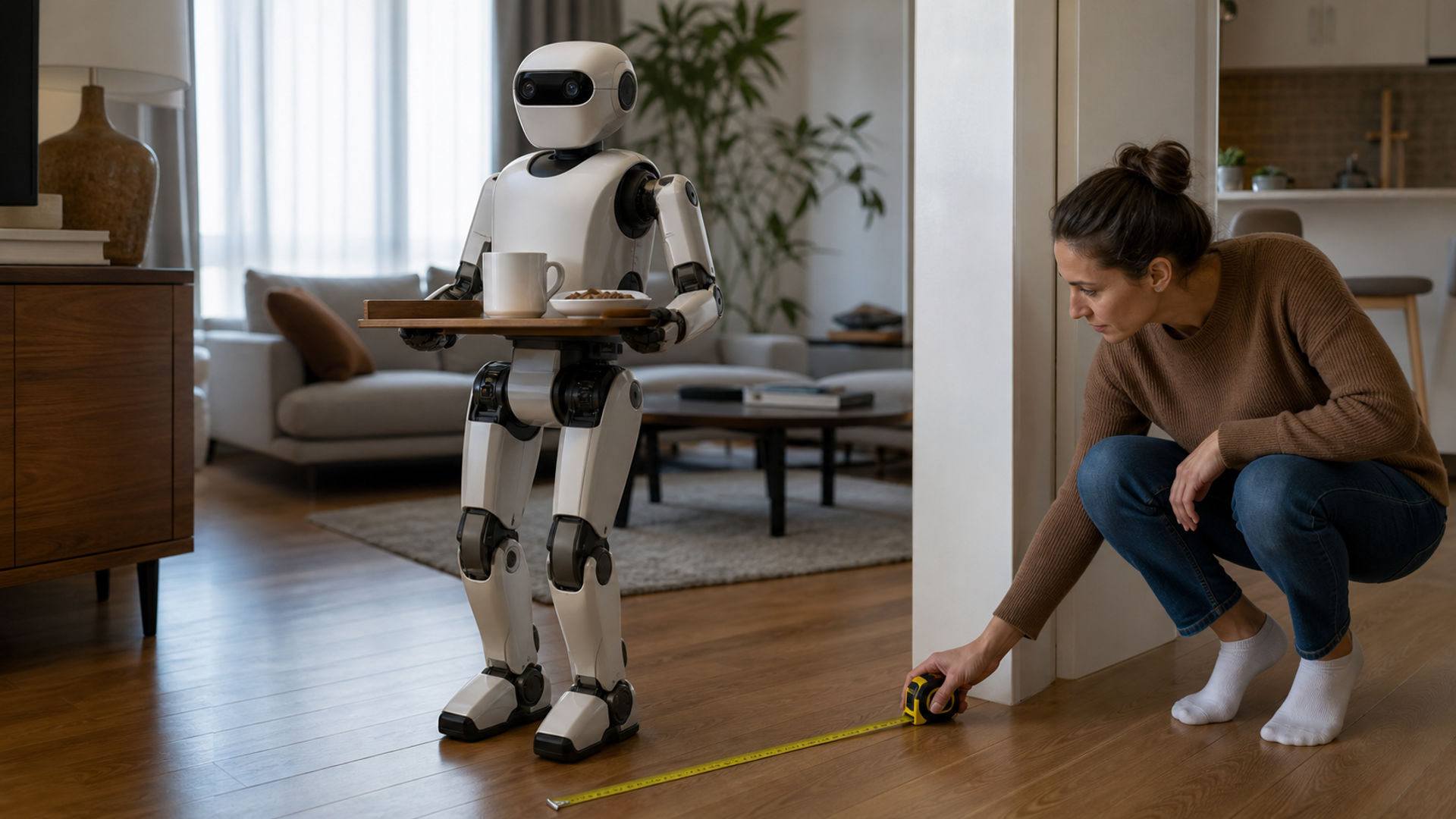
WAIC 2026 has intensified attention around humanoid robots, and official projections point to rapidly rising output. Production volume, however, does not tell a household whether a robot is safe, supportable, private or capable of repeating a useful task outside a controlled demonstration.
The short answer: Do not buy the highlight reel. Buy a written task envelope, safety case, support route and acceptance test for your actual home.
The question is more useful when it is converted into checks a reader can repeat. The matrix below separates what can be verified now from what still depends on a seller, service provider, venue or changing software policy. Details that vary by model, market, condition or account should be confirmed on the current source before money, access or irreplaceable evidence changes hands.
Decision matrix
| Decision point | Why it matters | Practical action |
|---|---|---|
| Define one deployable task | A narrow task can be tested, priced and stopped safely | Specify start state, objects, environment and acceptable completion time |
| Ask who controls the robot | The operator path matters whenever a camera and microphone move through a home | Map local, cloud and human-control modes and their indicators |
| Test the unglamorous edge cases | Household value comes from recovery, not the best run | Repeat the task with realistic clutter and deliberate interruptions |
| Demand a physical safety model | Emergency stop and safe-state behaviour are core product features | Test stop controls, power loss, collision response and child access |
| Price service and downtime | Total ownership cost can exceed the purchase headline | Request service levels, parts location, update term and end-of-life plan |
| Control household data | Privacy depends on collection, retention, access and deletion—not a lock icon | Require a data-flow diagram, role permissions and verifiable deletion |
Use the table as a sequence rather than a scorecard. A strong result in one row does not cancel a serious failure elsewhere: excellent hardware cannot repair a missing return route, a convincing story cannot replace provenance, and a convenient service does not justify unlimited data access.
Fast-moving technology creates an evidence timing problem: the demonstration is current, but support, privacy and reliability claims concern the future. Ask what is available now, what is announced, what requires remote operation and what happens when the service is interrupted. A useful early-adopter decision includes a narrow first deployment, an acceptance test and an exit route; it does not assume that the most dramatic demo represents ordinary household or travel use.
Separate capability from autonomy. A machine may complete a task while being supervised remotely, pre-mapped or rescued by an operator; that can still be useful, but it is a different product promise. Ask for completion rate, intervention rate, supported environment and failure recovery in writing. Then test one bounded task with a safe stop condition. If the provider cannot describe those limits, the buyer is being asked to finance an experiment without knowing its operational boundary.
1. Define one deployable task
General intelligence claims hide the difference between a scripted sequence and reliable autonomy. That matters because a narrow task can be tested, priced and stopped safely.
Specify start state, objects, environment and acceptable completion time. Record the result while the evidence is visible and repeat the check under the conditions in which the device, object or service will actually be used.
Do not pay for a future capability that is absent from the contract. A polished demonstration is only a starting observation; deployment quality is what survives ordinary interruptions and support requests.
2. Ask who controls the robot
The operator path matters whenever a camera and microphone move through a home. The useful evidence is observable: teleoperation, cloud inference and local autonomy have different latency and privacy consequences.
The practical move is to map local, cloud and human-control modes and their indicators. Keep the answer with its date and source, especially where a model, account, venue or regional policy can change.
Do not assume autonomous means no remote access. A polished demonstration is only a starting observation; deployment quality is what survives ordinary interruptions and support requests.
3. Test the unglamorous edge cases
Start with the behaviour, not the label. Doors, rugs, glare, pets and moved furniture defeat polished demos, so household value comes from recovery, not the best run.
Repeat the task with realistic clutter and deliberate interruptions. The test should be clear enough for a partner, support adviser, specialist or future buyer to repeat without relying on your memory.
A single successful run is not a reliability estimate. A polished demonstration is only a starting observation; deployment quality is what survives ordinary interruptions and support requests.
4. Demand a physical safety model
Mass, speed, reach and battery create real hazards around people and property. Read that alongside the practical consequence: emergency stop and safe-state behaviour are core product features.
A defensible response is to test stop controls, power loss, collision response and child access. If the seller or provider supplies the evidence, verify both its origin and its relevance to the exact item or account.
Do not accept a software disclaimer in place of demonstrated safeguards. A polished demonstration is only a starting observation; deployment quality is what survives ordinary interruptions and support requests.
5. Price service and downtime
The decision turns on a simple fact: a robot can require calibration, consumables, remote support and parts. As a result, total ownership cost can exceed the purchase headline.
Request service levels, parts location, update term and end-of-life plan. Then test the result once outside the ideal demonstration: different light, a longer session, an interrupted connection or another ordinary use condition.
A low launch price is not useful if support is geographically unavailable. A polished demonstration is only a starting observation; deployment quality is what survives ordinary interruptions and support requests.
6. Control household data
Privacy depends on collection, retention, access and deletion—not a lock icon. A buyer can test the premise because mobile cameras can reveal faces, layouts, routines and valuables.
Use this as the next action: require a data-flow diagram, role permissions and verifiable deletion. Preserve the controlling page, result and date without saving secrets or publishing personal identifiers.
Do not place the robot in private rooms until controls have been tested. A polished demonstration is only a starting observation; deployment quality is what survives ordinary interruptions and support requests.
A realistic scenario
A vendor demonstrates a humanoid carrying a tray, sorting objects and responding to voice commands. The buyer wants help with deliveries and household routines, but the home has stairs, pets, children, fragile objects and patchy Wi-Fi. The demo venue has trained staff and a mapped environment.
Apply the matrix to the actual situation, not an ideal showroom version of it. Identify the exact item, account, venue or service; preserve the current evidence; run the least destructive test first; and calculate the downside if the claim fails. A lower offer, narrower permission, service appointment, different product or decision to wait can all be successful outcomes.
The pre-decision checklist
Before proceeding, make sure you can do each of the following:
Specify start state, objects, environment and acceptable completion time.
Map local, cloud and human-control modes and their indicators.
Repeat the task with realistic clutter and deliberate interruptions.
Test stop controls, power loss, collision response and child access.
Request service levels, parts location, update term and end-of-life plan.
Require a data-flow diagram, role permissions and verifiable deletion.
This list is deliberately practical. It should be possible to complete it without handing a seller unnecessary personal data or accepting a verbal promise that cannot be checked later. If one missing answer controls safety, privacy, repair cost or authenticity, resolve that answer before optimising secondary features.
Build a record you can use later
Create a compact evidence folder for this decision. Save the controlling official page, receipt or reference, non-secret screenshots, the result and the date. Add software versions where behaviour can change, or condition photographs where physical value matters. Keep serials, identity data and account-recovery details private.
The record should let a support team, specialist, insurer or future buyer understand why the decision was reasonable at the time. A short, labelled chain is more credible than a large folder of unexplained screenshots. It also gives you a baseline if a hinge changes, an algorithm is updated, a ticket account closes, a service entitlement differs or a collector later questions provenance.
For adjacent decisions, see the VERTU guides on AI computer-use approval boundaries and AI-agent audit trails. These links answer the next practical question; they do not replace the primary evidence for this topic.
Sources and verification
The cited pages control the key rule, product context or official claim and may change after publication. Recheck availability, regulatory status, event controls, service entitlement and regional terms before acting. Where health, safety, legal or financial consequences are involved, this article offers general decision support rather than professional advice.
Final decision
Do not buy the highlight reel. Buy a written task envelope, safety case, support route and acceptance test for your actual home. Revisit the conclusion when the source, physical condition, permission boundary or support route changes. A decision remains strong when another person can understand the evidence, reproduce the important check and see what would make you stop.