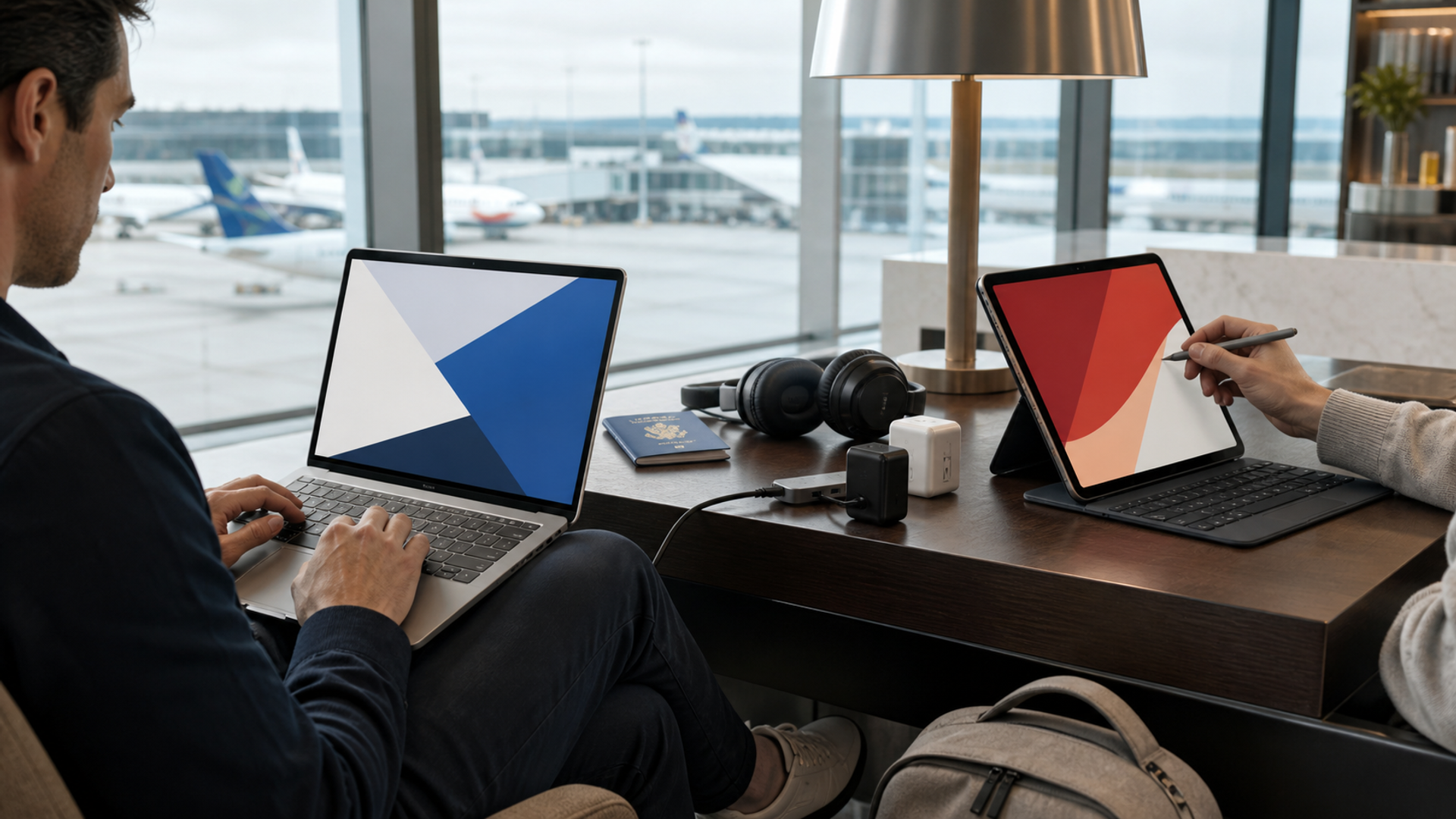
MacBook Air and Surface Pro are both premium travel computers, but one is a conventional ultralight laptop and the other a Windows tablet built around a kickstand and detachable keyboard. The right choice depends on software, lap use, touch and pen work, ports, external displays, charging and how much of the journey is spent away from a desk.
Choose the computing posture
Choose MacBook Air when laptop ergonomics, macOS workflows and quiet all-day mobility lead. Choose Surface Pro when touch, pen and tablet flexibility are essential and its keyboard posture works. Test the exact software, accessories and external-display setup before relying on headline battery claims.
| Decision factor | MacBook Air | Surface Pro | Choose by software and posture |
|---|---|---|---|
| Primary posture | Stable laptop use dominates | Tablet, pen and desk use dominate | Rehearse plane and lap use |
| Software | macOS applications are required | Windows applications are required | Test every critical tool |
| Input | Built-in keyboard and trackpad lead | Touch and pen add real value | Include accessory cost |
| Ports | Chosen Air port plan is sufficient | Chosen Surface port plan is sufficient | Pack the actual hub |
| Battery | Apple test conditions match the workload | Microsoft test conditions match the workload | Run a personal travel-day test |
| External displays | Air configuration supports the setup | Surface configuration supports the setup | Verify exact model limits |
This macbook air v surface pro matrix is the article's working value object. Read the macbook air v surface pro rows together: the decisive failure mode depends on this topic's evidence, operating context and reader objective.
What Apple and Microsoft establish
Evidence 1. Apple's current MacBook Air technical specifications define the exact model's ports, display support, memory, dimensions and test-based battery claims.
Evidence 2. Microsoft's current Surface Pro specifications define its processor, ports, display, accessory and battery-test conditions.
Evidence 3. Manufacturer battery figures use controlled methods and should not be transferred directly to an individual's workload.
Evidence 4. A detachable keyboard and kickstand change lap stability and tray-table depth compared with a conventional laptop hinge.
Reader-visible sources checked for this article:
apple.com — reader-visible current or official evidence
microsoft.com — reader-visible current or official evidence
For macbook air v surface pro, these sources establish only the claims inside their documented scope. Recheck every changeable specification, availability condition, price, policy or service term in the relevant market before acting.
Test the complete travel workflow
A buyer can resolve primary posture without starting from a brand preference. Ask whether stable laptop use dominates; compare that with whether tablet, pen and desk use dominate; then use rehearse plane and lap use as the third route's safeguard. An unknown condition stays unknown.
On software, popularity is not enough. The evidence for option one is that macOS applications are required. Option two means windows applications are required. Option three is rational where test every critical tool. Recheck any changeable term immediately before commitment.
The decision changes at input. Choose the first path only if built-in keyboard and trackpad lead; move to the second when touch and pen add real value; use the third when include accessory cost. Save the downside that would make this row fail.
For ports, the first route works when chosen Air port plan is sufficient; the second requires chosen Surface port plan is sufficient. The control for the third is pack the actual hub. Verify this row against the exact product, property, account or environment before it can reverse the decision.
The battery row exposes a practical boundary. Route one assumes apple test conditions match the workload, while route two is defensible only when microsoft test conditions match the workload. Route three depends on run a personal travel-day test. If that evidence is absent, keep the more reversible option.
Read external displays as a stop/go test: air configuration supports the setup supports the first option; surface configuration supports the setup supports the second; and verify exact model limits supports the third. Record which source proves the condition and when it was checked.
Facts that would reverse the current choice
Reversal control 1 — Primary posture. Before choosing MacBook Air, write down how the decision changes if “Stable laptop use dominates” proves false. Do the same for Surface Pro and “Tablet, pen and desk use dominate”. Keep the Choose by software and posture route available until “Rehearse plane and lap use” is verified. This control belongs to macbook air v surface pro; update it from the cited source or exact supplier rather than copying a generic checklist.
Reversal control 2 — Software. Before choosing MacBook Air, write down how the decision changes if “macOS applications are required” proves false. Do the same for Surface Pro and “Windows applications are required”. Keep the Choose by software and posture route available until “Test every critical tool” is verified. This control belongs to macbook air v surface pro; update it from the cited source or exact supplier rather than copying a generic checklist.
Reversal control 3 — Input. Before choosing MacBook Air, write down how the decision changes if “Built-in keyboard and trackpad lead” proves false. Do the same for Surface Pro and “Touch and pen add real value”. Keep the Choose by software and posture route available until “Include accessory cost” is verified. This control belongs to macbook air v surface pro; update it from the cited source or exact supplier rather than copying a generic checklist.
Reversal control 4 — Ports. Before choosing MacBook Air, write down how the decision changes if “Chosen Air port plan is sufficient” proves false. Do the same for Surface Pro and “Chosen Surface port plan is sufficient”. Keep the Choose by software and posture route available until “Pack the actual hub” is verified. This control belongs to macbook air v surface pro; update it from the cited source or exact supplier rather than copying a generic checklist.
Reversal control 5 — Battery. Before choosing MacBook Air, write down how the decision changes if “Apple test conditions match the workload” proves false. Do the same for Surface Pro and “Microsoft test conditions match the workload”. Keep the Choose by software and posture route available until “Run a personal travel-day test” is verified. This control belongs to macbook air v surface pro; update it from the cited source or exact supplier rather than copying a generic checklist.
Reversal control 6 — External displays. Before choosing MacBook Air, write down how the decision changes if “Air configuration supports the setup” proves false. Do the same for Surface Pro and “Surface configuration supports the setup”. Keep the Choose by software and posture route available until “Verify exact model limits” is verified. This control belongs to macbook air v surface pro; update it from the cited source or exact supplier rather than copying a generic checklist.
Audit software before hardware
List the five critical applications, plug-ins, security tools and peripherals. Verify native support and licensing on the exact operating system.
Rehearse the travel posture
Use each device on a lap, aircraft-sized table and standing counter with the intended case. Include keyboard attachment and charger.
Build the complete weight
Weigh device, keyboard, pen, charger, hub and protective case. A tablet configuration is not lighter if essential accessories erase the difference.
Test a personal battery day
Use normal brightness, calls, browser tabs and local files. Record remaining charge and charging opportunities rather than quoting one marketing number.
Three mobile-work patterns
Frequent keyboard work
MacBook Air can win when stable lap use and long writing sessions dominate. Define the fact that would reverse this recommendation before committing.
Pen and presentation workflow
Surface Pro can win when annotation, touch and tablet posture are genuinely used. Define the fact that would reverse this recommendation before committing.
Specialist software dependency
Operating-system compatibility should overrule design preference. Define the fact that would reverse this recommendation before committing.
Action checklist
List critical applications.
Verify exact processor model.
Test lap stability.
Include keyboard and pen.
Pack the real hub.
Check display support.
Run a battery day.
Weigh all accessories.
Confirm repair coverage.
Secure account recovery.
Continue the decision
The linked VERTU articles expand adjacent parts of the macbook air v surface pro decision. They do not substitute for the external evidence above.
The computer verdict
Choose MacBook Air when laptop ergonomics, macOS workflows and quiet all-day mobility lead. Choose Surface Pro when touch, pen and tablet flexibility are essential and its keyboard posture works. Test the exact software, accessories and external-display setup before relying on headline battery claims.
Keep the macbook air v surface pro decision reversible until its material cost, safety, access, privacy and compatibility facts are verified. Unknown evidence stays unknown; it is never silently scored as favourable.
Final macbook air v surface pro pre-commitment control
For macbook air v surface pro, record the exact option and the one matrix row that actually decides the purchase. Repeat that topic's own test using the intended wrist, room, bag load, road, software, stone, garment or itinerary. Name the evidence that would reverse the macbook air v surface pro conclusion, then date the manufacturer, programme, jeweller or maker source used for that evidence.
Save the specific macbook air v surface pro configuration assessed, including its market, seller, warranty and return route. If a material dimension, movement, benefit, accessory, setting, construction detail or specification changes, reopen the comparison. The final log must explain why the rejected option lost on this reader's decisive constraint rather than on brand familiarity or one attractive image.