| Feature | Kimi k2.5 | GPT-4o / GPT-5 | Claude 3.5 / 4.5 |
|---|---|---|---|
| Total Parameters | 1 Trillion | Proprietary | Proprietary |
| Active Parameters | 32 Billion | Proprietary | Proprietary |
| Architecture | Native MM MoE | Native MM | Dense / MoE |
| Agent Swarm | Yes (Native) | Limited Agents | Specialized Agents |
| Context Window | 256K | 128K – 2M | 200K |
| Bilingualism | Elite (EN/ZH) | Strong (EN) | Strong (EN) |
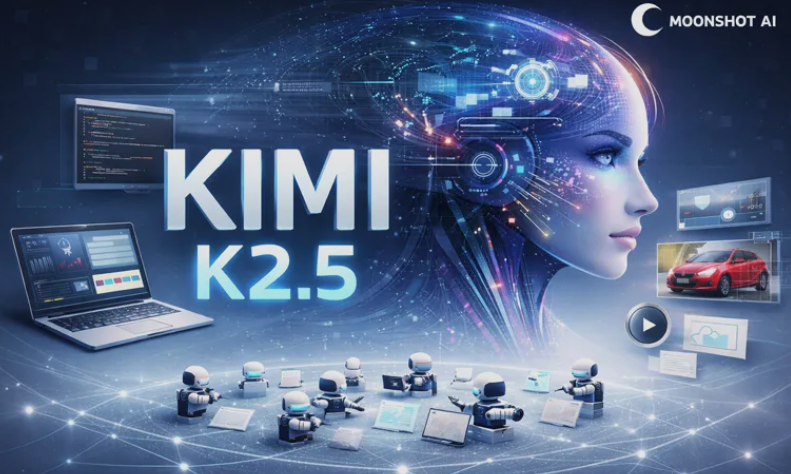
The landscape of Artificial Intelligence has shifted from passive chatbots to active, autonomous agents. At the forefront of this evolution is Kimi k2.5 , the latest flagship model from Moonshot AI. This model represents a landmark achievement in the "Agentic AI" era, offering a blend of native multimodality, massive reasoning power, and a revolutionary architecture designed for high-speed, parallel task execution.
What Makes Kimi k2.5 a Breakthrough?
Kimi k2.5 is the first mainstream, frontier-level AI model to successfully integrate a native multimodal architecture with a massively scaled Mixture-of-Experts (MoE) framework. Developed by Moonshot AI, it features 1 trillion total parameters , with 32 billion active parameters per token, allowing it to rival or exceed the performance of models like GPT-4o and Claude 3.5 Sonnet. Its defining innovation is the "Agent Swarm" capability, which enables the model to transition from sequential reasoning to parallel, multi-agent execution. This allows Kimi k2.5 to solve complex, multi-step problems—such as software engineering and deep research—by deploying and coordinating up to 100 specialized sub-agents simultaneously.
1. The Architectural Foundation: 1 Trillion Parameters and MoE
Kimi k2.5 is built on a sophisticated Mixture-of-Experts (MoE) architecture. Unlike dense models that activate every parameter for every prompt, MoE models only engage a specific subset of "experts" relevant to the task. Kimi k2.5 boasts a total of 1 trillion parameters, but it maintains extreme efficiency by activating only 32 billion parameters for any given token. This design allows the model to process information with the depth of a massive model while maintaining the speed and lower compute costs of a much smaller one.
The training density of Kimi k2.5 is equally impressive. It was pretrained on a dataset of 15 trillion tokens , including a vast array of high-quality bilingual (Chinese and English) text, code, and visual data. This massive training set ensures that the model possesses a "dense" understanding of world knowledge, making it significantly more reliable and less prone to hallucinations compared to its predecessors.
2. Native Multimodality: Seeing and Thinking in Real-Time
One of the core strengths of Kimi k2.5 is its Native Multimodal capability. Many AI models utilize a "modular" approach where a vision model is stitched onto a language model, leading to data loss during translation. Kimi k2.5, however, was trained as a single, unified architecture that perceives images, videos, and text simultaneously. This native approach allows the model to perform "Visual Reasoning" at a frontier level, ranking it among the top vision models globally.
This multimodal prowess is particularly evident in tasks involving complex visual data. Kimi k2.5 can ingest a video of a software bug or a screenshot of a complicated user interface and generate a logical, text-based explanation or even the corrected code. By treating pixels and text as parts of the same conceptual universe, the model achieves a level of spatial and logical comprehension that mimics human observation.
3. The "Agent Swarm" Revolution: Parallel Intelligence
The most significant leap forward in Kimi k2.5 is its Agent Swarm capability. Traditional LLMs operate on a sequential "Chain of Thought," solving one piece of a problem after another. Kimi k2.5 introduces a paradigm shift where it can autonomously split a complex goal into dozens of sub-tasks. It then instantiates a "swarm" of parallel agents to work on these tasks at the same time, coordinating their outputs into a final, unified solution.
- Parallel Execution: Can deploy up to 100 sub-agents to handle diverse aspects of a project simultaneously.
- Massive Workflow Capacity: Supports complex execution flows involving up to 1,500 individual steps.
- Efficiency Gains: Reduces end-to-end task completion time by 3x to 4.5x for parallelizable workloads.
- Self-Correction: The swarm architecture allows sub-agents to verify each other's work, significantly increasing the success rate of autonomous agents.
4. Coding with Vision: The Next Generation of Programming
Kimi k2.5 is a top-tier performer in the coding domain, but it adds a unique twist: Coding with Vision. This allows developers to bridge the gap between design and implementation effortlessly. A developer can upload a sketch of a website or a video of an app interaction, and Kimi k2.5 can generate the functional frontend code (React, HTML/CSS, etc.) that matches the visual input with pixel-perfect accuracy.
In standard coding benchmarks, Kimi k2.5 rivals the most advanced models in the world. Its ability to handle long-context codebases means it can "read" an entire project and suggest refactors or identify bugs that span multiple files. The model’s "Thinking Process" ensures that it doesn't just provide snippets but understands the architectural implications of the code it generates, making it a true partner for senior software engineers.
5. Performance Benchmarks and Global Ranking
The technical specifications of Kimi k2.5 are backed by industry-leading scores in various benchmarks. Whether in language understanding, mathematical reasoning, or visual perception, the model consistently places in the "Frontier" category.
- MMLU & Reasoning: Shows exceptional performance in massive multitask language understanding, rivaling GPT-4o.
- Math Reasoning: Its Chain-of-Thought training allows it to solve complex calculus and logic puzzles that typically stump smaller models.
- Vision Arena: Ranked among the top 10 multimodal models globally, often securing the #1 spot for open-source multimodal performance.
- Instruction Following: Boasts high adherence to complex, multi-layered prompts, which is a prerequisite for reliable agentic behavior.
6. Long Context Mastery: The 256K Token Advantage
Moonshot AI first made waves with its massive context windows, and Kimi k2.5 continues this tradition. The model supports a 256K token context window , which is roughly equivalent to a 200,000-word book. This allows users to upload massive technical manuals, legal contracts, or entire code repositories for analysis without the model "forgetting" the beginning of the document.
The "Needle-in-a-Haystack" performance—the ability to find a specific fact within a massive amount of data—is near-perfect for Kimi k2.5. This makes it an ideal tool for RAG (Retrieval-Augmented Generation) applications, where the model must search through proprietary data to provide accurate, grounded answers. For researchers and legal professionals, this capability transforms the model into an exhaustive document auditor.
7. Cost Efficiency and Developer Accessibility
One of the most disruptive aspects of Kimi k2.5 is its pricing. Moonshot AI has optimized the inference process to the point where Kimi k2.5 is significantly more affordable than comparable frontier models. According to industry reports, it is roughly 95% cheaper than premium enterprise models like Claude 4.5 or the original GPT-4 Pro, despite offering similar or superior reasoning capabilities.
This low cost allows developers to experiment with "expensive" AI workflows—such as large-scale agent swarms or repetitive code auditing—without the fear of massive API bills. By lowering the barrier to entry, Moonshot AI is effectively democratizing frontier-level AI, allowing startups and independent developers to build highly sophisticated, agent-driven applications that were previously the sole domain of big tech companies.
8. Quickstart Guide: How to Implement Kimi k2.5
For developers looking to integrate Kimi k2.5 into their applications, Moonshot AI provides a streamlined API through their open platform. The model is compatible with standard OpenAI-style API calls, making it a "drop-in" replacement for existing LLM integrations.
- Endpoint: Utilize the Moonshot AI API endpoint for text, vision, and tool-use requests.
- Model Name: Specify moonshot-v1-8k , 32k , 128k , or the flagship 256k versions of the k2.5 series.
- Tool Use: The model supports native function calling, allowing it to interact with external databases, search engines, and local file systems.
- Multimodal Input: Pass images or video frames directly in the message array for visual analysis.
9. Comparative Specs: Kimi k2.5 vs. Competitors
To understand where Kimi k2.5 sits in the 2026 AI hierarchy, a direct comparison with other frontier models is necessary. While Western models like GPT-5 (and its iterations) lead in certain creative and English-centric tasks, Kimi k2.5 dominates in bilingual efficiency and multimodal agentic execution.
10. The Ethical and Secure Deployment of Agents
As Kimi k2.5 introduces more autonomous "Agentic" features, Moonshot AI has prioritized safety and alignment. The model includes robust guardrails to prevent the generation of harmful content and ensure that its autonomous agents operate within the bounds of user instructions. For enterprise users, the model supports private cloud deployments and strict data-handling policies, ensuring that proprietary data used in "swarms" or long-context analysis remains secure.
The transparency of the "Thinking Process" is another key safety feature. By allowing developers to see the model's internal reasoning traces, it becomes much easier to audit the AI’s logic and interject if it begins to move in an unintended direction. This "human-in-the-loop" capability is essential for deploying AI in high-stakes environments like financial modeling or medical research.
11. Use Cases: Revolutionizing Industries in 2026
The versatility of Kimi k2.5 makes it applicable across a vast array of high-value industries. Its ability to think, see, and act in parallel transforms it from a tool into a teammate.
- Software Engineering: Automating the entire lifecycle of a feature request—from reading the UI design to writing the code, running tests, and submitting a pull request.
- Academic Research: Using Agent Swarm to summarize hundreds of papers, synthesize findings, and identify gaps in current literature.
- Supply Chain Management: Analyzing visual data from warehouses and reading thousands of shipping documents to optimize logistics in real-time.
- Global Customer Support: Providing high-reasoning, multilingual support that can resolve complex issues across multiple systems autonomously.
12. Conclusion: The Dawn of the Agentic Era
Kimi k2.5 is more than just an incremental update; it is a fundamental reimagining of what a Large Language Model can be. By proving that a model can possess trillion-parameter intelligence while maintaining thirty-billion-parameter efficiency, Moonshot AI has set a new benchmark for the industry. The introduction of "Agent Swarm" signals the end of the AI-as-a-chatbot era and the beginning of AI-as-a-workforce.
For the global developer community, Kimi k2.5 offers a powerful, cost-effective, and transparent platform for building the next generation of autonomous applications. Whether you are leveraging its native vision for front-end design or its massive context window for deep data analysis, Kimi k2.5 provides the "brain" required to thrive in a world driven by intelligent, parallel automation.