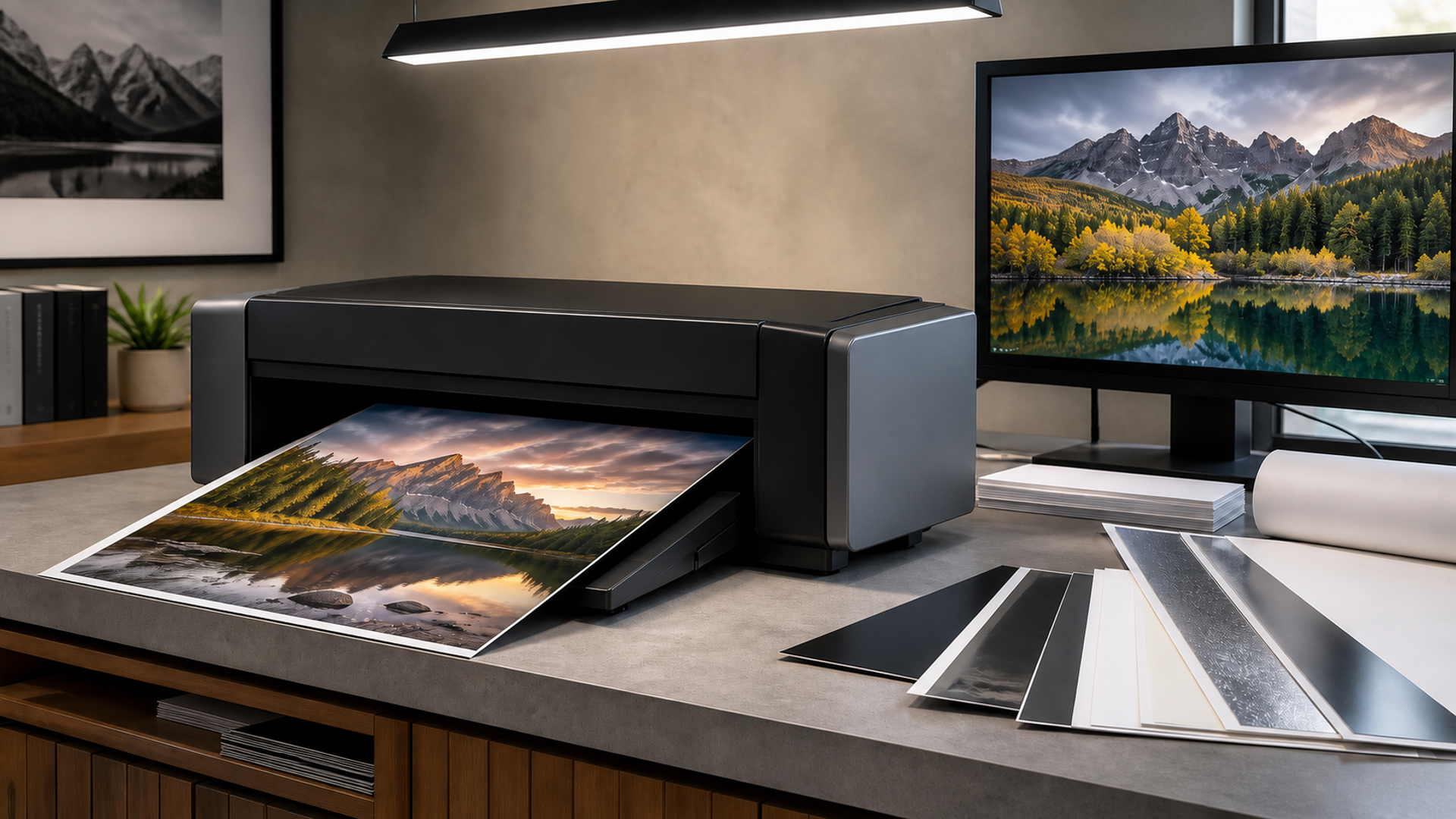
The best photo printer is the one that produces the intended print repeatedly on the intended paper, not the model with the longest colour list. Image editing, display conditions, profile selection, driver settings, ink condition and paper all affect the result. Dye and pigment systems have different strengths, but neither can bypass a broken colour workflow. Start with the finished print and work backwards through size, surface, longevity, speed and maintenance.
Define the finished print
Choose a printer whose maximum image size and paper path match the work, whose ink system suits the desired surfaces and display life, and whose manufacturer or paper suppliers provide usable ICC profiles. Budget for complete ink sets, cleaning cycles, test sheets and failed prints. If output is occasional, compare a professional lab before accepting the maintenance burden of an advanced pigment printer.
| Decision factor | Compact dye workflow | Pigment fine-art workflow | Profiled lab partnership |
|---|---|---|---|
| Finished size | Small and medium prints dominate | Larger sheets and fine-art media are routine | Rare large work is outsourced |
| Surface | Glossy and lustre are primary | Matte and textured papers are central | Lab supplies specialist surfaces |
| Colour control | Manufacturer profiles cover the shortlist | Custom or paper-maker profiles are maintained | Soft proof and lab profile are reconciled |
| Black behaviour | Gloss output and smooth tone matter | Matte black density and neutral control matter | Lab is judged by same-file proof |
| Throughput | Frequent small prints justify immediate access | Regular portfolio work offsets setup time | Occasional deadlines tolerate delivery |
| Maintenance | Simple nozzle checks fit the routine | Cleaning, tanks and calibration are budgeted | Lab carries printer maintenance |
| Cost evidence | Successful small-print cost is measured | Full ink set and rejected sheets are counted | Quote includes proof, shipping and reprint terms |
This best photo printer matrix is the article's working value object. Read the best photo printer rows together: the decisive failure mode depends on this topic's evidence, operating context and reader objective.
How ICC colour management fits the evidence chain
Evidence 1. The International Color Consortium describes ICC colour management as a profile-based way to communicate device colour characteristics across a workflow.
Evidence 2. The ICC registry provides registered profiles and metadata, but a profile must match the relevant device, ink, paper and settings to be useful.
Evidence 3. A printer profile cannot correct an uncalibrated or overly bright display, wrong driver media setting, clogged nozzle or unexpected viewing light.
Evidence 4. Cost per successful print includes ink used in maintenance, paper, rejected output and operator time, not only a nominal cartridge yield.
Reader-visible sources checked for this article:
color.org — reader-visible current or official evidence
registry.color.org — reader-visible current or official evidence
For best photo printer, these sources establish only the claims inside their documented scope. Recheck every changeable specification, availability condition, price, policy or service term in the relevant market before acting.
Compare ink, paper and maintenance together
Read finished size as a stop/go test: small and medium prints dominate supports the first option; larger sheets and fine-art media are routine supports the second; and rare large work is outsourced supports the third. Record which source proves the condition and when it was checked.
A buyer can resolve surface without starting from a brand preference. Ask whether glossy and lustre are primary; compare that with whether matte and textured papers are central; then use lab supplies specialist surfaces as the third route's safeguard. An unknown condition stays unknown.
On colour control, popularity is not enough. The evidence for option one is that manufacturer profiles cover the shortlist. Option two means custom or paper-maker profiles are maintained. Option three is rational where soft proof and lab profile are reconciled. Recheck any changeable term immediately before commitment.
The decision changes at black behaviour. Choose the first path only if gloss output and smooth tone matter; move to the second when matte black density and neutral control matter; use the third when lab is judged by same-file proof. Save the downside that would make this row fail.
For throughput, the first route works when frequent small prints justify immediate access; the second requires regular portfolio work offsets setup time. The control for the third is occasional deadlines tolerate delivery. Verify this row against the exact product, property, account or environment before it can reverse the decision.
The maintenance row exposes a practical boundary. Route one assumes simple nozzle checks fit the routine, while route two is defensible only when cleaning, tanks and calibration are budgeted. Route three depends on lab carries printer maintenance. If that evidence is absent, keep the more reversible option.
Read cost evidence as a stop/go test: successful small-print cost is measured supports the first option; full ink set and rejected sheets are counted supports the second; and quote includes proof, shipping and reprint terms supports the third. Record which source proves the condition and when it was checked.
Facts that would reverse the current choice
Reversal control 1 — Finished size. Before choosing Compact dye workflow, write down how the decision changes if “Small and medium prints dominate” proves false. Do the same for Pigment fine-art workflow and “Larger sheets and fine-art media are routine”. Keep the Profiled lab partnership route available until “Rare large work is outsourced” is verified. This control belongs to best photo printer; update it from the cited source or exact supplier rather than copying a generic checklist.
Reversal control 2 — Surface. Before choosing Compact dye workflow, write down how the decision changes if “Glossy and lustre are primary” proves false. Do the same for Pigment fine-art workflow and “Matte and textured papers are central”. Keep the Profiled lab partnership route available until “Lab supplies specialist surfaces” is verified. This control belongs to best photo printer; update it from the cited source or exact supplier rather than copying a generic checklist.
Reversal control 3 — Colour control. Before choosing Compact dye workflow, write down how the decision changes if “Manufacturer profiles cover the shortlist” proves false. Do the same for Pigment fine-art workflow and “Custom or paper-maker profiles are maintained”. Keep the Profiled lab partnership route available until “Soft proof and lab profile are reconciled” is verified. This control belongs to best photo printer; update it from the cited source or exact supplier rather than copying a generic checklist.
Reversal control 4 — Black behaviour. Before choosing Compact dye workflow, write down how the decision changes if “Gloss output and smooth tone matter” proves false. Do the same for Pigment fine-art workflow and “Matte black density and neutral control matter”. Keep the Profiled lab partnership route available until “Lab is judged by same-file proof” is verified. This control belongs to best photo printer; update it from the cited source or exact supplier rather than copying a generic checklist.
Reversal control 5 — Throughput. Before choosing Compact dye workflow, write down how the decision changes if “Frequent small prints justify immediate access” proves false. Do the same for Pigment fine-art workflow and “Regular portfolio work offsets setup time”. Keep the Profiled lab partnership route available until “Occasional deadlines tolerate delivery” is verified. This control belongs to best photo printer; update it from the cited source or exact supplier rather than copying a generic checklist.
Reversal control 6 — Maintenance. Before choosing Compact dye workflow, write down how the decision changes if “Simple nozzle checks fit the routine” proves false. Do the same for Pigment fine-art workflow and “Cleaning, tanks and calibration are budgeted”. Keep the Profiled lab partnership route available until “Lab carries printer maintenance” is verified. This control belongs to best photo printer; update it from the cited source or exact supplier rather than copying a generic checklist.
Reversal control 7 — Cost evidence. Before choosing Compact dye workflow, write down how the decision changes if “Successful small-print cost is measured” proves false. Do the same for Pigment fine-art workflow and “Full ink set and rejected sheets are counted”. Keep the Profiled lab partnership route available until “Quote includes proof, shipping and reprint terms” is verified. This control belongs to best photo printer; update it from the cited source or exact supplier rather than copying a generic checklist.
Specify size, surface and viewing light
List the largest regular print, not the once-a-year aspiration. Decide whether the work is glossy, lustre, matte, fine-art or mixed, and whether borderless output matters. Heavy cotton papers can require a straight path and wider margins. View prints under the light in which they will be judged. A print tuned under cool studio lighting may look different under warm domestic lamps, so the evaluation environment belongs in the workflow.
Choose dye or pigment by output
Dye systems can deliver smooth glossy output and compact designs, while pigment systems are often chosen for broader media support, matte black behaviour and display-life goals. Real products vary. Compare current manufacturer specifications and independent permanence data for the exact ink-paper combination rather than turning the chemistry label into a universal ranking. Switching black inks, paper paths or coatings may change time and waste.
Build a profile-controlled path
Calibrate and profile the display to an appropriate target, soft-proof using the correct printer-paper profile, select the matching media setting and avoid double colour management. Record driver, application and rendering settings for repeat jobs. Profiles from a paper maker are useful only for their named printer and ink combination. Custom profiling can help demanding work, but it does not rescue poor nozzles, unstable paper or inconsistent viewing.
Calculate ownership from real cycles
Price a complete ink replacement, maintenance tanks, printheads where applicable and the paper used for tests. Estimate how often the printer will sit idle and how the model handles automatic cleaning. Print a nozzle check before a valuable job. Small cartridges can be acceptable for light use, but frequent replacement interrupts production; large tanks can reduce interruption but tie up ink and space. Save usage data instead of trusting theoretical yields.
Decide whether to own or outsource
A lab can be more economical for rare large prints, unusual surfaces or tightly managed colour. Ownership is valuable when iteration speed, privacy, deadlines or creative control justify it. Compare the same file, size and paper through shortlisted routes. Inspect neutral gradients, deep shadow detail, saturated colour, skin tones and fine texture. The winning route is the one whose repeatability and total effort fit the actual portfolio.
Three photo-printing workflows
Family and travel prints
A compact dye printer can be practical when glossy output, simple operation and moderate size dominate. Verify consumable cost and do not overbuy fine-art capability. Define the fact that would reverse this recommendation before committing.
Fine-art matte portfolio
A pigment system with suitable black ink, straight paper path, current profiles and controlled viewing has a stronger case. Budget for maintenance and test output. Define the fact that would reverse this recommendation before committing.
Occasional exhibition print
Use a calibrated workflow but compare a professional lab. Outsourcing can preserve size and media choice without carrying idle-printer risk. Define the fact that would reverse this recommendation before committing.
Action checklist
Define maximum regular print size.
List glossy, matte and fine-art media needs.
Confirm paper thickness and feed path.
Compare dye and pigment for the actual surface.
Verify ICC profiles for exact ink and paper.
Calibrate the display to a print-appropriate target.
Avoid double colour management.
Price full ink and maintenance replacement.
Run a same-file comparison print.
Compare ownership with a professional lab.
Continue the decision
The linked VERTU articles expand adjacent parts of the best photo printer decision. They do not substitute for the external evidence above.
The photo-printer verdict
Choose a printer whose maximum image size and paper path match the work, whose ink system suits the desired surfaces and display life, and whose manufacturer or paper suppliers provide usable ICC profiles. Budget for complete ink sets, cleaning cycles, test sheets and failed prints. If output is occasional, compare a professional lab before accepting the maintenance burden of an advanced pigment printer.
Keep the best photo printer decision reversible until its material cost, safety, access, privacy and compatibility facts are verified. Unknown evidence stays unknown; it is never silently scored as favourable.