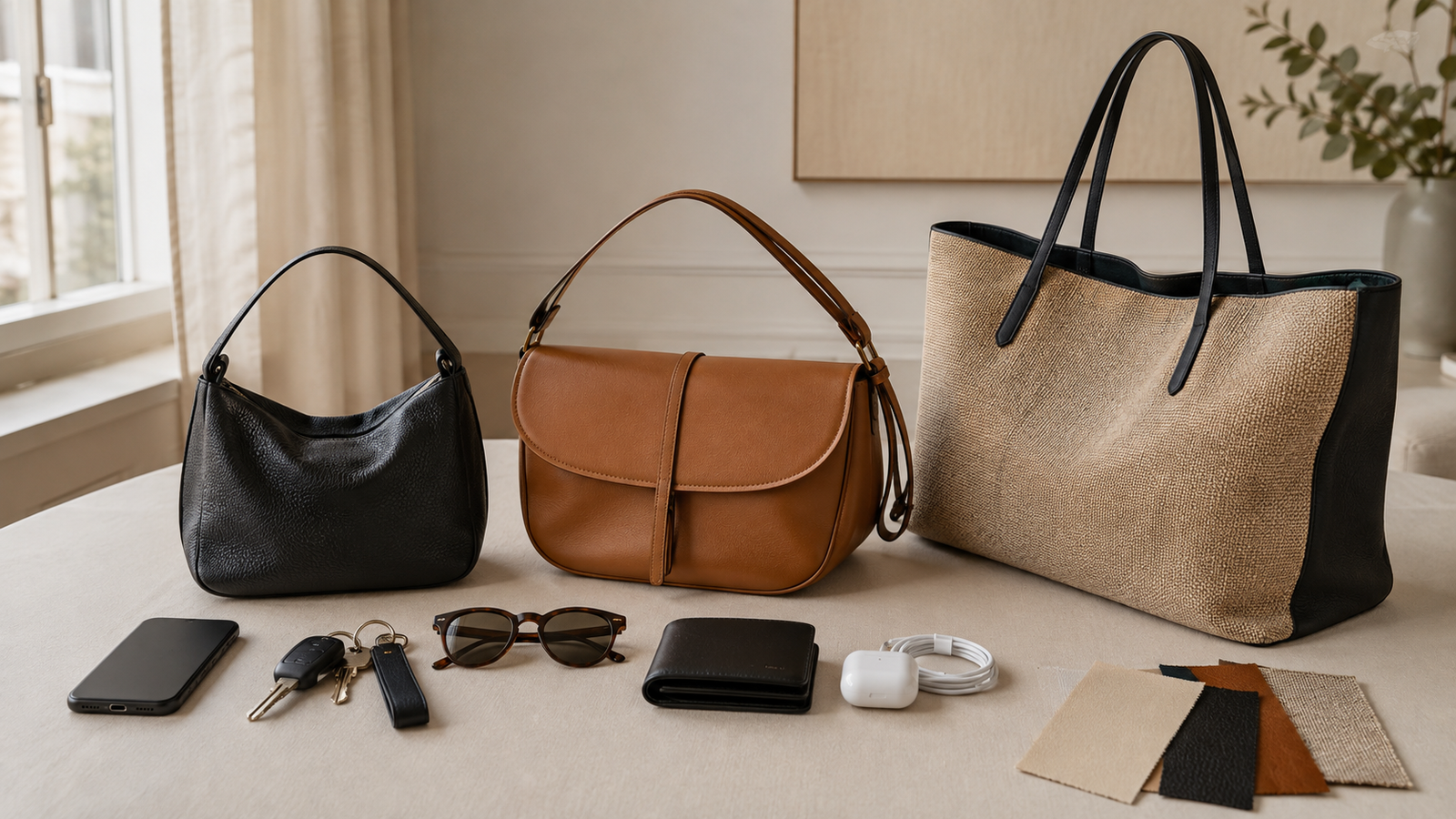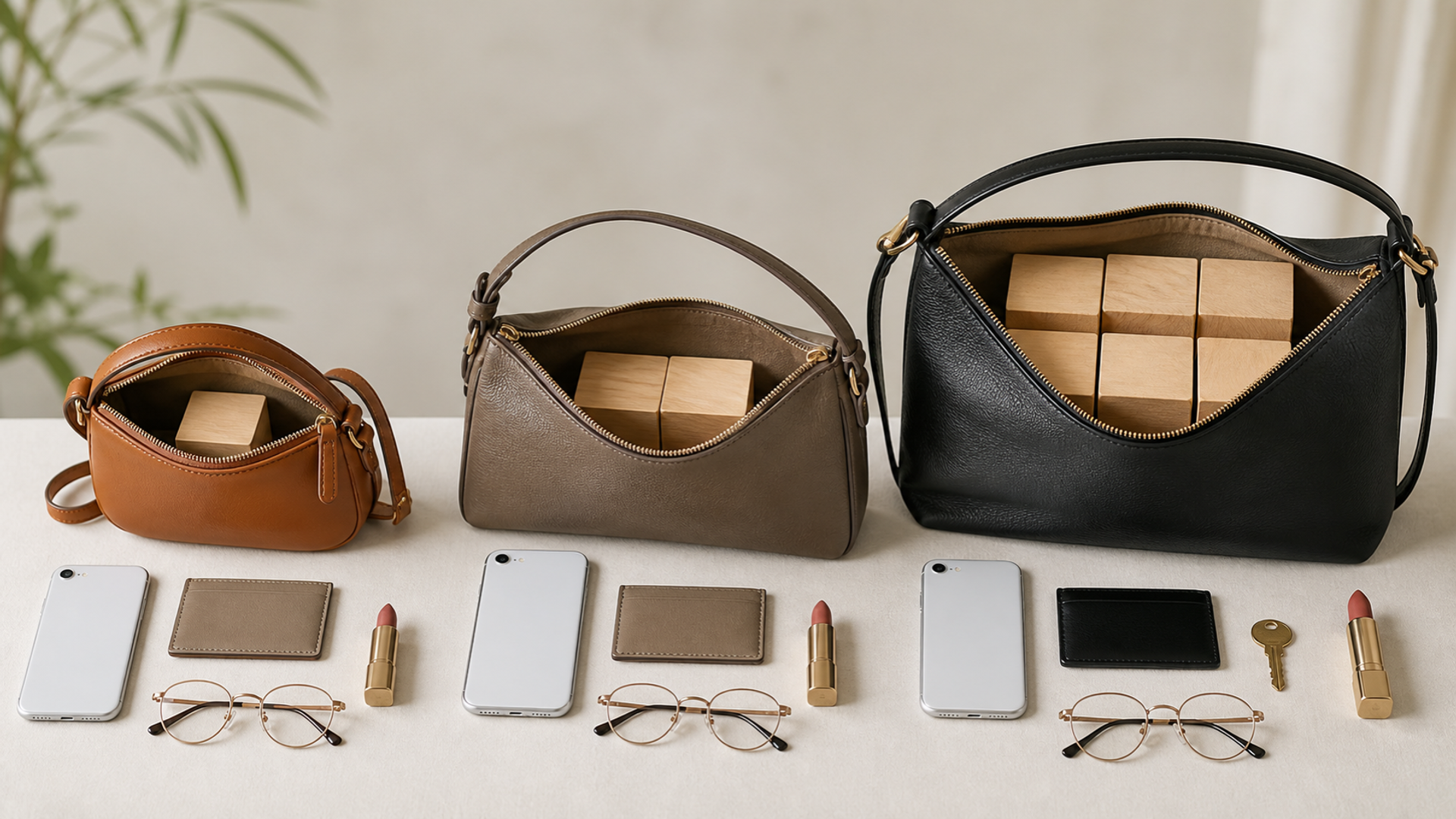
Small designer bags are often bought from exterior dimensions and styled photographs, yet usable capacity is governed by the opening, internal shape, gussets, closure and rigidity. A phone that fits the body may not pass through the zip. A chain can consume interior space. A miniature top handle may look balanced but become awkward after an hour. The expensive mistake is a bag that technically holds essentials only when they are unpacked and rearranged every time.
The right method is a physical packing test using the owner's actual phone, keys, cards, glasses and medication. Measure the objects and the bag's opening, not only its widest exterior. Then consider carry, security, evening or daytime use and how the material reacts to overfilling. Small can be liberating when the capacity is designed rather than guessed.
Direct answer: designer bags small
Choose the smallest bag that accepts your non-negotiable kit through its real opening, closes without strain and remains comfortable for the full occasion. Test phone fit, key bulk, glasses, card access, strap drop and security. Do not buy a mini bag whose capacity works only in an empty display photograph.
| Decision factor | Evidence to collect | Why it changes the answer | Control before purchase |
|---|---|---|---|
| Usable opening | zip, flap and frame openings can be narrower than the bag body | an object may fit the dimensions but not enter | measure the opening and insert the actual phone and case |
| Internal geometry | gussets, dividers, chains and curves consume nominal volume | litres or exterior dimensions overstate usable space | pack the exact essentials and close the bag without force |
| Object priority | phone, keys, cards, glasses and medication have fixed shapes | one bulky item can displace everything else | rank non-negotiables and choose a compact version only where safe |
| Carry | strap width, drop, chain weight and bag balance affect comfort | a light bag can become painful when loaded | wear it for twenty minutes with the intended load |
| Security | open tops, weak magnets and exposed phones change risk | occasion and location may require stronger closure | test one-handed access and deliberate closure |
| Material stress | overfilling distorts leather, glazing, corners and hardware | forcing capacity can create permanent wear | leave closure and seam tolerance rather than packing to the limit |
For designer bags small, this matrix is the article-specific value object. It prevents a famous name, one specification or one price from silently becoming the recommendation.
Current evidence baseline
Evidence 1. Hermès leather-care guidance warns against inserting contents that are too bulky or unsuitable because they can distort an object's shape. Source.
Evidence 2. Louis Vuitton's care service treats leather-goods condition and repair as model- and material-specific rather than a universal home-care problem. Source.
Evidence 3. Leather Working Group explains that material traceability and manufacturing audits have a defined scope and do not by themselves establish a finished bag's capacity or construction quality. Source.
Evidence 4. Hermès states that leather develops patina with use and that moisture, heat, light and friction influence its appearance over time. Source.
For designer bags small, these sources support only the claims stated above. They do not establish private transaction prices, permanent availability, universal authenticity or future appreciation.
How the decision factors change the result
Usable opening. The evidence to collect is that zip, flap and frame openings can be narrower than the bag body. That changes the decision because an object may fit the dimensions but not enter. The practical control is to measure the opening and insert the actual phone and case. For the usable opening test in designer bags small, record the date, exact reference or route, the source and the assumption that would cause the conclusion to change. This keeps the factor auditable rather than turning it into a vague quality impression.
Internal geometry. The evidence to collect is that gussets, dividers, chains and curves consume nominal volume. That changes the decision because litres or exterior dimensions overstate usable space. The practical control is to pack the exact essentials and close the bag without force. For the internal geometry test in designer bags small, record the date, exact reference or route, the source and the assumption that would cause the conclusion to change. This keeps the factor auditable rather than turning it into a vague quality impression.
Object priority. The evidence to collect is that phone, keys, cards, glasses and medication have fixed shapes. That changes the decision because one bulky item can displace everything else. The practical control is to rank non-negotiables and choose a compact version only where safe. For the object priority test in designer bags small, record the date, exact reference or route, the source and the assumption that would cause the conclusion to change. This keeps the factor auditable rather than turning it into a vague quality impression.
Carry. The evidence to collect is that strap width, drop, chain weight and bag balance affect comfort. That changes the decision because a light bag can become painful when loaded. The practical control is to wear it for twenty minutes with the intended load. For the carry test in designer bags small, record the date, exact reference or route, the source and the assumption that would cause the conclusion to change. This keeps the factor auditable rather than turning it into a vague quality impression.
Security. The evidence to collect is that open tops, weak magnets and exposed phones change risk. That changes the decision because occasion and location may require stronger closure. The practical control is to test one-handed access and deliberate closure. For the security test in designer bags small, record the date, exact reference or route, the source and the assumption that would cause the conclusion to change. This keeps the factor auditable rather than turning it into a vague quality impression.
Material stress. The evidence to collect is that overfilling distorts leather, glazing, corners and hardware. That changes the decision because forcing capacity can create permanent wear. The practical control is to leave closure and seam tolerance rather than packing to the limit. For the material stress test in designer bags small, record the date, exact reference or route, the source and the assumption that would cause the conclusion to change. This keeps the factor auditable rather than turning it into a vague quality impression.
Worked decision scenario
List the five non-negotiable objects and measure each at its widest point, including phone case and key fob. Test three bags and count successful closures without compression or rearranging more than once. Add a comfort score after twenty minutes and a security score for the intended setting. Divide price by projected wears over three years, assigning zero wears to occasions where the load fails. A smaller cheaper bag can be worse value if it repeatedly stays home.
Exterior size is not capacity
A structured rectangle, curved saddle and soft pouch with the same width hold different loads. Measure the opening, base and narrowest internal point. Dividers can organise cards but prevent a sunglasses case from rotating into place. A flap may need empty space to close. Try the bag with protective stuffing removed and any internal chain arranged as it will be worn. Record what fits without deforming the silhouette.
Start with the phone
Modern phones and protective cases often determine minimum bag length and opening. Insert the phone without angling it against a zip tooth or forcing the frame. Check whether it can be removed one-handed and whether a magnetic closure interferes with the layout. If the phone occupies the entire base, keys may scratch it and a glasses case may not fit. A dedicated pocket is useful only when it accepts the actual device.
Keys are the hidden capacity problem
A compact card case is predictable; keys are irregular, hard and capable of marking leather or screens. Use a pouch or key holder and include it in the test. Car fobs can be larger than expected. If keys must sit against a delicate lining, decide whether the bag is suitable for daily use. Do not assume a valet or another bag will always solve the problem unless that is genuinely part of the occasion.
Match closure to the setting
An open mini tote may be comfortable at a private dinner and unsuitable in a crowded transport hub. A secure zip can reduce the opening. A flap may slow access but protect contents. Test the closure with one hand and with the bag on the body. Check whether a chain or strap can detach unexpectedly. Security is not a universal ranking; it is the relationship between design and the places the owner will carry it.
Let material keep its shape
Overfilled bags place continuous force on corners, glazing, stitches and magnetic closures. Soft leather may bulge; coated canvas can crease at fold points; a rigid frame can stress the opening. Leave enough space to close naturally and avoid using hardware to compress the load. When storing, remove heavy contents and support the shape according to maker guidance. Capacity should be a repeatable working state, not the maximum achieved once.
Evidence checklist for designer bags small
[ ] Measure phone with case
[ ] Measure the real opening
[ ] Pack actual keys and glasses
[ ] Close without force
[ ] Test access with one hand
[ ] Wear for twenty minutes
[ ] Match security to occasion
[ ] Leave material tolerance
An unchecked designer bags small decision remains unknown. It should not be converted into a favourable assumption merely to complete the purchase.
Reader-visible sources and method
The external pages above were checked for this designer bags small publication. Price, availability, service, tax, regulation and platform terms must be reconfirmed for the buyer's market and date. The designer bags small ranking pages informed the separate SERP benchmark, but their prose was not copied and they do not control the claims in this article.
Continue with adjacent VERTU editorial research
For a designer bags small reader, these links provide adjacent premium-lifestyle and decision context; they do not replace specialist or official evidence for the transaction.
Final judgement
Choose the smallest bag that accepts your non-negotiable kit through its real opening, closes without strain and remains comfortable for the full occasion. Test phone fit, key bulk, glasses, card access, strap drop and security. Do not buy a mini bag whose capacity works only in an empty display photograph.
The useful standard for designer bags small is not certainty created by confident language. It is a decision whose evidence, downside and next review point are visible to the reader.