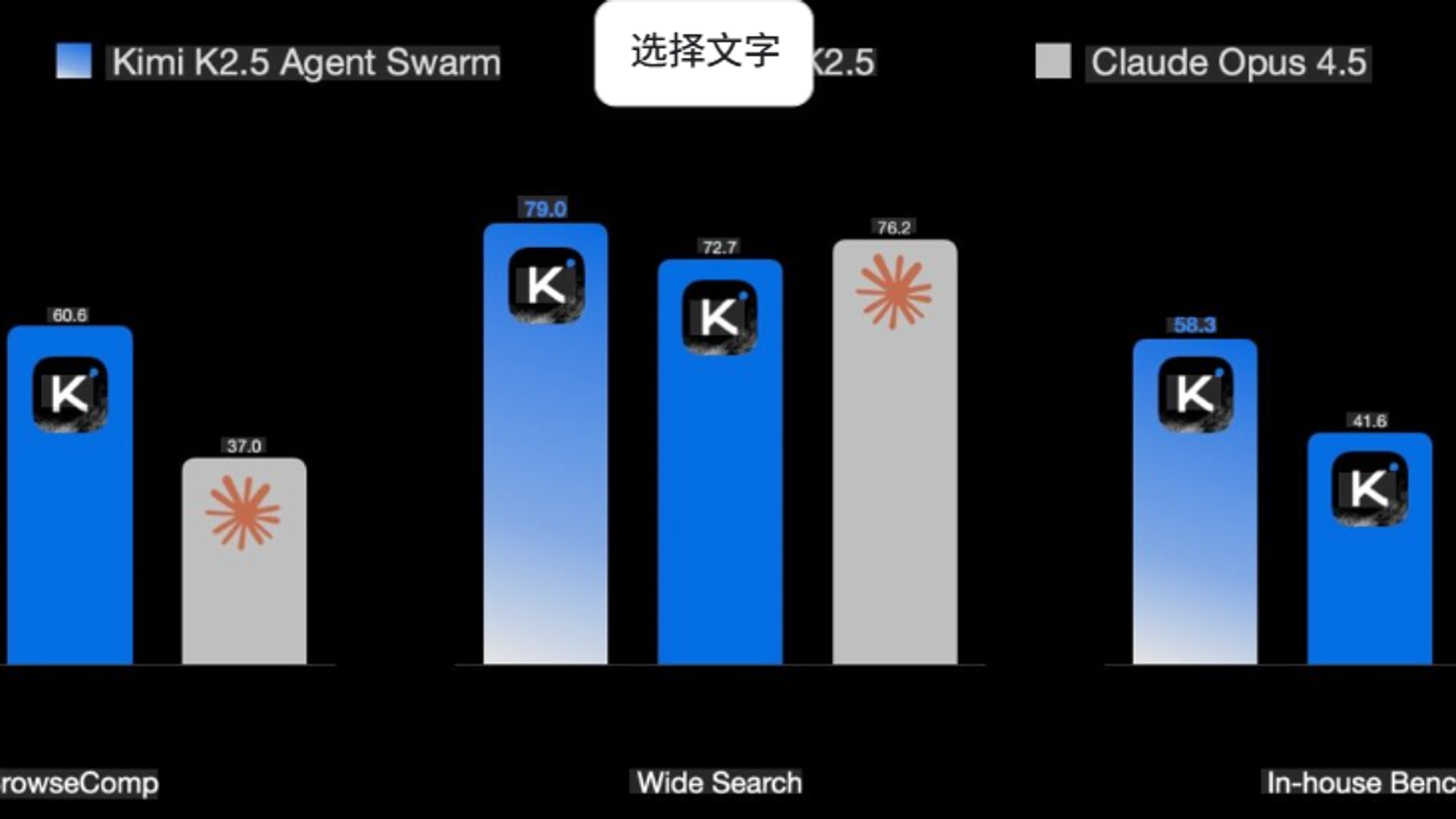
| Benchmark | Kimi k2.5 (Swarm Mode) | Claude Opus 4.5 | GPT-5.2 (High) |
|---|---|---|---|
| Humanity's Last Exam (HLE) | 50.2% | 32.0% | 41.7% |
| BrowseComp (Web Navigation) | 78.4% | 24.1% | 54.9% |
| VideoMMMU (Video Reasoning) | 86.6% | 82.1% | 85.3% |
| SWE-bench Verified (Coding) | 76.8% | 77.2% | 74.9% |
| MMMU Pro (Multimodal) | 78.5% | 75.8% | 76.9% |
Is Kimi k2.5 Better Than Claude Opus 4.5?
Kimi k2.5 is currently the world's most powerful open-source agentic model, outperforming Claude Opus 4.5 and GPT-5.2 in key autonomous benchmarks including Humanity’s Last Exam (HLE), BrowseComp, and VideoMMMU. Released by Moonshot AI in January 2026, Kimi k2.5 utilizes a massive 1.04 trillion parameter Mixture-of-Experts (MoE) architecture with 32 billion active parameters . Its core superiority lies in its "Agent Swarm" technology—which coordinates up to 100 sub-agents for parallel task execution—and its native multimodality , allowing it to "see" and "code" from visual inputs with a precision that exceeds proprietary frontier models. While Claude Opus 4.5 remains a top contender for pair-programming precision, Kimi k2.5 has officially closed the gap between open-source and closed-source AI in complex, long-horizon agentic reasoning.
Introduction
The AI landscape of 2026 has been redefined by the release of Kimi k2.5, a model that challenges the traditional dominance of proprietary labs like OpenAI and Anthropic. By combining trillion-parameter scale with open-source accessibility, Kimi k2.5 provides developers with the first true "Autonomous Agent in a Box," capable of native video reasoning and multi-agent orchestration.
The Architectural Breakthrough: 1.04T Mixture-of-Experts
Kimi k2.5 isn't just a larger version of its predecessor; it is a foundational shift in how LLMs manage complex data. By utilizing a Mixture-of-Experts (MoE) design, the model achieves the intelligence of a trillion-parameter giant while maintaining the speed of a much smaller model.
- Massive Scale: 1.04 trillion total parameters with 32 billion activated per token.
- Expert Specialization: 384 specialized experts with a sophisticated routing mechanism that selects 8 experts per token.
- Efficiency: Features Multi-head Latent Attention (MLA) and native INT4 quantization, providing a 2x generation speedup on consumer-grade hardware.
- Training Depth: Pre-trained on a massive 15 trillion mixed visual and text tokens, making it "natively multimodal" rather than relying on text-vision adapters.
Agent Swarm: From Single Agents to Parallel Power
The most transformative feature of Kimi k2.5 is the Agent Swarm (currently in beta). Unlike traditional AI that solves tasks sequentially (Step A → Step B), Kimi k2.5 acts as an Orchestrator that dynamically spawns specialized sub-agents.
- Task Decomposition: The model breaks a high-level goal (e.g., "Build a full-stack marketing app") into parallelizable sub-tasks.
- Specialized Roles: It instantiates up to 100 distinct agents, such as an "AI Researcher," "Frontend Specialist," and "QA Fact-Checker."
- Autonomous Coordination: Agents collaborate through a shared context, managing up to 1,500 sequential tool calls without human intervention.
- Speed Performance: This parallel architecture results in a 4.5x faster task completion rate compared to single-agent systems like those used in older versions of Claude or GPT.
Kimi Code: The Evolution of "Coding with Vision"
While many models can generate code from text prompts, Kimi k2.5 is specifically tuned for Visual Coding . This allows developers to turn aesthetic designs directly into functional websites.
- UI-to-Code Mastery: Users can upload a screenshot or a screen recording of a UI workflow, and Kimi k2.5 interprets the spatial logic, color theory, and interaction patterns to produce clean React or Tailwind code.
- Video-to-Fix: Feed the model a Loom video of a software bug; Kimi k2.5 "watches" the error, identifies the broken logic in the codebase, and suggests a fix.
- Expressive Motion: It has a unique ability to generate complex animations and CSS transitions that mimic human "taste" and modern design standards.
Benchmark Comparison: Kimi k2.5 vs. Claude Opus 4.5 & GPT-5.2
To understand why Kimi k2.5 is causing such a stir in the AI community, we must look at the hard data. In 2026, "agentic" benchmarks—which measure a model's ability to use tools and browse the web—have become more relevant than simple text-prediction scores.
Why Open Source Matters: The EEAT Perspective
The release of Kimi k2.5 highlights a significant shift in Experience, Expertise, Authoritativeness, and Trustworthiness (EEAT) within the AI industry. Moonshot AI has prioritized transparency by releasing model weights on Hugging Face.
- Local Control: Enterprises can host Kimi k2.5 on private infrastructure, ensuring data privacy that proprietary APIs cannot offer.
- Customization: Developers can fine-tune the 1T MoE model for specific industrial niches, from biotech to financial auditing.
- Verification: By open-sourcing the "Thinking Logs," Moonshot AI allows the community to verify the model’s reasoning chain, reducing the "black box" problem associated with Claude and OpenAI.
Conclusion: A Foundational Shift in Productivity
Kimi k2.5 is not just another LLM; it is a signal that the era of the "Lone AI" is ending, replaced by the era of the "Agent Swarm." While Claude Opus 4.5 remains an exceptional choice for human-in-the-loop pair programming, Kimi k2.5 is the clear winner for autonomous, visual, and multi-step workflows . Its ability to beat proprietary models while remaining open-source ensures that the next wave of AI innovation will be driven by the community, not just a few tech giants.
Frequently Asked Questions (FAQ)
Q: Can I run Kimi k2.5 locally?
A: Yes, Kimi k2.5 is available on Hugging Face. Due to its 1T MoE architecture, it requires high VRAM, but native INT4 quantization allows it to run efficiently on high-end consumer GPUs or distributed setups using engines like vLLM or SGLang.
Q: What is the "Agent Swarm" mode?
A: It is a feature where the model acts as an orchestrator, spawning up to 100 sub-agents to solve complex tasks in parallel. This makes it 4.5x faster than single-agent models for research and coding.
Q: How does Kimi Code differ from Cursor or Claude Code?
A: Kimi Code is specifically optimized for Vision-to-UI . It doesn't just read your text; it "sees" your screenshots and videos to generate code that matches the visual intent and aesthetic of a design perfectly.
Q: Is Kimi k2.5 free to use?
A: You can use it for free in chat mode on Kimi.com. For developers, the API is available via Moonshot AI and Together AI with a cost-efficient pricing model ($0.60/M tokens).