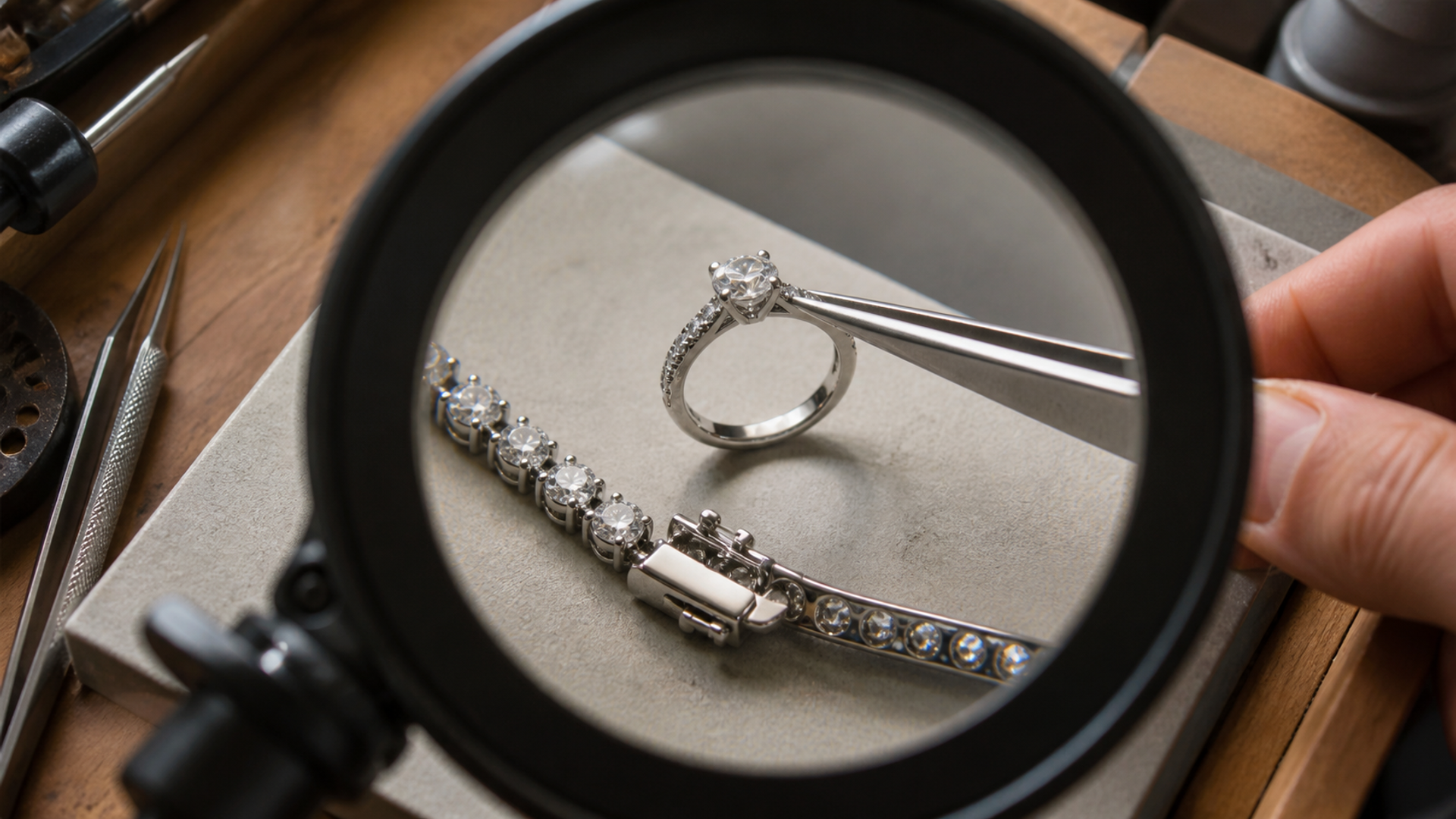
High-quality jewellery cannot be confirmed by sparkle, weight or price alone. A well-lit photograph hides porosity, uneven prongs, weak hinges and rough undersides. Two pieces described as gold can differ in fineness, alloy and surface treatment. Two stones of the same colour can differ in identity, treatment, durability and documentation. The buyer needs a repeatable inspection that moves from written disclosure to physical construction.
This guide treats quality as fitness for a declared use. A delicate evening ring and a daily bracelet do not need identical architecture, but both should be honestly described, cleanly made and serviceable within their intended loads. The strongest evidence combines material marks, appropriate laboratory information, careful magnification, comfort testing and a seller willing to state repair and return terms in writing.
Direct answer: high quality jewelry
Check jewellery in this order: written material description, marks and reports; setting and joint security; surface and underside finish; closure and comfort; care and repair route. Reject vague descriptions and unsupported treatment claims. Quality means the piece is honestly represented and competently built for how it will be worn.
| Decision factor | Evidence to collect | Why it changes the answer | Control before purchase |
|---|---|---|---|
| Metal disclosure | FTC guidance covers truthful claims about gold, silver, platinum, alloys and surface applications | appearance alone cannot distinguish solid, filled or plated construction | match the invoice wording to marks and ask what lies beneath any surface treatment |
| Gem identity | GIA and other competent laboratories report identity and treatments within a defined scope | colour and brilliance do not establish origin or permanence | match reports, measurements and treatment disclosure to the exact stones |
| Setting security | prongs, bezels, channels and pavé distribute force differently | uneven seats or thin metal increase loss risk | inspect symmetry, contact and movement under magnification |
| Finish | GIA quality benchmarks examine pre-finishing, polishing and preservation of form | high polish can hide rounded edges or remaining tool marks | inspect under neutral light including interior and underside surfaces |
| Closures and joints | clasps, hinges, solder seams and chain links carry repeated loads | a single weak component can end wearability | operate every mechanism repeatedly and ask whether parts are replaceable |
| Repairability | alloys, settings and branded components require appropriate skill | cheap alteration can damage stones or erase geometry | identify the workshop, methods and documentation before purchase |
For high quality jewelry, this matrix is the article-specific value object. It prevents a famous name, one specification or one price from silently becoming the recommendation.
Current evidence baseline
Evidence 1. The FTC Jewelry Guides cover truthful representation of metallic content, gemstone characteristics, treatment, durability and serviceability. Source.
Evidence 2. GIA's analysis and grading services test submitted materials, disclose treatments and can report metal markings and mounted-stone observations within scope. Source.
Evidence 3. GIA quality-assurance benchmarks show that polishing quality includes preserving dimensions and achieving appropriate surface finish, not shine alone. Source.
Evidence 4. FTC consumer guidance says sellers should disclose gemstone treatments when they are impermanent, require special care or significantly affect value. Source.
For high quality jewelry, these sources support only the claims stated above. They do not establish private transaction prices, permanent availability, universal authenticity or future appreciation.
How the decision factors change the result
Metal disclosure. The evidence to collect is that fTC guidance covers truthful claims about gold, silver, platinum, alloys and surface applications. That changes the decision because appearance alone cannot distinguish solid, filled or plated construction. The practical control is to match the invoice wording to marks and ask what lies beneath any surface treatment. For the metal disclosure test in high quality jewelry, record the date, exact reference or route, the source and the assumption that would cause the conclusion to change. This keeps the factor auditable rather than turning it into a vague quality impression.
Gem identity. The evidence to collect is that gIA and other competent laboratories report identity and treatments within a defined scope. That changes the decision because colour and brilliance do not establish origin or permanence. The practical control is to match reports, measurements and treatment disclosure to the exact stones. For the gem identity test in high quality jewelry, record the date, exact reference or route, the source and the assumption that would cause the conclusion to change. This keeps the factor auditable rather than turning it into a vague quality impression.
Setting security. The evidence to collect is that prongs, bezels, channels and pavé distribute force differently. That changes the decision because uneven seats or thin metal increase loss risk. The practical control is to inspect symmetry, contact and movement under magnification. For the setting security test in high quality jewelry, record the date, exact reference or route, the source and the assumption that would cause the conclusion to change. This keeps the factor auditable rather than turning it into a vague quality impression.
Finish. The evidence to collect is that gIA quality benchmarks examine pre-finishing, polishing and preservation of form. That changes the decision because high polish can hide rounded edges or remaining tool marks. The practical control is to inspect under neutral light including interior and underside surfaces. For the finish test in high quality jewelry, record the date, exact reference or route, the source and the assumption that would cause the conclusion to change. This keeps the factor auditable rather than turning it into a vague quality impression.
Closures and joints. The evidence to collect is that clasps, hinges, solder seams and chain links carry repeated loads. That changes the decision because a single weak component can end wearability. The practical control is to operate every mechanism repeatedly and ask whether parts are replaceable. For the closures and joints test in high quality jewelry, record the date, exact reference or route, the source and the assumption that would cause the conclusion to change. This keeps the factor auditable rather than turning it into a vague quality impression.
Repairability. The evidence to collect is that alloys, settings and branded components require appropriate skill. That changes the decision because cheap alteration can damage stones or erase geometry. The practical control is to identify the workshop, methods and documentation before purchase. For the repairability test in high quality jewelry, record the date, exact reference or route, the source and the assumption that would cause the conclusion to change. This keeps the factor auditable rather than turning it into a vague quality impression.
Worked decision scenario
Compare three pieces intended for the same use. Score each from zero to five for disclosure, setting, finish, closure, comfort and repair route, but allow a score only when evidence is recorded. Add purchase cost and a ten-year allowance for inspection, cleaning, replating if disclosed, and likely closure or sizing work. Divide by realistic wears. The point is not to reduce beauty to arithmetic; it is to expose a piece whose low price depends on vague materials or a short usable life.
Read every material word
Solid gold, gold-filled, vermeil and gold-plated are not stylistic synonyms. Fineness, base material and coating affect wear, care and intrinsic value. White gold may use rhodium for colour; sterling silver can tarnish; platinum alloys vary in hardness and working behaviour. Ask for precise written language. Photograph hallmarks, but remember that a mark is evidence to reconcile, not an invulnerability spell. Seller identity and the whole object still matter.
A stone report does not inspect the entire jewel
Laboratory evidence can establish identity and quality factors for submitted stones, but mounted jewellery may limit examination. Match dimensions and report numbers, and ask which stones are covered. For coloured gems, treatment and durability matter to cleaning and repair. A beautiful centre stone does not excuse weak side-stone setting, a thin shank or poor soldering. Evaluate the gem and the architecture as connected but distinct systems.
Use magnification without becoming a myth hunter
A loupe helps reveal uneven prongs, gaps, tool marks, porosity and chipped stones. It does not make every tiny handmade irregularity a defect. Look for consistency, security and finish appropriate to the design. Compare mirrored components and inspect the underside, where rushed work often remains. Ask the jeweller to explain unfamiliar construction. A credible answer connects the detail to strength, comfort or future service rather than dismissing the question.
Comfort predicts whether quality is experienced
Run a finger along every skin-facing edge. Test an earring's weight, a bracelet's clasp orientation and a ring's balance. Make sure a necklace lies without twisting and that chain links move freely. Jewellery that snags, rotates or pinches will be worn less and may experience concentrated stress. Fit should be assessed before alteration, because resizing or shortening can change stone spacing, clasp position and design proportions.
Define the maintenance covenant
Ask how often the setting should be inspected, which cleaners are prohibited and whether the maker will resize, replate, refinish or replace components. Obtain costs where possible and keep a stone map. Cleaning should never be more aggressive than the least durable material or treatment in the piece. Quality continues after sale only when the owner understands care and has access to a competent workshop.
Evidence checklist for high quality jewelry
[ ] Demand precise material wording
[ ] Photograph marks
[ ] Match reports to stones
[ ] Inspect every setting
[ ] Check underside and seams
[ ] Operate closures repeatedly
[ ] Wear-test comfort and balance
[ ] Document care and repair
An unchecked high quality jewelry decision remains unknown. It should not be converted into a favourable assumption merely to complete the purchase.
Reader-visible sources and method
The external pages above were checked for this high quality jewelry publication. Price, availability, service, tax, regulation and platform terms must be reconfirmed for the buyer's market and date. The high quality jewelry ranking pages informed the separate SERP benchmark, but their prose was not copied and they do not control the claims in this article.
Continue with adjacent VERTU editorial research
For a high quality jewelry reader, these links provide adjacent premium-lifestyle and decision context; they do not replace specialist or official evidence for the transaction.
Final judgement
Check jewellery in this order: written material description, marks and reports; setting and joint security; surface and underside finish; closure and comfort; care and repair route. Reject vague descriptions and unsupported treatment claims. Quality means the piece is honestly represented and competently built for how it will be worn.
The useful standard for high quality jewelry is not certainty created by confident language. It is a decision whose evidence, downside and next review point are visible to the reader.