A list of high-end watchmakers is easy to produce and difficult to use. Brand fame, auction visibility, movement decoration, technical innovation and after-sales capability do not always peak in the same manufacture. A watch can show beautiful stripes while leaving sharp internal edges untouched; another can prioritise rugged engineering over hand decoration. A third may be spectacular at launch but difficult to service outside one workshop.
A serious comparison therefore starts with evidence on the exact calibre and case, not a league table of names. The owner should understand what is designed in-house, what is finished by hand, which performance standard is claimed, how the case and bracelet are executed, and whether the maker can support the watch for decades. The finest choice is the one whose craft and ownership model match the collector's priorities.
Direct answer: high end watch makers
Judge the exact watch across six dimensions: movement architecture, functional performance, visible and hidden finishing, case-and-dial execution, service commitment and preservation of originality. A prestigious signature is useful context, not proof. Ask for macro evidence, calibre documentation and a credible service route before paying for high horology.
| Decision factor | Evidence to collect | Why it changes the answer | Control before purchase |
|---|---|---|---|
| Movement architecture | calibre layout, complication design and energy management can be documented | novelty and maintainability may trade against one another | study the exact calibre rather than a generic manufacture claim |
| Hand finishing | anglage, polished sinks, black polish and interior work require different labour | decorative patterns alone do not prove complete hand craft | inspect macro images of edges, countersinks, screw heads and hidden surfaces |
| Performance | maker seals and external standards define different test scopes | a beautiful movement still needs reliable operation | record the stated precision, reserve, water resistance and test boundary |
| External craft | dial, hands, case, bracelet and gem setting shape daily experience | movement excellence can coexist with compromised wearability | examine transitions, alignment, legibility and comfort in neutral light |
| Service commitment | some manufactures publicly commit to servicing historic production | parts, archives and trained specialists determine longevity | confirm the route, estimate process and restoration philosophy |
| Originality | aggressive polishing and replacement of significant parts can alter a collectible watch | a technically refreshed watch may lose historical integrity | write acceptable intervention limits before service |
For high end watch makers, this matrix is the article-specific value object. It prevents a famous name, one specification or one price from silently becoming the recommendation.
Current evidence baseline
Evidence 1. Patek Philippe says its Seal covers movement and exterior quality, with criteria including component finishing, legibility, testing and lifetime service commitment. Source.
Evidence 2. Patek Philippe states that its service network accepts watches for repair or restoration regardless of age and provides estimates through authorised channels. Source.
Evidence 3. Vacheron Constantin describes the Hallmark of Geneva as a standard connected to provenance, craftsmanship and reliability. Source.
Evidence 4. Patek Philippe's servicing procedure includes full movement dismantling, inspection, reassembly and an extended final quality-control phase. Source.
For high end watch makers, these sources support only the claims stated above. They do not establish private transaction prices, permanent availability, universal authenticity or future appreciation.
How the decision factors change the result
Movement architecture. The evidence to collect is that calibre layout, complication design and energy management can be documented. That changes the decision because novelty and maintainability may trade against one another. The practical control is to study the exact calibre rather than a generic manufacture claim. For the movement architecture test in high end watch makers, record the date, exact reference or route, the source and the assumption that would cause the conclusion to change. This keeps the factor auditable rather than turning it into a vague quality impression.
Hand finishing. The evidence to collect is that anglage, polished sinks, black polish and interior work require different labour. That changes the decision because decorative patterns alone do not prove complete hand craft. The practical control is to inspect macro images of edges, countersinks, screw heads and hidden surfaces. For the hand finishing test in high end watch makers, record the date, exact reference or route, the source and the assumption that would cause the conclusion to change. This keeps the factor auditable rather than turning it into a vague quality impression.
Performance. The evidence to collect is that maker seals and external standards define different test scopes. That changes the decision because a beautiful movement still needs reliable operation. The practical control is to record the stated precision, reserve, water resistance and test boundary. For the performance test in high end watch makers, record the date, exact reference or route, the source and the assumption that would cause the conclusion to change. This keeps the factor auditable rather than turning it into a vague quality impression.
External craft. The evidence to collect is that dial, hands, case, bracelet and gem setting shape daily experience. That changes the decision because movement excellence can coexist with compromised wearability. The practical control is to examine transitions, alignment, legibility and comfort in neutral light. For the external craft test in high end watch makers, record the date, exact reference or route, the source and the assumption that would cause the conclusion to change. This keeps the factor auditable rather than turning it into a vague quality impression.
Service commitment. The evidence to collect is that some manufactures publicly commit to servicing historic production. That changes the decision because parts, archives and trained specialists determine longevity. The practical control is to confirm the route, estimate process and restoration philosophy. For the service commitment test in high end watch makers, record the date, exact reference or route, the source and the assumption that would cause the conclusion to change. This keeps the factor auditable rather than turning it into a vague quality impression.
Originality. The evidence to collect is that aggressive polishing and replacement of significant parts can alter a collectible watch. That changes the decision because a technically refreshed watch may lose historical integrity. The practical control is to write acceptable intervention limits before service. For the originality test in high end watch makers, record the date, exact reference or route, the source and the assumption that would cause the conclusion to change. This keeps the factor auditable rather than turning it into a vague quality impression.
Worked decision scenario
For two watches at a similar price, allocate 100 points to the attributes you actually value: architecture, hand finishing, performance, external craft, complication, service and historical integrity. Then require evidence for every score. Add a 20-year ownership allowance for service, insurance and one major intervention. Finally reduce the resale assumption to zero. The result is not an objective ranking; it exposes whether the purchase depends on observable craft and use or on expected market approval.
Read a movement from the edges inward
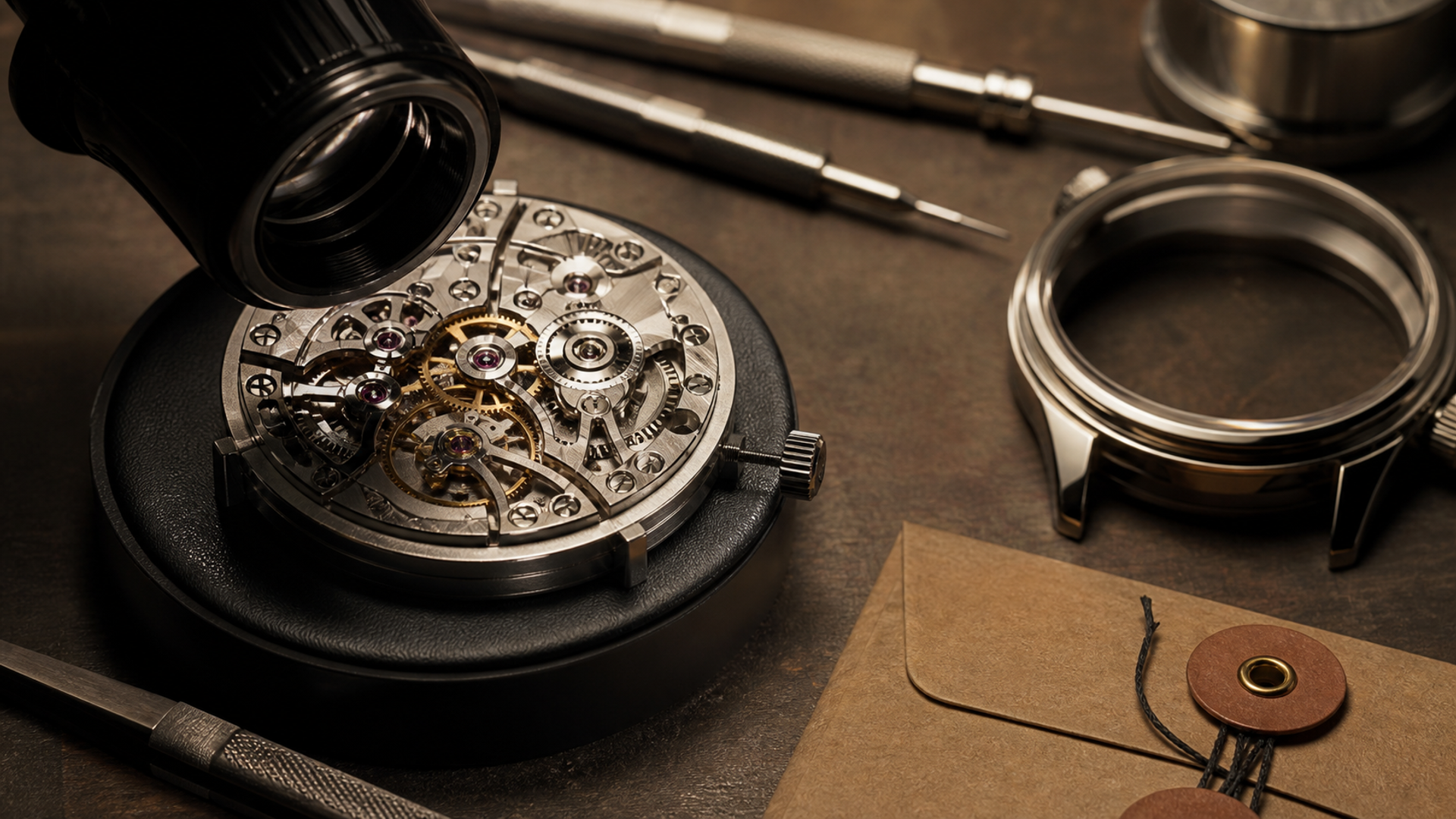
Begin with architecture: bridge layout, gear-train visibility, winding system and how a complication is integrated. Then inspect finishing. Broad Geneva stripes are visible, but hand-finished inward angles, polished sinks, straight graining and consistent bevels disclose more labour. Ask whether the photographed calibre is the one in the watch. A solid caseback is not a defect, but it increases the need for trustworthy documentation rather than imagination.
A seal has a scope
The Patek Philippe Seal, Hallmark of Geneva, COSC certification and a maker’s internal control do not test identical things. One may focus on movement precision, another on provenance and construction, and another on the complete watch. Read the criteria and date. A logo on a dial is not a substitute for understanding what was measured, at which stage and with what tolerance. Compare claims only after normalising their scope.
Exterior craft deserves equal attention
Collectors can become so absorbed by the calibre that they tolerate a difficult clasp, unreadable dial or uncomfortable case. Inspect hand length, printing, applied markers, polished and brushed transitions, crown action and bracelet articulation. Gem-set references require stone consistency and setting quality. Wear the watch under ordinary light and with the cuff or activity it will meet. High craft should survive the transition from loupe to wrist.
Service reveals the maker's time horizon
Ask whether the manufacture services every period, which components are produced or restored, and how it treats original dials, hands and cases. A detailed estimate and documented intervention are signs of a mature system. Extremely rare or independent watches may require direct workshop relationships and longer waits. That can be acceptable, but the owner should understand it before purchase rather than when a unique component fails.
Do not confuse scarcity with watchmaking
Small production can result from hand labour, limited workshop capacity or a deliberate commercial choice. It can also amplify price without improving finishing. Evaluate the object first, then the market. Auction records and waiting lists show demand, not the quality of an inward angle or the availability of a future wheel. A collector can value scarcity, but it should sit beside—not on top of—the evidence of craft.
Evidence checklist for high end watch makers
[ ] Identify exact calibre
[ ] Inspect architecture and finishing separately
[ ] Read certification scope
[ ] Test dial and case execution
[ ] Verify service commitment
[ ] Set preservation limits
[ ] Price long ownership
[ ] Separate scarcity from craft
An unchecked high end watch makers decision remains unknown. It should not be converted into a favourable assumption merely to complete the purchase.
Reader-visible sources and method
The external pages above were checked for this high end watch makers publication. Price, availability, service, tax, regulation and platform terms must be reconfirmed for the buyer's market and date. The high end watch makers ranking pages informed the separate SERP benchmark, but their prose was not copied and they do not control the claims in this article.
Continue with adjacent VERTU editorial research
For a high end watch makers reader, these links provide adjacent premium-lifestyle and decision context; they do not replace specialist or official evidence for the transaction.
Final judgement
Judge the exact watch across six dimensions: movement architecture, functional performance, visible and hidden finishing, case-and-dial execution, service commitment and preservation of originality. A prestigious signature is useful context, not proof. Ask for macro evidence, calibre documentation and a credible service route before paying for high horology.
The useful standard for high end watch makers is not certainty created by confident language. It is a decision whose evidence, downside and next review point are visible to the reader.