Key Takeaways
The Double-Wrist Dilemma is a Design Failure: Wearing a mechanical watch on one wrist and a mass-market plastic or aluminum tracker on the other was a rational compromise that created cognitive overload, cuff friction, and aesthetic discord.
Haute Digital Horology Defined: The convergence of Swiss-standard case architecture (Grade 5 titanium, sapphire crystals, hand-finished leather) with elite digital capability and bespoke lifestyle services.
Consolidation Over Proliferation: Secondary market shifts and export data indicate that modern collectors demand fewer, more deliberate possessions that fulfill multiple operational roles without sacrificing luxury presence.
The Single-Wrist Solution: Modern luxury connected watches, pioneered by maisons like VERTU, bridge the divide between computational utility and heirloom-grade prestige.
You know the routine. You check the time on your phone, then glance down at the mechanical chronograph you strapped on this morning. Before heading out to dinner, you reluctantly add a black-screen device to your other arm because your mechanical piece cannot track your recovery, notify you of discreet messages, or log your flights.
Two straps leave two distinct wear bands across your skin. Two case profiles fight your shirt cuffs. And inevitably, in the middle of a private conversation, you find yourself checking an inert slab of mass-produced glass instead of remaining present in the room.
That workaround is officially ending.
It is not ending because collectors have surrendered their appreciation for traditional watchmaking, nor because they have abandoned health and digital connectivity. It is ending because connected timepieces have finally entered the realm of haute digital horology: objects built to the exacting standards of finishing, materials, and architectural intent expected of high horology, but powered by modern computational capability.
By the end of this guide, you will understand the structural shifts driving this consolidation, how to evaluate high-grade connected timepieces against traditional criteria, and how to reclaim your wrist with a single, uncompromising object.
The Anatomy of the Two-Wrist Compromise
Double-wristing was never a vanity project; it was a pragmatic response to an unresolved functional divide.
Historically, wearing two timepieces was the signature of high-stakes utility. Fidel Castro wore two Rolexes simultaneously in 1963 to track Havana and Moscow time zones at a glance. General Norman Schwarzkopf famously strapped on a Seiko dive watch alongside an automatic Rolex during the Gulf War to track local Saudi time and Washington D.C. operational clocks simultaneously.
For the modern collector, this historical practice evolved into an uneasy lifestyle split:
The Mechanical Wrist: Carried heritage, emotional value, and architectural finishing, but offered zero connected utility.
The Digital Wrist: Delivered essential biometrics, travel telemetry, and alerts, but suffered from a disposable, commodity aesthetic.
The End Result: Continuous cognitive friction and an obvious sartorial clash.
The hidden costs of this setup have become impossible to ignore:
Aesthetic Conflict: Pairing a bespoke, hand-finished dress piece with an anonymous, mass-produced electronic pebble creates immediate visual friction.
Attention Fragmentation: Two wrists vibrate, chime, or catch the eye, scattering presence rather than anchoring it.
Physical Inconvenience: Dual deployments lead to uneven sleeve wear, wrist fatigue, and the perpetual hassle of managing two distinct charging and winding routines.
Double-wristing was an acceptable band-aid for a decade. But in 2026, collectors are asking a simpler, sharper question: Why hasn't digital intelligence been housed inside an object that respects the laws of fine watchmaking?
Market Realities: What the Horological Data Shows
The decline of double-wristing is backed by hard market data. The luxury watch industry is not shrinking; it is concentrating around objects that deliver uncompromising tangible value.
According to the Fédération de l'Industrie Horlogère (FH), Swiss watch exports have reached a decisive turning point:
While aggregate Swiss export volumes saw volatility in 2025 (falling 4.8% to 14.6 million units), the first half of 2026 witnessed an inversion: export values stabilized at CHF 12.8 billion, while unit demand for distinctive, high-end expressive pieces rebounded.
Chrono24’s Market Intelligence highlights a distinct collector migration toward deliberate craftsmanship: structured rectangular cases rose 9.3%, textured dials rose 9.5%, and precious and exotic metal configurations saw sustained double-digit demand.
The ChronoPulse Index reached 1,440 in early 2026, marking the end of a prolonged secondary market downturn and indicating renewed appetite for well-curated, durable investments.
These patterns reveal a clear trajectory across consumer segments:
Mass Consumer Wearables: Facing market saturation and digital fatigue as wearers tire of disposable screens.
Entry-Level Quartz: Experiencing a steep volume decline (-4.5%), showing that consumers reject low-craft alternatives.
High-Craft and Distinctive Geometries: Experiencing a strong resurgence (+9.5% to +20%), proving that collectors prize physical presence above all.
Collectors are no longer buying gadgets to replace watches; they are discarding mass-market electronics that fail to age gracefully. When collectors consolidate their wrists, they demand a piece that matches their mechanical standards in materiality and presence.
Defining Haute Digital Horology
To resolve the two-wrist dilemma, we must establish a precise vocabulary. What distinguishes a consumer device from a true luxury connected timepiece?
Haute Digital Horology is the synthesis of haute horlogerie exterior construction with high-performance connected capability. It is defined not by how many commodity sensors can be crammed onto a circuit board, but by how the case, crystal, ergonomics, and services are executed.
Dimension | Commodity Smartwatch | Traditional Mechanical Watch | Haute Digital Horology (e.g., VERTU) |
Case Metallurgy | Cast Aluminum / Stamped Steel | Stainless Steel / Precious Metals | Aerospace Grade 5 Titanium / Forged Carbon |
Dial Protection | Chemically Strengthened Glass | Sapphire Crystal | Synthetic Sapphire Crystal (9 Mohs Hardness) |
Exterior Finishing | Industrial Anodized / Molded | Hand-Polished / Satin-Brushed | Hand-Polished Facets / Chamfered Bezels |
Strap Architecture | Molded Silicone / Synthetic Rubber | Alligator / Fine Calfskin | Hand-Stitched Rare Leather & Exotic Skins |
Social Presence | Disposable Electronic Device | Timeless Heirloom & Status Anchor | Connoisseur's Hybrid: Tech Meets Prestige |
The Wrist Solution | Demands a Second Wrist for Style | Demands a Second Wrist for Data | Ends Double-Wristing in a Single Object |
True haute digital horology requires three immutable pillars:
Material Permanence: Utilizing materials derived from aerospace and fine watchmaking—such as Grade 5 titanium, ceramic, and monocrystalline sapphire—that resist degradation and develop authentic character.
Architectural Case Construction: Employing complex multi-part cases, brushed and mirror-polished facets, and water-resistance tolerances that feel substantial under a bespoke cuff.
Human-Centric Exclusivity: Luxury is not an operating system algorithm. It is the integration of high-touch services—such as personal concierge assistance—directly accessible from the wrist.
The Paradigm: How VERTU Reclaims the Single Wrist
Where Silicon Valley builds disposable gadgets designed for rapid obsolescence, VERTU approaches the wrist from the lineage of bespoke luxury craftsmanship.
In the past, the collector was caught in a clear compromise: wearing a Rolex or Patek Philippe on the left wrist for status and craft, and an Apple Watch on the right for critical data. The 2026 consolidation target resolves this split: the VERTU Luxury Smartwatch unites the horological body with the digital soul.
1. Watchmaking Materials and Geometry
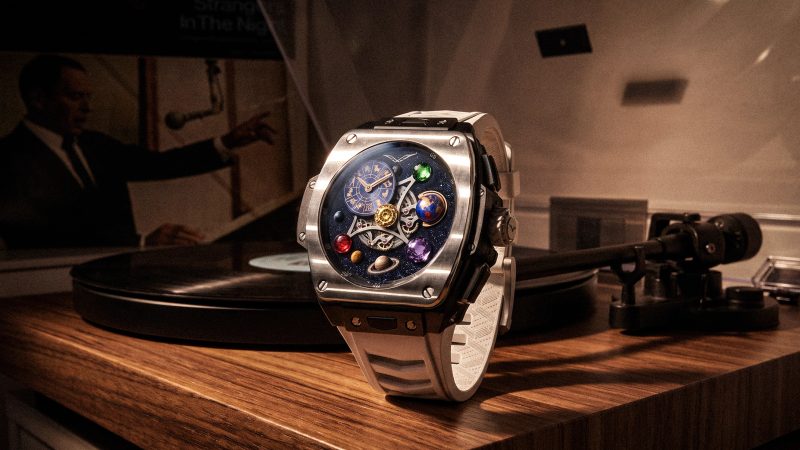
Rather than relying on rounded, generic aluminum shells, VERTU smartwatches utilize high-strength Grade 5 titanium alloy and faceted case architectures that mirror the presence of modern independent haute horlogerie. Protected by an ultra-hard sapphire crystal, the display delivers pristine visibility while withstanding the hazards of daily wear without the micro-scratches common to standard consumer tech.
2. Artisanal Tactility
A luxury timepiece is judged by touch. VERTU incorporates hand-selected, hand-stitched fine leathers—alligator grain, French calfskin, and custom-treated hides—integrated seamlessly into the lugs. It hugs the wrist with the warmth and comfort of a traditional Grand Complication, eliminating the synthetic sweat and clinical feel of rubber bands at formal events.
3. The Digital Ruby Key: Privilege Beyond Sensors
Traditional smartwatches ping you with algorithmic noise. VERTU reimagines digital utility through its legendary Ruby Key Concierge Service.
With a single interaction, the wearer transitions from algorithmic data tracking to high-touch, real-world execution: private dining reservations, VIP travel coordination, and tailored lifestyle management. It transforms connectivity from an administrative burden into an exclusive luxury privilege.
The 4-Week Protocol: How to Consolidate Two Wrists Into One
Transitioning from a two-wrist setup to a single, authoritative timepiece requires an intentional audit of your daily habits. Follow this four-stage path to declutter your wrists:
Week 1 (Diagnostic Quarantine): Place your tracker in a drawer. Wear only your mechanical watch. Log every phantom reach.
Week 2 (Functional Residue Audit): Sort your reach log to distinguish critical operational telemetry from notification clutter.
Week 3 (Single-Piece Test Drive): Switch to a luxury connected watch like VERTU. Consolidate notifications to priority contacts only.
Week 4 (Sartorial Equilibrium): Eliminate phantom reaches, resolve sleeve clearance, and restore undivided personal presence.
Step 1: The Diagnostic Quarantine (Week 1)
Leave your digital tracker in a desk drawer. Wear only your fine mechanical timepiece for seven consecutive days. Carry a pocket notebook or use your phone to log every instance you instinctively reach for the missing device.
Categorize each phantom reach into:
Operational Need: An urgent security alert, two-factor authentication, or incoming VIP call.
Biometric Need: Heart rate check, workout tracking, sleep monitoring.
Dopamine Reflex: Aimless notification clearing or app glancing.
Step 2: The Functional Residue Audit (Week 2)
Analyze your log. Most collectors find that 80% of their tracker interactions were dopamine reflexes. The remaining 20%—discrete operational communications and core wellness metrics—constitute your functional residue.
If your functional residue matters, you are an ideal candidate for a luxury connected watch.
Step 3: The Single-Piece Test Drive (Weeks 3–4)
Select a single timepiece capable of mastering both worlds. Strap on a luxury connected piece like the VERTU Smartwatch. Configure notifications strictly: allow only high-priority contacts, VIP messaging, and essential biometric monitoring. Wear it across every context—the boardroom, private dinners, the gym, and transatlantic flights.
By the end of the fourth week, the phantom reaches will cease. You will have recovered your wrist space, your focus, and your sartorial balance.
Frequently Asked Questions (FAQ)
What is the primary cause of double-wristing?
Double-wristing originated as an operational workaround: collectors refused to abandon the craftsmanship, emotional value, and prestige of their mechanical watches, but still required the health metrics, flight alerts, and discreet connectivity offered by modern digital sensors.
Can a luxury smartwatch truly replace a mechanical watch?
Yes, provided it meets high-horology physical criteria. While consumer smartwatches feel out of place in formal settings due to their plastic and stamped-aluminum construction, luxury smartwatches utilizing Grade 5 titanium, sapphire crystal, and hand-finished leathers provide the gravitas, heft, and elegance required of a luxury timepiece.
How does haute digital horology differ from standard smartwatches?
Standard smartwatches are treated as mass-market consumer electronics designed for rapid upgrade cycles. Haute digital horology prioritizes fine case finishing, elite metallurgy, high-grade leatherwork, and bespoke VIP services, creating an enduring personal accessory rather than an anonymous gadget.
Will wearing a luxury connected watch harm my collection's value?
Consolidating to a high-end luxury smartwatch does not mean liquidating your mechanical collection. Instead, it allows your mechanical pieces to return to their rightful place as dedicated, cherished horological works of art for special occasions, while your daily wrist is commanded by an object that satisfies modern operational needs with equal sophistication.
Conclusion: A Category, Not a Compromise
The two-wrist workaround was an understandable transitional phase in modern horology. It was the physical manifestation of an era when technology was brilliant inside, but pedestrian outside.
That era has drawn to a close.
The arrival of haute digital horology proves that you no longer need to compromise your aesthetic identity to navigate a connected world. You do not need two watches to lead one sophisticated life. By demanding that digital capability submit to the enduring codes of fine watchmaking, you reclaim your style, your attention, and your wrist.
Reclaim your wrist with uncompromising sophistication. Explore the VERTU Luxury Smartwatch Collection to experience where high-horology finishing meets elite digital mastery.