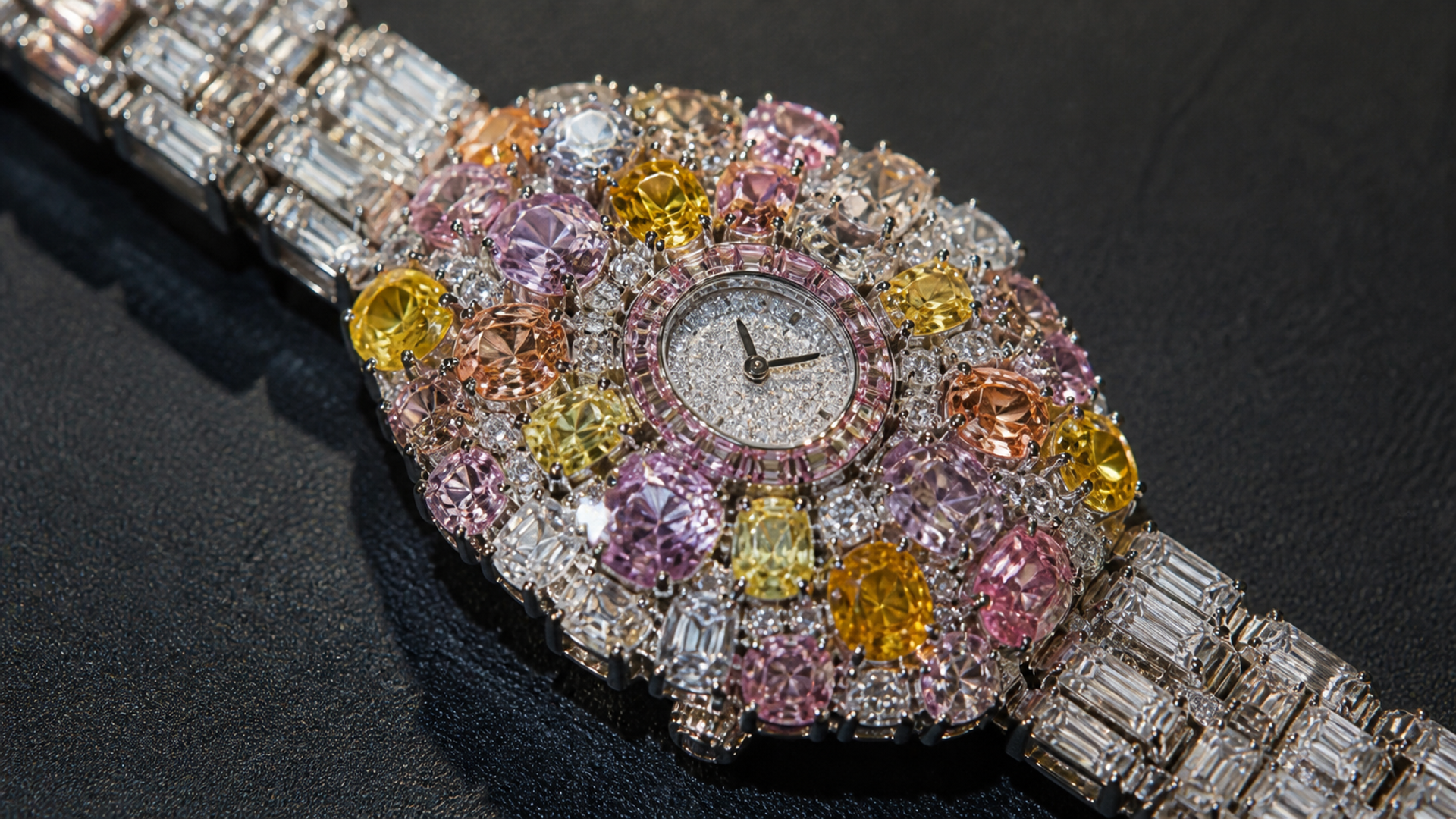
The Graff Diamonds Hallucination is routinely called a US$55 million watch. That number originated as a stated estimate when the piece was unveiled at Baselworld in 2014; it is not a public auction result and should not be described as money paid by a buyer. Contemporary reporting attributed to Graff described more than 110 carats of rare coloured diamonds set into a platinum bracelet.
The piece is best understood as high jewellery built around a small time display, not as a mechanical watch whose value is dominated by the movement. Its economic logic comes from the assembled stones, their individual grading characteristics, the design and setting work, provenance and the difficulty of recreating a comparable palette.
Direct answer: Graff Diamonds Hallucination watch
The US$55 million figure is a manufacturer-associated valuation reported at the 2014 launch, not a verified sale. The Hallucination's value thesis rests on more than 110 carats of fancy-colour diamonds and one-off execution. Compare it with auction records only after labelling the evidence class.
| Decision factor | Verified starting point | Why it changes the answer | Control before acting |
|---|---|---|---|
| Price evidence | the $55 million figure was presented as an estimate at launch | valuation is not a transaction | label it as a 2014 stated valuation |
| Stone identity | fancy-colour diamonds vary by hue, tone, saturation and grade | carat weight alone cannot establish value | require an inventory and independent grading reports |
| Setting | the stones form an articulated platinum bracelet | wearability and replacement risk differ from a conventional watch | inspect articulation, clasp and stone security |
| Movement | the time display is physically small relative to the jewellery composition | mechanical complexity is not the main value driver | separate watch service from gem-setting service |
| Insurance | a unique multi-stone object is difficult to replace | agreed-value cover and transit terms become central | obtain specialist insurance before movement |
| Liquidity | the piece has no public sale history | a valuation cannot predict a clearing price | treat exit value as unknown rather than $55 million |
For Graff Diamonds Hallucination watch, this decision matrix is the article-specific value object. It separates price evidence from ownership exposure, so a dramatic headline cannot silently become a recommendation.
Verified evidence baseline
Evidence 1. Contemporary 2014 reporting said Graff estimated the Hallucination at US$55 million and described more than 110 carats of fancy-colour diamonds. Source.
Evidence 2. Graff's current official watch category continues to position its watches as diamond-led jewellery creations. Source.
Evidence 3. GIA explains that fancy-colour diamond value depends on colour characteristics as well as standard quality factors. Source.
Evidence 4. No public auction result cited in the research proves a US$55 million transaction for the Hallucination. Source.
The primary-source boundary for Graff Diamonds Hallucination watch is deliberately narrow. Dated records, manufacturer specifications and official guidance support only the claims they actually make; they do not prove private transaction prices, future appreciation or universal suitability.
How each decision factor changes the result
Price evidence. The starting evidence for Graff Diamonds Hallucination watch is that the $55 million figure was presented as an estimate at launch. This changes the decision because valuation is not a transaction. Before committing, label it as a 2014 stated valuation. The dated result belongs in the buyer's evidence file, together with the exact model, market and assumption that could reverse it.
Stone identity. The starting evidence for Graff Diamonds Hallucination watch is that fancy-colour diamonds vary by hue, tone, saturation and grade. This changes the decision because carat weight alone cannot establish value. Before committing, require an inventory and independent grading reports. The dated result belongs in the buyer's evidence file, together with the exact model, market and assumption that could reverse it.
Setting. The starting evidence for Graff Diamonds Hallucination watch is that the stones form an articulated platinum bracelet. This changes the decision because wearability and replacement risk differ from a conventional watch. Before committing, inspect articulation, clasp and stone security. The dated result belongs in the buyer's evidence file, together with the exact model, market and assumption that could reverse it.
Movement. The starting evidence for Graff Diamonds Hallucination watch is that the time display is physically small relative to the jewellery composition. This changes the decision because mechanical complexity is not the main value driver. Before committing, separate watch service from gem-setting service. The dated result belongs in the buyer's evidence file, together with the exact model, market and assumption that could reverse it.
Insurance. The starting evidence for Graff Diamonds Hallucination watch is that a unique multi-stone object is difficult to replace. This changes the decision because agreed-value cover and transit terms become central. Before committing, obtain specialist insurance before movement. The dated result belongs in the buyer's evidence file, together with the exact model, market and assumption that could reverse it.
Liquidity. The starting evidence for Graff Diamonds Hallucination watch is that the piece has no public sale history. This changes the decision because a valuation cannot predict a clearing price. Before committing, treat exit value as unknown rather than $55 million. The dated result belongs in the buyer's evidence file, together with the exact model, market and assumption that could reverse it.
Worked scenario calculation
A defensible valuation build-up would start with an independently documented stone inventory, not a total carat number. Value each diamond by identity, grading, size, cut and market evidence; then add design provenance and workmanship without assuming every production cost is recoverable. Deduct risks for limited liquidity, complex replacement and the cost of separating or resetting stones. The public cannot perform this calculation from photographs, which is why the launch valuation should remain a dated claim rather than be continuously restated as market price.
A jewellery watch, not a movement-led complication
In traditional haute horlogerie, collectors may focus on calibre architecture, finishing and complication. The Hallucination inverts that hierarchy. The tiny dial creates a reason to wear an exceptional diamond composition on the wrist, while the gemstones and setting dominate visual and economic attention. This does not make it less serious; it places the object in a different collecting category.
Why 110 carats does not produce a simple formula
Fancy-colour diamonds are not fungible units. Two stones of equal weight can differ materially in colour grade, distribution, clarity, cut and provenance. A bracelet also requires a coherent sequence of shapes and colours that work together physically. Replacing one damaged stone may require more than buying the nearest carat match. The assembly has system value that a headline total cannot explain.
Valuation, asking price and auction record
A valuation estimates worth under stated assumptions. An asking price shows what an owner seeks. An auction result records what a buyer paid in a defined sale, usually including or excluding fees according to the house's reporting convention. The Hallucination belongs in the first category based on public evidence. Mixing those categories creates a spectacular but false league table.
Due diligence for a one-off high-jewellery watch
A buyer would need provenance, ownership title, detailed stone reports, condition documentation, service history, security planning and clarity on intellectual-property or exhibition restrictions. The inspection should cover the clasp, articulated links, settings and timekeeping component. Independent specialists in jewellery, watches, insurance and law may each answer different parts of the risk.
What long-term value can and cannot mean
Rarity and Graff provenance can support cultural and collector interest, but they cannot guarantee appreciation or a ready buyer. A one-off work may be priceless to its owner and illiquid at the same time. The sensible owner values access and enjoyment separately from resale assumptions, then insures and maintains the object as an irreplaceable composition rather than an ordinary watch. Periodic condition photography should use consistent lighting and angles, with any loose setting, abrasion or clasp change escalated before travel. That evidence protects conservation decisions and gives an insurer or future specialist a reliable baseline instead of asking memory to reconstruct when damage occurred.
Risk-control checklist for Graff Diamonds Hallucination watch
[ ] Label the $55m as valuation
[ ] Obtain stone inventory
[ ] Verify GIA reports
[ ] Inspect settings and clasp
[ ] Separate movement service
[ ] Arrange specialist transit
[ ] Use agreed-value insurance
[ ] Assume resale is uncertain
The Graff Diamonds Hallucination watch checklist is meant to be completed with evidence. An unchecked item remains an unknown rather than being treated as a favourable assumption.
Reader-visible sources and methodology
The record and product pages for Graff Diamonds Hallucination watch were observed for this publication run. Market-variable price, availability, tax, insurance, service and regulatory conditions must be reconfirmed in the buyer's jurisdiction. Competitor pages informed the SERP gap analysis but were not copied and do not control the claims above.
Continue with adjacent VERTU editorial research
For Graff Diamonds Hallucination watch, these internal links provide adjacent premium-lifestyle and decision context. They do not replace the authoritative evidence or professional advice required for a specific transaction.
Final judgement
The US$55 million figure is a manufacturer-associated valuation reported at the 2014 launch, not a verified sale. The Hallucination's value thesis rests on more than 110 carats of fancy-colour diamonds and one-off execution. Compare it with auction records only after labelling the evidence class.
For Graff Diamonds Hallucination watch, quality means preserving the boundary between a verified fact, a reported estimate and an ownership assumption. The decision should be reopened when a source, market, condition or intended use materially changes.