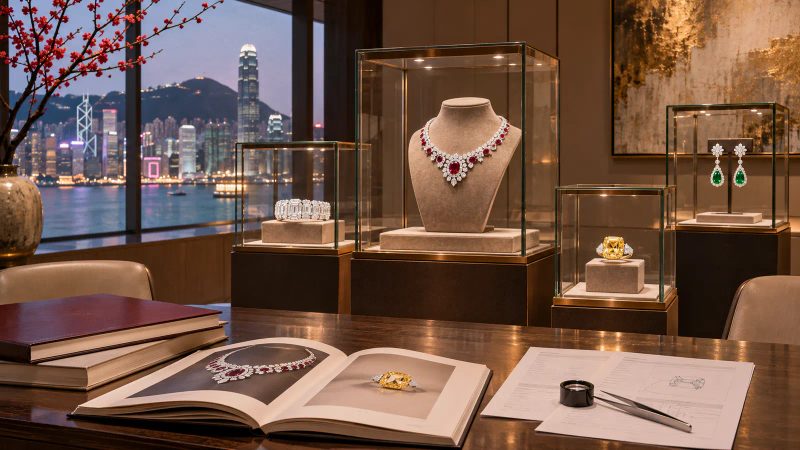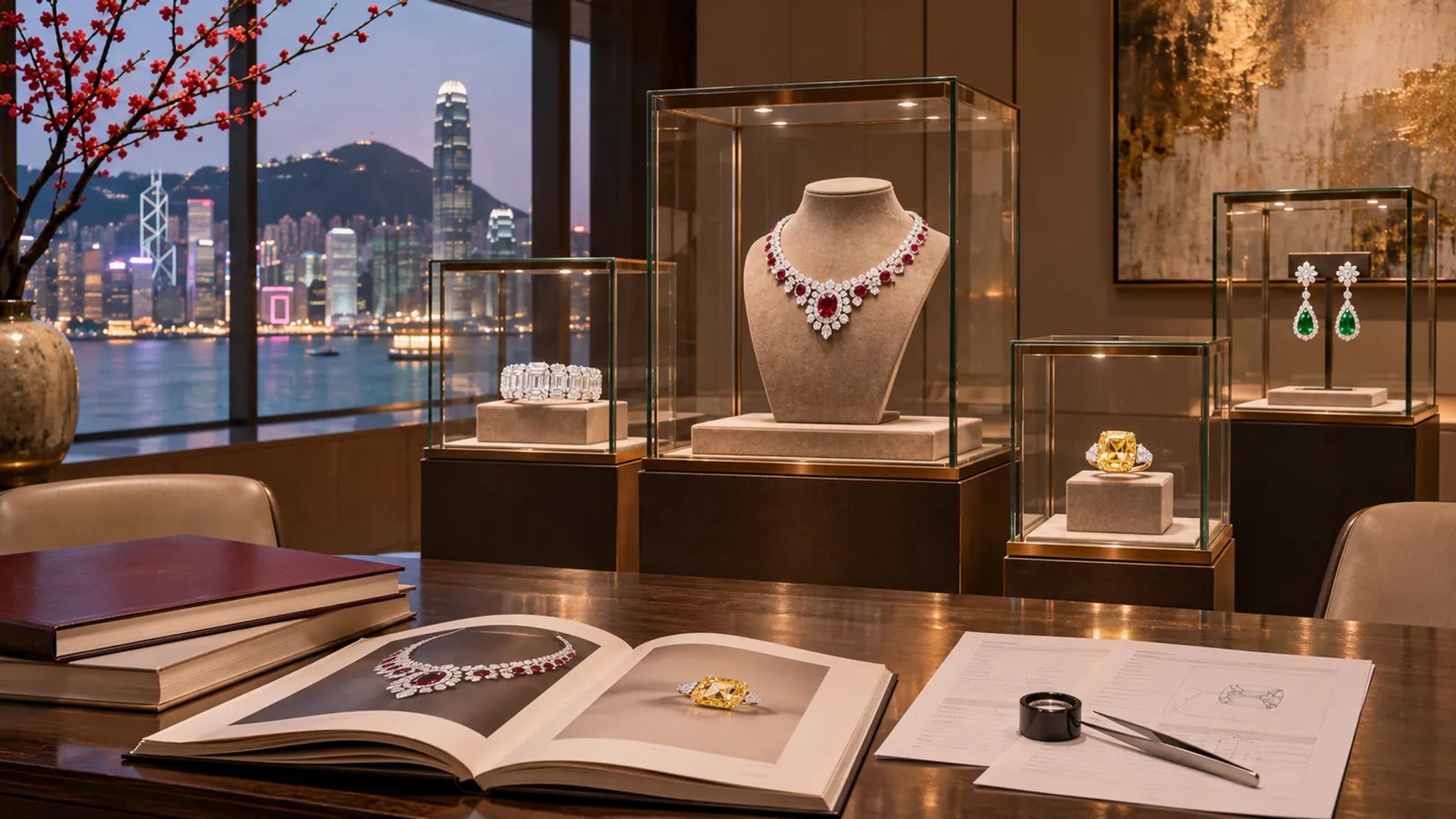
The Hong Kong jewellery auction result on 24 November 2026 was strong, but it is a sale result rather than a forecast for every jewel. Christie’s reported HK$536,886,800 (US$68,502,031) for its Magnificent Jewels auction, with 91% of lots sold and the total hammer price 125% above the aggregate low estimate. Those measures describe one curated sale, not a guaranteed return for an owner or a general price index.
Key Takeaways
- Christie’s reported HK$536.9 million for its 24 November 2026 Hong Kong Magnificent Jewels sale.
- The 91% sell-through rate counts lots sold; the hammer comparison uses the sale’s aggregate low estimate.
- A sale total combines different stones, makers, conditions, provenance and buyer preferences.
- Read the catalogue, condition report and individual lot result before applying the headline to a similar object.
- Jewellery should be assessed for wear, craftsmanship and provenance as well as any possible resale route.
What exactly did the Hong Kong jewellery auction report?
According to Christie’s official 24 November 2026 results release, its Hong Kong Magnificent Jewels sale brought HK$536,886,800, equivalent in that release to US$68,502,031. The same document reports 91% sold by lot, a total hammer price 125% above the low estimate, and 57% of lots selling above their high estimates. These are distinct denominators. The first is a total in money, the second a share of the catalogue that found buyers, and the last a share of lots beating the upper presale estimate.
The distinction matters because a reader may hear “125% above estimate” and assume every item beat its own estimate by that amount. Christie’s phrase refers to the total hammer price relative to the aggregate low estimate. Some lots can outperform substantially while others sell within estimate, below it, or not at all. The 57% above-high figure shows breadth of demand in this sale, but it still does not describe the future value of an individual ring or necklace. The sale total can also include a few exceptionally expensive lots that make the average unhelpful to a buyer in another price bracket.
Why is an auction total different from a price trend?
An auction is a selection of objects offered on a particular date to a particular pool of buyers. Its total changes with the number of lots, the quality and rarity of those lots, the auction house’s estimates, competing bidders, currency and the presence of headline stones. A larger total than another season is not proof that like-for-like jewellery values increased. To argue for a market trend, one would need comparable objects, consistent condition and provenance, and enough repeated transactions to reduce the effect of one exceptional sale.
Even a repeated sale of the same jewel would need careful adjustment. A stone can be recut, remounted, regraded or given new documentation. Ownership history may become more or less persuasive. The sale format may differ, as can the buyer’s premium and applicable tax. A previous hammer price and a current price paid by a buyer are not interchangeable. The practical reading is narrower and more useful: this particular Christie’s selection met vigorous bidding on the reported date.
Which figures should a collector compare before drawing a conclusion?
| Figure | What it answers | What it cannot prove alone |
|---|---|---|
| Sale total: HK$536,886,800 | Money realised across the reported sale | Price growth for a comparable individual jewel |
| 91% sold by lot | Share of offered lots that sold | Profit for a consignor after costs |
| Hammer 125% above aggregate low estimate | How total bidding compared with the sale’s presale low | That every lot beat its estimate |
| 57% above high estimate | Share of lots beyond their upper estimate | The resale value of an unsold or different jewel |
Start with the auction house’s original release, then open the lot page for the object that actually resembles the piece under consideration. Record its dimensions, carat weight, grading report, maker, period, alterations, condition, estimate and final price. Ask whether the result displayed is hammer or a total including premium. Note whether the catalogue description includes qualifiers such as “attributed to,” “circa,” or “possibly.” These words change the strength of the claim about a maker or date.
What does an above-estimate result say about a particular jewel?
It says at least two bidders valued that lot above the auctioneer’s published high estimate on that day. It does not tell us why without examining the object and the bidding context. An unusual colour, documented origin, distinctive design, a maker’s signature or a strong provenance may help explain interest. Sometimes a conservative estimate also draws broader participation. A result is evidence of a transaction, not a complete explanation of the transaction.
A useful editorial test is to separate the object’s attributes from the story attached to the event. First describe what was sold. Then state what the auction house measured. Only then discuss possible reasons for interest, labelled as interpretation. This order prevents a dramatic headline from turning a collectible object into a supposed asset class. It also allows the reader to compare the item with objects they could actually buy, rather than with an entire evening’s takings.
How should a buyer read an auction lot before bidding?
- Read the full catalogue description. Note stone characteristics, dimensions, metal, signature and any dated or attributed wording.
- Request the condition report. Check repairs, replacements, wear and whether every component was inspected.
- Examine independent documentation. Where relevant, match a gemmological report number to the actual stone and check its scope and date.
- Calculate the all-in cost. Add the buyer’s premium, taxes, shipping, insurance, conversion costs and any intended alteration.
- Decide the use case. A piece intended for regular wear has different tolerances from one acquired primarily for collecting.
- Set a maximum before bidding. Do not let another bidder’s willingness to pay become your evidence of value.
These steps are a due-diligence framework, not investment advice. Auction conditions and charges vary by sale and location. Read the terms attached to the exact lot and obtain specialist help where an attribution, gemstone treatment or legal ownership question materially affects the decision. A beautifully made object can be desirable even when it has no predictable resale path.
Where does craftsmanship enter the decision?
High jewellery is not simply a container for stones. The setting determines how comfortably a piece wears, how securely the stones sit, and how light reaches them. Check the backs and joints, the regularity of the finish, clasp action and whether later repairs are consistent with the original design. A close photograph helps, but it cannot replace a condition report or inspection. Ask whether an alteration to improve fit would change originality or make future servicing more difficult.
That distinction also helps with contemporary jewellery. VERTU’s accessories collection offers a route to examine current design and material information for an exact VERTU piece. A current retail design is not comparable to a unique auction lot merely because both use precious-looking materials or sculptural forms. Compare materials, edition, craftsmanship and ownership purpose on their own terms. Do not borrow an auction premium to imply a VERTU product will appreciate.
Does a strong Hong Kong result change the case for buying jewellery?
It may indicate that the objects in this sale found a receptive audience, particularly where provenance, gem quality and design were persuasive. It does not remove the everyday questions a buyer faces: Will the piece be worn? Can it be cared for and insured appropriately? Is its origin documented? Is the price acceptable without assuming a later sale? Those questions remain relevant in a strong auction room and a quiet one.
For a gift, the recipient’s taste and fit may matter more than the auction narrative. For a collector, the condition and documentation may matter more than the breadth of a category headline. For a person assessing a future resale route, fees, liquidity and uncertainty deserve explicit attention. The HK$536.9 million result is useful context, but its best use is to prompt better questions about an individual object.
Frequently asked questions
How much did the November 2026 Hong Kong jewellery auction make?
Christie’s reported HK$536,886,800, or US$68,502,031, for its Magnificent Jewels sale on 24 November 2026. This is the auction house’s sale total, not a valuation for every jewel in Hong Kong.
Did every lot sell above estimate?
No. Christie’s said 57% of lots sold above their high estimates and 91% sold by lot. Its aggregate hammer-price comparison should not be applied to each lot individually.
Does an above-estimate auction price mean jewellery is a good investment?
No. A single result reflects one object and one sale. Costs, condition, provenance, buyer demand and resale timing can materially change an owner’s outcome.
What should I check first on a similar auction lot?
Start with the original lot page and condition report. Match the stone, maker attribution, dimensions and documentation; then calculate the total cost under that sale’s terms.
Conclusion
The Hong Kong jewellery auction result on 24 November 2026 deserves attention because Christie’s reported both a substantial HK$536.9 million total and broad bidding across its selected lots. The disciplined interpretation stops there until the individual objects, estimates and costs are examined. For a collector or gift buyer, an exact piece’s design, documentation, condition and suitability remain more useful than the room’s headline total.