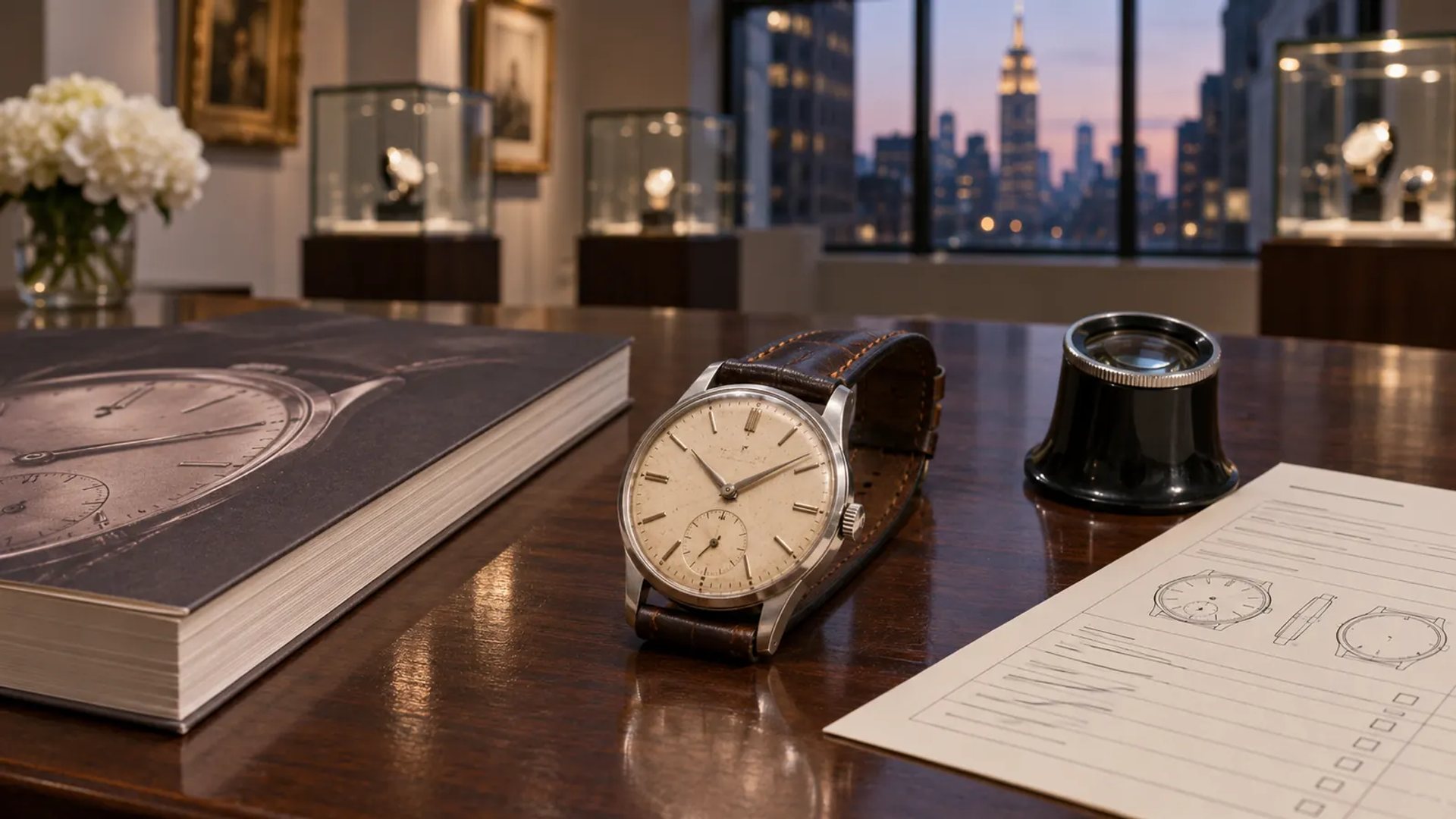
New York watch auctions in December 2026 offer several different ways to examine the market before bidding. Christie’s has announced a live Important Watches sale for 4 December and an online New York Edit running 2–11 December. Sotheby’s lists its Important Watches sale for 7 December. A preview is an invitation to inspect specific watches and sale terms, not evidence that an estimate will become a final price.
Key Takeaways
- Christie’s live Important Watches sale is scheduled for 4 December 2026 in New York; its online sale runs 2–11 December.
- Sotheby’s lists a New York Important Watches auction for 7 December 2026.
- Compare a lot’s reference, condition, provenance, estimate and total purchase cost before bidding.
- An auction estimate is a presale guide, not a promise of the hammer price or final buyer cost.
- Watch the results after the gavel for individual evidence rather than drawing a trend from a preview headline.
Which New York watch auctions are actually on the calendar?
Christie’s Important Watches overview schedules a live auction at Rockefeller Plaza for 4 December 2026 at 10 a.m. Eastern time. Its Watches Online: The New York Edit is open from 2 to 11 December. Sotheby’s Important Watches page lists a 7 December New York sale. Dates and lot availability can change; a bidder should recheck the auction house’s live page before making travel or bidding plans.
These sales are different events with different lots and conditions. A collector cannot treat an estimate at one house as an interchangeable quotation for another house’s watch, even when the dial names or makers look similar. Reference, production year, service history, case condition and accompanying papers can change the object materially. The useful calendar is therefore a starting point for selecting lots to inspect, not a ranking of which sale will produce the strongest results.
What is worth watching in the Christie’s live sale?
Christie’s 23 November preview names a Patek Philippe dual-time reference 3452/1 associated with Louis Cottier as a lead lot, with a presale estimate of US$800,000–1,600,000. The release describes the circa-1961 watch and its long family ownership. Those are catalogue and auction-house claims to examine in the complete lot materials, not a completed transaction. The estimate describes the auction house’s presale expectation, and the eventual hammer may be below, within or above it.
The same preview highlights other vintage and modern pieces, showing that the live sale is not one uniform type of purchase. A historically unusual watch calls for close attention to provenance and originality. A modern complicated watch may bring different questions about service, warranty, documentation and how a buyer intends to use it. The presence of a prominent lead lot does not make every other lot a comparable investment or even a comparable wearing experience.
How does the online sale change the process?
Christie’s New York Edit is an online sale across several days. That gives a prospective bidder time to read the catalogue and ask questions, but it does not remove the need for a condition assessment. A photograph can show dial layout and broad case appearance, yet it may not reveal every service replacement, surface finish or mechanical issue. Ask the auction house for the precise condition report and any additional images, and determine whether an in-person or specialist inspection is possible before the bidding deadline.
An online bid also needs a cost ceiling decided in advance. The displayed current bid may differ from the maximum one must pay once buyer’s premium, taxes, shipping and currency conversion are included. Review the exact sale’s conditions rather than carrying over the fee assumptions from a different auction. A useful prebid worksheet has five columns: lot reference, evidence still needed, maximum hammer bid, estimated all-in cost and a reason to withdraw. Fill the last column before bidding, when the decision is calm.
What does the Sotheby’s 7 December listing establish?
It establishes a scheduled New York Important Watches sale and a published catalogue to inspect. It does not establish the future result for any listed watch. A lot may be withdrawn, its estimate may be revised, and its condition report may add detail that changes a collector’s view. The correct next action is to open the exact lot page, read its current description and ask the sale specialist specific questions. Avoid relying on a search-result snippet or an early preview after the sale page has been updated.
Some watches combine several collecting stories: an unusual case, a historical retailer signature, a military association, a rare dial or a celebrated movement. Each claim has a different evidentiary burden. A retailer signature should be assessed for originality, not merely for visual appeal. A historical association needs records. A complicated movement requires attention to working order and future service. “Rare” is only useful when the maker’s production, surviving examples and configuration are defined.
How should you read a watch auction estimate?
| Number or claim | What it is | What to check |
|---|---|---|
| Low and high estimate | Presale auction-house range | Currency, date and any reserve or fee rules |
| Hammer price | Final accepted bid | Whether the result shown excludes buyer’s premium |
| Price realised | Reported total under the house’s convention | Premium inclusion and tax treatment |
| Asking price elsewhere | Seller’s requested amount | Whether it ever became a completed sale |
The table matters because enthusiasts often compare an auction result with a dealer listing without aligning the two measures. An unsold listing is evidence of an offer, not a transaction. An auction hammer is not automatically the buyer’s bill. A meaningful comparison states exactly which number is being used and whether the objects have comparable reference, condition and documentation.
What should a buyer ask before the gavel falls?
- Identity: Is the reference, serial information and production period documented for the exact lot?
- Originality: Which dial, hands, bezel, case and bracelet components are believed to be original, restored or replaced?
- Condition: What does the condition report say about operation, wear, water resistance and service?
- Provenance: Which ownership claims are supported by documents rather than repeated lore?
- Costs: What will premium, tax, shipping, insurance and likely service add to a winning bid?
- Exit: Would you still want the watch if its resale price did not rise?
Send these questions to the auction specialist with the lot number. A vague answer is not necessarily a reason to reject a watch, but it is a reason to narrow the claim and adjust the bid. Historic objects may have incomplete records; the buyer’s job is to price that uncertainty explicitly.
Should you consign a watch to the same December sale?
A seller should ask the house about the consignment deadline, estimate rationale, reserve, seller’s commission, photography, insurance and settlement timing. Calendar proximity alone does not mean a watch will be accepted or catalogued in time. Obtain written terms for the exact object and compare the likely net proceeds with other channels. A high-profile sale can bring a relevant audience, but it also places the watch beside strong alternatives and subjects it to the discipline of public bidding.
For an owner, paperwork is part of preparation. Gather purchase records, warranty cards, service receipts, boxes and any earlier catalogue entries without implying that missing documents can be reconstructed. Photograph the condition before handover and ask how damage claims would be handled. A realistic estimate is a tool for attracting informed bidders, not a certificate of what the watch is worth in every market.
Where does a contemporary VERTU watch fit?
VERTU’s current watch collection offers a different buying route: review the exact contemporary product page, materials, dimensions, availability and current ownership terms rather than bidding on a vintage lot’s history. This is a useful comparison for someone deciding whether they want a watch to wear regularly or an object with a specific collecting story. VERTU is not presented here as a lot in these auctions or as an investment equivalent to a rare historical watch.
A collector might reasonably choose both kinds of ownership at different times. The discipline remains the same: verify what is actually being offered, document the total cost and identify what makes the object valuable to the wearer. For a new watch, that may be fit, design and service access. For an auction lot, it may be originality, provenance and the pleasure of a particular reference. A December sale calendar cannot substitute for either decision.
Frequently asked questions
When are the major New York watch auctions in December 2026?
Christie’s lists a 4 December live Important Watches sale and a 2–11 December online New York Edit. Sotheby’s lists Important Watches on 7 December. Recheck the live sale pages for changes.
Does the auction estimate include buyer’s premium?
Do not assume it does. Read the exact sale’s conditions and calculate the expected all-in price before bidding.
Can I rely on auction photographs to assess condition?
No. Request the complete condition report and additional inspection where material questions remain. Images alone cannot establish mechanical condition or every replacement part.
Is a high estimate proof a watch will appreciate?
No. An estimate is a presale guide for one lot and date. Future demand, condition and selling costs remain uncertain.
Conclusion
New York watch auctions in December 2026 are best approached as a sequence of verifiable decisions: confirm the sale calendar, inspect the exact lot, understand the estimate and calculate the full cost. The gavel will later provide transaction evidence, but it cannot answer every question about originality or long-term value. Go to the preview prepared to ask better questions, and let the documents determine the bid.