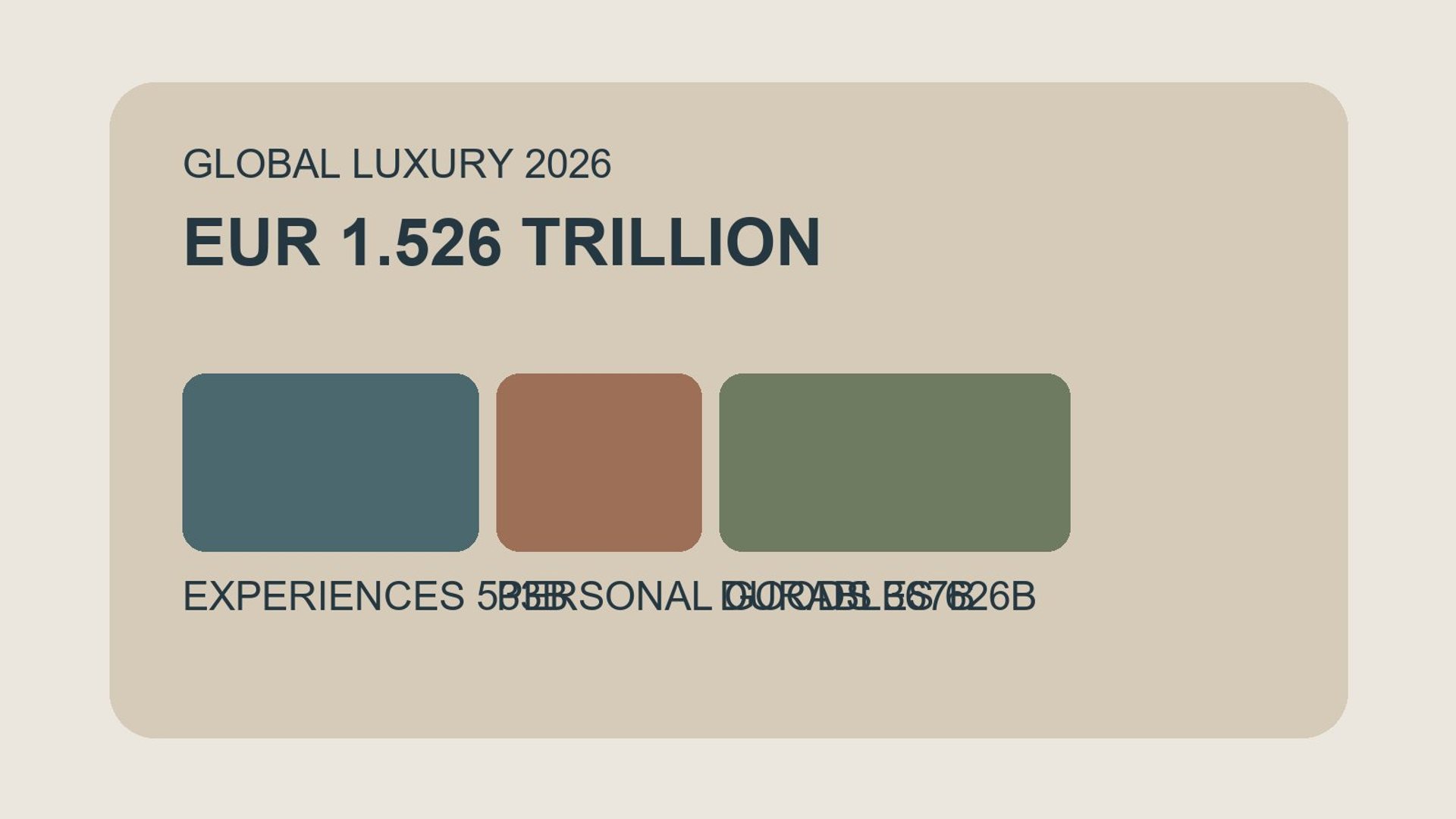
The global luxury market size in 2026 is about €1.5 trillion, according to the Altagamma–Bain Worldwide Luxury Market Monitor released on 18 November. The headline describes a broad market including experiences, personal luxury goods and durable goods or assets; it is not the size of handbags, watches or fashion alone. Overall growth is broadly flat to 2%, while category performance differs sharply.
Key Takeaways
- Altagamma reports €1.526 trillion across its detailed 2026 luxury-market categories, commonly rounded to “over €1.5 trillion”.
- The total combines €533 billion in experiences, €367 billion in personal luxury goods and €626 billion in durable goods and assets.
- Bain reports 2026 jewellery growth of 8–10%; Altagamma’s separate 2027 consensus forecasts 6% jewellery growth. These figures measure different years and should not be combined.
- Personal luxury buyers fell from 330 million in 2025 to 315 million in 2026 in the Altagamma release, even as the broader luxury consumer count stayed around 450 million.
- The data suggests that category and customer fit matter more than a single “luxury is growing” headline.
What does the €1.5 trillion global luxury market include?
Altagamma’s 25th Observatory release gives a detailed total of €1.526 trillion for 2026. Within it, experiential luxury accounts for €533 billion, personal luxury goods for €367 billion, and durable luxury goods and assets for €626 billion. These categories encompass different buying occasions and economics. A reader should not compare the €1.5 trillion headline directly with a brand’s sales, a jewellery segment estimate or a fashion-only forecast.
The release describes global luxury as stable, at 0–2% growth versus 2025. The range reflects an estimate at the time of publication, not a final audited total for every transaction worldwide. The figure is most useful as a map of spending categories: experiences and certain durable objects can gain attention even when the aggregate appears flat. The article uses the published release, not a proprietary VERTU market study.
How is experiential luxury performing?
Altagamma puts experiential luxury at €533 billion and describes 2–4% growth in 2026. Hospitality, fine dining, yachting and cruises are among the activities highlighted in its release. That does not mean every operator in those categories grew. It means the category as defined by the study is outperforming the broad total. The distinction matters for brands that sell both objects and services: a customer may want a well-made item and a meaningful experience around acquiring or using it.
There is a practical editorial implication. A luxury product page that only lists material specifications may miss the role of service, discovery and ownership. Conversely, an article that speaks only of “experiences” without showing how an object performs or lasts gives a buyer little decision value. Those are interpretations of the study, not claims that it measured VERTU customers or proved a particular conversion strategy.
What is happening to personal luxury goods?
The same Altagamma release values personal luxury goods at €367 billion and indicates moderate 1–3% recovery in 2026. Yet it also says the number of buyers of those goods fell from 330 million in 2025 to 315 million in 2026. A category can show modest value growth while its buyer base contracts, for example when spending becomes more concentrated among high-spending customers. The release attributes much of the recovery to that upper tier, while more aspirational customers remain under pressure.
This combination should prevent a simplistic headline. “The luxury market is stable” does not mean every customer segment is stable. Likewise, “fewer personal-goods buyers” does not mean every product category is declining. Brands and writers need to specify whether they are discussing total value, number of buyers, one category or one geography. The denominator changes the story.
Which 2026 product categories grew fastest?
Bain’s 18 November 2026 release identifies jewellery as the strongest-performing personal-goods category, with estimated growth of 8–10% in 2026. It cites self-purchase, everyday wear and creativity across price points. Eyewear is reported at 4–6%, watches at 3–5%, beauty at 2–4%, apparel at 1–3% and leather goods at 0–2%. Shoes are forecast to decline 3–5% in that release. These are category estimates for 2026, not guarantees about individual brands.
The ranking is notable because it cuts across an easy “all hard luxury wins” story. Jewellery outperforms, but watches and eyewear occupy different growth bands; leather goods are near flat. Buyers are making more selective decisions, and category labels conceal substantial differences in design, price and service. A brand cannot assume that being adjacent to jewellery automatically transfers its growth rate to another product.
Why do some reports say jewellery is growing 6%, not 8–10%?
They refer to different timeframes and methodologies. The Altagamma–Bain monitor describes 2026 jewellery performance at 8–10% in Bain’s release. The Altagamma Consensus 2027, presented in the same Observatory materials, forecasts jewellery growth of 6% for 2027. The latter is an analyst expectation at constant exchange rates relative to 2026, not a revision of the 2026 observation. Mixing these numbers would make the article appear inconsistent when the underlying reports are answering different questions.
The same caution applies to regional forecasts. Altagamma’s consensus projects India at 6% and North America at 5% growth for 2027, with the Middle East at 4.5%, Asia excluding China at 4%, Europe at 3% and China at 1%. These are forecasts, not final outcomes. They should not be inserted into a 2026 performance table without a visible year label.
What does the data say about luxury buyers?
Altagamma reports roughly 450 million luxury consumers worldwide, while personal luxury goods buyers decreased to 315 million. The broader count includes spending beyond personal goods. The report describes a shift toward experiences, wellness and longevity. It also values the second-hand market at €202 billion, with 4–6% growth in its 2026 account. The coexistence of primary purchases, experiences and resale is part of the market’s structure, not evidence that customers have abandoned new objects.
For a buyer, the useful question is what endures after the purchase: function, craftsmanship, after-sales support and the ability to enjoy the object over time. For an editor, the data argues for specific evidence rather than generic claims of “timeless value.” Show materials, construction, service terms and actual use cases. Avoid implying that a particular product will hold resale value unless comparable transaction evidence exists.
How should global luxury market figures be read together?
| Measure | Reported figure | Year and scope |
|---|---|---|
| Global luxury market | €1.526 trillion detailed total | 2026, broad market |
| Experiential luxury | €533 billion; +2–4% | 2026 category |
| Personal luxury goods | €367 billion; +1–3% | 2026 category |
| Durable goods and assets | €626 billion | 2026 category |
| Jewellery growth | +8–10% | 2026 Bain estimate |
| Jewellery outlook | +6% | 2027 Altagamma Consensus forecast |
| Personal-goods buyers | 315 million versus 330 million | 2026 versus 2025 |
The table is a reading aid derived from the cited releases. Figures are rounded and category boundaries come from the study, not from an independent census. Readers comparing reports should check currency basis, exchange-rate treatment, year and whether “luxury” includes experiences or only personal goods.
What does this mean for watches and smart jewellery?
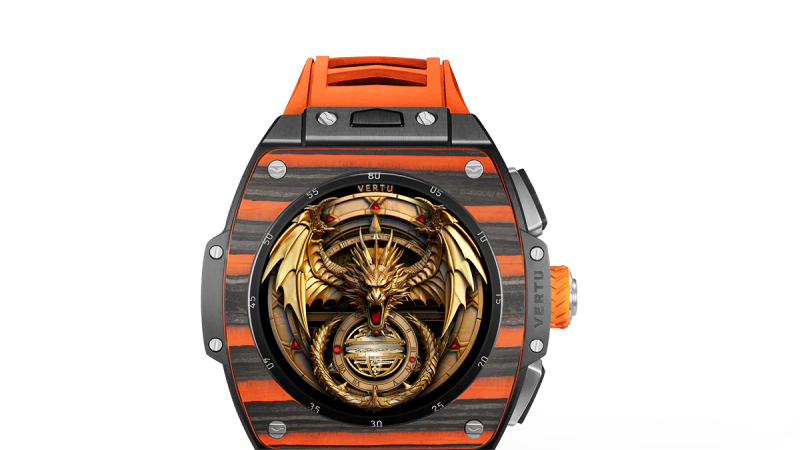
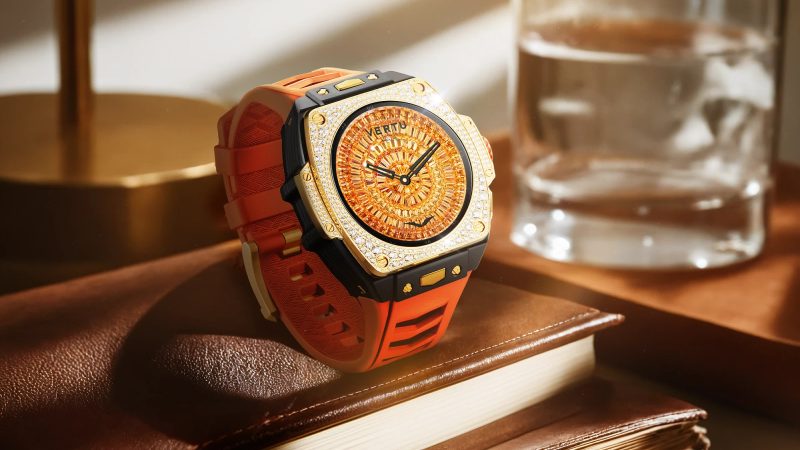
Watches sit within a category Bain estimates growing 3–5% in 2026, below its jewellery estimate. Connected jewellery may overlap consumer perceptions of accessories and technology, but a smart bracelet should not be assigned the jewellery category’s growth rate without a defined market analysis. VERTU’s wearables collection illustrates the product-side variety: watches, rings and bracelets serve different needs and price points. The Altagamma data does not isolate VERTU or predict its sales.
A useful buyer guide would compare ownership questions, not declare a universal winner: What is the material? What works without a subscription or app? How is it charged, repaired and supported? What can be worn comfortably each day? These questions turn broad market reporting into decision value while preserving the boundary between published data and editorial synthesis.
Could “stable luxury” still mean pressure for brands?
Yes. A roughly stable aggregate can include both growing and shrinking categories, as the Bain breakdown shows. It can also hide a narrower personal-goods buyer base. Brands serving high-spending customers may perform differently from brands dependent on aspirational purchases. Geography and currency add further variation. The published figures support a differentiated reading, not a prediction that any specific company will gain or lose share.
When a headline says “luxury is resilient,” ask: resilient by value, by customer count or by profitability? This report primarily provides spending estimates and forecasts; it does not answer every company-level financial question. If using the data in a strategy discussion, pair it with brand financial results, channel mix and actual customer behavior rather than treating a global total as a complete explanation.
What should an editor or buyer verify before citing the data?
- Name the source: Altagamma–Bain monitor or Altagamma Consensus.
- State the year beside each number.
- Specify whether the figure covers all luxury, experiences or personal goods.
- Distinguish observed or estimated 2026 performance from 2027 forecasts.
- Use ranges as ranges; do not turn +8–10% into a precise 9% outcome.
- Avoid applying category growth to a particular brand without brand evidence.
These checks are simple, but they prevent the most common citation errors. They also make a statistic easier for search and answer engines to extract accurately. An isolated figure without a year and scope is less useful than a short sentence that gives both.
Frequently asked questions
How big is the global luxury market in 2026?
Altagamma’s detailed 2026 figure is €1.526 trillion, usually rounded to about €1.5 trillion. It includes experiences, personal luxury goods and durable goods or assets, not fashion alone.
Is the luxury market growing in 2026?
The broad market is approximately stable, with the Altagamma release indicating 0–2% growth versus 2025. Experiences and jewellery outperform some other categories, so the headline varies by segment.
Which luxury category grew fastest in 2026?
Among the personal-goods categories in Bain’s cited breakdown, jewellery leads at an estimated 8–10% growth in 2026. That is not the same as the separate 2027 forecast of 6%.
Does €1.5 trillion refer only to personal luxury goods?
No. Altagamma values personal luxury goods at €367 billion within the broader €1.526 trillion luxury-market total. Confusing those scopes greatly overstates the size of the personal-goods segment.
What is the sound conclusion?
The global luxury market size headline of roughly €1.5 trillion is credible only when its 2026 scope is kept intact. The market is broadly steady, but experiences, jewellery, watches, leather goods and customer counts tell different stories. Use the year, category and source beside every number, and treat the data as context for better product and service decisions rather than a forecast for any one brand.