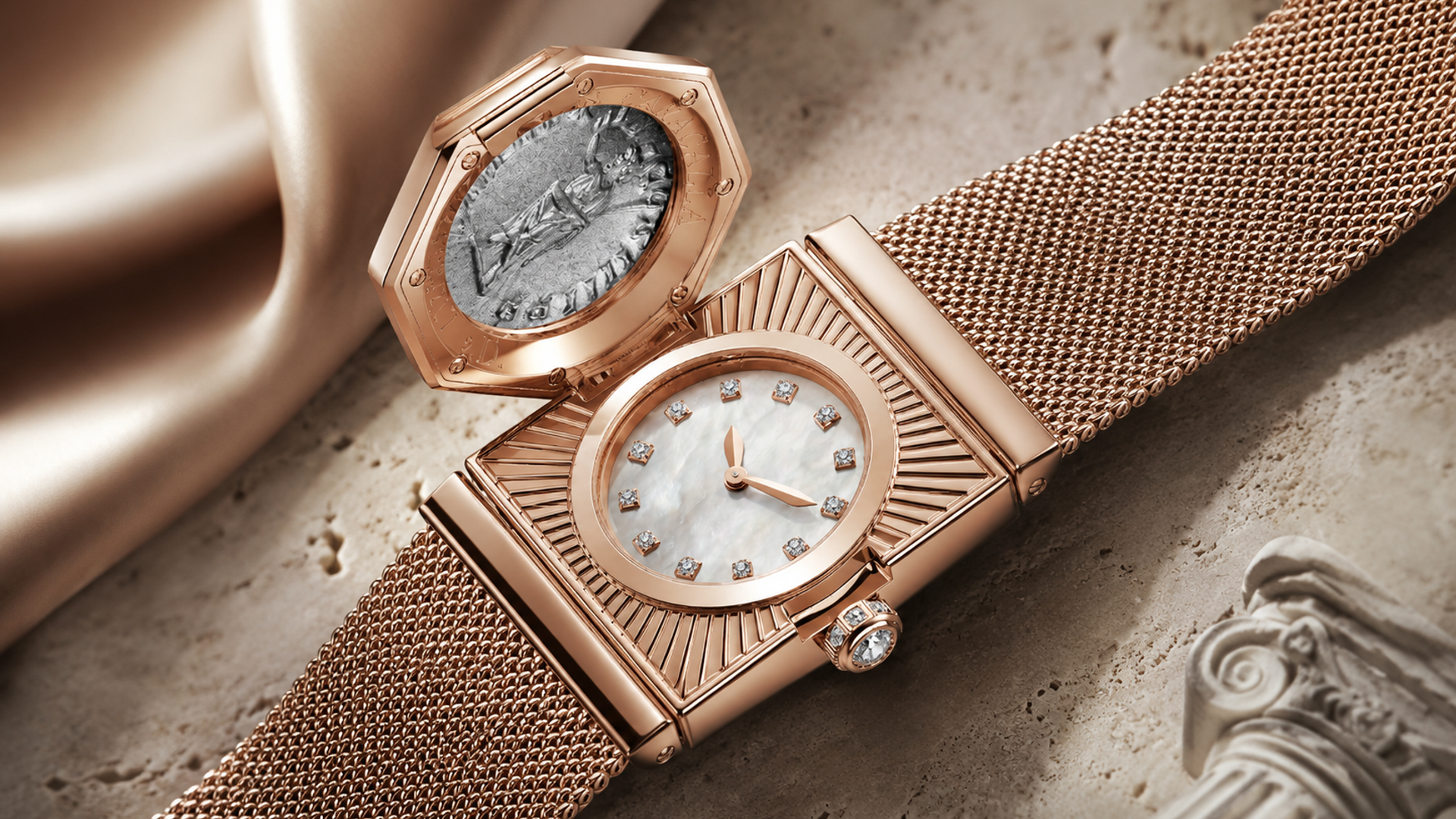
Some watches announce themselves from across the room. Others ask you to come closer—and then reward you for waiting. The Bvlgari Maglia Milanese Monete Secret Watch belongs to that quieter species: it reads, at first glance, as a bracelet of sculpted gold with an antique at its center. Only later does it admit it’s also a watch.That premise alone explains the attention. At a moment when luxury timepieces are increasingly performative—openworked, oversized, insistently visible—Bvlgari offers a deliberate counterpoint: time kept politely out of sight. It’s a “secret watch” not as a nostalgic trick, but as a contemporary idea of discretion.
Why this launch matters right now
The piece arrived in Milan in the orbit of LVMH Watch Week, and Bvlgari positioned it as part of an “Art of Gold” conversation—heritage, jewelry craft, and modern micro-mechanics in one object. In the brand’s own words, it revisits Monete (introduced in the mid-1960s) while bringing a newly spotlighted technique to the wrist: Milanese mesh, “born in Renaissance Milan” and made from “interlaced gold threads assembled with extraordinary precision,” as described in Bvlgari’s LVMH Watch Week story.
What’s compelling is how little the watch tries to convince you. It simply is what it is: a jewel that happens to keep time—and a mechanical watch that refuses to cosplay as jewelry.
Monete: Roman history, made wearable
“Monete” isn’t a decorative theme for Bvlgari; it’s part of its design language. When the maison began setting ancient coins into gold in the 1960s, it wasn’t borrowing the look of antiquity so much as reasserting Rome as a source of glamour. A coin carries a particular kind of authority: it was made to circulate, to be handled, to repeat its message—profile, inscription, emblem—until power became familiar.
On this watch, that message is literal. The cover is an authentic Roman silver coin depicting Emperor Caracalla—an object with its own patina, its own small scars of time. Watch-press reporting confirms the Caracalla coin as the centerpiece of the secret cover, including Time and Watches’ 2026 report on the model.
There’s a reason this resonates with collectors who already own “serious” watches: a coin isn’t a motif. It’s provenance made visible.
The secret watch as modern etiquette
Historically, secret watches belonged to rooms where looking at your wrist could read as impatience. Today, their appeal is different. Discretion has become its own luxury language—less about manners, more about autonomy.
The Maglia Milanese Monete plays that language beautifully. Closed, it’s a cuff-like jewel: coin framed by crisp geometry, with diamond light at the edges. Open, it becomes unmistakably a watch: the dial is white mother-of-pearl, with diamond hour markers, and the hands do what hands have always done—mark the minutes, without commentary.
Collector’s note: A secret watch offers a specific pleasure: you choose when time is part of the room. That choice is the complication.
Milanese mesh, explained the way a jeweler would
Most bracelets are engineered as structure: links, pins, defined articulation points. Milanese mesh is engineered as a surface.
The technique is built from countless fine coils or wires woven into a dense sheet, then finished until it behaves like fabric in metal form. The weave is what creates the signature drape: instead of bending only where links allow, the mesh flexes across its entire width, distributing weight and contouring to the wrist with a soft, continuous compliance.
That drape also changes the visual experience. Light doesn’t strike one broad plane and bounce; it scatters across thousands of micro-surfaces. The effect is less “shine” than shimmer—an animated glow that feels closer to textile than hardware.
There are practical implications, too. A finely woven bracelet is often exceptionally comfortable (it breathes; it doesn’t have the same hard edges as a rigid cuff), but it also rewards care: occasional cleaning to keep the weave crisp, and mindful storage so it doesn’t snag against something rough. If you want the long view—where milanaise comes from, and why it wears the way it does—Quill & Pad’s 2018 explainer on milanaise mesh bracelets is an excellent primer.In Bvlgari’s case, the mesh isn’t merely a strap choice. It’s the thesis: the watch is called Maglia Milanese for a reason.
Micro-mechanics in service of proportion
A jewelry watch lives or dies on proportion. Hide a dial under a coin and you’ve already committed to thickness; add a bulky movement and the object becomes a statement piece that wears you instead.
Bvlgari avoids that trap with the Piccolissimo BVP100 (also referred to as BVL 100 in watch coverage): a hand-wound movement measuring 13.5mm in diameter and 2.5mm thick, with a 30-hour power reserve and an almost counterintuitive weight of 1.9 grams. Those specifics—dimensions, architecture, and purpose—are laid out clearly in Monochrome’s 2026 introduction to the Maglia Milanese Monete.
What matters isn’t the record-book romance of smallness. It’s intent. Miniaturization here doesn’t exist to win a headline; it exists so the coin can remain the face, the mesh can remain the body, and the dial can stay exactly where the concept demands it: present, precise, and discreet.
What to look for, beyond the obvious
The seduction is immediate: ancient silver against warm rose gold; hard geometry against woven softness; the private flash of mother-of-pearl when the cover lifts.But the connoisseur detail is the way Bvlgari lets different kinds of craftsmanship speak without competing. The coin carries history. The mesh carries touch. The movement carries proof.That’s why the Bvlgari Maglia Milanese Monete Secret Watch has become a conversation piece in luxury circles. It isn’t trying to convert a sports-watch collector into jewelry, or a jewelry client into horology. It’s reminding both that the most persuasive luxury objects don’t beg to be noticed—they simply keep revealing themselves.