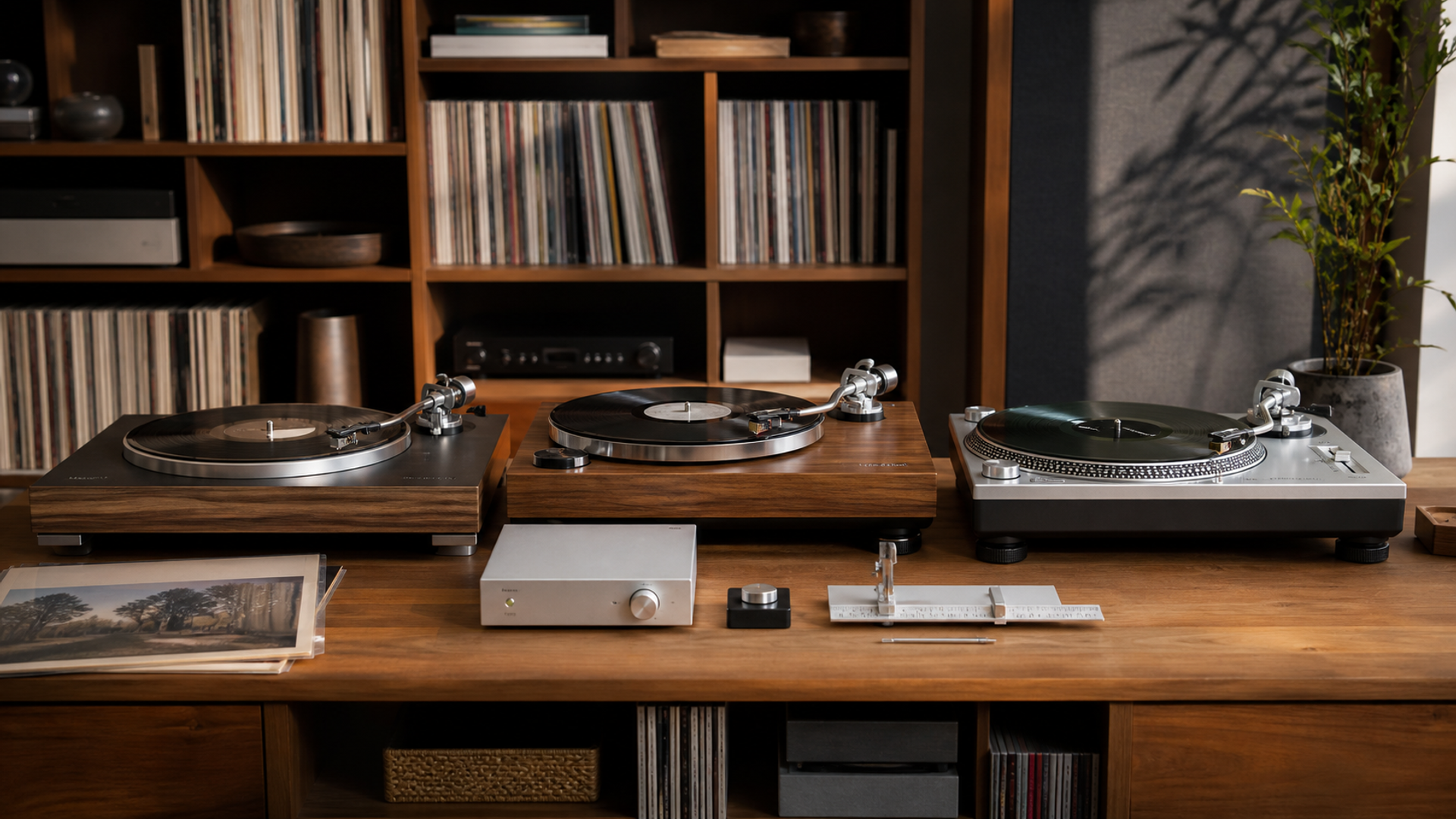
A turntable is a mechanical system before it is a lifestyle object. The deck, cartridge, tonearm, phono stage, support furniture and record condition all shape the result. Spending heavily on one visible component while ignoring alignment, isolation or gain can produce a worse experience than a modest system that is correctly matched and easy to use.
The short answer by listening ritual
Choose an integrated turntable with built-in phono stage for simple, repeatable listening; a manual belt-drive deck when cartridge and phono upgrades are part of the plan; or a direct-drive deck when speed stability, fast operation and robust daily use matter. Reserve budget for setup tools, a stable support, record care and the correct input on the amplifier.
| Decision factor | Integrated turntable | Manual belt-drive deck | Direct-drive deck |
|---|---|---|---|
| Listening priority | Simple operation and fewer boxes matter | Tuning and upgrade path matter | Speed stability and quick use matter |
| Phono stage | Built-in stage matches the amplifier | External stage and gain can be selected | Built-in or external route is chosen deliberately |
| Cartridge | Factory match limits setup risk | Alignment and future swaps are accepted | Replaceable headshell or cartridge supports use |
| Isolation | Moderate support and isolation are sufficient | Rigid level platform is carefully prepared | Motor torque and support are controlled |
| Automation | Auto stop or simple controls are valued | Fully manual ritual is desired | Fast start and cueing suit frequent listening |
| Service | One supplier supports the system | Belts, stylus and setup service are available | Parts and calibration support are available |
This best turntables 2026 matrix is the article's working value object. Read the best turntables 2026 rows together: the decisive failure mode depends on this topic's evidence, operating context and reader objective.
Understand the complete analogue chain
Evidence 1. The RIAA explains that vinyl playback remains an analogue medium whose records and playback equipment require physical care; the format's growth does not remove setup requirements.
Evidence 2. Audio Engineering Society standards and technical work illustrate that level, equalisation and measurement belong to an engineering chain rather than a single turntable specification.
Evidence 3. Cartridge output must match the phono stage's moving-magnet or moving-coil input, gain and loading; incompatible matching can create low level, overload or altered frequency response.
Evidence 4. Tracking force, cartridge alignment, anti-skate and turntable level are model-specific setup values that should come from the current manuals and cartridge instructions.
Reader-visible sources checked for this article:
riaa.com — reader-visible current or official evidence
aes.org — reader-visible current or official evidence
rega.co.uk — reader-visible current or official evidence
us.technics.com — reader-visible current or official evidence
For best turntables 2026, these sources establish only the claims inside their documented scope. Recheck every changeable specification, availability condition, price, policy or service term in the relevant market before acting.
Allocate budget to setup and support
On listening priority, popularity is not enough. The evidence for option one is that simple operation and fewer boxes matter. Option two means tuning and upgrade path matter. Option three is rational where speed stability and quick use matter. Recheck any changeable term immediately before commitment.
The decision changes at phono stage. Choose the first path only if built-in stage matches the amplifier; move to the second when external stage and gain can be selected; use the third when built-in or external route is chosen deliberately. Save the downside that would make this row fail.
For cartridge, the first route works when factory match limits setup risk; the second requires alignment and future swaps are accepted. The control for the third is replaceable headshell or cartridge supports use. Verify this row against the exact product, property, account or environment before it can reverse the decision.
The isolation row exposes a practical boundary. Route one assumes moderate support and isolation are sufficient, while route two is defensible only when rigid level platform is carefully prepared. Route three depends on motor torque and support are controlled. If that evidence is absent, keep the more reversible option.
Read automation as a stop/go test: auto stop or simple controls are valued supports the first option; fully manual ritual is desired supports the second; and fast start and cueing suit frequent listening supports the third. Record which source proves the condition and when it was checked.
A buyer can resolve service without starting from a brand preference. Ask whether one supplier supports the system; compare that with whether belts, stylus and setup service are available; then use parts and calibration support are available as the third route's safeguard. An unknown condition stays unknown.
Facts that would reverse the current choice
Reversal control 1 — Listening priority. Before choosing Integrated turntable, write down how the decision changes if “Simple operation and fewer boxes matter” proves false. Do the same for Manual belt-drive deck and “Tuning and upgrade path matter”. Keep the Direct-drive deck route available until “Speed stability and quick use matter” is verified. This control belongs to best turntables 2026; update it from the cited source or exact supplier rather than copying a generic checklist.
Reversal control 2 — Phono stage. Before choosing Integrated turntable, write down how the decision changes if “Built-in stage matches the amplifier” proves false. Do the same for Manual belt-drive deck and “External stage and gain can be selected”. Keep the Direct-drive deck route available until “Built-in or external route is chosen deliberately” is verified. This control belongs to best turntables 2026; update it from the cited source or exact supplier rather than copying a generic checklist.
Reversal control 3 — Cartridge. Before choosing Integrated turntable, write down how the decision changes if “Factory match limits setup risk” proves false. Do the same for Manual belt-drive deck and “Alignment and future swaps are accepted”. Keep the Direct-drive deck route available until “Replaceable headshell or cartridge supports use” is verified. This control belongs to best turntables 2026; update it from the cited source or exact supplier rather than copying a generic checklist.
Reversal control 4 — Isolation. Before choosing Integrated turntable, write down how the decision changes if “Moderate support and isolation are sufficient” proves false. Do the same for Manual belt-drive deck and “Rigid level platform is carefully prepared”. Keep the Direct-drive deck route available until “Motor torque and support are controlled” is verified. This control belongs to best turntables 2026; update it from the cited source or exact supplier rather than copying a generic checklist.
Reversal control 5 — Automation. Before choosing Integrated turntable, write down how the decision changes if “Auto stop or simple controls are valued” proves false. Do the same for Manual belt-drive deck and “Fully manual ritual is desired”. Keep the Direct-drive deck route available until “Fast start and cueing suit frequent listening” is verified. This control belongs to best turntables 2026; update it from the cited source or exact supplier rather than copying a generic checklist.
Reversal control 6 — Service. Before choosing Integrated turntable, write down how the decision changes if “One supplier supports the system” proves false. Do the same for Manual belt-drive deck and “Belts, stylus and setup service are available”. Keep the Direct-drive deck route available until “Parts and calibration support are available” is verified. This control belongs to best turntables 2026; update it from the cited source or exact supplier rather than copying a generic checklist.
Map every component before choosing the deck
List amplifier inputs, existing phono stage, speakers or headphones and available furniture. Confirm whether the turntable needs line-level output or a phono input. If a moving-coil cartridge is planned, record gain and loading. Include cables, dust cover clearance and grounding. The deck cannot be judged independently from hum, gain and loudspeaker placement. A simple integrated model may outperform a theoretically superior manual deck when the rest of the chain is mismatched.
Treat setup as part of the purchase price
A cartridge must sit squarely at the correct geometry, track at the specified force and meet a level record surface. Budget for a gauge, alignment tool, suitable brush and professional setup if uncertain. Check the tonearm's cartridge weight and compliance range before upgrading. Recheck after transport. Never guess tracking force from online discussion when the current cartridge manual supplies a value; excessive or insufficient force can damage records, stylus or both.
Control vibration before chasing upgrades
Place the deck away from loudspeakers and footfall, on a rigid level platform. Suspended floors may need wall support or better isolation. Close the dust cover only if the manufacturer recommends playback that way; covers can transmit or trap vibration on some systems. Test feedback at normal and elevated volume. A new cartridge will not fix a shelf that moves with every step. Isolation is often the highest-value upgrade because it protects every record and cartridge.
Plan the collection workflow
Clean new and used records, use inner sleeves and store vertically away from heat. Track stylus hours and inspect wear according to maker guidance. Keep original cartridge guards and transport screws. Decide whether automatic stop matters for late-night listening and whether 45 rpm changes are convenient. A collector deck should invite use; if every side change requires a fragile ritual, records may remain untouched. Service access and replacement parts are part of collectability.
Three collectors who need different decks
The first serious vinyl system
An integrated turntable reduces matching errors and makes sense when the amplifier lacks a phono input. Define the fact that would reverse this recommendation before committing.
The ritual-led collector
A manual belt-drive deck rewards careful setup and a planned cartridge or phono-stage path. Define the fact that would reverse this recommendation before committing.
The frequent listener and mixed collection
A direct-drive deck can offer stable speed and quick operation where many records and regular cueing dominate. Define the fact that would reverse this recommendation before committing.
Action checklist
List amplifier inputs and phono-stage needs.
Choose moving-magnet or moving-coil path.
Confirm cartridge and tonearm compatibility.
Budget for alignment and tracking-force tools.
Prepare a rigid level support.
Check dust-cover and cable clearance.
Test hum and grounding.
Plan record and stylus cleaning.
Verify local setup and parts support.
Retain packaging for safe transport.
Continue the decision
The linked VERTU articles expand adjacent parts of the best turntables 2026 decision. They do not substitute for the external evidence above.
The turntable verdict
Choose an integrated turntable with built-in phono stage for simple, repeatable listening; a manual belt-drive deck when cartridge and phono upgrades are part of the plan; or a direct-drive deck when speed stability, fast operation and robust daily use matter. Reserve budget for setup tools, a stable support, record care and the correct input on the amplifier.
Keep the best turntables 2026 decision reversible until its material cost, safety, access, privacy and compatibility facts are verified. Unknown evidence stays unknown; it is never silently scored as favourable.