Quick Answer:
Choose the Microcrystalline Black Ceramic case if you spend your days in boardrooms, diplomatic settings, or formal dining environments where pristine surface preservation (~1,200–1,500 HV) and substantial wrist presence are priorities. Choose the Filament-Coloured Carbon case if you lead an active lifestyle requiring maximum shock tolerance, ultralight all-day comfort (1.5–1.6 g/cm³ density), and integrated performance tracking for golf and tennis.
In contemporary luxury horology, material choice dictates the daily ownership experience far more than case dimensions. For the VERTU Grand Watch, core foundations—the architectural 44mm tonneau silhouette, the Grade 9 Mohs sapphire crystal, and the 10-layer 3D AMOLED display—remain uncompromising constants. The defining variable is the case material wrapped around the wrist.
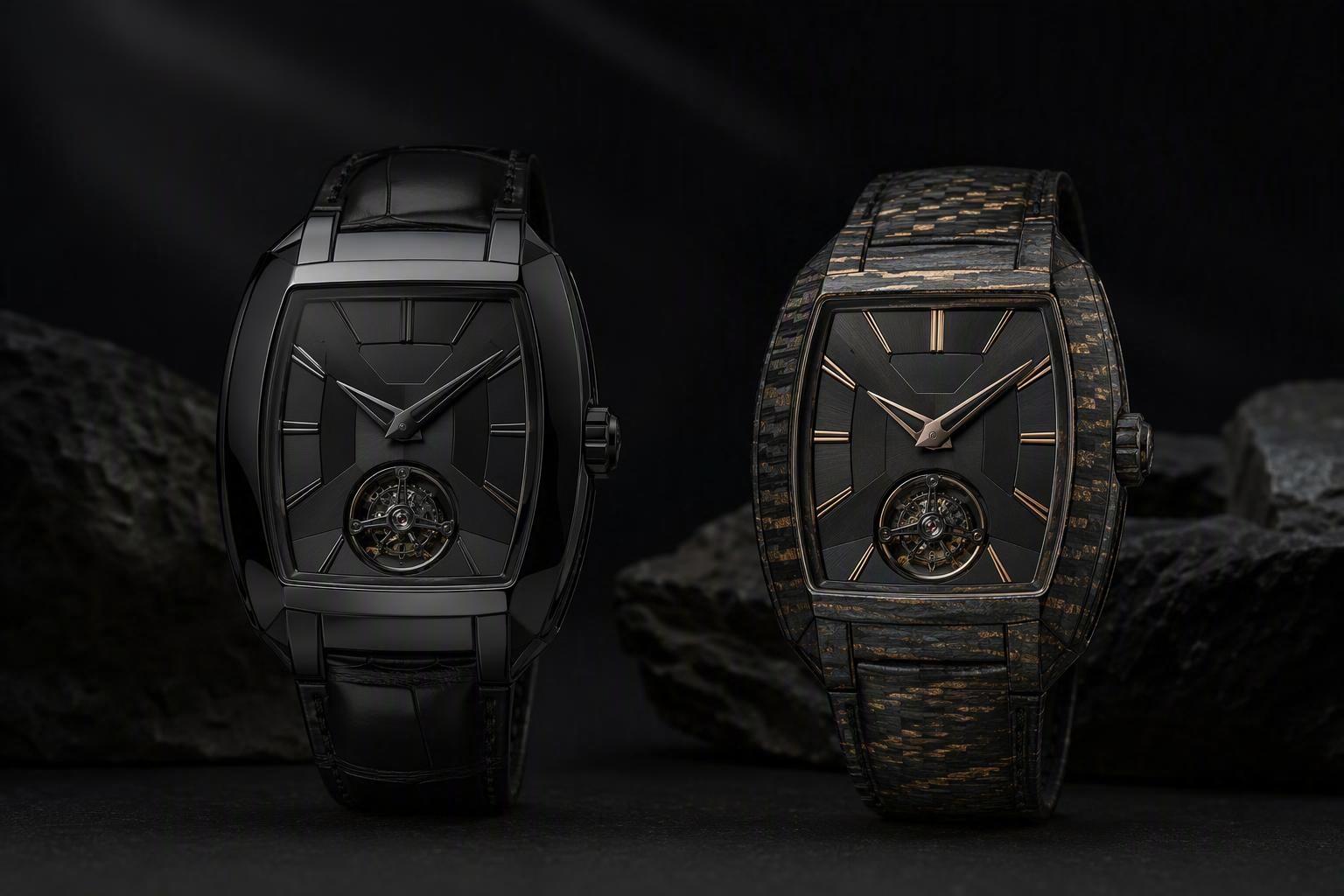
The microcrystalline black ceramic watch is engineered for quiet formal authority. Polished with fine-mesh emery to an immaculate monolithic black, it delivers near-scratchproof surface hardness (~1,500 HV) and substantial physical density. In contrast, the filament-coloured carbon variant speaks the technical vocabulary of motorsport. Formed from interleaved carbon strands, it yields featherweight ergonomics, high shock absorption, and an irreproducible organic weave.
Neither material is universally superior; each is calibrated for distinct physical environments and daily routines. Here is a definitive, engineering-led comparison across scratch resistance, weight distribution, impact behavior, and aesthetic presence to determine which case belongs on your wrist.
At a Glance: Case Material Comparison
Evaluation Metric | Microcrystalline Black Ceramic | Filament-Coloured Carbon |
Surface Hardness | ~1,200–1,500 HV (Near-scratchproof) | ~800 HV (Resin layer can show micro-wear) |
Impact Absorption | Moderate (Brittle under hard shock/drops) | High (Superior kinetic dissipation) |
Material Density | ~5.7–6.0 g/cm³ (Substantial wrist presence) | ~1.5–1.6 g/cm³ (Featherweight ergonomics) |
All-Day Comfort | Cool to touch, reassuringly weighted | Ultra-lightweight, disappears during sport |
Visual Texture | Monolithic, satin-smooth deep black | Two-tone woven filaments (Every case unique) |
Style Profile | Formal, executive, understated luxury | Avant-garde, technical, motorsport |
Dedicated Sports Tracking | Mainstream cardio modes | Golf & Tennis performance tracking |
Voice Productivity | AI Health Guard | AI Health Guard + Voice-to-Text conversion |
Thermal Range | Optimized for -20°C to 55°C | Standard operational limits |
Scratch Resistance: Ceramic’s Surface Invulnerability
This is the clearest distinction between the two materials, and it cuts decisively in favour of ceramic.
High-tech ceramic — the grade used in the VERTU Grand Watch's microcrystalline black case — reaches hardness ratings of approximately 1,200 to 1,400 Vickers, according to a materials analysis published by Watch Police. For context, standard stainless steel sits around 200 HV. The result is that surface-level marks from keys, desk edges, or cufflinks simply do not register. The case polished with 1200-mesh fine emery stays silky and uniform for years.
The filament-coloured carbon operates differently. Its structural fibre layers are extraordinarily tough, but the outer resin matrix that binds them is softer. As the ceramic-vs-carbon materials guide at Ceramic Field Guide documents, carbon composite cases — including the woven filament variant — rate around 800 HV, and the epoxy-bonded surface is more susceptible to hairline surface marks over time. These do not compromise the structural integrity of the case, but they are visible under close inspection.
If you return the watch to the same pristine black it left the box in — two, five, or ten years from now — the ceramic case has the structural advantage.
Weight and Daily Ergonomics: Density vs. Agility
How a 44mm tonneau timepiece distributes its mass across eight to twelve hours fundamentally shapes wearer comfort:
Filament-Coloured Carbon: Boasts a density of roughly 1.5 to 1.6 g/cm³. On the wrist, it dramatically reduces fatigue during athletic movements, international travel, or prolonged keyboard work. It wears closer to an ultralight carbon instrument than a dense mechanical timepiece, making it the choice for uninterrupted, 24/7 biometric tracking.
Microcrystalline Black Ceramic: Possesses a density of approximately 5.7 to 6.0 g/cm³. While noticeably lighter than gold, platinum, or solid steel, ceramic possesses a reassuring, tactile density. It settles cool against the skin, offering the unmistakable, substantial heft that traditional collectors associate with fine watchmaking.
The choice is ideological: do you prefer the reassuring physical gravity of ceramic, or the near-weightless utility of technical carbon?
Impact Tolerance: The Drop Scenario
Ceramic's one significant liability is brittleness. The same hardness that repels surface scratches means ceramic resists deformation rather than absorbing it. A hard impact — concrete floor, sharp edge, accidental collision at speed — can chip or crack the case. Testing data from the ODM Watch case materials analysis found that carbon composite cases absorb approximately 30% more impact force before fracture compared to ceramic alternatives.
The filament-coloured carbon behaves differently under stress. Carbon fibre's structural properties allow it to flex microscopically before transferring load, which means the case is far more forgiving of the kind of knocks that happen in active daily life.
This is not a problem exclusive to VERTU — it applies to ceramic across watchmaking. If your typical day involves construction sites, sports courts, or environments where the watch regularly contacts hard surfaces at force, the carbon case is the more resilient choice. If your day is a controlled sequence of meetings, travel, and meals, the ceramic case's impact risk is largely theoretical.
How to assess your own risk: Think about the last time you knocked your wrist against something unexpectedly in a single month. More than twice a week — choose carbon. Less than that — ceramic's brittleness is unlikely to matter.
Aesthetic Identity: Executive Restraint vs. Motorsport Complexity
Both options share the same 44mm tonneau lines, yet project entirely different social statements:
Microcrystalline Black Ceramic: Monolithic, calm, and deliberate. Its seamless, dark satin-gloss luster complements midnight-blue tuxedos, bespoke tailoring, and boardroom settings. It does not shout; it embodies the quiet confidence of an expertly tailored suit.
Filament-Coloured Carbon: Dynamic and visually intricate. Interleaved carbon filaments reflect ambient light at varied angles, creating a three-dimensional depth that shifts with wrist motion. Because every filament layer aligns differently during production, no two carbon Grand Watch cases carry an identical pattern. The visual reference point is the exposed monocoque of a Formula 1 car—a celebration of engineering mastery.
Feature Depth: When Case Choice Influences Data Capabilities
While the core hardware—including the 2.5D Ultra GPU (60 fps), Grade 9 Mohs sapphire crystal, and 5–7 day battery life—remains identical across both models, VERTU differentiates their functional software profiles:
Carbon-Exclusive Features: The filament-coloured carbon edition is equipped with specialized Golf and Tennis sports modes, delivering stroke and swing performance data tailored for club and court play. It also includes an advanced voice-to-text AI dictation engine for executive productivity on the move.
Ceramic Environmental Resilience: The ceramic model highlights optimized thermal stability from -20°C to 55°C, ensuring dimensional stability and skin comfort across extreme temperature swings.
Buyer's Guide: Matching the Material to Your Lifestyle
Choose Microcrystalline Black Ceramic if:
You demand an unblemished, scratchproof finish (~1,500 HV) that defies daily desk-rub and metal contact.
Your weekly schedule centers on boardrooms, private aviation, fine dining, and black-tie events.
You prefer a watch with noticeable physical density and a cool, hypoallergenic touch against the skin.
You favor monolithic, understated luxury over overt technical displays.
Choose Filament-Coloured Carbon if:
You want an ultralight case that virtually disappears on the wrist during extended wear and sleep tracking.
Your routine involves high-impact environments, golf courses, tennis courts, or open-air athletics.
You appreciate that the organic, woven composite pattern makes your timepiece visually one-of-a-kind.
You will actively utilize dedicated golf/tennis swing analysis and integrated voice-to-text dictation.
Frequently Asked Questions (FAQ)
Can the ceramic case of the VERTU Grand Watch crack if dropped?
Like all high-tech ceramics in luxury watchmaking, microcrystalline ceramic is extremely hard (~1,500 HV) but brittle. While it will never scratch from keys or metal surfaces, dropping it directly onto hard surfaces such as concrete, tile, or stone can chip or fracture the case.
Does the carbon fiber case scratch easily?
The structural carbon filaments inside the case are practically indestructible. However, the outer binding resin matrix rates around 800 HV, meaning it can accumulate minor hairline scuffs over years of abrasive friction. These marks are cosmetic and do not affect the case's structural integrity.
Are both the ceramic and carbon cases hypoallergenic?
Yes. Both microcrystalline ceramic and sealed filament carbon are biologically inert and skin-friendly. They do not contain nickel or copper alloys, making both cases suitable for wearers prone to contact dermatitis or metal allergies.
Is there a difference in battery life between the ceramic and carbon models?
No. Both variants utilize the exact same internal architecture, battery cell, and low-power power management system, delivering 5 to 7 days of normal daily use and up to 72 hours in continuous always-on display mode.
The Final Verdict
The choice between microcrystalline black ceramic and filament-coloured carbon is not a question of quality—it is a question of alignment with your lifestyle.
The Microcrystalline Black Ceramic Grand Watch is the purist's choice: enduring, scratchproof, and formal, carrying the timeless permanence demanded by classic luxury horology.
The Filament-Coloured Carbon Grand Watch is the performance instrument: ultralight, shock-resilient, visually dynamic, and equipped with dedicated athletic tracking.
Select ceramic for the formal elegance of an unyielding finish; select carbon for the active freedom of high-performance engineering. Whichever material defines your wrist, the VERTU Grand Watch stands as an uncompromising statement of modern luxury.