

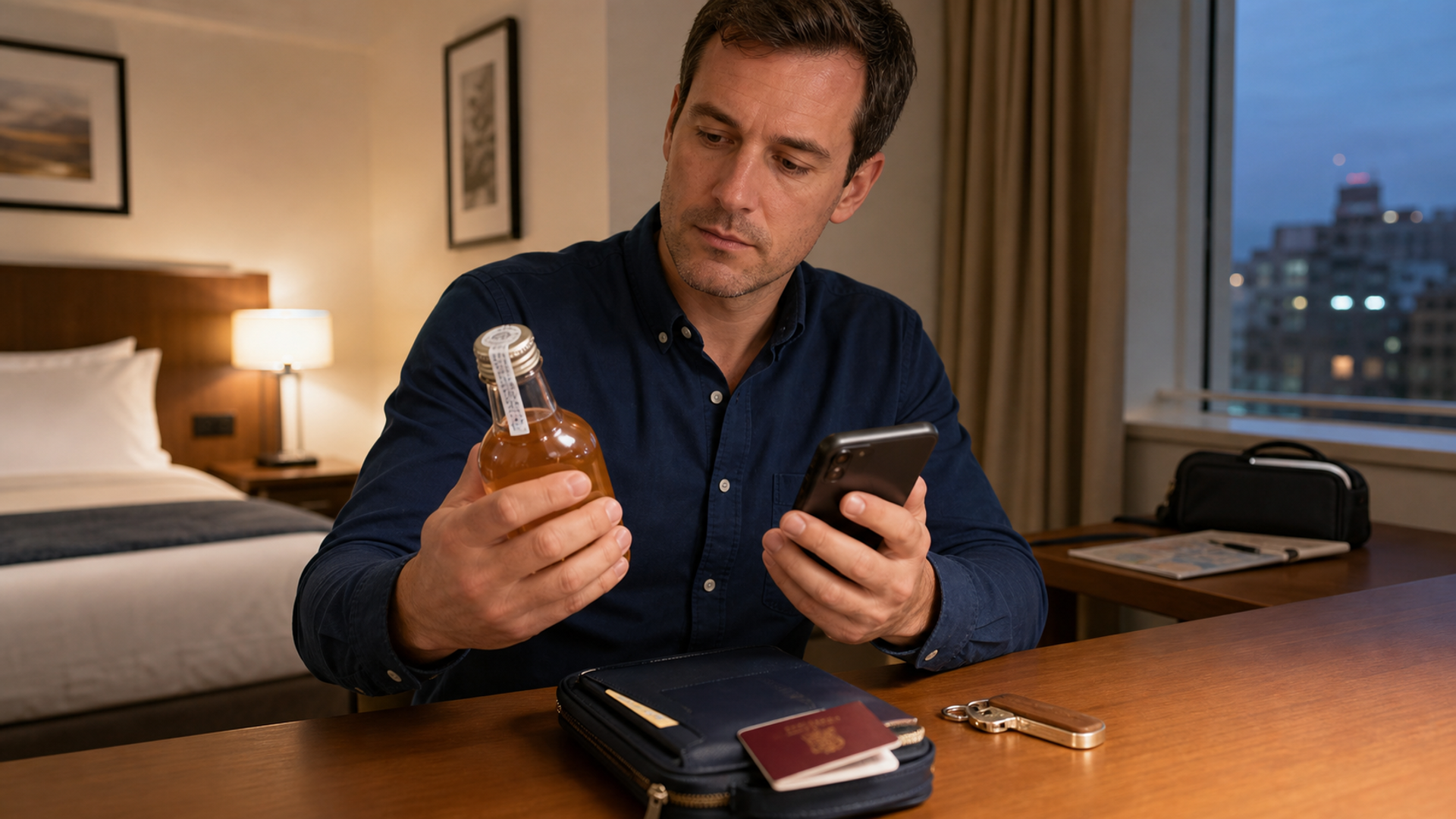
The safest response to suspected methanol poisoning is emergency medical care, not a home test, a night’s sleep or a flight home. A practical methanol poisoning travel safety plan starts before an evening out: spend 15 minutes checking destination advice, saving local emergency details and agreeing which drinks you will reject. The phrase “15-minute plan” describes preparation only. It is not a treatment window.
Methanol-contaminated alcohol may look ordinary, and methanol is colourless and odourless. If you know or reasonably suspect that you have consumed contaminated alcohol—or if headache, nausea, abdominal pain, confusion, unusual breathing or any visual disturbance follows drinking—contact local emergency services and seek urgent professional care. Do not wait for every symptom to appear.
The plan below cannot make drinking risk-free and cannot diagnose poisoning. Its purpose is narrower and more useful: reduce avoidable exposure, recognise reasons to escalate and remove indecision when minutes matter.
The 15-minute methanol poisoning travel safety plan
Use this preparation shortly before departure or on arrival, while you are sober and connected. It is easier to save an address and agree a group rule in a hotel room than in a noisy venue with an unreliable signal.
| Time | Preparation action | What “done” looks like |
|---|---|---|
| Minutes 0–3 | Read the official destination health and safety advice | You have checked the current country page on the UK Foreign, Commonwealth & Development Office travel advice service, or your government’s equivalent, and noted any alcohol or methanol warning. |
| Minutes 3–6 | Save the local emergency route | The local emergency number and the address of a suitable emergency department are saved offline. You know that an insurer, hotel or embassy can assist with logistics but does not replace emergency services. |
| Minutes 6–9 | Make the group contact card | Everyone has the accommodation name, address, phone number, insurer assistance number and one another’s mobile numbers. |
| Minutes 9–12 | Agree the drink rule | The group will reject homemade, streetside, unlabelled or suspiciously cheap alcohol, free shots and spirit mixtures whose source cannot be checked. |
| Minutes 12–15 | Agree the emergency phrase | Everyone can say: “Possible methanol exposure after alcohol; urgent medical assessment needed,” followed by the location, time of drinking and number of people affected. |
Official advice changes as incidents and local supply risks change. A destination that had no warning when a trip was booked may have one by departure, while a warning for one country does not prove that every drink there is unsafe. Check close to travel and again during a longer stay.
The before-drinking risk checklist
The only way to remove the risk from alcoholic drinks is not to drink them. If you do choose to drink, this checklist reduces exposure without pretending to certify any bottle or venue.
| Check before drinking | Lower-risk decision | Stop sign |
|---|---|---|
| Official advice | Current destination guidance has been checked and any local warning understood. | You have not checked, or an active warning advises particular caution that the proposed drink does not meet. |
| Container | Choose a branded beer, cider, wine or premixed drink in a sealed bottle or can; inspect the seal and open it yourself where possible. | The cap, ring, foil, label or container looks altered, reused or inconsistent. |
| Source | Buy from a licensed establishment with a traceable retail supply. | The alcohol is homemade, bootleg, streetside, decanted from an unlabelled container or supplied from an unclear source. |
| Drink format | Prefer a sealed, single-serve product whose identity remains visible. | A spirit-based shot, cocktail, bucket, jug or premix arrives with no credible way to check what was poured. |
| Price and promotion | The price and offer are plausible for the venue and product. | The spirit is implausibly cheap, a “premium” bottle looks wrong, or a complimentary shot appears without a clear source. |
| Venue confidence | Treat a reputable venue as one useful risk reducer, not a guarantee. | Staff dismiss a reasonable question about the bottle, seal or source, or pressure you to drink. |
| Senses | Do not use smell, colour or taste as a methanol test. | Someone claims a flame, odour, taste or improvised trick proves the drink safe. |
| Personal control | Keep the drink in sight and stop if its custody is uncertain. | The drink was left unattended, swapped, topped up without consent or handled out of view. |
| Group behaviour | Stay connected, share the venue and note what the group ordered. | A companion becomes unexpectedly unwell or disappears, and nobody can identify what or where they drank. |
| Doubt | Leave the drink. Choosing another sealed product—or no alcohol—has a trivial cost. | You feel obliged to finish because it was expensive, gifted or already poured. |
This is a screening tool for decisions, not a test for contamination. Australia’s official Smartraveller methanol guidance says reputable establishments reduce risk but do not eliminate it, and warns that labels can be counterfeit. The same guidance explains why sensory confidence is unreliable: methanol is colourless and odourless.
The US Centers for Disease Control and Prevention’s 2026 Yellow Book chapter on toxic exposures during travel adds an important supply-chain distinction. Methanol can remain after improper distillation or be used deliberately to adulterate a beverage. That is why “local”, “traditional” or “premium-looking” is not meaningful evidence of safety by itself.
Symptom-to-urgent-action timeline
This timeline starts with recognition and ends with professional care. It is not a countdown during which it is safe to wait. Symptoms can overlap with ordinary intoxication, a hangover and other medical emergencies, so a traveller should not try to distinguish them without clinical assessment.
| What you observe | Why it matters | Urgent action |
|---|---|---|
| Known or credible suspected consumption of contaminated alcohol, even before symptoms | Methanol effects can be delayed, and feeling well initially does not rule out danger. | Contact local emergency services or an official poison service immediately for professional direction and state that methanol exposure is suspected. Emergency assessment is required; do not wait for symptoms. |
| Headache, dizziness, fatigue, nausea, vomiting or abdominal pain after a concerning drink | These signs are non-specific, but official guidance includes them among possible early features. | Seek urgent emergency medical care now. Give the time, venue and drink details; do not label it “just a hangover” and delay. |
| Confusion, unusual drowsiness or a condition that is worsening rather than resolving | A changing mental state after suspected exposure is an emergency signal, regardless of the eventual diagnosis. | Call emergency services. Keep the person with a sober companion and follow the dispatcher’s instructions. |
| Blurred, dim, “snowfield” or tunnel vision; flashes; light sensitivity; altered colour perception; any loss of sight | Visual disturbance is a particularly serious warning described by government guidance. | Request emergency care immediately and explicitly report the visual change and possible methanol exposure. Do not drive. |
| Breathlessness, rapid or difficult breathing, collapse, seizure or reduced consciousness | These are severe emergency signs. | Activate local emergency services immediately. State the person’s condition and exact location, and follow professional instructions until help arrives. |
| More than one person who shared a bottle, batch or jug becomes unwell | A shared exposure may affect others who do not yet have the same symptoms. | Tell emergency clinicians that others consumed the same drink. Give names and contact details so professionals can advise each exposed person without delay. |
The time ranges in public guidance are not identical. Smartraveller says symptoms can take 12–24 hours to appear, while the UK Health Security Agency’s methanol toxicological overview says the latent period is typically 12–24 hours and occasionally extends to 48 hours; visual effects may develop within 12–48 hours. Individual exposure, co-ingestion and clinical course vary. The safe conclusion is not to choose one range; it is to treat delayed symptoms as possible and never use either figure as permission to wait.
What to communicate in the emergency call
A concise, factual call helps the dispatcher route care. You do not need to prove methanol poisoning. Say that it is suspected and provide what is known:
your exact location, including venue or hotel name, street and room number;
the symptoms and whether the person is conscious and breathing normally;
what was consumed, including brand or drink description;
the approximate time and amount, making clear when either is uncertain;
whether anyone else shared the same bottle, batch, cocktail or jug;
any photograph of the label, receipt or container that already exists; and
the caller’s number and a second contact if the signal is unstable.
Do not delay departure for care while trying to collect evidence. A container, photograph or receipt may help clinicians or authorities only if it is already available and safe to retain. The priority is getting the person to emergency professionals.
Travel insurance assistance can help identify facilities, guarantee payment or coordinate later movement, depending on the policy. Consular staff may help with local contacts. Neither should become an extra approval layer before calling an ambulance or reaching an emergency department.
Why common reassurance fails
“It came from a good hotel”
Venue quality can reduce risk, but it cannot independently verify every bottle or upstream supplier. Treat reputation as one layer in the checklist, not as a substitute for a sealed, traceable product and current official advice.
“It tasted normal”
There is no useful traveller’s taste or smell test for methanol contamination. Improvised flame tests, colour checks and online tricks can create false confidence and introduce additional hazards. If provenance is doubtful, the correct consumer decision is to reject the drink.
“It is probably only a hangover”
That may ultimately be true, but the overlap is exactly why self-diagnosis is unsafe. Headache, nausea and dizziness are non-specific; visual changes, worsening breathlessness and confusion are especially urgent. A clinician should assess suspected poisoning.
“Symptoms would have started already”
Both the Australian and UK government sources warn of delayed presentation. A normal first hour does not clear a suspicious exposure, and the next morning is not an automatic point of safety.
“Only one region has this problem”
Outbreaks and warnings have affected multiple regions, and official country lists change. Risk should not be turned into a stereotype about residents, destinations or local culture. The useful questions concern the current warning, the product, the supply chain and the action plan.
Build a group protocol, not a solo memory test
Alcohol, noise, unfamiliar streets and poor connectivity make recall less reliable. A group protocol distributes the work: one person checks the seal, everyone retains their own drink, and at least one sober contact knows the venue and accommodation. Nobody who is unwell is left alone to “sleep it off”.
Save the emergency card offline and share it in the group chat before going out. Include the local emergency number, hospital address, insurance assistance number, accommodation details and a trusted contact at home. For trips exposed to wider disruption, the same contact discipline can sit beside a broader phone and communication plan for sudden airspace closures. That separate plan does not replace the medical steps here; it keeps communications working around them.
The group should also agree that cost, embarrassment, language difficulty or concern about spoiling the trip will not delay a call. Emergency departments need symptoms and exposure facts, not certainty from the traveller.
The limits of any travel safety plan
No checklist can authenticate every bottle, predict an outbreak or tell a traveller whether symptoms are caused by methanol. Country guidance may lag a local incident. A licensed venue can still receive counterfeit stock. A sealed container can be convincingly imitated. Conversely, feeling unwell after alcohol does not confirm methanol poisoning.
Those limits are not reasons for fatalism. They define the boundary between prevention and medicine. Prevention means choosing lower-risk products, refusing doubtful drinks, maintaining group awareness and preparing emergency details. Medicine begins when exposure is credibly suspected or warning signs appear. At that boundary, professional emergency care is required.
The decision to make before the first drink
Spend 15 minutes while sober: check the destination advice, save the emergency route, share the contact card and agree the drinks you will refuse. Choose sealed, traceable products if you drink, but remember that no venue, label or sensory check can promise safety.
Most importantly, decide in advance that suspected exposure or concerning symptoms will trigger emergency care without debate. The point of the plan is not to make travellers diagnose methanol poisoning. It is to make the safe next action obvious when uncertainty is highest.
![How to Scan Receipts and Documents with Your Phone [Full Guide]](https://cdn.sanity.io/images/e0gp1l2g/production/0db13feec1d5e72b8a8a5f976d1f3e86619c9228-3840x1860.webp?w=180&h=180&q=78&auto=format&fit=crop)
![How to Scan Receipts and Documents with Your Phone [Full Guide]](https://cdn.sanity.io/images/e0gp1l2g/production/0db13feec1d5e72b8a8a5f976d1f3e86619c9228-3840x1860.webp?w=800&h=450&q=82&auto=format&fit=crop)
![Top 10 Two-Tone Carbon-Fibre Watches for Men [2026 List]](https://cdn.sanity.io/images/e0gp1l2g/production/18870799ba33fab0e038968359cd5772d7d7db30-1024x576.webp?w=800&h=450&q=82&auto=format&fit=crop)
![Top 10 Luxury Watches with Digital Complication Displays for Men [Latest]](https://cdn.sanity.io/images/e0gp1l2g/production/c4f6bf8c080f291c39f7cc85c7344ecff2fd3799-1024x553.webp?w=800&h=450&q=82&auto=format&fit=crop)