

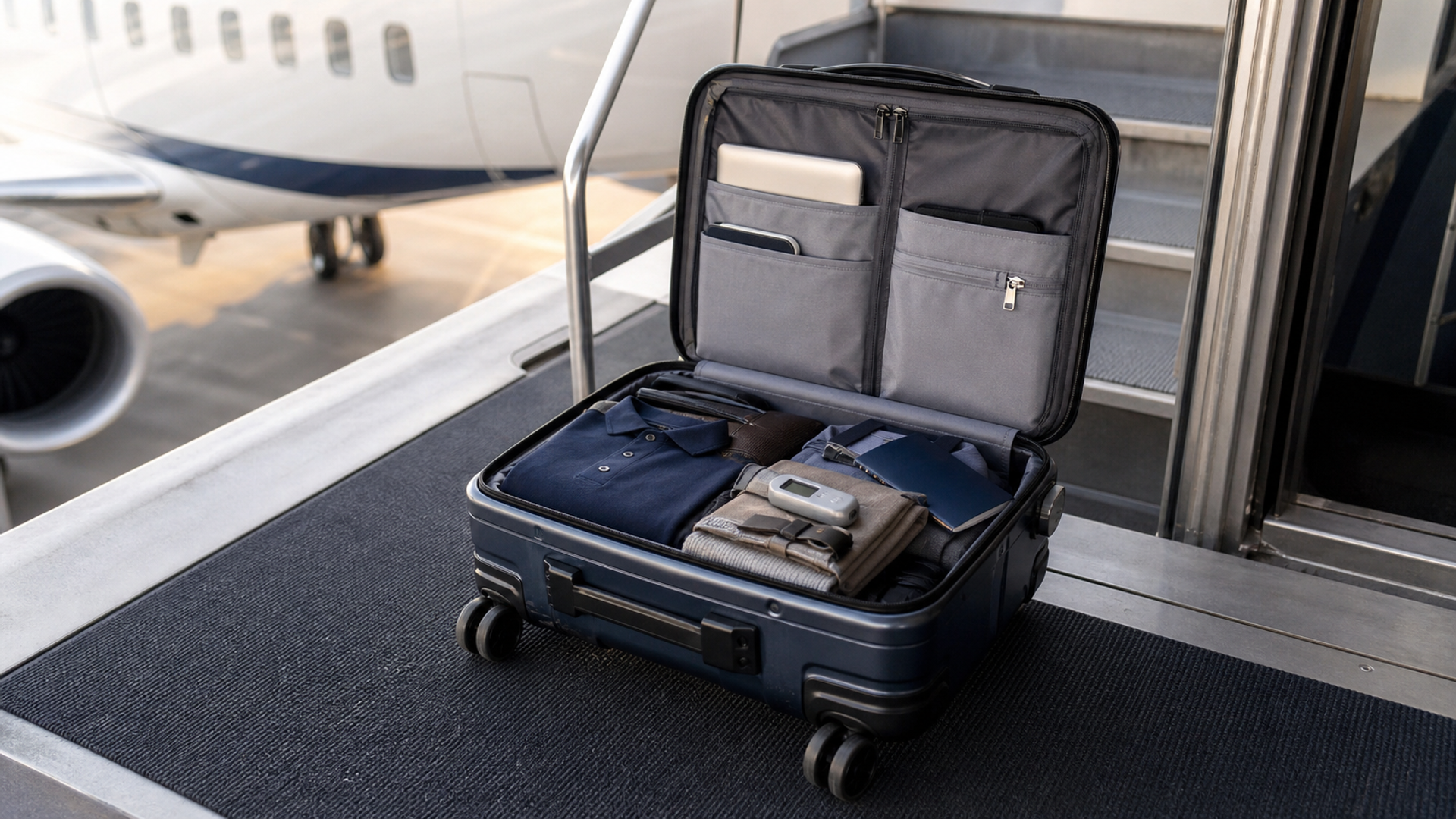
A luxury carry-on can look spacious in a showroom and still fail at the gate. Airlines enforce external dimensions, weight or both, while wheels, handles, dividers and hard-shell walls consume space before the traveller packs anything. The useful decision is therefore a balance between measured capacity, empty weight, repairability and the specific routes on which the case will be used.
Start with the route and the cabin
Choose a lightweight volume-first case when the airline permits the dimensions and packing volume is the constraint; a weight-first premium case when limits are strict and the load is dense; or a route-specific case when the traveller repeatedly flies with one airline or aircraft. Measure the case, weigh it with the intended packing system and verify current carrier rules before departure.
| Decision factor | Lightweight volume-first case | Weight-first premium case | Route-specific cabin case |
|---|---|---|---|
| Main constraint | External dimensions and usable volume lead | The empty case must leave weight headroom | One airline or route sets the rules |
| Packing style | Soft organisation uses every litre | Structured compartments prevent overpacking | A repeatable route kit is prepared |
| Airline variance | The case works across several limits | The strictest limit is used as the baseline | Carrier-specific size is acceptable |
| Movement | Light wheels and stable handle matter | Durability and repair matter more | Aircraft and terminal handling are known |
| Repair | Local wheel and handle service is important | Premium service justifies cost | Brand service follows the route |
| Ownership | Lower empty weight improves every trip | Materials and structure support long use | A dedicated case earns repeat use |
This best carry on luggage 2026 matrix is the article's working value object. Read the best carry on luggage 2026 rows together: the decisive failure mode depends on this topic's evidence, operating context and reader objective.
What airline and bag evidence can prove
Evidence 1. UK government hand-luggage guidance makes clear that airport security rules are separate from an airline’s cabin-bag allowance, so travellers should check both before relying on a universal size.
Evidence 2. A carry-on’s external dimensions include wheels, handles and protrusions in many airline measurements; the manufacturer’s nominal body size is not the complete gate measurement.
Evidence 3. Empty weight is a fixed cost on every trip: a heavier case leaves less allowance for clothing, work equipment and personal items when a carrier uses a weight limit.
Evidence 4. Repairability includes wheels, handles, zips, shells and authorised service access; a durable case still needs a realistic repair route if it is used frequently.
Reader-visible sources checked for this article:
gov.uk — reader-visible current or official evidence
aa.com — reader-visible current or official evidence
caa.co.uk — reader-visible current or official evidence
gov.uk — reader-visible current or official evidence
For best carry on luggage 2026, these sources establish only the claims inside their documented scope. Recheck every changeable specification, availability condition, price, policy or service term in the relevant market before acting.
Test weight, volume and repairability
A buyer can resolve main constraint without starting from a brand preference. Ask whether external dimensions and usable volume lead; compare that with whether the empty case must leave weight headroom; then use one airline or route sets the rules as the third route's safeguard. An unknown condition stays unknown.
On packing style, popularity is not enough. The evidence for option one is that soft organisation uses every litre. Option two means structured compartments prevent overpacking. Option three is rational where a repeatable route kit is prepared. Recheck any changeable term immediately before commitment.
The decision changes at airline variance. Choose the first path only if the case works across several limits; move to the second when the strictest limit is used as the baseline; use the third when carrier-specific size is acceptable. Save the downside that would make this row fail.
For movement, the first route works when light wheels and stable handle matter; the second requires durability and repair matter more. The control for the third is aircraft and terminal handling are known. Verify this row against the exact product, property, account or environment before it can reverse the decision.
The repair row exposes a practical boundary. Route one assumes local wheel and handle service is important, while route two is defensible only when premium service justifies cost. Route three depends on brand service follows the route. If that evidence is absent, keep the more reversible option.
Read ownership as a stop/go test: lower empty weight improves every trip supports the first option; materials and structure support long use supports the second; and a dedicated case earns repeat use supports the third. Record which source proves the condition and when it was checked.
Facts that would reverse the current choice
Reversal control 1 — Main constraint. Before choosing Lightweight volume-first case, write down how the decision changes if “External dimensions and usable volume lead” proves false. Do the same for Weight-first premium case and “The empty case must leave weight headroom”. Keep the Route-specific cabin case route available until “One airline or route sets the rules” is verified. This control belongs to best carry on luggage 2026; update it from the cited source or exact supplier rather than copying a generic checklist.
Reversal control 2 — Packing style. Before choosing Lightweight volume-first case, write down how the decision changes if “Soft organisation uses every litre” proves false. Do the same for Weight-first premium case and “Structured compartments prevent overpacking”. Keep the Route-specific cabin case route available until “A repeatable route kit is prepared” is verified. This control belongs to best carry on luggage 2026; update it from the cited source or exact supplier rather than copying a generic checklist.
Reversal control 3 — Airline variance. Before choosing Lightweight volume-first case, write down how the decision changes if “The case works across several limits” proves false. Do the same for Weight-first premium case and “The strictest limit is used as the baseline”. Keep the Route-specific cabin case route available until “Carrier-specific size is acceptable” is verified. This control belongs to best carry on luggage 2026; update it from the cited source or exact supplier rather than copying a generic checklist.
Reversal control 4 — Movement. Before choosing Lightweight volume-first case, write down how the decision changes if “Light wheels and stable handle matter” proves false. Do the same for Weight-first premium case and “Durability and repair matter more”. Keep the Route-specific cabin case route available until “Aircraft and terminal handling are known” is verified. This control belongs to best carry on luggage 2026; update it from the cited source or exact supplier rather than copying a generic checklist.
Reversal control 5 — Repair. Before choosing Lightweight volume-first case, write down how the decision changes if “Local wheel and handle service is important” proves false. Do the same for Weight-first premium case and “Premium service justifies cost”. Keep the Route-specific cabin case route available until “Brand service follows the route” is verified. This control belongs to best carry on luggage 2026; update it from the cited source or exact supplier rather than copying a generic checklist.
Reversal control 6 — Ownership. Before choosing Lightweight volume-first case, write down how the decision changes if “Lower empty weight improves every trip” proves false. Do the same for Weight-first premium case and “Materials and structure support long use”. Keep the Route-specific cabin case route available until “A dedicated case earns repeat use” is verified. This control belongs to best carry on luggage 2026; update it from the cited source or exact supplier rather than copying a generic checklist.
Measure the case as the airline sees it
Measure length, width and height with wheels, handles and pockets in their normal travel position. Weigh it empty, then weigh a representative trip load. Keep a record of the strictest carrier and aircraft you use. If the case expands, treat the expanded size as a separate configuration that may not meet the same rule.
Calculate usable volume rather than litres alone
Pack the exact items for a three-day business trip, including shoes, laptop, charger and outer layer. Note the space lost to wheels, frame, divider and curved corners. A case with a bigger published volume can be less useful if its interior is fragmented. Compression helps organisation but cannot make an airline’s external or weight limit disappear.
Match construction to service access
Check wheel replacement, handle repair, shell or fabric repair, zip service and warranty exclusions. Ask whether service is available in the markets where the case will travel. A premium case has a stronger ownership case when a damaged wheel can be repaired before the next trip rather than requiring a new purchase.
Build an airline-specific departure check
Before departure, open the carrier’s current cabin-bag page, confirm the operating airline and measure the packed case. If the route is strict, leave weight headroom for a purchase or documents. Keep a small packing scale for regular travel. A good case reduces uncertainty; it cannot override the carrier’s terms.
Three carry-on decisions
Frequent short business trips
A lightweight case with repeatable packing and enough laptop protection may deliver the best return. Define the fact that would reverse this recommendation before committing.
Dense equipment load
A durable structured case can make sense, but empty weight must be measured before the purchase is called premium. Define the fact that would reverse this recommendation before committing.
One airline and aircraft family
A route-specific case can be efficient when the carrier’s current rule and overhead-bin pattern are verified repeatedly. Define the fact that would reverse this recommendation before committing.
Action checklist
Measure wheels, handles and pockets.
Weigh the empty case.
Pack a representative three-day load.
Check the strictest carrier rule.
Record usable interior space.
Test wheels and handle stability.
Confirm repair and warranty access.
Keep weight headroom.
Recheck the operating airline.
Carry a small travel scale.
Continue the decision
The linked VERTU articles expand adjacent parts of the best carry on luggage 2026 decision. They do not substitute for the external evidence above.
The carry-on verdict
Choose a lightweight volume-first case when the airline permits the dimensions and packing volume is the constraint; a weight-first premium case when limits are strict and the load is dense; or a route-specific case when the traveller repeatedly flies with one airline or aircraft. Measure the case, weigh it with the intended packing system and verify current carrier rules before departure.
Keep the best carry on luggage 2026 decision reversible until its material cost, safety, access, privacy and compatibility facts are verified. Unknown evidence stays unknown; it is never silently scored as favourable.
![How to Scan Receipts and Documents with Your Phone [Full Guide]](https://cdn.sanity.io/images/e0gp1l2g/production/0db13feec1d5e72b8a8a5f976d1f3e86619c9228-3840x1860.webp?w=180&h=180&q=78&auto=format&fit=crop)
![How to Scan Receipts and Documents with Your Phone [Full Guide]](https://cdn.sanity.io/images/e0gp1l2g/production/0db13feec1d5e72b8a8a5f976d1f3e86619c9228-3840x1860.webp?w=800&h=450&q=82&auto=format&fit=crop)
![Top 10 Two-Tone Carbon-Fibre Watches for Men [2026 List]](https://cdn.sanity.io/images/e0gp1l2g/production/18870799ba33fab0e038968359cd5772d7d7db30-1024x576.webp?w=800&h=450&q=82&auto=format&fit=crop)
![Top 10 Luxury Watches with Digital Complication Displays for Men [Latest]](https://cdn.sanity.io/images/e0gp1l2g/production/c4f6bf8c080f291c39f7cc85c7344ecff2fd3799-1024x553.webp?w=800&h=450&q=82&auto=format&fit=crop)