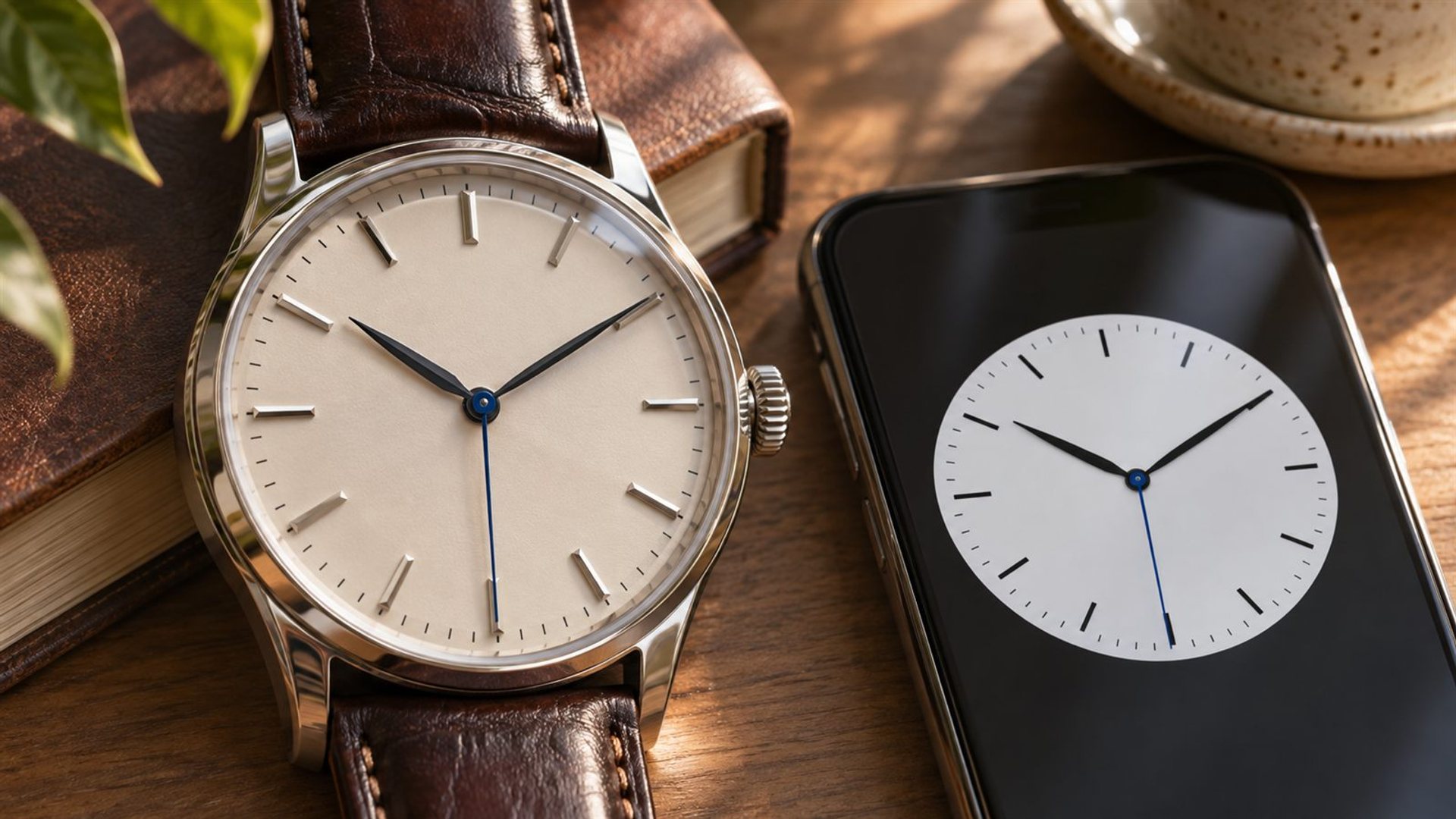
Watch accuracy can be assessed at home without a timegrapher by comparing the watch with one reliable reference clock at the same time over several days. Record the offset in seconds, then divide the change in offset by the number of elapsed days. This gives an observed daily rate for your wearing pattern. It does not replicate a watchmaker's multi-position test or diagnose every cause of poor timekeeping.
First identify the kind of watch. A mechanical movement can gain or lose time as its balance runs; a quartz or connected watch has a different timing system. The steps below focus on a simple owner log, followed by what to do when the result looks unusual.
What do you need for a home accuracy check?
You need a reliable time reference, a notebook or spreadsheet, and a way to read the seconds on the watch. Use the same reference throughout the test. A phone displaying time from its normal network connection can be convenient, but check that the phone itself is set to automatic time and the correct time zone. A dedicated official time service is another option where available. Avoid changing reference sources mid-test because small differences can obscure the watch's rate.
Choose one check time, such as 8 a.m., and keep it reasonably consistent. The watch should be fully wound or worn normally according to its movement type. Note whether it spent the night on the wrist or on a bedside table, because position can affect a mechanical movement. Do not adjust the hands in the middle of a measurement period unless you record exactly when you did so.
How do you record a useful baseline?
Set the watch carefully against the reference at the start, then write down the date, time and initial offset. If the watch is 5 seconds ahead, record +5; if it is 5 seconds behind, record -5. It is acceptable to start at a non-zero offset, provided you measure the change consistently. Take a photograph that shows both displays if that helps you review the reading later.
At each later check, record the offset without correcting the watch. For example, a watch starting at +5 seconds and reading +20 seconds after three days has gained 15 seconds over that interval, or an observed average of +5 seconds per day. This is a simple arithmetic result from your log, not a manufacturer specification. A single reading cannot show whether the rate is stable.
Repeat the check over several days of normal wear. A short test can reveal a large problem, but a longer consistent log gives a better picture of ordinary use. Keep the method identical so you can compare like with like. If you travel across time zones, record the change and avoid treating a one-hour setting difference as a movement fault.
Why measure rate instead of the total error?
Total error is how far the watch is from the reference at one moment. Rate is how quickly that error changes. A watch that is two minutes late because it was set carelessly may have an excellent daily rate; a watch that looks correct now may have been reset every morning. The two questions require different evidence.
Use the same sign convention throughout. If the offset moves from -10 seconds to -4 seconds in two days, the watch gained six seconds relative to the reference, an average of +3 seconds per day. If it moves from +10 to +4, it lost six seconds, or -3 seconds per day. Writing the calculation next to the readings makes the result easy to check.
What daily rate is acceptable?
Use the specification for the exact watch and movement, not a generic target. A certified chronometer has a defined test context, but that does not make its tolerance the warranty standard for every mechanical watch. COSC describes its traditional mechanical chronometer criterion as -4 to +6 seconds per day under its certification testing. That is a benchmark for qualifying movements, not a promise about an uncertified watch in every wearing condition.
Rolex describes a -2 to +2 seconds-per-day criterion for its own Superlative Chronometer finished-watch testing. That brand-specific standard should not be copied onto another maker's watch. Temperature, position, winding state and wear pattern can change an owner's observed rate. Consult the particular maker's service guidance before deciding that an adjustment is due.
Focus on a sudden change from your watch's established pattern. If a familiar watch begins gaining or losing far more than before, or stops intermittently, the change is more informative than comparison with an unrelated model. Note the date, any impact, recent service and whether it was exposed to a magnetic source. Do not attempt to open the case to investigate.
What can change a mechanical watch's rate?
A mechanical watch relies on a physical oscillator. Its observed rate can vary with position, state of wind, temperature and condition. A watch that rests dial-up overnight may behave differently from one worn on the wrist all day. That variation is one reason to log your normal routine rather than performing a single desk comparison and declaring a fault.
A strong impact, water ingress or magnetisation may cause a conspicuous change. These are possibilities, not diagnoses that a home log can prove. If the watch is running erratically after an event, consult the manufacturer or a qualified watchmaker. Do not rely on an improvised phone app to establish magnetisation unless the watchmaker confirms it with appropriate equipment.
Service history matters too. A newly serviced movement can be assessed against the service provider's stated standard, while an older watch may need inspection when its behaviour changes. Bring the log to the appointment. It offers the technician a useful description of the problem without pretending to replace instrument testing.
How is a smartwatch accuracy check different?
A connected watch normally displays digital time maintained by its electronic system and, often, synchronised through a paired phone. If its display shows the wrong time, first check time zone, automatic date and time settings, pairing and software state. Rebooting or re-pairing may be appropriate only under the device maker's instructions. A mechanical seconds-per-day log is usually not the first diagnostic tool for a synchronisation issue.
VERTU's Agent Watch launch information describes a connected watch whose voice workflow works with a paired phone's Agent. The VERTU knowledge base also identifies digital faces and connected features. This is not a claim that Agent Watch contains a mechanical movement or meets a chronometer standard. If its displayed time is wrong, check the watch and phone configuration and consult current support instructions.
The Agent Watch collection shows the available product family. A buyer who cares about timing should ask a different question for each category: mechanical rate for a traditional watch, time synchronisation and time-zone behaviour for a connected one. Combining the two into a single “accuracy” score conceals the actual problem.
When is professional assessment worthwhile?
Seek assessment when the watch stops unexpectedly, develops a large and repeatable change, shows moisture under the crystal or has suffered a significant impact. Also ask for help if the rate is outside the maker's stated tolerance after a careful normal-use log. A technician can test several positions, amplitude and beat error on a mechanical movement and inspect physical condition. The owner cannot infer those values from a clock comparison.
Before the appointment, keep a short record: reference source, start and end offsets, number of days, winding or wearing routine and any recent event. Avoid repeatedly resetting the hands just before service, because that erases the evidence of accumulated drift. If the watch is under warranty, follow the authorised service path and keep proof of purchase and prior work.
Home measurement is most valuable as a clear description of behaviour. It tells you whether a concern is repeatable and gives a service professional a starting point. It should not be used to adjust a movement at home or to declare a watch certified.
Frequently asked questions
Can I check a mechanical watch with my phone?
Yes, if the phone shows reliable automatic time and the correct time zone. Use the same reference throughout the test and record the watch's offset at consistent intervals. A phone comparison estimates real-world rate; it does not measure movement amplitude or beat error.
How many days should I track a watch?
Several days of normal wear are more informative than one reading. Record the same information each day and calculate the change in offset over the full interval. If the watch changes suddenly or stops, consult a service professional rather than waiting for a perfect log.
Does COSC's -4/+6 rule apply to every watch?
No. It is a certification criterion for qualifying mechanical movements under COSC's test method. Other watches and finished-watch programmes may have different specifications. Check the maker's terms for the exact model before using any published number as a service threshold.
What if my connected watch shows the wrong hour?
Check time zone and automatic time settings on the watch and paired phone first. A one-hour discrepancy often points to configuration or travel settings rather than oscillator drift. Follow the device maker's current pairing and support instructions if the display remains wrong.