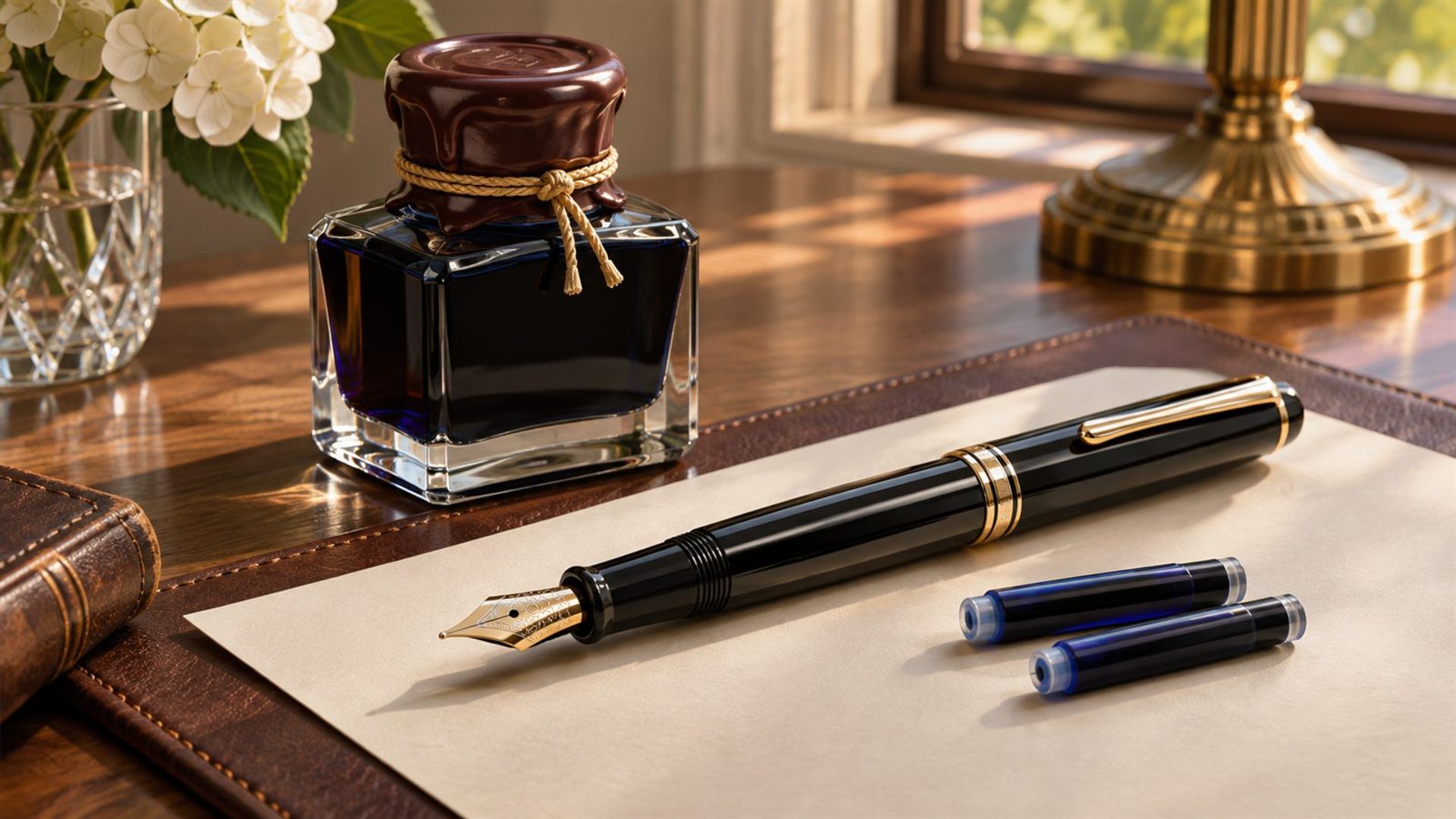
Fountain pen ink shelf life has no single answer that applies to every bottle and cartridge. Ink can become unsuitable through evaporation, contamination or changes in consistency, even when a printed date is absent. A sealed cartridge and a repeatedly opened bottle have different risks. Inspect the supply before filling a valued pen, and follow the ink maker's guidance for that specific formula.
Age alone is only one clue. Storage temperature, a loose cap, sunlight and contact with a dirty nib can matter more than the calendar. This guide explains what to check, how to store ink and when a fresh supply is the sensible choice.
Does fountain pen ink have an expiry date?
Some ink packages may include a date or batch code, but there is no dependable universal expiry interval for all fountain pen inks. Formulations, containers and conditions differ. Treat any manufacturer's printed instructions as the first authority; do not transfer a number from one brand or ink type to another. A bottle that appears normal may still write differently from when it was new, while a correctly stored older bottle may remain usable.
The important question is whether the ink has changed in a way that could impair flow or contaminate the pen. Check it visually and by smell before filling. If it shows unfamiliar floating growth, an unusual odour or pronounced thickening, do not put it in the pen. Replacing ink is generally easier than cleaning a feed clogged by a questionable liquid.
Do not apply the shelf-life expectations of printer ink, drawing ink or India ink to fountain pen ink. These products are designed for different delivery systems. Pelikan's writing FAQ specifically distinguishes its fountain pen inks from inkjet printer ink and warns against assuming compatibility.
Do sealed cartridges and bottled ink age differently?
Yes. A cartridge is sealed for convenience but can gradually lose water through its packaging over long storage. Pelikan says its cartridges may be stored for up to 12 months and explains that older ones can become partly empty as water evaporates. That is Pelikan's statement about its own cartridges, not a universal limit for every brand. A cartridge that has visibly shrunk or become unusually concentrated is a poor candidate for a prized pen.
A bottle is more exposed each time it is opened. The cap may not be closed fully, water can slowly evaporate, and a dipped nib or converter may introduce residue. A bottle also lets the owner see the ink more clearly before filling. Check the neck and underside of the cap for dried deposits. A little dried ink at the rim does not by itself prove the liquid inside is spoiled, but it signals that the seal and contents deserve closer attention.
What are the warning signs in old ink?
Start with the liquid's appearance under good light. Look for an unexpected film, fuzzy material, floating clusters or a new separation that does not match the manufacturer's description. Some specialised inks contain pigments or shimmer and are meant to be handled differently, so a visual change must be assessed in the context of the exact product. When you cannot distinguish intended particles from contamination, ask the ink maker rather than testing it in an expensive pen.
Compare the smell with what you remember of a fresh bottle of the same ink. An unusual or unpleasant odour can be another reason to discard it. Odour alone is not a laboratory test, and ink formulas have different inherent smells. The combination of changed smell, visible growth and altered flow is more meaningful than one ambiguous observation.
Finally, notice whether the ink has become unusually thick, stringy or reluctant to flow. Evaporation can alter concentration. A very weak-looking cartridge may have lost liquid. Do not add tap water to a suspect bottle in an attempt to restore it: dilution changes the formulation and introduces another contamination route. Ask the maker for product-specific advice if a bottle is valuable or unusual.
How should bottled ink be stored?
Keep the original bottle upright, tightly closed and away from strong light and heat. A stable indoor storage place is preferable to a sunny shelf, a hot car or a damp windowsill. Check that the cap is seated properly after every fill, and wipe residue from the rim with a clean material if the maker's instructions permit. Avoid transferring ink into an unlabelled decorative vessel; the original container preserves the product identity and may offer a better seal.
Use clean filling habits. Do not return surplus ink from a converter or syringe to the original bottle, where it may carry residue from the pen. If you routinely fill several pens, a small separate sample vial can reduce repeated contact with the main supply, but label it clearly and keep it clean. A vial does not extend the chemical life of an ink by itself.
Should you flush a pen before changing old ink?
Yes, when changing colour or returning a pen to service after a long idle period, clean it according to the pen maker's directions. Old residue in the feed can alter the appearance and flow of fresh ink. Montblanc's writing-instrument care guidance recommends removing ink and cleaning with water without additives when its fountain pen will not be used for an extended period; it also advises regular cleaning. That guidance is for Montblanc products, so check your own pen's instructions before disassembly or soaking.
If a pen is writing poorly after a new fill, the cause may be dried residue in the pen rather than defective fresh ink. Diagnose the two separately. First confirm the cartridge or bottle is compatible and sound, then follow the maker's cleaning procedure. Do not force tools into the nib or feed. A technician can assess a valuable pen if ordinary cleaning does not restore flow.
How does this apply to VERTU Marengo?
The VERTU product knowledge base describes the Marengo Fountain Pen as an instrument with a custom German SCHMIDT writing system and cartridge filling; the current official product page also lists a converter option. Neither specifies a universal ink expiry date or declares every third-party ink compatible. For an owner, the practical step is to identify the filling method and current care instructions supplied with the precise edition, then use fresh, compatible ink from a reliable source.
Marengo's sculptural design makes routine maintenance worth doing carefully, but the decorative exterior does not change ink chemistry. If a cartridge has been stored for years, inspect it for lost volume or leakage before installation. If the pen has stood unused with ink inside, follow the supplied care guidance or ask VERTU support how to clean it safely. Avoid opening or altering parts unrelated to the filling system.
Explore VERTU's guides for broader care advice. The shelf-life decision remains product-specific: the condition and compatibility of the actual ink take priority over a broad claim that old ink is always safe or always unusable.
When should old ink be discarded?
Discard it when the maker's stated limit has passed, when a cartridge has clearly evaporated or leaked, or when the bottle shows convincing signs of contamination or serious change. If there is doubt and the pen is valuable, replacing the ink is a proportionate precaution. Keep the cap on while disposing of a bottle and follow local waste instructions for the container and contents.
Do not judge solely by colour on paper. Lighting, paper and a pen's wetness can change the apparent shade. Conversely, a familiar shade does not prove the liquid is clean. Look at the entire chain: storage history, seal, visible contents, smell and writing behaviour. Record when a bottle was opened if you maintain a large collection; the note helps you identify older supplies without inventing a fixed date for them.
Frequently asked questions
Can I use a half-full old cartridge?
A half-full cartridge may have lost water in storage. Pelikan describes this pattern for its own cartridges. Check the instructions for your brand and avoid a visibly concentrated or leaking cartridge in a valuable pen. A fresh compatible cartridge is the safer simple choice.
Does dried ink around a bottle cap mean the ink is spoiled?
Not necessarily. Ink at the rim can dry after normal filling, but it warrants checking the cap seal and the liquid inside. Look for changes in smell, consistency or unexpected material before using it. Clean the rim according to the maker's guidance and close the cap firmly.
Can I add water to thick fountain pen ink?
Do not add water to a suspect original bottle without product-specific advice. It changes the formulation and can introduce contamination. If the ink has thickened markedly, replace it or contact the ink manufacturer for guidance rather than experimenting in a valued pen.
Should I leave ink in a pen during long storage?
Generally, clean the pen before extended storage according to its maker's instructions. Montblanc advises removing ink and cleaning its fountain pens with water without additives for a long idle period. Follow the instructions for your own model, especially if its filling system is unfamiliar.