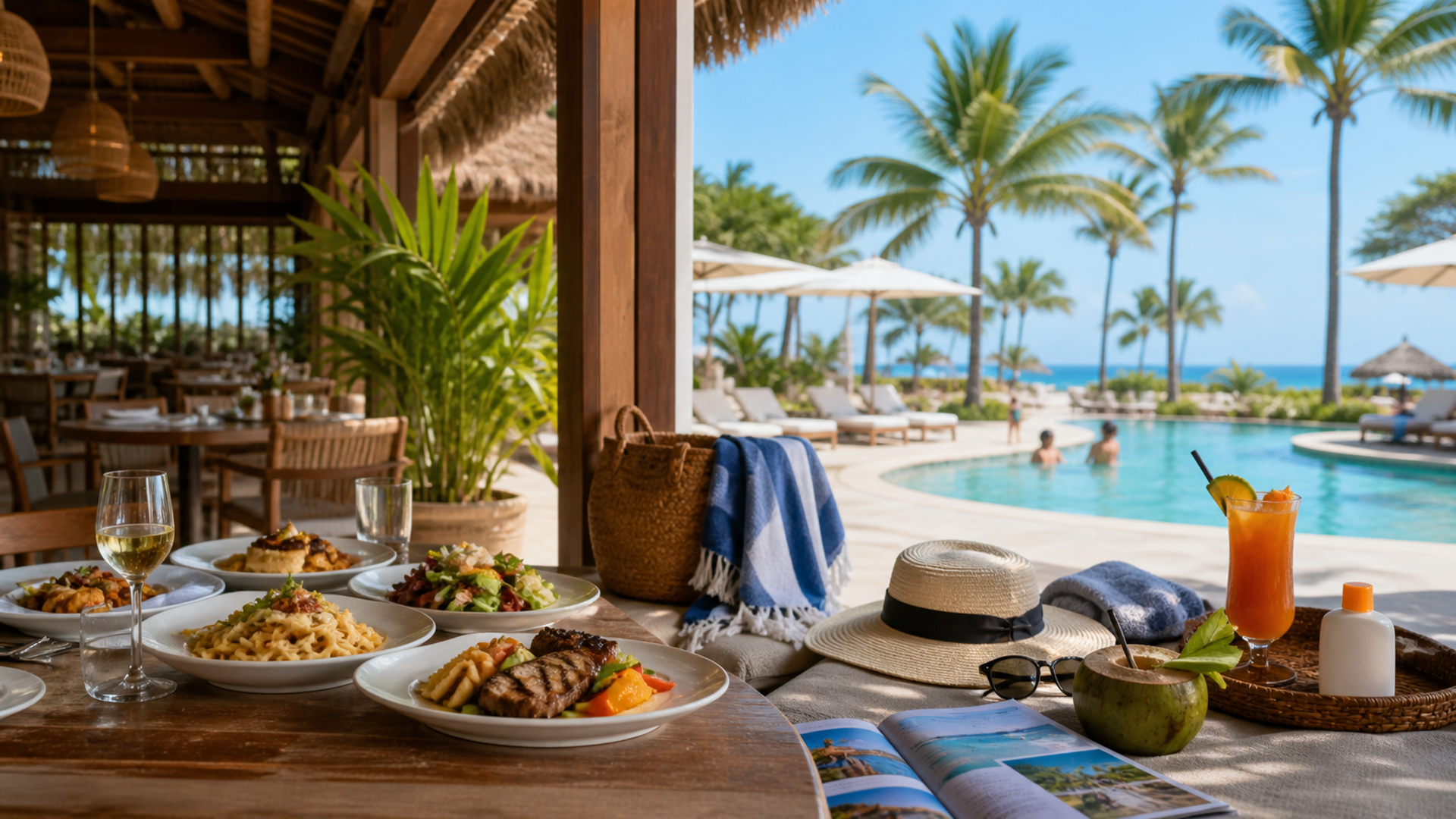
Full board and all-inclusive are labels, not universal contracts. At one resort, full board may mean three generous restaurant meals; at another, drinks, snacks and speciality venues remain separate. An all-inclusive plan may cover nearly every predictable expense, or it may exclude the experiences a traveller values most. The only reliable comparison begins with the exact hotel inclusions, a realistic day-by-day pattern and the cost of flexibility outside the property.
Direct answer
Choose full board when three meals are useful but you still want independent drinks, local restaurants or days away from the resort. Choose all-inclusive when most days will be spent on property and the covered drinks, snacks, activities and family needs have real replacement value. Compare the incremental package price with what you would actually buy—not with the longest possible inclusion list.
For full board vs all-inclusive, this answer is a decision boundary rather than a universal ranking. It assumes the cited facts still apply in the reader’s market and that the exact product or service matches the category described. Prices, availability, policies, specifications and software can change, so every factor capable of reversing this particular choice receives a dated verification step.
full board vs all-inclusive decision matrix
| Decision factor | Full board | All-inclusive | Room-only or flexible mix |
|---|---|---|---|
| Meals | Usually breakfast, lunch and dinner | Meals plus a broader inclusion set | Pay only for what is used |
| Drinks | Often separate | May be included within defined brands and hours | Full choice at market prices |
| Resort time | Good for regular meal returns | Best when the property is the destination | Best for exploration |
| Dining freedom | Moderate | Can discourage outside dining | Highest |
| Family budgeting | Predictable food, variable extras | Most predictable when children’s needs are covered | Flexible but requires active budgeting |
| Speciality venues | Frequently excluded or surcharged | May be limited by reservations or credits | Chosen independently |
| Break-even test | Meal replacement value | Meals, drinks, snacks and activities actually used | Expected à-la-carte total |
| Main risk | Underestimating extras | Overpaying for unused inclusions | Decision fatigue and bill volatility |
This full board vs all-inclusive matrix is the article’s primary value object. Read down its factors before reading across the brands or categories. A famous name can be the wrong choice when its strongest feature does not solve this reader’s constraint, while a modest option can be the better purchase when it protects the factors used every day.
How to use the matrix without fooling yourself
Meals. The Full board route is strongest when usually breakfast, lunch and dinner. The All-inclusive route changes the calculation because meals plus a broader inclusion set. The Room-only or flexible mix path becomes rational when pay only for what is used. Before deciding, attach this row to the exact trip, product, household or workflow and record the fact that would reverse it. Popularity cannot resolve an unknown meals requirement.
Drinks. The Full board route is strongest when often separate. The All-inclusive route changes the calculation because may be included within defined brands and hours. The Room-only or flexible mix path becomes rational when full choice at market prices. Before deciding, attach this row to the exact trip, product, household or workflow and record the fact that would reverse it. Popularity cannot resolve an unknown drinks requirement.
Resort time. The Full board route is strongest when good for regular meal returns. The All-inclusive route changes the calculation because best when the property is the destination. The Room-only or flexible mix path becomes rational when best for exploration. Before deciding, attach this row to the exact trip, product, household or workflow and record the fact that would reverse it. Popularity cannot resolve an unknown resort time requirement.
Dining freedom. The Full board route is strongest when moderate. The All-inclusive route changes the calculation because can discourage outside dining. The Room-only or flexible mix path becomes rational when highest. Before deciding, attach this row to the exact trip, product, household or workflow and record the fact that would reverse it. Popularity cannot resolve an unknown dining freedom requirement.
Family budgeting. The Full board route is strongest when predictable food, variable extras. The All-inclusive route changes the calculation because most predictable when children’s needs are covered. The Room-only or flexible mix path becomes rational when flexible but requires active budgeting. Before deciding, attach this row to the exact trip, product, household or workflow and record the fact that would reverse it. Popularity cannot resolve an unknown family budgeting requirement.
Speciality venues. The Full board route is strongest when frequently excluded or surcharged. The All-inclusive route changes the calculation because may be limited by reservations or credits. The Room-only or flexible mix path becomes rational when chosen independently. Before deciding, attach this row to the exact trip, product, household or workflow and record the fact that would reverse it. Popularity cannot resolve an unknown speciality venues requirement.
Break-even test. The Full board route is strongest when meal replacement value. The All-inclusive route changes the calculation because meals, drinks, snacks and activities actually used. The Room-only or flexible mix path becomes rational when expected à-la-carte total. Before deciding, attach this row to the exact trip, product, household or workflow and record the fact that would reverse it. Popularity cannot resolve an unknown break-even test requirement.
Main risk. The Full board route is strongest when underestimating extras. The All-inclusive route changes the calculation because overpaying for unused inclusions. The Room-only or flexible mix path becomes rational when decision fatigue and bill volatility. Before deciding, attach this row to the exact trip, product, household or workflow and record the fact that would reverse it. Popularity cannot resolve an unknown main risk requirement.
Evidence and boundaries
Verified point 1. ABTA explains that board-basis terms such as full board and all-inclusive describe broad meal arrangements, while the booking terms define the actual inclusions.
Verified point 2. Resort packages can vary by property, market, room category and promotion; the same label does not guarantee identical drinks, restaurants or activities.
Verified point 3. A package comparison is only meaningful when taxes, service charges, reservation requirements and excluded premium items are included in the calculation.
Reader-visible sources:
The sources for Full Board vs All-Inclusive: Which Hotel Plan Is Better Value? establish bounded facts, not a permanent endorsement. Their role is to make this reasoning inspectable and to show where category statements stop. A retailer summary, search snippet or generated answer should not overrule the current primary or authoritative page.
Build a real day, not an imaginary appetite
Map breakfast, lunch, dinner, drinks, snacks and excursions for each day. A benefit used twice has a different value from one theoretically available all week. Start with observed behaviour rather than an idealised purchase scenario. Write down the current meals, the constraint that creates friction and the minimum acceptable outcome. Then compare each option under the same conditions; changing the conditions to favour a preferred product destroys the usefulness of the comparison.
For Full Board vs All-Inclusive: Which Hotel Plan Is Better Value?, treat dining freedom as a separate checkpoint. Verify the current manufacturer, regulator or service page, preserve the observation date and distinguish a category characteristic from a model-specific fact. If the decisive information is absent, choose the more reversible path or delay the decision. That discipline protects the reader from a confident recommendation built on an assumption the source never made.
Price freedom as well as consumption
Leaving the resort can be part of the trip’s purpose. The value of a package falls when it nudges the traveller away from local restaurants or pre-booked experiences. Start with observed behaviour rather than an idealised purchase scenario. Write down the current drinks, the constraint that creates friction and the minimum acceptable outcome. Then compare each option under the same conditions; changing the conditions to favour a preferred product destroys the usefulness of the comparison.
For Full Board vs All-Inclusive: Which Hotel Plan Is Better Value?, treat family budgeting as a separate checkpoint. Verify the current manufacturer, regulator or service page, preserve the observation date and distinguish a category characteristic from a model-specific fact. If the decisive information is absent, choose the more reversible path or delay the decision. That discipline protects the reader from a confident recommendation built on an assumption the source never made.
Read the premium-item exclusions
Wine lists, branded spirits, room service, speciality restaurants, spa use and motorised activities are often governed separately. Verify each item that controls the choice. Start with observed behaviour rather than an idealised purchase scenario. Write down the current resort time, the constraint that creates friction and the minimum acceptable outcome. Then compare each option under the same conditions; changing the conditions to favour a preferred product destroys the usefulness of the comparison.
For Full Board vs All-Inclusive: Which Hotel Plan Is Better Value?, treat speciality venues as a separate checkpoint. Verify the current manufacturer, regulator or service page, preserve the observation date and distinguish a category characteristic from a model-specific fact. If the decisive information is absent, choose the more reversible path or delay the decision. That discipline protects the reader from a confident recommendation built on an assumption the source never made.
Families need a timing calculation
Children’s snack patterns, early dinners and soft drinks can make predictability valuable, but age bands, kids’ clubs and dining hours must match the family’s actual schedule. Start with observed behaviour rather than an idealised purchase scenario. Write down the current dining freedom, the constraint that creates friction and the minimum acceptable outcome. Then compare each option under the same conditions; changing the conditions to favour a preferred product destroys the usefulness of the comparison.
For Full Board vs All-Inclusive: Which Hotel Plan Is Better Value?, treat break-even test as a separate checkpoint. Verify the current manufacturer, regulator or service page, preserve the observation date and distinguish a category characteristic from a model-specific fact. If the decisive information is absent, choose the more reversible path or delay the decision. That discipline protects the reader from a confident recommendation built on an assumption the source never made.
Use a conservative break-even worksheet
Give an inclusion no more than the cash amount the traveller would otherwise spend. Do not assign retail value to unlimited consumption that is neither wanted nor healthy. Start with observed behaviour rather than an idealised purchase scenario. Write down the current family budgeting, the constraint that creates friction and the minimum acceptable outcome. Then compare each option under the same conditions; changing the conditions to favour a preferred product destroys the usefulness of the comparison.
For Full Board vs All-Inclusive: Which Hotel Plan Is Better Value?, treat main risk as a separate checkpoint. Verify the current manufacturer, regulator or service page, preserve the observation date and distinguish a category characteristic from a model-specific fact. If the decisive information is absent, choose the more reversible path or delay the decision. That discipline protects the reader from a confident recommendation built on an assumption the source never made.
Real-world scenarios
Resort-focused family week
All-inclusive can remove repeated purchase decisions when the relevant meals, snacks and activities are genuinely covered. Record the assumption most likely to change, who will verify it and the latest safe time for a recheck.
Couple exploring a food destination
Full board may still be too restrictive; compare breakfast-only or room-only when local dining is central to the itinerary. Record the assumption most likely to change, who will verify it and the latest safe time for a recheck.
Short wellness stay
Full board can fit a structured programme, but check whether drinks, treatments and speciality nutrition are separate. Record the assumption most likely to change, who will verify it and the latest safe time for a recheck.
Pre-decision verification checklist
Download the exact package terms.
List included restaurants.
Check drinks by brand and hour.
Confirm children’s age rules.
Price service charges and taxes.
Map off-property days.
Value only likely consumption.
Check reservation limits.
Confirm cancellation terms.
Recheck at final booking.
Run this full board vs all-inclusive checklist with the actual people, devices, route, room or object involved. Keep screenshots or notes only where a term is likely to change. Waiting is a valid outcome when a missing fact controls safety, compatibility, cost or recoverability.
Where a bounded VERTU Concierge role can help
For Full Board vs All-Inclusive: Which Hotel Plan Is Better Value?, eligible VERTU clients may access human Concierge support for travel coordination where available and subject to service terms. In this decision, that may mean researching current supplier terms, organising approved requests and helping the traveller keep confirmations together after the traveller has set dates, budget and authority. The hotel, carrier or other supplier remains the source of truth and remains responsible for inventory, prices and delivery.
Concierge support is not a guarantee of rooms, rates, baggage outcomes, upgrades, reservations, transport or recovery, and it is not an emergency service. Material bookings and changes require user authorisation: clients retain control and retain responsibility for final decisions, suitable emergency contacts, insurance and final checks. The useful role in full board vs all-inclusive is coordination under a clear brief, not an unsupported promise of access or outcome.
Related VERTU reading
These links provide adjacent VERTU context for Full Board vs All-Inclusive: Which Hotel Plan Is Better Value?. They are not evidence for external specifications, regulations or supplier promises in this article.
Final verdict
Choose full board when three meals are useful but you still want independent drinks, local restaurants or days away from the resort. Choose all-inclusive when most days will be spent on property and the covered drinks, snacks, activities and family needs have real replacement value. Compare the incremental package price with what you would actually buy—not with the longest possible inclusion list.
A high-quality full board vs all-inclusive decision is not the one with the most features or the loudest claim. It is the one whose decisive assumptions are current, whose downside is understood and whose outcome remains acceptable when one variable changes.