

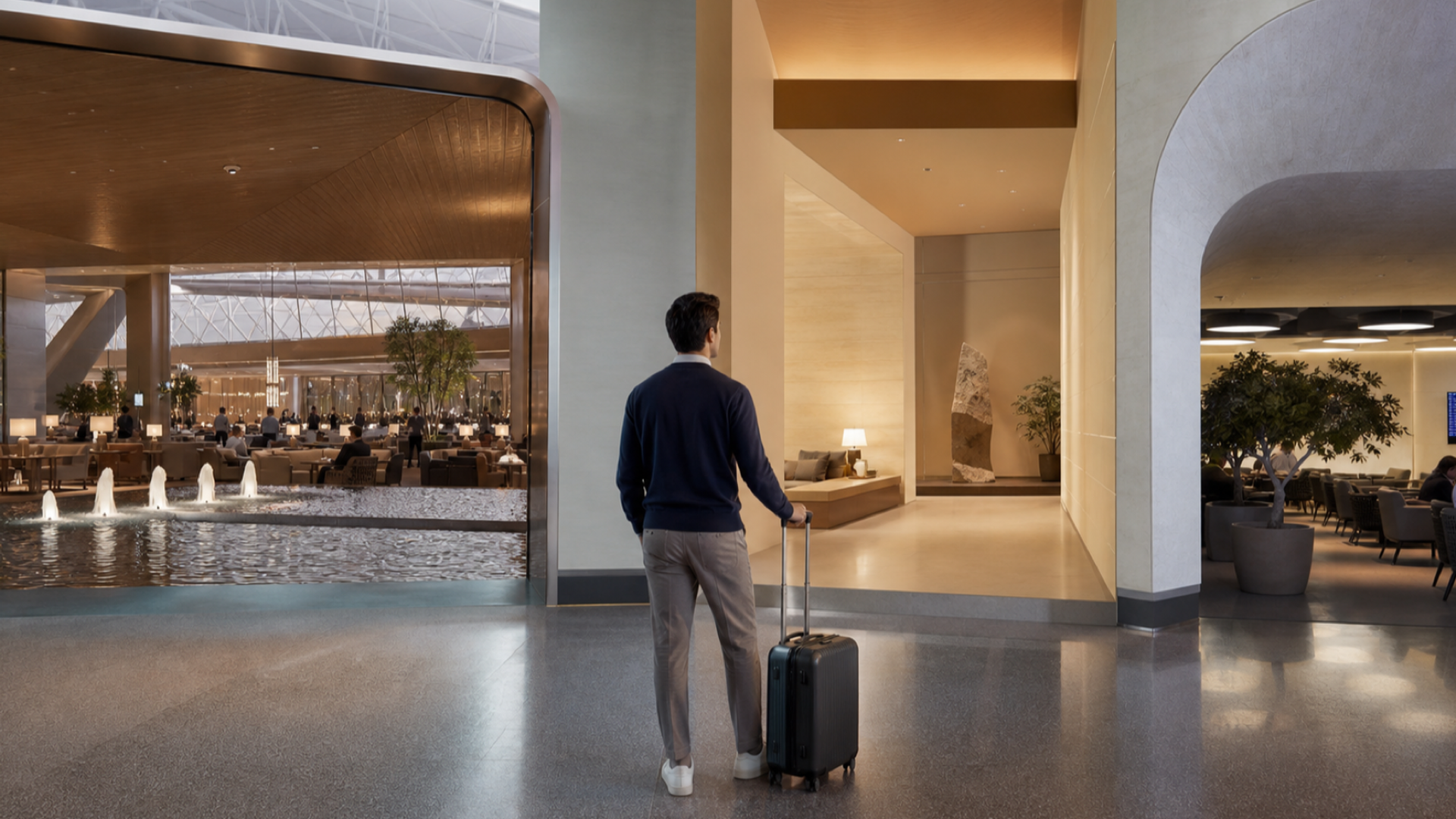
The expensive mistake in premium air travel is rarely choosing an obviously bad product. It is buying the right-sounding label for the wrong itinerary. The useful question is not which option looks most luxurious in a campaign image; it is which verified option improves sleep, time, privacy, recovery or control on the exact date being booked.
This guide compares Al Mourjan Business, Al Safwa First and Al Maha Transit using current official material and a live VERTU inventory check. Prices, aircraft, access, schedules and capacity can change. Treat the framework as a way to ask better questions, then confirm the exact booking before payment.
The short answer
Al Mourjan is the default premium choice for eligible Qatar and oneworld business travellers and can also be sold to some other passengers. Al Safwa is the First Class flagship and may be purchasable for eligible Qatar Business tickets. Al Maha is a simpler paid transit option. Ticket rules, concourse and connection length decide the result.
The decision should survive a late gate change, a different aircraft, a shorter connection or a revised arrival obligation. If it only works when every operational assumption is perfect, it is not a robust premium choice.
Decision matrix
| Decision factor | Al Mourjan Business | Al Safwa First | Al Maha Transit |
|---|---|---|---|
| Core audience | Eligible Business/oneworld premium travellers | Eligible First and selected paid Business access | Pay-per-use transit travellers |
| Strength | Dining, work and broad premium facilities | Highest privacy and First-led environment | Simpler paid rest during a connection |
| Main trap | Business Lite or wrong entitlement assumption | Assuming Business always enters free | Comparing it as if it were the flagship lounge |
| Verify | Fare family, operating carrier and concourse | Cabin, paid eligibility and price | Current rate, duration and capacity |
Use the matrix on one itinerary and one travel date. Comparing different dates, fares or passenger combinations can make the more expensive option appear better for reasons unrelated to the product itself.
What the official material confirms
Qatar Airways identifies Al Safwa as its First Class lounge and Al Mourjan as its Business Class lounge family at Hamad International Airport. Its current access material distinguishes complimentary entry by fare family and cabin from paid entry, and lists paid six-hour access for several lounges. Al Maha is a transit lounge product rather than a substitute for every flagship entitlement.
The primary evidence used for this guide is reader-visible:
Official pages describe intended products and rules. They do not guarantee day-of-travel capacity, an unchanged aircraft or discretionary admission. The live booking, boarding pass and airport team remain the final operational sources.
Fare family can matter as much as cabin
A ticket labelled Business does not automatically produce identical Doha lounge rights. Qatar Airways publishes distinctions between fare families, while oneworld access also depends on the marketing and operating carrier. A traveller should retain the fare family and lounge wording shown at purchase. If the itinerary contains a codeshare, the operating carrier and through-journey rules deserve a separate check.
Al Mourjan South or The Garden
Al Mourjan is now a family of spaces rather than one universal room. South is positioned near the main terminal's southern concourses, while The Garden serves the northern side and creates a different walking pattern. The correct choice is often the one closest to the onward gate after allowing for boarding. Travellers should not cross the airport for a marginal preference when the connection is short or the gate is remote.
When Al Safwa is rational
Al Safwa is designed around a First Class experience, with more privacy and a quieter sense of space. Paying for access can be rational during a long premium connection when rest and controlled surroundings have real value. It is less rational when the stay will be brief or when Al Mourjan already meets the traveller's needs. Confirm eligibility and the current paid-access price before treating it as an available upgrade.
Where Al Maha fits
Al Maha Transit Lounge is useful when the traveller has no premium-cabin entitlement and wants a defined airside rest product. It should be judged on access price, capacity, shower availability, food and distance to the gate. It is not a discounted Al Safwa, and comparing only the entry fee would misstate the proposition. For a very short layover, free terminal seating near the gate may still win.
Connection length changes value
Under two usable hours, walking and boarding time compress the experience sharply. Between two and five hours, a meal, shower and focused rest can justify a lounge. On an overnight connection, sleep quality and the possibility of a proper hotel or sleep pod should enter the comparison. The published lounge access duration is a ceiling, not proof that every minute can be used.
Build a disruption-safe plan
Doha operations can change gates and connection times, so the plan should survive a late inbound flight. Keep medication, chargers and sleep essentials in hand luggage. Save the paid-access terms and avoid making a non-refundable lounge purchase before an uncertain flight when the product does not protect against delay. A premium connection is successful when the traveller reaches the onward gate rested and without rushing.
Match the choice to the traveller
| Traveller or trip | Practical recommendation |
|---|---|
| Qatar Business Comfort passenger | Confirm included Al Mourjan access and select South or The Garden by gate. |
| Qatar Business Lite passenger | Price paid Al Mourjan access against Al Maha and the actual connection duration. |
| Qatar First passenger | Use Al Safwa unless gate geography or an extremely short connection makes that impractical. |
| Economy traveller overnight | Compare Al Maha with a sleep product; a lounge chair is not always sufficient recovery. |
The same traveller may choose differently on the outbound and return. An overnight sector before a meeting puts a higher value on sleep and certainty; a daytime return can favour schedule and price. Couples, families and solo passengers should also use different seat, lounge and hotel criteria rather than copying a single ranking.
A value test before paying
Start with the incremental cost over the best acceptable alternative. Divide it by the hours in which the additional benefit can actually be used, then add only consequences that matter: protected sleep, a shower, a safer connection, reduced recovery time, useful baggage or genuine flexibility. Remove duplicate benefits already supplied by status, a credit card, a fare bundle or another part of the itinerary.
Set three price zones before shopping. In the automatic zone, the verified benefit is worth taking because the premium is small. In the conditional zone, proceed only if the exact product, location and timing are confirmed. In the decline zone, keep the lower option unless the journey has unusually high stakes. Pre-set zones stop scarcity messages, auction sliders and polished photography from moving the budget.
Points and miles need the same discipline. Convert them at a conservative personal value, add fees and compare the result with the best cash alternative. A low number of points can still be expensive if it consumes a balance that would fund a more valuable future trip.
Booking-day verification checklist
Confirm the marketing carrier, operating carrier, flight number, date and terminal.
Save the aircraft, seat map, lounge, hotel or programme page shown for the exact itinerary.
Read fare conditions, cancellation rules, guest policies and any capacity language.
Verify the feature that drives the purchase rather than assuming it from the product name.
Price every traveller, including guest fees, children, transfers, meals, taxes and add-ons.
Calculate usable time after security, immigration, baggage, terminal movement and boarding buffers.
Recheck before the free-change deadline, at online check-in and after any schedule notification.
Keep medicine, chargers, documents and overnight essentials in hand luggage.
Save a fallback option that still works after a late arrival, gate change or aircraft substitution.
Do not make a non-refundable purchase when the key operational dependency remains unconfirmed.
This checklist cannot remove disruption. It reduces the chance that the traveller pays for a benefit the booking never promised and makes later support conversations easier because the evidence and conditions are documented.
A simple decision worksheet
Write down five answers before purchase: the single problem being solved, the verified feature that solves it, the usable time, the maximum acceptable premium and the fallback. If the first two answers are vague, the premium is probably being justified by branding rather than outcome. If usable time is short, location and certainty deserve more weight. If the fallback is unacceptable, buy flexibility or a confirmed alternative instead of hoping.
Then stress-test the choice. Move the gate farther away, shorten the connection by forty-five minutes, substitute the aircraft or remove one advertised amenity. A strong choice remains sensible. A weak choice collapses because its value depended on one fragile detail.
Where VERTU Concierge may fit
Eligible VERTU clients may ask human Concierge support to help coordinate a complex itinerary, lounge plan, stopover or authorised booking step where available and subject to service terms. That support can organise options and timing, but it is not a guarantee of inventory, admission, visa approval, upgrades, schedules or supplier performance. Clients retain control of material choices and changes, while airlines, airports, hotels, immigration authorities and other suppliers retain operational responsibility.
Related VERTU guides
These links provide adjacent decision frameworks, not substitute evidence for the current itinerary. Use them to compare the broader premium-travel trade-off, then return to the official source for the flight, airport or programme being booked.
Verdict
Al Mourjan is the default premium choice for eligible Qatar and oneworld business travellers and can also be sold to some other passengers. Al Safwa is the First Class flagship and may be purchasable for eligible Qatar Business tickets. Al Maha is a simpler paid transit option. Ticket rules, concourse and connection length decide the result.
Buy the verified outcome, not the category label. The most premium decision is often the one that protects time and arrival condition with the least operational fragility.
![How to Scan Receipts and Documents with Your Phone [Full Guide]](https://cdn.sanity.io/images/e0gp1l2g/production/0db13feec1d5e72b8a8a5f976d1f3e86619c9228-3840x1860.webp?w=180&h=180&q=78&auto=format&fit=crop)
![How to Scan Receipts and Documents with Your Phone [Full Guide]](https://cdn.sanity.io/images/e0gp1l2g/production/0db13feec1d5e72b8a8a5f976d1f3e86619c9228-3840x1860.webp?w=800&h=450&q=82&auto=format&fit=crop)
![Top 10 Two-Tone Carbon-Fibre Watches for Men [2026 List]](https://cdn.sanity.io/images/e0gp1l2g/production/18870799ba33fab0e038968359cd5772d7d7db30-1024x576.webp?w=800&h=450&q=82&auto=format&fit=crop)
![Top 10 Luxury Watches with Digital Complication Displays for Men [Latest]](https://cdn.sanity.io/images/e0gp1l2g/production/c4f6bf8c080f291c39f7cc85c7344ecff2fd3799-1024x553.webp?w=800&h=450&q=82&auto=format&fit=crop)