Quick Answer:
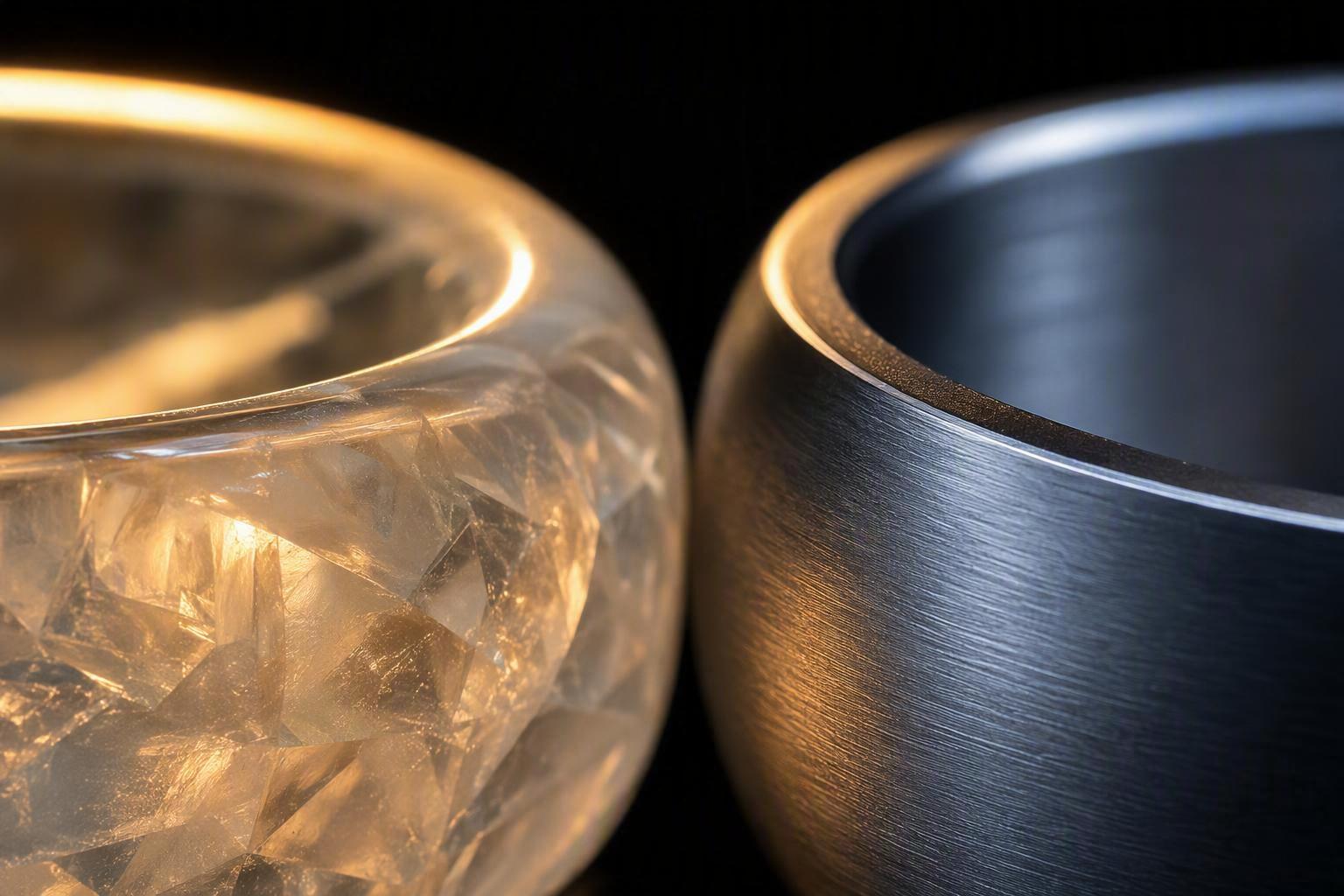
Choosing between smart ring materials is not about deciding which is "harder"—it is about choosing a failure mode. Titanium is ductile: it absorbs heavy blunt impacts without cracking, but naturally accumulates fine surface scuffs from ambient quartz dust (Mohs 7). Translucent crystal composite (engineered optical glass and resin) is harder than titanium: it resists daily micro-scratches indefinitely, but possesses a brittle threshold that can chip or crack under concentrated, sharp point-load impacts.
Most smart ring comparisons rank materials along a single hardness scale and declare an arbitrary winner. That approach asks the wrong question and inevitably produces the wrong answer.
The right question is: What does the surface look like after three years of your daily routine?
Materials fail differently under mechanical stress. Titanium absorbs force by deflecting and scuffing; crystal composite maintains an immaculate, mirror-smooth surface against friction until an extreme impact chips it. Within the VERTU Ring Collection, this engineering decision defines two distinct wearable experiences: the handcrafted, translucent crystal composite of the VERTU AI Aura Ring (formerly Meta Ring) and the featherweight build of its titanium counterpart.
The Decision at a Glance: Material Specifications
Criterion | Translucent Crystal Composite (VERTU AI Aura Ring) | Grade 5 / Medical Titanium | Real-World Engineering Trade-off |
Material Base | Optical crystal glass & hypoallergenic resin | Medical-grade Ti-6Al-4V alloy | High-hardness composite vs. ductile metal |
Surface Hardness | ~Mohs 6.5 – 7.0 | Mohs 6.0 – 6.5 | Composite resists fine abrasive friction better |
Primary Failure Mode | Brittle: Chips under sharp point impacts | Ductile: Dents/scuffs without fracturing | Sudden localized chip vs. gradual cosmetic wear |
Skin-Contact Layer | Non-porous, chemically inert resin matrix | Passivated natural titanium dioxide (TiO2) film | Both meet hypoallergenic standards |
Weight | From 5.7 g | From 2.3 g | Substantial jewelry presence vs. featherweight wear |
Battery Endurance | Up to 10 days | 5 to 7 days | Composite chassis accommodates a larger battery |
Water Resistance | 5 ATM (50 meters) | 5 ATM (50 meters) | Tie (Equal sealed water protection) |
Subscription Fee | None ($0/month) | None ($0/month) | Complete lifetime access to hardware & analytics |
1. Scratch Resistance: Why Mohs Hardness is Often Misunderstood
A common misconception in smart jewelry discussions is confusing bulk strength with everyday scratch resistance.
Mohs hardness measures the ability of one mineral to scratch another through shear friction.
Vickers hardness (HV) measures resistance to localized surface indentation under pressure.
Neither benchmark tells the full story alone, because ambient city air is filled with microscopic abrasives.
Titanium Alloy (Mohs 6.0 – 6.5) < Crystal Composite (Mohs 6.5 – 7.0) < Quartz Dust & Urban Grit (Mohs 7.0) < Sapphire Crystal (Mohs 9.0)
Medical-grade titanium alloy sits between Mohs 6.0 and 6.5. While mechanically tough, it is softer than ordinary quartz dust—the primary component of sand, soil, concrete particles, and ambient building grit—which registers at Mohs 7.0. When an uncoated titanium ring develops fine hairline swirls after gym workouts or desk friction, the metal has not failed; it has simply encountered a harder ambient mineral.
By contrast, the translucent crystal composite developed for the VERTU AI Aura Ring fuses crystal glass with high-density resin through a dedicated 20-step artisanal manufacturing process. This raises exterior surface hardness toward Mohs 7.0. Keys, loose coins, desk edges, and metal zippers glide across the composite without leaving dull friction trails.
The Trade-off: Crystal composite wins the gradual battle against everyday micro-abrasion; titanium survives the sudden, heavy accident.
2. Biocompatibility: What Actually Contacts Your Finger?
Because a smart ring stays in continuous contact with your finger day and night, biocompatibility is governed by surface chemistry rather than marketing terms.
The Titanium Passivation Mechanism
Titanium forms a spontaneous, adherent titanium dioxide (TiO2) oxide layer when exposed to air. This self-healing boundary prevents metal ions from leaching into perspiration. It is the primary reason leading clinical authorities, including the Mayo Clinic and the American Academy of Dermatology, advise individuals with severe nickel allergies to choose medical-grade titanium over common alloys.
The Crystal Composite Barrier
The crystal glass and resin matrix of the VERTU AI Aura Ring approaches skin tolerance through total chemical stability. Because the cured resin is dense and non-porous:
It will not absorb body oils, sweat, or cosmetic residue.
It releases no reactive chemical compounds or ions into the skin.
It eliminates the abrupt cold-shock sensation typical of bare metal bands in winter conditions.
3. Weight, Form Factor, and Continuous Vitality Tracking
A wellness ring only provides actionable health data if you keep it on your hand overnight. When a ring feels intrusive in bed, sleep monitoring suffers.
The Titanium Advantage (Ultralight Profile): Weighing from just 2.3 grams with an ultra-slim 2 mm profile, a titanium ring is easy to forget you are wearing. For light sleepers or individuals who wear tight gloves during sports, minimal mass reduces finger fatigue.
The Crystal Composite Advantage (Extended Battery Autonomy): The VERTU AI Aura Ring begins at 5.7 grams. That slight increase in mass allows space for an expanded battery cell providing up to 10 days of continuous operation between charges.
Equipped with Bluetooth 5.0 (BLE 5.0) and an integrated nano-sensor core, the AI Aura Ring streams health tracking data directly into the Metaself App:
Sleep Monitoring: Decodes full sleep cycles across deep sleep, light sleep, and REM phases.
Real-Time Heart Rate: Continuously measures cardiovascular rhythm during rest and physical activity.
Real-Time Body Tension: Monitors physical tension indicators and vitality trends throughout demanding days.
Activity & Vitality: Tracks daily step count and estimated VO2 Max levels.
AI Personalization: Delivers tailored vitality readings combining Da Vinci Human Design, astrology, and traditional BaZi frameworks.
4. Practical Maintenance: Preserving Surface and Sensors
Surface degradation is rarely caused by sweat chemistry alone. It is usually caused by fine particulate grit trapped between the skin and the inner ring wall acting like sandpaper. Follow these practical care habits:
Rinse After Saltwater and Pools: Both materials feature a 5 ATM water resistance rating. Always rinse your ring with fresh water after swimming in the ocean or chlorinated pools to prevent salt crystal deposits from clouding the sensor windows.
Remove Before Heavy Gripping: Take off your ring before heavy barbell lifting, rock climbing, or operating heavy steel tools. This protects ductile titanium from crushing deformation and protects crystal composite edges from severe point impact.
Clean the Sensor Array: Wipe the inner circumference weekly using a microfiber cloth and warm, mild soapy water. Keeping the nano-sensor window free of skin oils maintains proper optical transmission.
5. Decision Framework: Which Material Fits Your Lifestyle?
Choose the Translucent Crystal Composite (VERTU Aura Ring) if:
You prioritize lasting visual clarity and want an immaculate, jewel-like finish free of hairline scuffs from keyboards, car doors, and daily office tasks.
You demand class-leading battery autonomy (up to 10 days) to avoid frequent charging interruptions.
You appreciate artisanal transparency that showcases internal nano-sensing architecture.
Choose Titanium if:
Your daily activities involve manual labor, free-weight training, or hard outdoor gear where sudden heavy impacts occur.
You demand the lightest possible ring (from 2.3 grams) that becomes virtually imperceptible during sleep.
You prefer a classic brushed metal or dark stealth finish that pairs naturally with traditional luxury watches.
Conclusion: Which Material Belongs on Your Hand?
The choice between titanium and crystal composite is not about which material is universally stronger—it is about matching material physics to your daily routine:
Choose Titanium if your lifestyle involves heavy physical strain, gym weights, or outdoor gear where blunt impact resistance and featherweight comfort are essential.
Choose Crystal Composite if you prioritize a lasting, scratch-free jewelry aesthetic against daily desk and pocket friction, paired with an extended 10-day battery life and non-porous skin comfort.
Put simply: titanium survives the sudden accident; crystal composite wins the slow war against daily abrasion.
Ready to elevate your daily vitality? Discover the craftsmanship of the VERTU AI Aura Ring, or explore all styles and finishes in the official VERTU Aura Ring Collection.
Frequently Asked Questions
Is a crystal composite smart ring as durable as titanium?
Durability depends on the physical challenge. Crystal composite is more durable against everyday micro-scratches caused by dust and keys because of its higher surface hardness. Titanium is more durable against heavy blunt drops and crushing forces because metal bends and dents rather than cracking.
What is the benefit of the VERTU AI Aura Ring's 20-step craftsmanship?
The 20-step artisanal manufacturing process bonds optical crystal glass with high-density resin into a single non-porous structure. This provides certified 5 ATM water resistance, protects the internal nano-sensors from moisture, and produces a lustrous, scratch-resistant jewelry finish.
Does the VERTU AI Aura Ring require an ongoing monthly subscription?
No. The VERTU AI Aura Ring operates on a 100% subscription-free model. All wellness monitoring features—including sleep cycle tracking, real-time heart rate, body tension metrics, and personalized AI readings within the Metaself App—are available without recurring membership costs.
Which material is better for sensitive skin or metal allergies?
Both materials are exceptionally safe. The VERTU AI Aura Ring uses a non-leaching, non-porous resin composite that is completely hypoallergenic. Grade 5 titanium forms an inert, natural oxide layer that prevents metallic ion transfer, making it a gold standard among dermatologists.