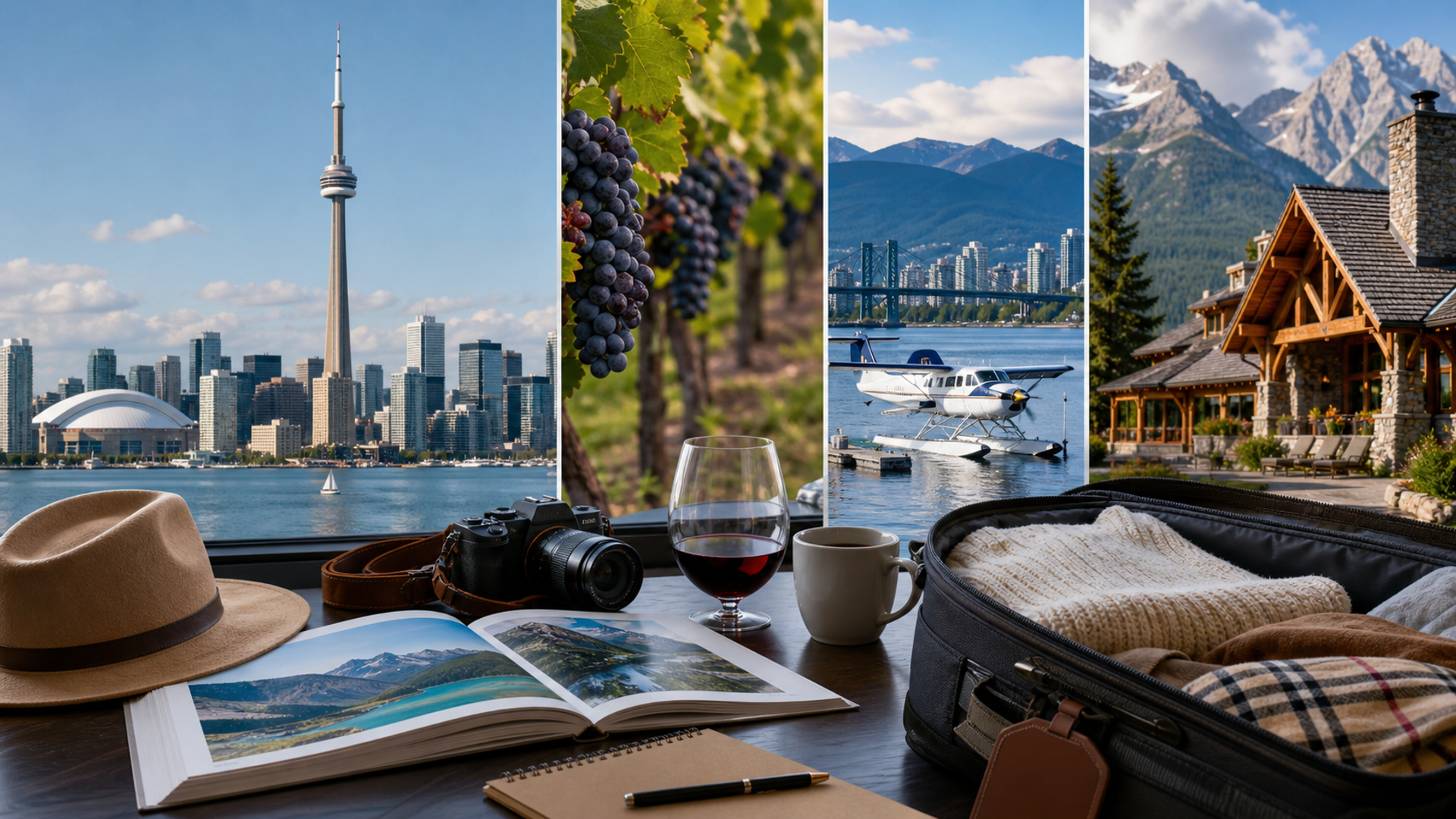
Canada is a continent-sized travel decision disguised as one destination. A ten-day trip can be a polished city-and-wine itinerary, a mountain lodge sequence, a Pacific coast journey or a northern expedition; attempting to combine all four usually converts luxury into transit. Current official tourism planning is leaning into Canada's 2026 visibility, while search interest for Canada tourism has begun to rise. The opportunity is real, but the route must be built around time and season rather than a list of icons.
Current demand and source evidence makes canada tourism 2026 worth examining now, but timing does not excuse weak claims. Current retailer, destination, manufacturer or platform material is identified below, while recommendations remain conditional on the reader's exact market, dates and requirements.
The short answer for canada tourism 2026
For a first high-comfort visit, choose one gateway city and one contrasting landscape for seven to ten nights. Toronto plus Niagara, Vancouver plus the coast, Montréal plus rural Québec, Calgary plus the Rockies, or a carefully timed northern journey all work when transfers are treated as part of the itinerary. Add a third region only when the trip is at least two weeks and private transfers materially reduce friction.
For canada tourism 2026, the decision should survive three checks: the underlying fact is current, the option fits this exact use case, and the downside remains acceptable if a supplier or product detail changes. The E02 headline cannot replace any of those checks.
The E02 comparison matrix
| Decision factor | City plus nearby region | Single landscape immersion | Multi-region grand tour |
|---|---|---|---|
| Ideal length | Seven to ten nights | Five to eight nights | Fourteen nights or more |
| Transfer burden | One gateway and one short extension | Low after arrival | High without flights and recovery time |
| Weather resilience | Strong indoor alternatives | Depends on the landscape | Several climate zones add uncertainty |
| Service continuity | Hotel-led and easier to coordinate | Lodge or operator-led | Multiple suppliers and hand-offs |
| Best for | First visits and mixed interests | A clear wildlife, ski, food or wellness goal | Experienced Canada travellers |
| Packing complexity | Moderate | Purpose-specific | Highest across cities and wilderness |
| Budget control | Easiest to forecast | Predictable once the lodge is chosen | Air and transfer costs can dominate |
| Failure mode | Over-scheduling the city | Choosing the wrong season | Losing days to movement |
This E02 table is deliberately shaped around the canada tourism 2026 decision. It prevents one large price, famous name or current launch from dominating the factors that determine this article's real outcome.
What the primary evidence currently confirms
Verified point 1. Destination Canada's official 2026 outlook describes the year as a moment of elevated global visibility and frames tourism growth as a long-term national opportunity.
Verified point 2. Destination Toronto's official luxury itinerary identifies Yorkville and Yorkdale for high-end shopping and highlights private, culinary and Niagara extensions as examples of premium planning.
Reader-visible evidence used for those points:
destinationcanada.com official or current source —
https://www.destinationcanada.com/en-ca/news/canadas-global-moment-sets-tourism-sector-course-banner-2026-growth-2035destinationtoronto.com official or current source —
https://www.destinationtoronto.com/travel-trade/tools-resources/itineraries/luxury/
The E02 observation is bounded to the linked pages and this publication run. The changeable facts behind canada tourism 2026—including relevant prices, inventory, dates, descriptions, specifications, staffing or service terms—must be checked on the exact live page before action.
Reading every row without false precision
Ideal length: the E02-1 decision
For City plus nearby region, the evidence to test is whether seven to ten nights. The Single landscape immersion route instead means five to eight nights. With Multi-region grand tour, the practical control is that fourteen nights or more. This ideal length row should be resolved with the exact product, room, route or service in front of the reader; it is not a generic popularity vote. If the evidence is still incomplete, preserve the least irreversible option and set a date to recheck it.
Transfer burden: the E02-2 decision
For City plus nearby region, the evidence to test is whether one gateway and one short extension. The Single landscape immersion route instead means low after arrival. With Multi-region grand tour, the practical control is that high without flights and recovery time. This transfer burden row should be resolved with the exact product, room, route or service in front of the reader; it is not a generic popularity vote. If the evidence is still incomplete, preserve the least irreversible option and set a date to recheck it.
Weather resilience: the E02-3 decision
For City plus nearby region, the evidence to test is whether strong indoor alternatives. The Single landscape immersion route instead means depends on the landscape. With Multi-region grand tour, the practical control is that several climate zones add uncertainty. This weather resilience row should be resolved with the exact product, room, route or service in front of the reader; it is not a generic popularity vote. If the evidence is still incomplete, preserve the least irreversible option and set a date to recheck it.
Service continuity: the E02-4 decision
For City plus nearby region, the evidence to test is whether hotel-led and easier to coordinate. The Single landscape immersion route instead means lodge or operator-led. With Multi-region grand tour, the practical control is that multiple suppliers and hand-offs. This service continuity row should be resolved with the exact product, room, route or service in front of the reader; it is not a generic popularity vote. If the evidence is still incomplete, preserve the least irreversible option and set a date to recheck it.
Best for: the E02-5 decision
For City plus nearby region, the evidence to test is whether first visits and mixed interests. The Single landscape immersion route instead means a clear wildlife, ski, food or wellness goal. With Multi-region grand tour, the practical control is that experienced Canada travellers. This best for row should be resolved with the exact product, room, route or service in front of the reader; it is not a generic popularity vote. If the evidence is still incomplete, preserve the least irreversible option and set a date to recheck it.
Packing complexity: the E02-6 decision
For City plus nearby region, the evidence to test is whether moderate. The Single landscape immersion route instead means purpose-specific. With Multi-region grand tour, the practical control is that highest across cities and wilderness. This packing complexity row should be resolved with the exact product, room, route or service in front of the reader; it is not a generic popularity vote. If the evidence is still incomplete, preserve the least irreversible option and set a date to recheck it.
Budget control: the E02-7 decision
For City plus nearby region, the evidence to test is whether easiest to forecast. The Single landscape immersion route instead means predictable once the lodge is chosen. With Multi-region grand tour, the practical control is that air and transfer costs can dominate. This budget control row should be resolved with the exact product, room, route or service in front of the reader; it is not a generic popularity vote. If the evidence is still incomplete, preserve the least irreversible option and set a date to recheck it.
Failure mode: the E02-8 decision
For City plus nearby region, the evidence to test is whether over-scheduling the city. The Single landscape immersion route instead means choosing the wrong season. With Multi-region grand tour, the practical control is that losing days to movement. This failure mode row should be resolved with the exact product, room, route or service in front of the reader; it is not a generic popularity vote. If the evidence is still incomplete, preserve the least irreversible option and set a date to recheck it.
Five route archetypes that preserve the sense of place
Toronto and Niagara combine urban dining, shopping and a short wine-country extension. Vancouver and the Pacific coast join a walkable harbour city to nature without a cross-country flight. Montréal and rural Québec reward travellers who value food, design and a strong cultural shift. Calgary and the Rockies suit lodge-led landscape travel. Northern Canada demands the most specialist planning because access, weather and operator capability shape the entire trip.
Season is a product specification, not background
The same route can serve a different purpose in summer, autumn and winter. Start with the non-negotiable experience—skiing, wildlife, foliage, festivals, food or clear northern skies—then build the dates around its realistic window. Shoulder season can improve value, but reduced operating days may remove the very restaurant, lodge or transport link that justified the journey.
Design transfers as recovery time
A premium itinerary should identify when luggage is handled, where a traveller can work, how meals fit the transfer and what happens after a delayed arrival. A seaplane, scenic train or chauffeured drive can be part of the story; an airport connection with no margin is simply risk. Add a protected first evening after long-haul arrival and avoid placing a fixed experience directly after a remote transfer.
Use a route brief before requesting prices
A useful brief states dates, party size, mobility needs, room configuration, food restrictions, work windows and the one experience that cannot fail. It also sets approval limits and names who can change the plan. Without that information, even a capable travel adviser or hotel concierge is forced to optimise for availability rather than fit.
Three owner-specific decisions for canada tourism 2026
Seven-night executive reset
Keep one city base, add one two-night landscape extension and protect a work-capable arrival day. Choose direct transfers over a second domestic flight when the time saving is small. Define the fact that would reverse this choice and preserve it in the trip, purchase or technical record.
Ten-night couple's journey
Pair a distinctive urban hotel with a lodge or wine-country stay. Alternate structured days with unbooked time so premium facilities are actually used. Define the fact that would reverse this choice and preserve it in the trip, purchase or technical record.
Fourteen-night first grand tour
Use two gateways at most and book an open-jaw international itinerary. The third region must earn its place by offering a genuinely different landscape rather than another luxury hotel. Define the fact that would reverse this choice and preserve it in the trip, purchase or technical record.
The E02 verification checklist
Choose one non-negotiable experience.
Verify its seasonal operating window.
Set a maximum number of domestic flights.
Protect the first night after long-haul arrival.
Confirm room and luggage capacity.
Check cancellation terms for remote suppliers.
Record transfer ownership at every hand-off.
Keep one weather-flexible day.
Verify travel insurance scope.
Reconfirm all services before departure.
Complete the E02 checklist against the exact canada tourism 2026 option and save the source date behind any fact that can reverse this recommendation. In this decision boundary, unknown does not mean zero, unavailable or safe; it means the choice remains open.
A bounded role for VERTU Concierge in a Canada itinerary
Eligible VERTU clients may access human Concierge support for travel coordination where available and subject to service terms. In this route-planning context, that can mean helping research options, organise requests and coordinate approved changes after the traveller has set dates, priorities and spending authority. It is useful because a Canada itinerary can involve several independent hotels, operators and transfers.
That role has firm limits: availability and service terms apply, and support is not a guarantee of inventory, reservations, upgrades, access, schedules or outcomes. The client must retain control of material choices, approvals and purchases; hotels, carriers, operators and other suppliers retain responsibility for pricing and performance. Concierge support is not an emergency service, so travellers still need suitable insurance, emergency contacts and their own final confirmation of every critical booking.
The best request is therefore a constrained brief rather than “plan everything”. State what may be researched, what may be held, what requires explicit authorisation and when the request expires. This keeps coordination useful without turning convenience into an unverified promise.
Related VERTU reading
These VERTU links provide adjacent context for canada tourism 2026 readers; they are not evidence for the external claim evaluated in article E02.
Final decision
For a first high-comfort visit, choose one gateway city and one contrasting landscape for seven to ten nights. Toronto plus Niagara, Vancouver plus the coast, Montréal plus rural Québec, Calgary plus the Rockies, or a carefully timed northern journey all work when transfers are treated as part of the itinerary. Add a third region only when the trip is at least two weeks and private transfers materially reduce friction.
For article E02, the disciplined canada tourism 2026 choice is the one whose critical assumptions can be verified now and whose failure mode remains manageable. If its decisive term is unavailable, choose a reversible alternative or wait for stronger primary evidence instead of converting attention into certainty.