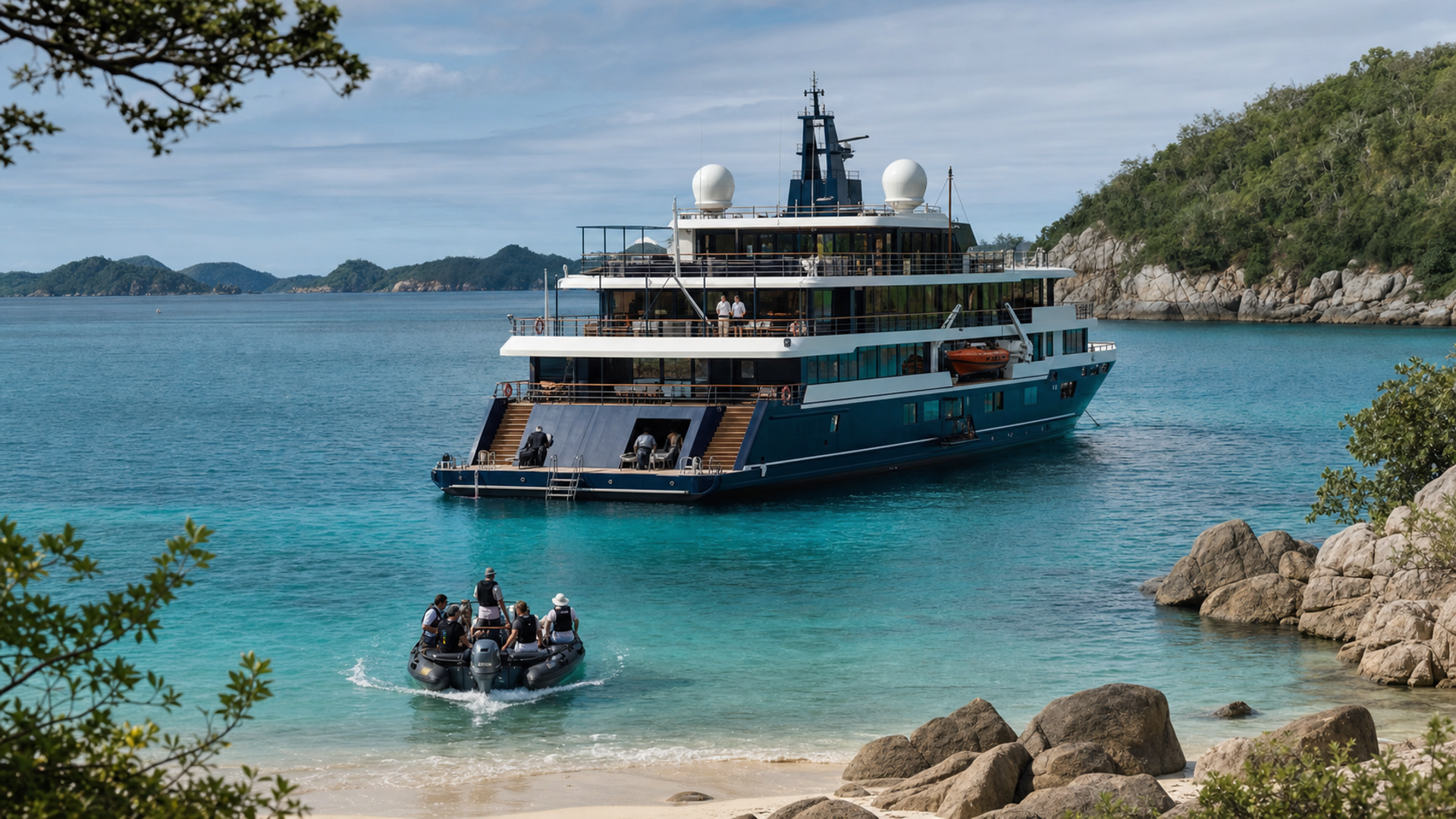
The best luxury small-ship cruise is not the vessel with the grandest suite or the fewest guests. It is the ship whose scale and operating purpose match the destination. Choose The Ritz-Carlton Yacht Collection for a hotel-yacht atmosphere in warm-water and cultural itineraries; Scenic Eclipse for a high-amenity discovery yacht; Seabourn Venture or Pursuit for a balanced expedition-and-resort experience; Silver Endeavour for an intimate polar platform; and PONANT's Le Commandant Charcot when icebreaking access and polar specialism are the reason to travel.
That shortlist is deliberately organised by fit, not an invented universal ranking. “Small ship” can describe a 220-guest polar vessel, a 264-guest expedition ship or an all-suite yacht with roughly 150 to 226 suites. Those ships can share fine dining and attentive service while delivering completely different days ashore.
Start with three questions: Where must the ship take you? How active do you want the expedition programme to be? What do you want on a day when weather keeps everyone aboard?
What small-ship luxury actually changes
Small scale can make a voyage feel less like moving through a resort and more like travelling with a temporary community. Fewer guests may mean quieter public rooms, shorter internal distances and a closer relationship with crew and expedition staff. A smaller hull may call at ports unavailable to large vessels or deploy tenders and Zodiacs into remote landing sites.
But small is not automatically better. It can mean fewer restaurants, less entertainment, more motion in open water and tighter competition for specialist activities. In polar regions, the decisive advantage is not décor but equipment, ice class, expedition staffing and the operational plan. In the Mediterranean or Caribbean, a marina platform and late port time may matter more than a laboratory or helicopter.
There is no single industry threshold that turns a ship into “small”. This guide uses the operator's published guest or suite count and, more importantly, the practical experience: yacht-style warm-water cruising, discovery cruising or purpose-built expedition travel.
Luxury small-ship cruise comparison for 2026
| Ship or collection | Published scale | Best fit | Distinctive strength | Check before booking |
|---|---|---|---|---|
| The Ritz-Carlton Yacht Collection | Evrima 149 suites; Ilma 224; Luminara 226 | Mediterranean, Caribbean and hotel-led yachting | All-suite format, marina and resort-style social spaces | Yacht, route and included services differ |
| Scenic Eclipse | Up to 228 guests; 200 in Antarctica | Travellers who want expedition equipment plus many onboard choices | Up to ten dining experiences, helicopters/submersible where operated | Aircraft and submersible availability is destination- and condition-specific |
| Seabourn Venture / Pursuit | 264 guests | Balanced expedition traveller | PC6 ships, 24 Zodiacs and expedition-team model | Some voyages are non-expedition; read the exact programme |
| Silver Endeavour | 220 guests | Intimate luxury in polar regions | High crew-to-guest ratio and all-balcony suite positioning | Verify included activities and suite category on the sailing |
| Le Commandant Charcot | Maximum 245 guests | High-latitude specialist | PC2 icebreaking design and science focus | Ice, route and landing conditions remain uncertain |
Figures come from the operators' current pages observed on 3 August 2026. They are useful for comparing formats, not predicting space, service or activity availability on a particular departure.
The Ritz-Carlton Yacht Collection: best for hotel-yacht travellers
This collection makes the strongest case for readers who want a cruise to feel like a coastal luxury hotel that happens to move. The current fleet page lists 149 suites on Evrima, 224 on Ilma and 226 on Luminara. It also describes all-suite yachts, marina access and multiple food-and-drink venues.
The attraction is not simply low capacity. It is the sequence of the day: breakfast overlooking a harbour, a tender or marina departure, a destination-led afternoon and a return to a vessel organised around suites, terraces and social spaces rather than expedition briefings. This format fits Mediterranean islands, Caribbean coves and city-paired itineraries particularly well.
Choose it if your priority order is suite, food, pool deck, port and evening atmosphere. Look elsewhere if you expect a deep naturalist programme, polar equipment or guaranteed access to specialist adventure hardware. Even within the collection, do not treat Evrima, Ilma and Luminara as interchangeable; the difference in scale and venues can change the mood.
Scenic Eclipse: best for travellers who want equipment and choice
Scenic Eclipse sits between a superyacht fantasy and an expedition platform. Scenic's official ship page publishes capacity of up to 228 guests—200 in Antarctica—across 114 suites, alongside a close-to-one-to-one guest-to-crew ratio. It also lists Zodiacs, kayaks, stand-up paddleboards, helicopters and a submersible, plus a broad dining and wellness programme.
That combination suits couples who disagree about how adventurous the holiday should be. One may want a Zodiac landing and naturalist interpretation; the other may value spa time, varied restaurants and a polished suite. The ship offers a framework in which both can belong to the same trip.
The crucial word is “where”. Scenic explicitly notes that helicopters are not operational in several destinations, including the UK and parts of the polar and global programme. Weather, regulation and safety can restrict equipment elsewhere too. Treat spectacular hardware as a conditional enhancement, not the purchase itself. The itinerary and core expedition operation must still justify the fare if a headline activity does not run.
Seabourn Venture and Pursuit: best balanced expedition choice
Seabourn's two expedition ships are a strong middle path for travellers who want serious destination capability without making machinery the centre of the holiday. The Seabourn Venture page lists 264 guests, PC6 construction, 24 Zodiacs, kayaks and a dedicated expedition team. The operator's 2026 deployment page covers both expedition and non-expedition voyages.
That last distinction matters. The same ship may deliver a polar landing-led voyage on one departure and a more conventional small-ship itinerary on another. A buyer who sees the vessel name and assumes every sailing includes the full expedition pattern can choose the wrong holiday.
Seabourn fits travellers who value lectures, wildlife interpretation and active landings but also want a recognisable luxury-cruise rhythm when they return aboard. It is particularly persuasive for Antarctica, the Arctic, the Kimberley and remote coastlines where Zodiacs and field expertise shape the day. Before paying, read the daily-experience language for the exact itinerary and distinguish included expedition activities from optional ones.
Silver Endeavour: best for intimate polar luxury
Silversea publishes Silver Endeavour at 220 guests and 207 crew, with balconies across the suite inventory. On numbers alone it is the most intimate of the polar-oriented vessels in this shortlist, though capacity does not automatically translate into personal attention at every moment.
The ship suits a traveller who wants the destination programme to remain central but prefers a compact, suite-led environment. Its value case is strongest when the itinerary uses that expedition design: Antarctica, the Arctic or other remote regions where observation space, Zodiac operations and field teams matter.
Do not choose solely from the crew ratio or the word “ultra-luxury”. Ask what happens on a weather day, how many guests share each activity window, which excursions are included, and whether the suite location works in rough seas. A midship lower-deck suite may serve a motion-sensitive traveller better than a larger accommodation high and forward.
Le Commandant Charcot: best when polar access is the purpose
PONANT's Le Commandant Charcot is the specialist choice. The operator lists a maximum of 245 guests, 123 staterooms and suites, 215 crew, dedicated science areas and a hybrid-electric polar exploration design. Its PC2 icebreaking capability distinguishes it from ships designed primarily to sail around, rather than through, challenging ice environments.
The right buyer is not simply someone who likes cold destinations. It is the traveller for whom high-latitude geography, ice interpretation and scientific context are the central reasons to spend. Onboard French hospitality and dining add character, but the ship's engineering and route possibilities drive the decision.
Capability still does not mean certainty. Ice moves, weather closes landing sites, wildlife is unscripted and authorities control access. The most credible polar purchase is made by someone who sees itinerary change as part of expedition travel, not a service failure whenever the printed plan moves.
Choose the destination before the ship
The matrix becomes clearer when applied to a map.
Mediterranean and Caribbean: prioritise port size, tender pattern, marina access, late departures and the onboard atmosphere after dinner. The Ritz-Carlton yachts are a natural first look; Scenic can suit travellers who want discovery equipment on selected routes.
Kimberley, South Pacific and remote warm-water coasts: expedition staffing, Zodiac capacity, heat management and wet-landing mobility become more important. Seabourn Pursuit and discovery-yacht formats deserve attention.
Antarctica and the high Arctic: choose on ice class, field team, landing operation, parka and equipment arrangements, medical requirements and contingency philosophy. Silver Endeavour, Seabourn's expedition ships, Scenic Eclipse and Le Commandant Charcot each answer the problem differently.
Open-ocean repositioning: small vessels can move more than large resort ships. Read deck plans, stabilisation information and cabin position; a beautiful remote itinerary may include difficult sea days.
The small-ship trade-offs most brochures soften
First, “all-inclusive” never means identical inclusions. Premium wine, specialist dining, spa services, air, hotels, visas, private transfers, helicopters, submarines and shore activities may each follow different rules. Build a line-item comparison from the actual fare terms.
Second, activity capacity matters. A ship may carry equipment without offering every guest the same slot on every day. Ask how reservations work and what happens if weather cancels an activity. Never value a voyage as if a conditional helicopter, submersible or landing were guaranteed.
Third, mobility requirements can be stricter than the hotel-like environment suggests. Zodiac steps, wet landings, ice, swell and remote terrain demand balance and confidence. Discuss accessibility with the operator in writing for the precise sailing.
Fourth, small-ship evenings are intentionally quieter. Travellers who need large productions, extensive shopping or a different restaurant every night may be happier on a bigger vessel. Intimacy works only if the social and entertainment scale suits you.
A booking checklist that protects the decision
Identify the three ports, landings or environments that make the itinerary worth buying.
Confirm whether the sailing is expedition, discovery or conventional ocean cruising.
Compare guest count with the number and cadence of landing groups—not capacity alone.
Mark every headline activity as included, optional, condition-dependent or unavailable on the route.
Compare the complete fare: air, transfers, hotel, gratuities, drinks, excursions, equipment and insurance.
Choose the suite for motion, noise and access before choosing it for square metres.
Read cancellation, itinerary-change and medical-evacuation terms.
Keep at least one pre-cruise buffer night when a missed embarkation would be costly.
For eligible VERTU clients, human Concierge support may be used to help coordinate a complex travel workflow—such as pre- and post-cruise hotels, private transfers, dining requests and changing flight sectors—subject to service eligibility, availability, terms and user authorisation. It does not guarantee cruise inventory, upgrades, reservations, expedition activities, schedules or outcomes. The operator remains the source of truth for the sailing.
Readers still comparing the wider market can use our broader luxury cruise-line guide; those prioritising an adult atmosphere rather than vessel scale can use the adults-focused comparison.
Verdict: buy the operating purpose, not the adjective
Choose Ritz-Carlton when the yacht-hotel life is the destination, Scenic when you want expedition hardware without giving up onboard variety, Seabourn for a balanced field-and-resort rhythm, Silver Endeavour for compact polar luxury, and Le Commandant Charcot when advanced ice capability is the point.
The best small ship is the one whose ordinary day fits you—and whose disrupted day you would still value.
Related VERTU reading
Where VERTU Concierge may help
For eligible VERTU clients arranging a small-ship journey with flights, transfers and private extensions, VERTU Concierge may support coordination where available and subject to service terms. It cannot guarantee cabin inventory, upgrades, tender operations, weather or outcomes; operators and suppliers retain responsibility.
Sources and verification
Sources were checked for this 3 August 2026 publication package. Terms and specifications can change; recheck the linked source before acting.