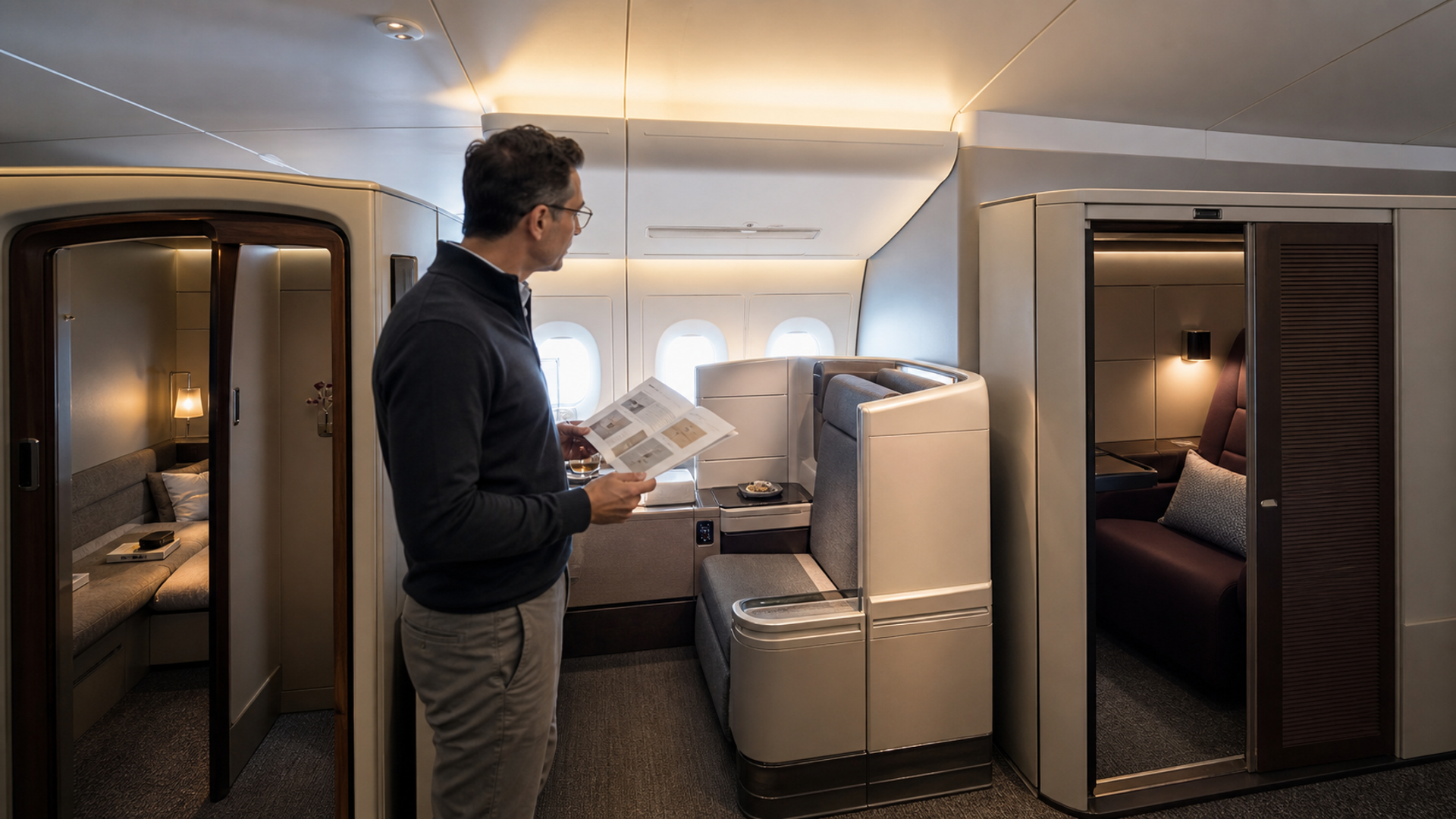
The best first class airline in 2026 is the one that puts its strongest aircraft on the route you actually need. Singapore Airlines is the clearest choice for couples seeking an A380 Suites experience, Emirates is compelling when its A380 or latest fully enclosed Boeing 777 suite aligns with the itinerary, and Etihad deserves consideration when its First suite—or the far more specialised Residence—is available. None is a universal winner: aircraft, configuration, connection quality, fare conditions and award availability can reverse the decision.
This guide compares the products as bookable travel decisions, not as abstract brand rankings. Published cabin features are current at the time of writing, but route assignment, aircraft, price and redemption inventory require a fresh search before payment.
The first-class decision matrix
| Decision factor | Singapore Airlines | Emirates | Etihad | What to verify live |
|---|---|---|---|---|
| Flagship product | A380 Suites | A380 First Class or selected 777 enclosed suite | First suite; Residence on relevant aircraft | Exact aircraft and seat map |
| Best fit | Couples, privacy and measured service | Feature-rich experience and Dubai connectivity | Abu Dhabi journeys and highly private accommodation | End-to-end routing |
| Published privacy | Personal Suite; paired Suites can form a double bed | Privacy doors on A380; fully enclosed suite on selected 777s | Private suite; Residence is a separate multi-room proposition | Door, wall and seat configuration |
| Sleep proposition | Separate bed in A380 Suites; First product differs by aircraft | Seat/bed product varies by A380 or 777 configuration | Turndown service is advertised in First | Mattress, bedding and bed dimensions |
| Dining proposition | Gourmet dining and Book the Cook on eligible journeys | Dine-on-demand positioning in A380 First | À la carte dining in First | Route-specific menu and preorder window |
| Distinctive feature | A380 Suites for a sanctuary-like layout | A380 shower spa; selected 777 virtual windows | Residence and First suite concepts | Availability on the chosen flight |
| Network logic | Strong Singapore hub for Asia-Pacific connections | Broad Dubai hub connectivity | Abu Dhabi hub and selected long-haul routes | Connection time and terminal flow |
| Main risk | Suites disappear if the A380 changes | Mixed fleet means the advertised product can vary | Smaller footprint makes product matching essential | Change notification and fallback cabin |
| Price comparison | Quote by date, origin and fare rules | Quote by date, origin and fare rules | Quote by date, origin and fare rules | All-in cash fare or points plus charges |
The table deliberately avoids declaring one airline “best” on reputation alone. A spectacular suite on an inconvenient route may deliver less value than a slightly less theatrical cabin on a non-stop service with a sensible arrival time.
Start with the route, not the suite
First class only creates value when it solves the whole journey. Begin with non-stop availability, departure time, arrival time, connection risk and ground transfer. Then inspect the cabin. A longer routing taken solely to sample a product can add an overnight connection, shorten useful sleep or put the traveller into a weaker regional cabin for the second sector.
For Singapore Airlines, the official cabin page states that Suites are exclusive to its A380 fleet and explicitly warns that they will not be available if the aircraft type changes for operational reasons. Emirates likewise says its First Class features vary by route, aircraft model and configuration, and that operational needs can cause last-minute aircraft changes. Those caveats are not footnotes to ignore; they are central to the purchase.
Singapore Airlines: best for a composed Suites experience
Singapore Airlines describes Suites and First Class as personal sanctuaries for working, dining or resting. Its published proposition includes gourmet meals, fine wines and champagne, exclusive amenities and Book the Cook. The A380 Suites product is distinct from First Class on the Boeing 777, so the labels should not be treated as interchangeable.
The strongest reason to choose Singapore Airlines is product coherence. Travellers who value quiet service, personal space and a bed separate from the seat may find the A380 layout more meaningful than a longer amenity list. Couples can also care about paired-suite availability, but the relevant seat pair must be confirmed on the live seat map. Solo travellers should judge the individual suite rather than assume the double-bed possibility changes their experience.
The weakness is scarcity. The required A380 may not operate every frequency, and an aircraft substitution can remove Suites. Before booking, record the flight number, aircraft and seat map, then read the change and refund conditions for the fare or redemption.
Emirates: best for distinctive onboard features
Emirates publishes two materially different First Class stories. On the A380 it highlights privacy doors, fine dining at any time, an onboard shower spa and access to the lounge bar. On selected Boeing 777 configurations it promotes a fully enclosed suite with temperature controls, mood lighting and virtual windows.
That makes Emirates attractive to travellers who want the flight itself to be an event. Yet “Emirates First Class” is not one standard seat. The official page warns that Emirates operates earlier and later models and that products can vary by route and configuration. A buyer comparing fares must therefore compare flight-specific hardware, not photographs from a general marketing page.
Dubai can also be an advantage when it provides a clean one-stop itinerary between regions. It is less attractive when the connection fragments sleep or when the desired A380 feature is only present on one sector. Check lounge access, chauffeur-drive eligibility and connection handling against the actual ticket, because ancillary conditions can depend on route, fare and market.
Etihad: best when its specialised product fits the journey
Etihad’s current cabins page presents First as a private suite with à la carte dining and signature turndown service. It separately presents The Residence as a more exclusive proposition. The two should not be collapsed into one ranking entry: their space, availability and price logic are different.
Etihad is most persuasive when Abu Dhabi belongs naturally in the itinerary and the selected service carries the intended cabin. A traveller who wants privacy without the scale of a larger hub may prefer that fit. The constraint is route coverage. Because flagship products appear on limited aircraft, the buyer must inspect every sector rather than infer continuity from the airline name.
For The Residence in particular, treat any online description as product context, not proof of availability or price. Only a live offer tied to a date, route and passenger count can support a purchase decision.
Privacy and sleep matter more than spectacle
The practical first-class hierarchy changes on an overnight flight. Door height, aisle exposure, cabin traffic, temperature, bedding, noise and the relationship between seat and bed determine whether the traveller arrives functional. A shower or bar may be memorable, but four uninterrupted hours of sleep can be more valuable before a board meeting.
Use a simple test: estimate the realistic sleep window after take-off, meal service and pre-arrival preparation. Then ask whether the cabin lets you protect that window. A separate bed can be valuable, but only if the schedule is long enough to use it. On a shorter overnight sector, fast dining and fewer interruptions may matter more.
Service should be judged as a system
Service quality is difficult to rank responsibly because crews and circumstances vary. Compare what the airline system allows: meal preselection, dine-on-demand flexibility, bedding preparation, response to a missed connection and the clarity of digital trip management. Published features establish a baseline, not a guaranteed personal performance.
Travellers deciding whether a premium cabin upgrade is worthwhile can use the same discipline applied in our Singapore Airlines Premium Economy versus Business Class guide: identify the outcome—sleep, privacy, work or schedule protection—then pay only for features that improve it.
Dining is route- and timing-dependent
Singapore Airlines advertises Book the Cook, Emirates highlights fine dining at any time in A380 First, and Etihad lists à la carte dining in First. These are meaningful differences, but availability, menu choice and preorder deadlines may vary. A late-night departure can also make a shorter service preferable to a full tasting sequence.
Before travel, confirm dietary requests, preorder cut-offs and whether the traveller intends to eat in the lounge or onboard. The best meal plan is the one that preserves sleep and arrival energy, not the one with the longest menu.
Ground experience can decide close comparisons
A first-class trip includes check-in, security, lounge time, boarding, connection and arrival. Compare the operating terminal, minimum connection time, lounge location and ground-transfer eligibility. A beautiful cabin loses value if a rushed connection creates avoidable stress.
Do not assume a named chauffeur or meet-and-assist benefit applies globally. Verify the exact booking class, route, distance limit, request deadline and passenger eligibility. Keep written confirmation with the itinerary.
Cash, points and route value
There is no durable global “first class price”. Fares move by origin, destination, date, fare basis, remaining inventory, taxes and currency. Award seats introduce programme rules, transfer times, surcharges and change policies. Consequently, compare three live totals: the best acceptable first-class itinerary, the best business-class alternative and the cost of repositioning to a gateway.
Value per hour is useful but incomplete. Add the cost of extra connections, hotels, transfers and lost working time. A non-stop business-class seat may beat a first-class redemption that requires a positioning flight and fragile separate tickets.
Plan for aircraft swaps and disruption
Save the seat map and product description when booking, but do not interpret them as guarantees. Recheck the itinerary after schedule changes and again before departure. If the aircraft changes, identify whether the new seat still meets the essential requirement and what remedies the ticket terms allow.
Our AI-agent and human-concierge travel disruption matrix explains which monitoring tasks can be automated and which decisions should remain with a person. The principle is especially useful for first class: software can detect a swap, but the traveller should authorise any rebooking that changes route, date, ticket conditions or cost.
How to choose in five steps
First, list the two best end-to-end itineraries without considering branding. Second, verify the aircraft and seat map for every premium sector. Third, rank the features that affect the traveller’s real outcome: sleep, privacy, schedule or companionship. Fourth, compare the all-in cash or redemption cost, including positioning and ground travel. Fifth, document a fallback if the aircraft or connection changes.
Choose Singapore Airlines when the A380 Suites routing is convenient and a calm, bed-led experience is the priority. Choose Emirates when the verified A380 or latest 777 configuration and Dubai routing add genuine value. Choose Etihad when Abu Dhabi works naturally and its First suite or Residence is specifically available. If those conditions do not hold, compare business class rather than paying for a first-class label alone.
Where VERTU fits
VERTU Concierge can be relevant for eligible users when a multi-sector premium itinerary requires coordinated monitoring, ground arrangements or a human review of alternatives. Availability varies, significant external actions require user authorisation, and neither inventory nor outcomes are guaranteed. Airline operating decisions, ticket rules and supplier confirmations remain controlling.