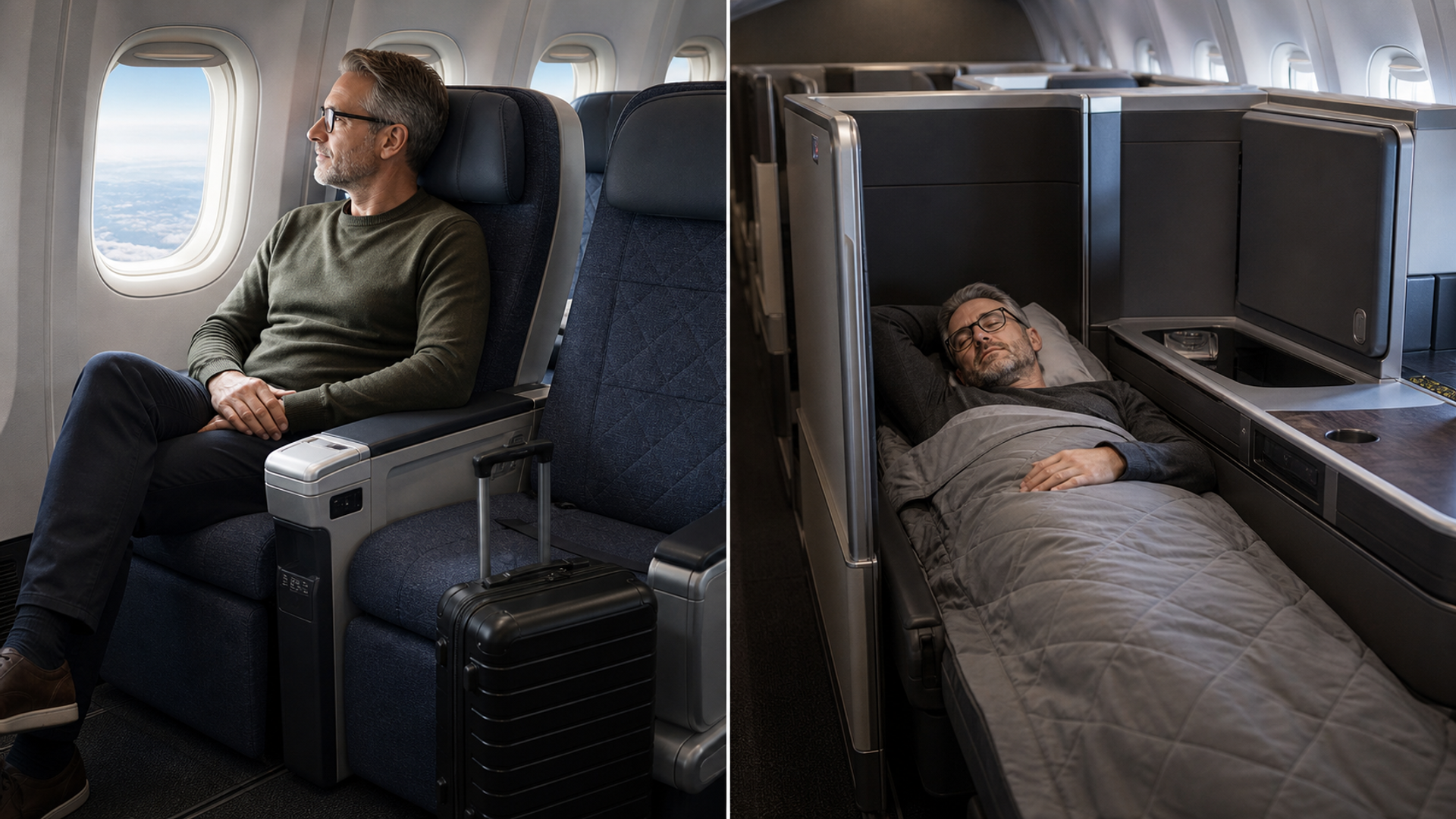
ANA Premium Economy is usually the value choice for travellers who want a spacious recliner, a quieter cabin and selected airport benefits without buying a bed. ANA Business Class is the stronger decision when the exact aircraft offers a lie-flat product such as THE Room or another staggered direct-aisle configuration, the sector is overnight and the arrival has real consequences. ANA's fleet variety makes aircraft verification essential.
This guide compares the two cabins as an itinerary: seat, sleep, lounge, food, aircraft, fare gap and arrival performance. It does not assume every ANA Business seat is THE Room or every Premium Economy ticket receives identical ground benefits.
Quick answer
Choose ANA Premium Economy for a daylight long-haul flight, a comfortable leisure arrival or a fare gap that would materially improve the rest of the trip. Choose ANA Business Class when the confirmed flight offers a lie-flat, direct-aisle seat, the body-clock night is long enough to use it and your first day in Japan or after returning home is difficult to move.
If your dates are flexible, compare both cabins across nearby flights. A different departure can change the aircraft, seat and price enough to reverse the answer.
ANA cabin decision matrix
| Decision factor | Premium Economy | Business Class | What to verify |
|---|---|---|---|
| Seat | Typically wider recliner with about 38-inch pitch; some new 787-9 seats publish 40 inches | THE Room, THE Room FX or other lie-flat/staggered products depending on aircraft | Aircraft subtype and seat map |
| Sleep | Strong seated rest | Horizontal sleep and more privacy | Route duration and service timing |
| Aisle access | Usually shared in paired or centre seats | Direct access on many long-haul layouts | Exact row and layout |
| Lounge | Available to eligible Premium Economy guests at specified airports | Broader premium ground proposition | Airport and itinerary eligibility |
| Dining | Upgraded meal and drink options | More elaborate Japanese and international service | Flight and meal schedule |
| Best use | Day flight, couple, lower fare | Night flight, solo privacy, high-stakes arrival | Fare gap and first-day value |
Fleet variation is the first question
ANA's official Premium Economy seat page describes a generally 38-inch pitch and 19.3-inch width, while a newer 206-seat Boeing 787-9 configuration publishes a 40-inch pitch and nine inches of recline. That variation is meaningful. A buyer should not transfer the newest specification to every route.
The official Business Class seat guide shows an even wider range. THE Room and THE Room FX use doors and substantial personal space on selected aircraft, while other staggered lie-flat products provide a different environment. ANA's own pages repeatedly tie features to aircraft type.
Open ANA's international seat maps before booking. Confirm the aircraft subtype, seat orientation, window alignment, storage and whether your chosen seat has direct aisle access. Recheck after a schedule change. An operational aircraft swap can preserve the cabin name while changing the actual seat.
Premium Economy is a strong sitting product
ANA Premium Economy addresses the most common long-haul discomforts: knee room, seat width, leg support and cabin density. For a daytime flight to Tokyo, that can be the sensible sweet spot. You can work, dine and watch films with more personal space without paying for a feature—the flat bed—that you may barely use.
The seat still requires compromise. A deep recline is not horizontal, and a neighbour may control your aisle access. Travellers who struggle to sleep upright, have mobility needs or need frequent aisle access should assign more value to Business.
Seat position also matters inside Premium Economy. A bulkhead can improve leg freedom but alter storage and screen placement. Rows near galleys or lavatories may experience more light and foot traffic. The cabin label is only the first filter.
Business buys control over sleep and privacy
The most important Business benefit is not the meal or amenity kit. It is the ability to choose when to sleep, work and move. On a route equipped with THE Room, the door and broad seat create a notably private space. Other ANA Business products may be less dramatic but can still provide a lie-flat surface and direct aisle access.
Calculate the usable sleep window. An eleven-hour scheduled flight may offer far less after take-off, dinner and pre-arrival service. Eastbound flights can compress the night, while a westbound daylight sector may encourage you to remain awake. If only three usable sleep hours remain, the fare gap must be judged against those three hours, not the full flight duration.
Couples should also consider social preference. Some Business layouts support conversation better than others, while adjacent Premium Economy seats can be more naturally shared. Solo travellers often value privacy more.
Use an arrival-readiness calculation
Write down the first fixed event after landing: a meeting, train connection, ceremony, long drive or simply hotel check-in. Then estimate how each cabin changes the probability of arriving ready.
Subtract meal and service time from the flight duration.
Estimate your personal recliner sleep and lie-flat sleep.
Add only confirmed ground benefits you will actually use.
Divide the fare gap by additional useful hours.
Compare the result with the cost of a poor arrival.
If Business costs £1,400 more and protects four additional useful hours, the premium is £350 per hour. That could be rational before a negotiation and unnecessary before three recovery days in Kyoto. A fare sale can change the answer without changing the seat.
Include flexibility in the calculation. A restrictive Business ticket is not automatically superior to a flexible Premium Economy fare if the trip may move.
Lounge access: verify the airport and ticket
ANA publishes a dedicated Premium Economy lounge page and states that access depends on boarding class and airport. Business generally has a broader lounge proposition, but the exact facility, opening times and partner arrangements vary.
A lounge has high utility during a long connection when you can shower, eat and work. It has little value when departure is soon after arrival at the airport. At crowded times, the environment may also differ from promotional photography.
Do not assume a card lounge and an airline lounge are equivalent. Food, showers, quiet areas, guest rules and terminal location can differ. The separate airport lounge membership guide explains how to avoid paying twice for access you already receive.
Eligible VERTU clients may use human Concierge support to coordinate flights, airport assistance, chauffeurs, hotels or dining where available and subject to service terms. It cannot guarantee an ANA seat, lounge admission, upgrade, timetable or disruption result. Material bookings require user authorisation, and ANA remains responsible for its operation and ticket.
Dining: Japanese service can be valuable, but not decisive
ANA is known for both Japanese and international meal options, and Business offers a more elaborate service than Premium Economy. On a daytime flight, the pacing, table space and choice can materially improve the journey. On an overnight flight, the best strategy may be to eat quickly and protect sleep.
Menus and beverages rotate, and special meals can vary by departure point. Treat a specific dish as a pleasant variable, not a reason to spend a four-figure premium. The durable differences are seat category, privacy, aisle access and control of time.
If eating on the ground is possible and lounge access is confirmed, doing so may produce more sleep than waiting through a full onboard service. Decide your plan before boarding rather than automatically following the cabin ritual.
Baggage, check-in and priority
Both cabins can provide improved airport treatment relative to Economy, but allowances and priority depend on the exact fare, route and status. Partner-operated or separately ticketed segments can apply different rules. Read the booking confirmation rather than relying on a generic table.
Do not count status benefits twice. If Star Alliance status already provides lounge, priority and baggage advantages, the incremental Business value may be concentrated almost entirely in the seat. That may still justify the fare, but the calculation becomes cleaner.
Priority baggage is useful but not a guaranteed delivery sequence. It should never be used to make a tight self-connection appear safe.
Three scenarios
Overnight Europe to Tokyo before a working day
Business is usually stronger when THE Room or another lie-flat product is confirmed and the morning cannot move. Sleep autonomy and direct aisle access protect the first day.
Daytime Tokyo to North America
Premium Economy can be the better value when you intend to remain awake. The larger recliner, service and quieter cabin capture much of the comfort while leaving budget for accommodation or dining.
Two travellers on holiday
Adjacent Premium Economy seats can create a calm shared experience at a far lower combined fare. Business becomes stronger if one passenger cannot sleep seated, needs privacy or faces an immediate commitment.
Compare route, not just airline
Schedule and nonstop operation can matter more than cabin. A direct ANA Premium Economy flight may beat Business on another airline with a long or risky connection. Conversely, a confirmed Business product with a useful arrival time may justify a modest premium.
Use the Singapore Airlines cabin comparison as a method for testing another Asian carrier, not as evidence for ANA. Product names are not interchangeable.
Pre-booking checklist
Is the flight ANA-operated?
Which exact aircraft subtype is currently assigned?
Does the Business layout show THE Room, THE Room FX or another product?
Does your seat have direct aisle access?
How long is the realistic body-clock sleep window?
Which lounge is available at the actual airport and terminal?
Are priority and baggage benefits already supplied by status?
What are the change, cancellation and aircraft-substitution terms?
Would a nonstop Premium Economy itinerary beat a connecting Business option?
Final verdict
ANA Premium Economy is the rational choice when the journey needs better sitting, more space and a quieter cabin. ANA Business earns its premium when a verified lie-flat product, meaningful sleep window and valuable arrival day align. Check the aircraft, calculate the fare per protected hour and choose the cabin that solves the itinerary's hardest constraint.
Sources
ANA, Premium Economy seats, accessed 3 August 2026.
ANA, Business Class seats, accessed 3 August 2026.
ANA, Premium Economy lounge information, accessed 3 August 2026.
ANA, International aircraft seat maps, accessed 3 August 2026.