

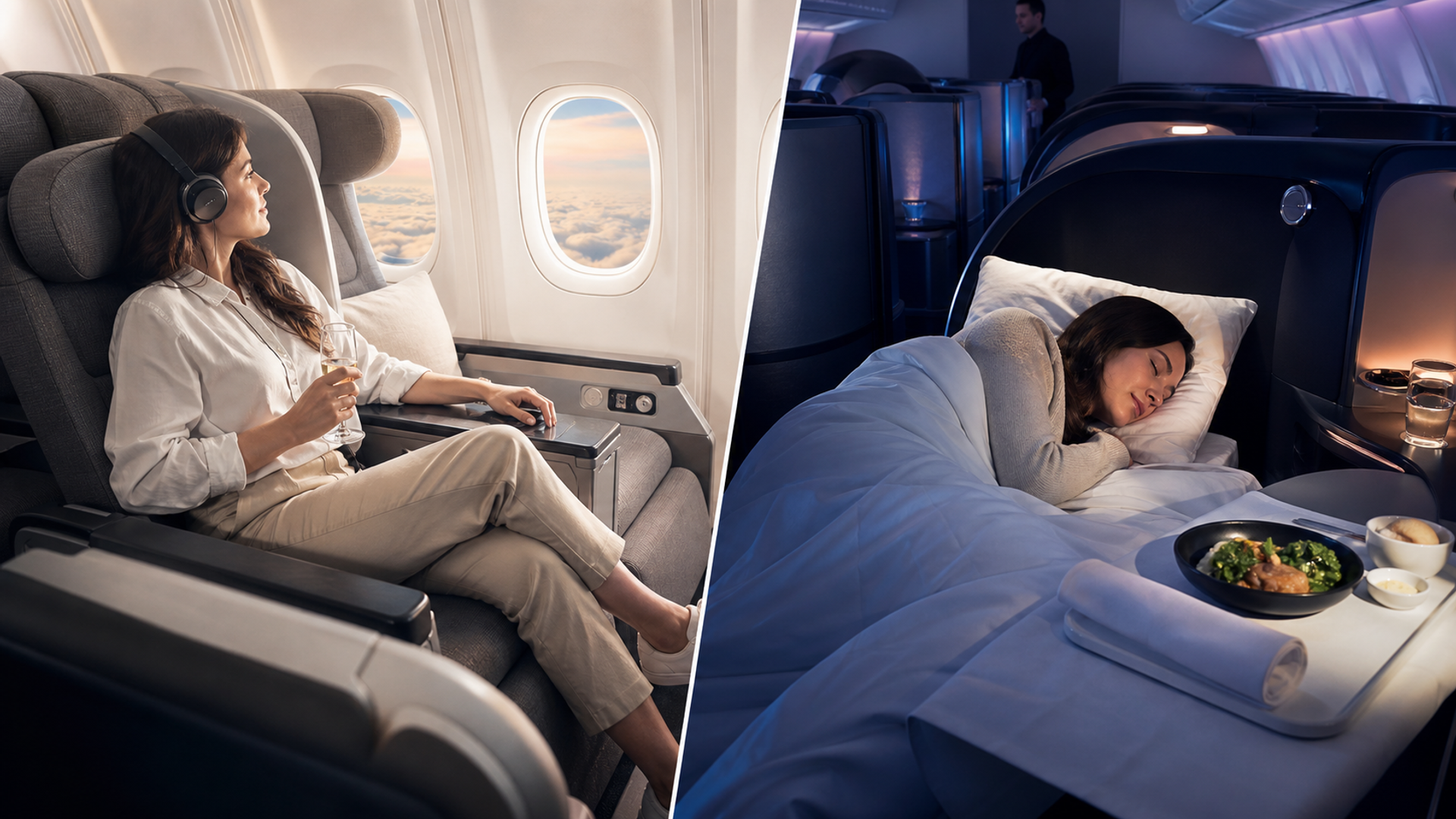
Air New Zealand Premium Economy and Business Premier solve different problems. Premium Economy buys personal space, a quieter cabin and a more comfortable seated journey. Business Premier buys a flat bed, airport privileges and a much better chance of arriving functional after an overnight flight. The useful question is therefore not whether Business Premier is “better”. It is whether sleep, lounge access and disruption resilience are worth the fare gap on your exact aircraft and itinerary.
That distinction matters on Air New Zealand’s long-haul network. A daytime Auckland–Los Angeles flight, an overnight Auckland–New York journey and a connection through Auckland do not place the same value on the same benefits. Aircraft substitutions can also alter the cabin layout. Always confirm the operating aircraft and seat map before paying; Air New Zealand publishes its current Boeing 777-300 seat map and cabin pages, but the booking screen is the final source for a particular service.
The decision in one table
| Decision factor | Premium Economy | Business Premier | Who should pay for Business Premier? |
|---|---|---|---|
| Seat | Wider recliner with more room than Economy | Seat converts into a lie-flat bed | Travellers who need horizontal sleep |
| Privacy | Separate smaller cabin, but still an open recliner | More personal space, though layout varies by aircraft | Solo travellers working or sleeping overnight |
| Airport | Standard fare-dependent airport journey | Priority services and eligible lounge access | Tight connections and time-sensitive trips |
| Dining | Upgraded meal and service | More extensive premium dining and service | Travellers for whom the onboard meal is part of the experience |
| Baggage | More generous than Economy on eligible fares | Higher premium allowance | Long trips, formal wardrobes or equipment-heavy travel |
| Day flight value | Often strong | Harder to justify if sleep is unnecessary | Only if privacy, work or airport time has high value |
| Overnight value | Better comfort, but seated sleep | Flat-bed sleep is the defining advantage | Executives, light sleepers and immediate-arrival commitments |
| Best buying rule | Choose when the fare gap from Economy is reasonable | Choose when the cost per usable sleep hour is acceptable | Price the whole journey, not just the seat |
What Premium Economy actually changes
Air New Zealand describes its long-haul Premium Economy as a distinct premium cabin rather than an Economy seat with a little extra legroom. The practical gains are a wider seat, greater recline, more space around the passenger and a more deliberate meal service. Those changes are meaningful on a 12-hour flight. They reduce shoulder conflict, make it easier to use a laptop and improve the odds of resting.
Yet Premium Economy remains a recliner. Your body is still angled rather than horizontal, and another passenger’s movement can still affect you. A window seat may offer a wall to lean against but can require negotiating past a neighbour. An aisle seat gives easier movement but exposes the passenger to cabin traffic. Couples may value a pair of seats; solo travellers should study the row configuration rather than assume every seat is equivalent.
Premium Economy is strongest when the flight operates mostly during waking hours, when the traveller can recover after arrival, or when Business Premier is several multiples of the fare. It is also a rational middle ground for leisure travellers who want a distinctly better journey without converting the flight into the largest line item of the trip.
What Business Premier actually changes
Air New Zealand’s Business Premier proposition is built around the lie-flat bed, premium airport handling and an elevated onboard service. The bed is the feature that changes the decision. On an overnight sector, horizontal sleep can produce several usable hours that a reclining seat cannot reliably match. For a traveller heading directly into meetings, a wedding, a tour or another flight, that can be worth more than the catering or champagne.
Business Premier also changes the journey before boarding. Eligible passengers receive priority treatment and lounge access according to the ticket and airport. Air New Zealand publishes its international lounge information, but partner lounges and opening hours vary by station. Check the operating carrier, terminal and access rules; a premium ticket does not make every lounge in an airport available.
The cabin is not a private suite. Depending on aircraft and seat position, passengers may face into the cabin or have different sightlines and storage. Travellers accustomed to closing doors should judge Business Premier by its bed, service and network rather than by assumptions drawn from another airline’s newest product.
Seat and sleep: the decisive difference
For most buyers, the choice can be reduced to one question: how much is real sleep worth on this flight? Premium Economy may be comfortable enough for films, dining and intermittent rest, but it does not remove the biomechanical compromise of sleeping seated. Business Premier provides a flat surface, bedding and more control over when to sleep.
Use a simple cost-per-sleep-hour calculation. Suppose Business Premier costs £1,600 more than Premium Economy for an overnight journey and you reasonably expect five hours of meaningful sleep. The upgrade costs £320 per potential sleep hour. If the traveller would otherwise lose a working day, book an extra hotel night or arrive unable to participate in a high-value event, the number may be defensible. If the flight is daytime and sleep has little value, the same fare gap is much harder to support.
Do not calculate from advertised flight duration alone. Subtract boarding, meal service, cabin lighting, descent and any time-zone adjustment. An 11-hour sector may offer only six or seven practical sleep hours. A shorter westbound day flight may offer almost none.
Dining, work and cabin rhythm
Premium Economy provides a more considered meal than Economy, but its cabin rhythm remains communal: service, clearing and neighbours’ screens influence the experience. Business Premier gives more space and a premium service sequence, making it easier to eat, work and then convert the seat for rest.
If you plan to work, consider the nature of the work. A larger personal area helps with a laptop, but neither cabin should be treated as a confidential office. Use privacy screens, avoid displaying sensitive material and assume that people behind or across the aisle can observe a screen. For highly confidential travel, the value of a premium cabin is physical comfort, not guaranteed information security.
Baggage and the whole itinerary
Air New Zealand’s checked-baggage guidance should be checked against the fare purchased, route and any partner segments. Premium cabins generally come with more generous allowances, but through itineraries can involve different operating carriers and rules. The most restrictive or most-significant-carrier rule may affect the journey.
This is where a comparison based only on the outbound seat can fail. Price the return, connecting flights, change conditions, seat selection, lounge access and baggage together. A slightly higher flexible fare can be more valuable than a cabin upgrade on a trip whose dates may move. Conversely, a through Business Premier itinerary with protected connections may be more useful than mixing separate tickets to save money.
Which cabin fits each traveller?
Choose Premium Economy when
the long sector is primarily daytime;
the fare gap to Business Premier is very large;
you value width, legroom and a calmer cabin more than a bed;
you can rest after arrival;
you are travelling as a couple and prefer sitting together;
the trip budget is better spent on accommodation or experiences.
Choose Business Premier when
the flight is overnight and sleep affects the next day;
you have a meeting, event or onward journey soon after landing;
a tight connection makes priority handling and lounge access useful;
you need more personal space for a long solo trip;
the ticket is flexible enough to protect an uncertain itinerary;
a points or upgrade offer reduces the marginal cost substantially.
Be cautious when
the booking does not clearly show the operating aircraft;
the itinerary includes partners with different cabins;
you are assuming a particular lounge without checking terminal access;
the cheapest premium fare has restrictive change or refund conditions;
a schedule change could turn an overnight flight into a daytime one.
A smarter way to book the upgrade
First, compare the exact dates in both cabins and inspect nearby days. Premium-cabin pricing can vary sharply even when Economy does not. Second, check one-way and return combinations; a Business Premier overnight outbound and Premium Economy daytime return can be more rational than buying the same cabin both ways. Third, examine points, upgrade products and change rules without assuming availability.
Then verify the aircraft, seat map and connection. For a couple, decide whether proximity matters more than the most private seat. For a solo traveller, consider cabin traffic, galley position and access to the aisle. Avoid choosing solely from a generic seat photograph.
Complex premium trips may also involve ground transfers, hotels and dining timed around arrival. That is where human coordination can add value. VERTU Concierge can be relevant for eligible members when the task is coordinating the wider journey rather than promising airline inventory or upgrades. The distinction is important: a concierge can help organise a request and alternatives, but the airline controls fares, seats, schedules and disruption outcomes. For broader planning, see our guide to travel agents versus travel concierges.
Travellers still comparing carriers can use our best Premium Economy airlines buyer matrix. For a useful benchmark on another long-haul network, see Singapore Airlines Premium Economy versus Business Class; do not transfer its seat or lounge conclusions to Air New Zealand without checking the live aircraft.
The verdict
Premium Economy is Air New Zealand’s value cabin for travellers who want a materially better long-haul seat but do not need a bed. Business Premier is the functional choice when sleep, airport time and next-day performance carry real value. On a daytime flight, Premium Economy often wins the cost-benefit test. On a long overnight flight followed by an immediate commitment, Business Premier can justify itself even when the onboard luxury is not the primary motivation.
The best answer is often a mixed itinerary: flat bed on the overnight direction, Premium Economy on the daytime return. Confirm the live aircraft, fare rules, baggage and lounge access before purchase, and compare the upgrade against the value of the hours it may actually restore.
Sources and verification
Official pages were checked for this 4 August 2026 publication package. Aircraft, cabins, fares, baggage and lounge access can change by flight and ticket.
![How to Scan Receipts and Documents with Your Phone [Full Guide]](https://cdn.sanity.io/images/e0gp1l2g/production/0db13feec1d5e72b8a8a5f976d1f3e86619c9228-3840x1860.webp?w=180&h=180&q=78&auto=format&fit=crop)
![How to Scan Receipts and Documents with Your Phone [Full Guide]](https://cdn.sanity.io/images/e0gp1l2g/production/0db13feec1d5e72b8a8a5f976d1f3e86619c9228-3840x1860.webp?w=800&h=450&q=82&auto=format&fit=crop)
![Top 10 Two-Tone Carbon-Fibre Watches for Men [2026 List]](https://cdn.sanity.io/images/e0gp1l2g/production/18870799ba33fab0e038968359cd5772d7d7db30-1024x576.webp?w=800&h=450&q=82&auto=format&fit=crop)
![Top 10 Luxury Watches with Digital Complication Displays for Men [Latest]](https://cdn.sanity.io/images/e0gp1l2g/production/c4f6bf8c080f291c39f7cc85c7344ecff2fd3799-1024x553.webp?w=800&h=450&q=82&auto=format&fit=crop)