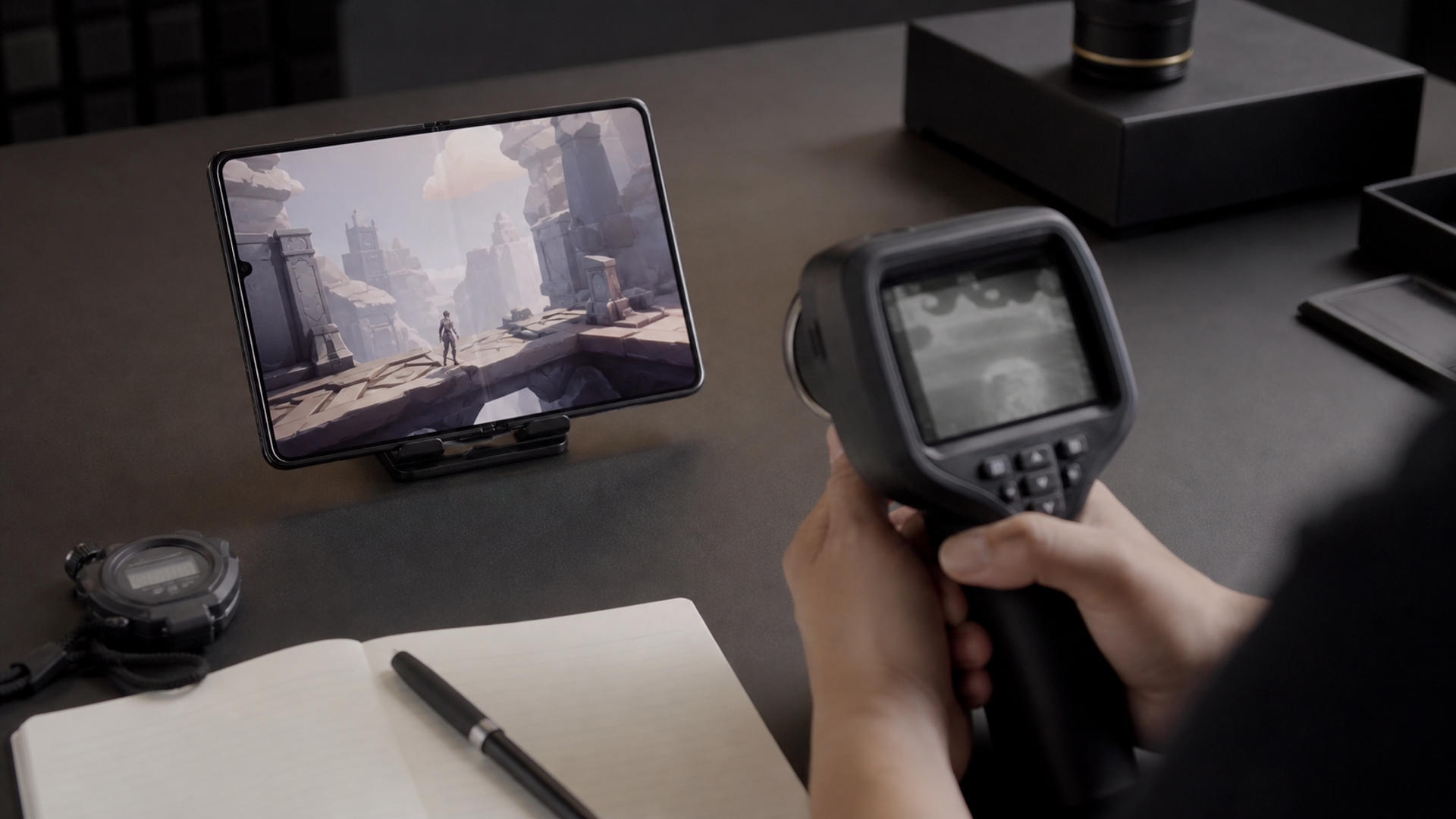
VERTU ALPHAFOLD has the hardware ingredients to justify a serious mobile-gaming test. It does not yet have the independent sustained-performance evidence required for us to call it a gaming phone.
The practical question is not whether a luxury phone can launch a game. It is whether performance remains smooth, manageable and connected after the first impressive minutes.
This article does not invent that result. No independent ALPHAFOLD gaming benchmark was available for this draft. Instead, it defines the test that should decide the verdict: 30 minutes of repeatable play measuring frame pacing, surface heat, touch control, network stability, battery use and foldable ergonomics.
What the verified specifications tell us—and what they do not
The current ALPHAFOLD product page and the VERTU product knowledge base snapshot used for this article list a Snapdragon 8 Elite Supreme platform, 16GB RAM, 1TB storage, a 6.53-inch outer display, an 8.05-inch inner display, a 6,500mAh battery, 65W charging, a 264g weight, Wi-Fi 7 and Bluetooth 5.4. The approved product context positions ALPHAFOLD as a luxury AI foldable and, for authorised enterprise scenarios, a mobile ERP-ready business phone. It does not position the device as a dedicated gaming handset.
Those are relevant specifications, but they answer only static questions.
| Verified specification | Reason it matters to gaming | Outcome it does not prove |
|---|---|---|
| Snapdragon 8 Elite Supreme platform | Establishes the processor specified for the device and a basis for testing. | Stable frame times after sustained load, game-specific optimisation or thermal comfort. |
| 16GB RAM and 1TB storage | Provides room for large game installations and memory-heavy multitasking. | Faster frame rates, shorter every loading sequence or better network play. |
| 8.05-inch inner and 6.53-inch outer displays | Creates two distinct play surfaces and a potentially wider unfolded view. | Correct game scaling, unobstructed controls, ideal aspect ratio or crease-free interaction. |
| 6,500mAh battery and 65W charging | Gives the test a strong capacity baseline and a practical recharge route. | Hours of gaming from capacity alone; display, modem, thermal and software behaviour all affect endurance. |
| 264g body | Quantifies the physical load a player will hold. | Whether that weight feels balanced in landscape orientation or during a 30-minute session. |
| Wi-Fi 7 and Bluetooth 5.4 | Provide modern connectivity capabilities where supported by the network and accessories. | Low latency on a particular router, carrier, server or controller. |
This distinction is central to responsible product writing. A processor name can support a hypothesis. Only observed frame-time, thermal and power data can support a gaming-performance conclusion.
For readers comparing foldable hardware more broadly, VERTU Signals has separate guides to AI-phone hardware features that actually matter and AI-ready foldable phones. The present question is narrower: can ALPHAFOLD sustain play convincingly, not whether its broader executive feature set is valuable.
Why a five-minute benchmark is not enough
Mobile processors are dynamic. Performance changes with temperature, battery state, workload, game settings and the device maker's power policy. Android's own Dynamic Performance Framework guidance explains that games and intensive apps interact with changing CPU and thermal conditions, and that sustainable performance matters because a device must avoid overheating.
Frame rate also needs more precision than an average number. Android defines frame pacing as synchronising a game's logic and rendering loop with the display system and hardware. Its Frame Pacing library documentation explains how inconsistent frame times can appear as stutter and can increase input latency. A phone that briefly reaches a high frame rate but alternates between short and long frames may feel worse than one delivering a lower, steadier rate.
Qualcomm's Snapdragon gaming platform material describes the graphics and gaming capabilities available in its ecosystem. Those platform capabilities are useful context, but they are not an ALPHAFOLD benchmark. Device cooling, firmware, display behaviour and game support still determine the experience in the hand.
The 30-minute ALPHAFOLD sustained-performance test card
This is the article's value object: a reproducible test that separates observable results from specification-based assumptions. It should be run on a retail device with production software, not an engineering sample.
Test setup
Record the exact ALPHAFOLD software build, game version and graphics preset.
Start between 80% and 100% battery, with charging disconnected.
Record room temperature and keep it as consistent as practical.
Fix display brightness and refresh-rate settings; do not use automatic brightness.
Close non-essential background tasks while leaving normal system services active.
Use the same account, game scene, server region and network for comparison runs.
Test the device in its normal retail configuration. If accessories are tested, report them as a separate run.
Run once on the outer display and once unfolded where the game supports both layouts.
| Test dimension | What to record for 30 minutes | A credible positive result | Warning signs | Verdict boundary |
|---|---|---|---|---|
| Sustained frame pacing | Frame-time or supported FPS trace at 0–5, 10–15 and 25–30 minutes; note preset and refresh rate. | Consistent delivery without a material late-session collapse or repeated stutter in the same scene. | Strong opening numbers followed by sustained drops, oscillation or hitching. | No “gaming phone” verdict without a time-series result. |
| Surface heat | Ambient temperature plus repeatable readings at the rear, hinge area and both hand-contact zones; note subjective comfort separately. | Heat remains manageable without a sharp concentration under the holding hand. | Rising temperature accompanied by frame degradation, dimming or uncomfortable grip. | Do not publish a thermal claim from touch alone. |
| Touch and controls | Missed inputs, accidental edge touches, gesture conflicts and controller behaviour on each display. | Reliable input with controls clear of the fold, edges and system gestures. | Dead zones, mis-scaled controls, palm rejection problems or layout changes after folding. | Display size is not a control-quality proxy. |
| Network stability | Ping, jitter, packet loss or game reconnects on the same Wi-Fi/router and server; repeat on mobile data where supported. | Stable session with no device-specific reconnect pattern. | Spikes that repeat on ALPHAFOLD but not on a control device under the same conditions. | Wi-Fi 7 does not prove low latency without compatible infrastructure. |
| Battery endurance | Start/end percentage, test duration, brightness, network, graphics preset and display used. | Predictable consumption without thermal shutdown or unexplained background drain. | Rapid late-session drain, heavy dimming or temperature-linked performance changes. | Do not extrapolate full-session hours from one percentage point or from 6,500mAh alone. |
| Foldable ergonomics | Weight balance, hand pressure, hinge position, crease interaction, game scaling and controller mounting. | Stable landscape grip and correctly scaled controls on the chosen display. | Top-heavy feel, hinge pressure, awkward reach or content obscured by aspect-ratio handling. | A larger canvas is useful only when the game and grip benefit from it. |
The data should be preserved with screenshots, a screen recording where it does not distort performance, and photographs of the thermal-measurement positions. If developer instrumentation is available, Android Performance Tuner can measure and aggregate frame-time, loading and fidelity information, while Android's platform tools can provide a deeper trace. A consumer-facing review should still explain the method in plain English rather than presenting a single unexplained score.
Frame pacing: test consistency, not the highest number
The best first test is not the most demanding title available. It is a stable, repeatable section of a game that can be replayed across devices. Record the initial five minutes, then the same behaviour near the end of the session. If the game has a frame-rate display, retain the full trace or periodic captures; do not report only the peak.
Average FPS can conceal a poor experience. The important questions are whether frame times remain even, whether stutter arrives as the phone warms and whether input remains responsive. If a game supports multiple presets, test a realistic default first and one higher preset second. Changing resolution, frame cap and visual quality between devices turns a comparison into marketing theatre.
Heat: separate silicon temperature from human comfort
A thermal result needs three layers: the room temperature, the measured surface and the user's grip. “Runs cool” is not a credible finding without a method.
Measure the same points at the same intervals. On a foldable, include the hinge region and both areas touched in landscape orientation. Note whether the display dims or the game reduces performance, because comfort and throttling are related but not identical. A device can protect internal components while still feeling unpleasant to hold; conversely, a warm surface does not by itself prove damaging internal temperatures.
The current product context does not establish a cooling-system specification or a measured gaming outcome. Only a test on a retail device can show whether the complete device sustains the workload.
Touch, network and battery: the three shortcuts to avoid
First, do not infer touch quality from display size. The unfolded 8.05-inch canvas may create more visual space, but game controls can sit across an awkward reach or scale poorly. The outer display may offer a firmer grip but less room. Both need testing with the same title.
Second, do not equate Wi-Fi 7 with a guaranteed low-latency session. Router capability, radio conditions, server location and the game network all matter. A fair test holds those variables steady and uses a comparison device on the same network.
Third, do not convert 6,500mAh directly into an endurance claim. Battery capacity is only one input. The inner display, graphics workload, frame-rate target, modem use and thermal policy affect consumption. Report the measured percentage used under a defined setup, then repeat before projecting a longer figure.
What would justify the verdict?
ALPHAFOLD should earn one of three conclusions after testing:
Gaming-capable luxury foldable: stable frame pacing at a sensible preset, manageable heat, reliable controls and predictable battery use.
Strong for casual or shorter sessions: good initial performance, but a material ergonomic, thermal or endurance compromise under sustained load.
Not yet validated for gaming: incomplete measurements, inconsistent software support or results that cannot be reproduced.
None of those conclusions requires ALPHAFOLD to imitate a dedicated gaming handset. Its approved positioning is broader: a luxury AI foldable and, for authorised enterprise scenarios, a mobile ERP-ready business phone, depending on configuration and availability. Gaming is an additional use case that must be evaluated on its own evidence.
The honest answer today
Can VERTU ALPHAFOLD be a gaming phone? Its verified hardware makes the question reasonable. The answer remains conditional until a retail device completes a transparent sustained test.
That is more useful than an unsupported ranking. It tells a buyer exactly what evidence to request, gives a reviewer a method that can be repeated, and leaves room for the product to succeed or fail on observable behaviour. When the results exist, the verdict should follow the frame-time trace, thermal measurements, touch record, network comparison, battery log and foldable fit—not the processor name alone.