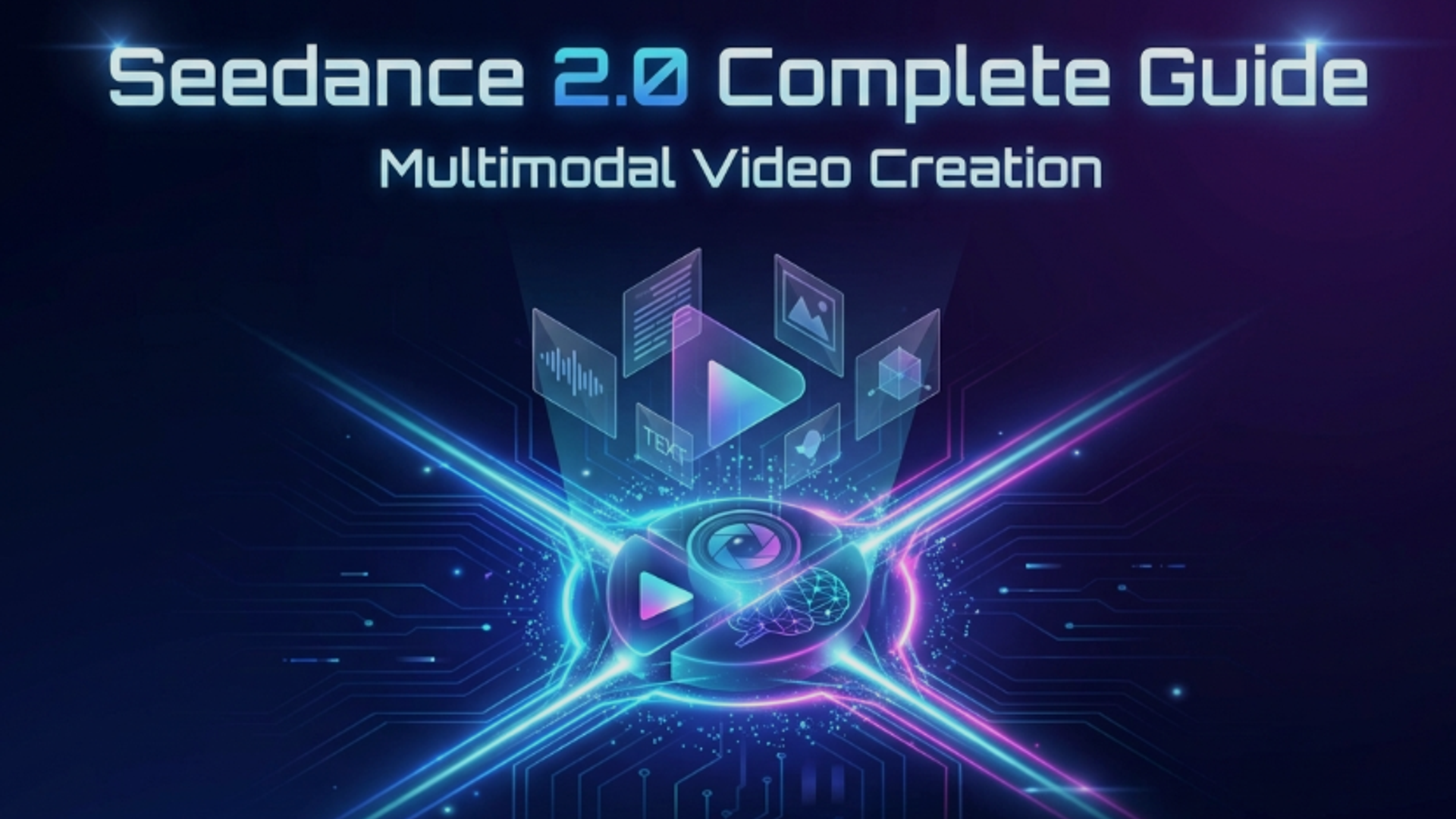
Seedance 2.0 represents a fundamental shift in AI video generation by accepting images, videos, audio, and text simultaneously as inputs—enabling filmmaker-level control over every aspect of creation. The Multimodal Breakthrough : Upload up to 9 images, 3 videos (15s max), 3 audio files (15s max), plus text prompts (12 files total per generation) using @ mention reference system to explicitly control style, motion, camera work, rhythm, and narrative. The Quality Leap : Sharp 2K resolution with enhanced colors, automatic lighting adjustment, smooth physics, fluid motion, precise instruction following, and style consistency throughout 4-15 second outputs. The Speed Advantage : 30% faster generation than previous versions while supporting videos 3x longer , maintaining professional quality without delays. The Character Consistency : Faces, product details, logos, text, environments, and visual styles remain accurate across all frames—solving previous AI video's identity drift problem. The Advanced Capabilities : Motion/camera replication from reference videos (choreography, tracking shots, crane movements, Hitchcock zooms), creative template replication (ad formats, visual effects, film techniques), video extension, video editing (character replacement, element addition/removal, plot subversion), audio-synchronized generation (lip-sync dialogue, sound effects, background music), beat-synced editing, and one-take continuity shots. The @ Reference Power : Natural language instructions like "@Image1 as first frame, reference @Video1 for camera movement, use @Audio1 for background music" giving explicit control over each uploaded asset's contribution. The Applications : Advertising/e-commerce product demos, content localization with multi-language lip-sync, storyboard-to-video conversion, template-based creation, music videos, cinematic sequences. Available Now : On WaveSpeedAI, ImagineArt and Topview platforms with free trials.
Part I: What Makes Seedance 2.0 Revolutionary
The Fundamental Paradigm Shift
Traditional AI Video Limitations :
Text prompts only (abstract, imprecise)
Single reference image maximum
No audio input capability
Limited control over specific elements
Generic, unpredictable outputs
Seedance 2.0 Innovation :
Multimodal inputs : Images + videos + audio + text simultaneously
Explicit reference control : @ mention system for precise asset usage
Filmmaker-level direction : Control over style, motion, camera, audio separately
Predictable results : Natural language instructions for exact specifications
Professional outputs : Cinema-quality 2K resolution
The Technical Specifications
Input Capabilities :
Output Specifications :
The @ Reference System
How It Works : After uploading assets, reference them in prompts using @ followed by file identifier
Basic Syntax Example :
@Image1 as the first frame, reference @Video1 for camera movement, use @Audio1 for background music Why It Matters : Explicit control eliminates guesswork—you specify exactly what each file contributes
Natural Language Processing : Model understands context and intent
Part II: Core Capabilities in Depth
1. Enhanced Base Quality
Physics Accuracy :
Objects fall, collide, interact according to real-world rules
Proper gravity, momentum, inertia
Realistic material behavior (fabric, liquids, solids)
Natural environmental interactions
Example Prompt :
A girl elegantly hanging laundry, finishing one piece and reaching into the basket for another, shaking it out firmly. Result : Continuous action with accurate fabric physics, natural body mechanics, smooth transitions—no explicit physics instructions needed
Fluid Motion :
Proper momentum and timing
Smooth transitions between poses
Natural acceleration/deceleration
Lifelike movement patterns
Precise Instruction Following :
Complex multi-step prompts executed accurately
Understands nuanced creative direction
Maintains consistency with specifications
Interprets filmmaker terminology correctly
Style Consistency :
Visual coherence throughout entire video
No style drift between frames
Stable color palette
Consistent lighting and atmosphere
2. The Multimodal Reference System
What You Can Reference :
From Images :
Character appearances and faces
Product details and branding
Visual style and aesthetics
Color palettes and mood
Architectural/environmental elements
Clothing and accessories
From Videos :
Motion patterns and choreography
Camera techniques and movements
Editing rhythm and pacing
Visual effects and transitions
Action sequences
Performance styles
From Audio :
Background music and atmosphere
Rhythm and beat synchronization
Sound effect templates
Dialogue and voice patterns
Emotional tone
From Text :
Narrative structure
Scene descriptions
Character motivations
Technical specifications
Creative direction
The Key Principle : Use natural language to describe what to extract from which file
Advanced Example :
Reference @Image1 for the man's appearance in @Image2's elevator setting. Fully replicate @Video1's camera movements and the protagonist's facial expressions. Hitchcock zoom when startled, then several orbit shots inside the elevator. Doors open, tracking shot following him out. Exterior scene references @Image3, man looks around. Reference @Video1's mechanical arm multi-angle following shots tracking his line of sight. 3. Character and Object Consistency (The Identity Lock) The Previous Problem : AI video models struggle maintaining identity across frames—faces morph, products change, details disappear
Seedance 2.0 Solution :
Face Consistency :
Characters maintain exact appearance throughout
Facial features stable across all angles
Expression changes natural while preserving identity
Multi-character scenes keep everyone distinct
Product Detail Preservation :
Logos remain crisp and accurate
Text legibility maintained
Brand colors consistent
Fine details (stitching, textures) preserved
Scene Coherence :
Environments stable throughout
Architecture consistent
Props maintain appearance
Background elements don't drift
Complex Example :
Man @Image1 comes home tired from work, walks down the hallway slowing his pace, stops at the front door. Close-up of his face as he takes a deep breath, adjusts his expression from stressed to relaxed. Close-up of him finding his keys, inserting them into the lock. He enters and his daughter and pet dog run to greet him with a hug. The interior is warm and cozy, with natural dialogue throughout. Result : Man's face identical across all shots (long, medium, close-up), daughter and dog maintain appearances, interior consistent, emotional arc clear
4. Motion and Camera Replication
What You Can Replicate :
Complex Choreography :
Fighting sequences with multiple moves
Dance routines and steps
Action scenes with stunts
Athletic performances
Coordinated group movements
Camera Techniques :
Dolly shots : Smooth tracking on rails
Crane movements : Vertical and sweeping motions
Tracking shots : Following subject motion
Handheld feel : Documentary-style natural shake
Hitchcock zoom : Dolly zoom/vertigo effect
Whip pans : Fast transitions between subjects
Orbit shots : 360° circular camera movement
Editing Rhythm :
Cut timing between shots
Transition styles (hard cuts, fades, wipes)
Pacing variations
Montage sequences
Advanced Camera Example :
Reference @Image1 for the man's appearance in @Image2's elevator setting. Fully replicate @Video1's camera movements and the protagonist's facial expressions. Hitchcock zoom when startled, then several orbit shots inside the elevator. Doors open, tracking shot following him out. Exterior scene references @Image3, man looks around. Reference @Video1's mechanical arm multi-angle following shots tracking his line of sight. 5. Creative Template Replication Advertising Formats :
Product reveal sequences
Lifestyle montages
Brand storytelling structures
Call-to-action endings
Visual Effects :
Particle systems (sparks, smoke, magic)
Morphing and transformations
Stylized transitions (light leaks, glitch effects)
Text animations and kinetic typography
Film Techniques :
Opening credit sequences
Title card designs
Dramatic reveals
Scene transitions
Music Video Cuts :
Beat-synced editing
Performance montages
Narrative intercuts
Abstract visual sequences
Complex Template Example :
Replace the person in @Video1 with the girl in @Image1. Replace the moon goddess CG with an angel referencing @Image2. When the girl crouches, wings grow from her back. Wings sweep past camera for transition. Reference @Video1's camera work and transitions. Enter the next scene through the angel's pupil, aerial shot of the angel (spiraling wings match the pupil), camera descends following the angel's face, pulls back on arm raise to reveal the stone angel statues in background. One continuous shot throughout. 6. Video Extension (Seamless Continuity) Capability : Extend existing videos while maintaining narrative and visual coherence
Example Prompt :
Extend @Video1 by 15 seconds. Reference @Image1 and @Image2 for the donkey-on-motorcycle character. Add a wild advertisement sequence: Scene 1: Side shot, donkey bursts through fence on motorcycle, nearby chickens startled. Scene 2: Donkey performs spinning stunts on sand, tire close-up then aerial overhead shot of donkey doing circles, dust rising. Scene 3: Mountain backdrop, donkey launches off slope, ad copy appears behind through masking effect (text revealed as donkey passes): "Inspire Creativity, Enrich Life". Final shot: motorcycle passes, dust cloud rises. Result : Original video seamlessly continues with new scenes matching style, character, motion quality, and narrative flow
Best Practice : Set generation duration to match extension length (extend by 5s = generate 5s)
7. Video Editing (Non-Destructive Modification)
Character Replacement :
Swap actors while keeping action identical
Change protagonists in scenes
Replace background characters
Element Addition/Removal :
Add objects to scenes
Remove unwanted elements
Modify environment details
Style Transfer :
Apply new visual treatments
Change color grading
Modify lighting atmosphere
Narrative Changes (Plot Subversion):
Dramatic Example :
Subvert the plot of @Video1. The man's expression shifts instantly from tender to cold and ruthless. In the moment the woman least expects it, he shoves her off the bridge into the water. The push is decisive, premeditated, without hesitation—completely subverting the romantic character setup. As she falls, no scream, only disbelief in her eyes. She surfaces and shouts at him: "You were lying to me from the start!" He stands on the bridge with a cold smile and says quietly: "This is what your family owes mine." Result : Complete tonal shift from original—romantic scene becomes thriller/betrayal
8. Audio-Synchronized Generation
Native Audio Capability : Seedance 2.0 generates videos with built-in sound—not silent outputs requiring post-production
What's Generated :
Lip-Sync Dialogue :
Multi-language support
Natural mouth movements
Proper timing and expression
Emotional delivery
Sound Effects :
Actions matched to visuals (footsteps, door creaks, impacts)
Environmental sounds (wind, rain, ambient noise)
Object interactions
Natural acoustics
Background Music :
Mood-appropriate scoring
Rhythm matching visual pacing
Dynamic intensity changes
Professional composition
Voice Acting :
Character-appropriate voices
Emotional expression
Proper enunciation
Natural dialogue flow
Audio Reference Example :
Fixed shot. Fisheye lens looking down through circular opening. Reference @Video1's fisheye effect. Make the horse from @Video2 look up at the fisheye lens. Reference @Video1's speaking motion. Background audio references @Video3's sound effects. 9. Beat-Synced Editing (Music Video Creation) Single Image Beat Sync :
The girl in the poster keeps changing outfits. Clothing styles reference @Image1 and @Image2. She holds the bag from @Image3. Video rhythm references @Video1. Multiple Image Sequence :
Images @Image1 through @Image7 cut to the keyframe positions and overall rhythm of @Video1. Characters in frame are more dynamic. Overall style is more dreamlike. Strong visual impact. Adjust reference image framing as needed for music and visual flow. Add lighting changes between shots. Result : Professional music video with cuts hitting beats, dynamic lighting changes, dreamlike visuals, strong impact—all automated from references
10. One-Take Continuity (Long Shots)
The Challenge : Maintaining visual consistency and narrative flow in single unbroken shots
Seedance 2.0 Solution : Generates long tracking shots with perfect continuity
Simple Example :
@Image1 through @Image5, one continuous tracking shot following a runner up stairs, through corridors, onto the roof, ending with an overhead view of the city. Complex Spy Thriller Example :
Spy thriller style. @Image1 as first frame. Front-facing tracking shot of woman in red coat walking forward. Full shot following her. Pedestrians repeatedly block the frame. She reaches a corner, reference @Image2's corner architecture. Fixed shot as woman exits frame, disappears around corner. A masked girl lurks at the corner watching maliciously, mask girl appearance references @Image3 (appearance only, she stands at the corner). Camera pans forward toward woman in red. She enters a mansion and disappears. Mansion references @Image4. No cuts. One continuous take. Result : Cinematic one-take with multiple characters, location changes, camera movements, all seamlessly connected
Part III: How to Use Seedance 2.0 (Step-by-Step)
Entry Point Selection
First/Last Frame Mode :
Use When : Simple projects needing starting image + text prompt
Process : Upload one image, write prompt describing desired action
Best For : Quick generations, straightforward animations
Universal Reference Mode :
Use When : Complex multimodal projects
Process : Upload multiple images/videos/audio, use @ syntax
Best For : Professional productions, template replication, advanced control
The @ Mention Workflow
Step 1: Upload Your Assets
Drag and drop images, videos, audio files
Verify file names/numbers for @ referencing
Maximum 12 files total per generation
Step 2: Write @ Reference Instructions
Basic Pattern :
@[FileType][Number] [purpose/instruction] Common Patterns :
Step 3: Set Output Parameters
Duration : 4-15 seconds (slider or dropdown)
Resolution : 720p, 1080p, 2K
Aspect Ratio : 16:9, 1:1, 9:16, or custom
Enhancement : Enable prompt enhancement if needed
Step 4: Generate and Review
Click "Generate" button
Wait 30-120 seconds (depending on complexity)
Review output video with sound
Regenerate with adjusted prompt if needed
Platform-Specific Access
On WaveSpeedAI :
Visit wavespeed.ai
Navigate to Models → Seedance 2.0
Upload assets in Universal Reference mode
Write @ reference prompts
Configure settings and generate
On ImagineArt :
Visit imagine.art/video
Select Seedance 2.0 model
Choose text-to-video or image-to-video mode
Upload assets and write prompts
Select resolution and aspect ratio
Generate and export
Part IV: Creative Applications
Advertising and E-Commerce
Product Demonstrations :
Upload product images as @Image1
Reference professional ad video for style
Add synchronized narration via @Audio1
Generate lifestyle shots automatically
Brand Storytelling :
Upload brand assets (logos, colors, environments)
Reference creative templates from successful campaigns
Maintain brand consistency across all frames
Generate multi-scene narratives
Marketing Content :
Create platform-optimized videos (16:9, 1:1, 9:16)
Beat-synced edits for social media
Product reveals with cinematic camera work
Call-to-action endings
Content Localization
Multi-Language Adaptations :
Reference original video for motion and timing
Generate new lip-synced dialogue in target language
Maintain visual consistency while changing audio
Export multiple language versions from single template
Cultural Adaptation :
Replace characters while keeping narrative
Modify environmental elements for local relevance
Adjust visual style for regional preferences
Storyboard to Video
Animation Workflow :
Upload storyboard panels as @Image1, @Image2, @Image3...
Describe motion between panels in prompt
Reference timing from animatic video if available
Generate animated sequence matching boards
Pitching and Previz :
Convert static concepts to moving previews
Test camera angles and editing before production
Client presentations with realistic motion
Budget estimates based on generated complexity
Template-Based Creation
Style Transfer Process :
Find video style you admire
Upload as @Video1 reference
Upload your characters/products as images
Prompt: "Create video with @MyCharacter in style of @Video1"
Generate content matching template aesthetics
Franchise Consistency :
Maintain visual language across series
Reference previous episodes for style lock
Character consistency throughout seasons
Brand identity preservation
Music Video Production
Beat-Sync Workflow :
Upload music track as @Audio1
Upload visual concepts as images
Reference rhythm from existing music video
Prompt: "Cut images to @Audio1 beats, reference @Video1 pacing"
Performance Videos :
Upload artist images
Reference choreography from dance videos
Sync lip movements to lyrics
Generate dynamic camera movements
Cinematic Sequences
Action Scenes :
Reference stunt choreography from @Video1
Apply to your characters from images
Add Hitchcock zooms and orbit shots
One-take continuous action
Dramatic Moments :
Close-up character expressions
Tracking shots through environments
Slow-motion effects
Emotional arc visualization
Part V: Best Practices and Pro Tips
Maximizing Quality
1. Be Explicit About References :
❌ Weak : "Use the video"
✅ Strong : "Reference @Video1's camera movement and lighting, but keep @Image1's character design"
2. Prioritize Your 12-File Limit :
Choose assets with greatest impact on final output
One excellent reference video > three mediocre images
Audio crucial for rhythm—don't skip if doing music sync
3. Double-Check @ Mentions :
With multiple files, easy to confuse @Image1 vs @Image2
Write list of files and purposes before prompting
Verify each @ reference in prompt matches intended file
4. Specify Edit vs. Reference :
❌ Ambiguous : "Use @Video1"
✅ Clear Edit : "Extend @Video1 by 5 seconds"
✅ Clear Reference : "Reference @Video1's camera work for new scene with @Image1 character"
5. Align Duration Settings :
Extending 10s video by 5s → set generation to 5s duration
Creating new video → choose 4-15s based on content needs
Longer ≠ better—match duration to narrative requirements
6. Use Natural Language :
Model understands filmmaker terminology
"Hitchcock zoom when startled" works perfectly
"Dolly tracking shot following the character" is clear
"Orbit shot around the subject" interpreted correctly
7. Test Iteratively :
Start simple with one reference type
Add complexity gradually
Regenerate with refined prompts
Save successful prompt patterns
Common Pitfalls to Avoid
❌ Too Many Competing References :
Reference @Video1's motion, @Video2's camera, @Video3's lighting, @Image1's style, @Image2's colors, @Image3's mood... Result : Confused output pulling from too many sources
✅ Focused References :
Reference @Video1 for camera and motion. Apply @Image1's color palette and @Image2's character design. ❌ Vague Instructions :
Make it look cool with @Image1 ✅ Specific Direction :
@Image1 as first frame. Character performs backflip, landing in hero pose. Slow-motion on apex. Dramatic lighting from below. ❌ File Overload Without Purpose :
Uploading 12 files just because you can
Including redundant references
Assets that don't contribute to vision
✅ Strategic Selection :
2-4 carefully chosen high-impact assets
Each file serving clear purpose
Quality over quantity
Troubleshooting
Issue: Generated video doesn't match reference
Solutions :
Make @ instructions more explicit
Use stronger directive language ("exactly replicate")
Simplify prompt to isolate which reference isn't working
Try different reference video if current one too complex
Issue: Character consistency fails
Solutions :
Upload higher quality reference images
Specify "maintain @Image1 character appearance throughout"
Use close-up reference for facial features
Avoid extreme angles if face preservation critical
Issue: Audio sync off
Solutions :
Verify audio file duration matches video duration setting
Use clearer dialogue reference if lip-sync needed
Specify "sync lip movements to @Audio1 dialogue"
Try shorter audio clips for better precision
Issue: Motion too subtle or exaggerated
Solutions :
Reference specific video with desired motion intensity
Add descriptors: "subtle", "dramatic", "explosive"
Specify speed: "slow-motion", "fast-paced", "normal speed"
Provide comparison: "more energetic than @Video1"
Part VI: Technical Advantages
2K Resolution Benefits
Visual Sharpness :
Every detail visible—textures, patterns, fine print
Professional quality suitable for commercial use
Large screen display without quality loss
Zoom capability maintaining clarity
Color Enhancement :
Automatic color grading
Balanced saturation
Natural lighting adjustments
Vivid but realistic palette
Texture Preservation :
Fabric weaves visible
Skin pores and details maintained
Material properties distinguishable
Depth and dimension enhanced
30% Speed Increase
Production Efficiency :
Faster iterations during creative process
Quick A/B testing of concepts
Rapid client revisions
Same-day project turnaround possible
Workflow Integration :
Fits into tight production schedules
Real-time creative direction adjustments
Immediate feedback loops
Batch processing multiple variations
3x Length Extension
Longer Narratives :
Complete story arcs in single generation
Tutorial and educational content
Product demonstrations with detail
Character development sequences
Maintained Quality :
No quality degradation in longer videos
Consistent motion throughout
Stable visual style end-to-end
Professional output regardless of length
Platform Optimization
Automatic Formatting :
Right size for each platform (YouTube, TikTok, Instagram)
Correct aspect ratio without manual cropping
Resolution optimized for platform requirements
Export ready for immediate upload
API Integration :
Programmatic access for developers
Batch processing capabilities
Workflow automation potential
Custom pipeline integration
Cross-Platform Consistency :
Same visual quality across all formats
Brand consistency maintained
Future-proof for new platforms
No rework needed for distribution
Conclusion: The Future of AI Video Is Multimodal
What Seedance 2.0 Achieves
Filmmaker-Level Control : @ reference system giving explicit direction over every element
Professional Quality : 2K resolution, accurate physics, smooth motion, style consistency
Speed and Scale : 30% faster, 3x longer, without quality compromise
Creative Flexibility : Images + videos + audio + text opening infinite possibilities
Character Consistency : Identity lock solving AI video's biggest previous weakness
Advanced Techniques : Camera replication, template matching, audio sync, beat editing, one-take shots
Who Benefits Most
Content Creators : Rapid video production for social media, YouTube, streaming
Marketers : Product demos, brand stories, ad campaigns without expensive production
Filmmakers : Previz, storyboarding, concept testing before physical shoots
Educators : Tutorial videos, explainers, educational content at scale
E-Commerce : Product showcases, lifestyle integration, customer testimonials
Agencies : Client pitches, template libraries, multi-platform campaigns
Musicians : Music videos, lyric videos, performance clips
Indie Developers : Game trailers, cinematic sequences, promotional content
The Competitive Landscape
Versus Sora 2 : Seedance 2.0 offers multimodal input (Sora text-only)
Versus Kling 3.0 : @ reference system provides more explicit control
Versus Veo 3.1 : Native audio generation and beat-sync capabilities
Versus WAN 2.6 : Superior character consistency and motion replication
Versus Runway Aleph : More accessible pricing and faster generation
Getting Started Today
Free Trials Available :
WaveSpeedAI: Sign up for free credits
ImagineArt: Free tier with limited generations
Learning Curve : Moderate—@ syntax intuitive, experiment friendly
Community Resources :
Tutorial videos
Prompt libraries
Discord communities
Example galleries
Best First Projects :
Simple product reveal (1 image + text)
Character animation (3 images showing progression)
Music video (1 audio + 3-5 images)
Camera replication (1 reference video + your character image)
Ready to Create?
Start on WaveSpeedAI : wavespeed.ai → Models → Seedance 2.0
Start on ImagineArt : imagine.art/video → Select Seedance 2.0
Pro Tip : Begin with Universal Reference Mode and 2-3 carefully chosen assets—you'll achieve better results than uploading maximum 12 files without clear purpose.
The Bottom Line : Seedance 2.0's multimodal @ reference system (9 images + 3 videos + 3 audio + text) delivers filmmaker-level control over AI video generation at 2K resolution, 30% faster, 3x longer than predecessors, with groundbreaking character consistency, camera replication, native audio sync, and beat-matched editing—making professional video creation accessible to anyone through natural language instructions on WaveSpeedAI , ImagineArt and Topview platforms. The future of video isn't text-to-video—it's image+video+audio+text-to-cinema .
Stop limiting yourself to text prompts. Start directing with multimodal references.